Best Wireless Gaming Headsets 2026: The Complete Guide for Every Budget
From the $62 dual-wireless budget champ to the $600 four-source flagship — every wireless gaming headset worth buying in 2026, tier by tier, with battery life, connectivity, ANC, and mic quality compared.
By GamepadSquire — August 3, 2026Verified
Wireless gaming headsets in 2026 have crossed a threshold: a $100 set now delivers 80 hours of battery, sub-20ms latency, and a mic that filters out keyboard clatter, while the $600 flagships mix four audio sources at once and carry lab-certified hi-res wireless audio. The hard part is no longer finding a good one — it's figuring out which compromises you're willing to live with, because every wireless headset is a bundle of trade-offs that a spec sheet won't reveal.
This guide is the wireless-specific companion to our full headset roundup. It covers every wireless headset we've reviewed in depth — from the $62 HyperX Cloud Jet to the $600 SteelSeries Arctis Nova Elite — organized by price tier, with the real-world owner sentiment surfaced up front. If you want the deep dive on any pick, the full review is one click away.
Quick Picks
| Tier | Pick | Price | Why |
|---|---|---|---|
| Best premium flagship | SteelSeries Arctis Nova Elite | $599.99 | Four-source mixing, best-in-class ANC, hot-swap batteries |
| Best premium value | SteelSeries Arctis Nova Pro Omni | $379.99 | 90% of the Elite for 60% of the price |
| Best multi-platform battlestation | Logitech G Astro A50 X | $355.88 | HDMI 2.1 switcher base, 4K 120Hz passthrough |
| Best audiophile | Audeze Maxwell 2 | $329.99 | Planar magnetic sound nothing else matches |
| Best all-rounder | Alienware AW Pro Wireless | $179.99 | 315g, hybrid ANC, 75h battery, great mic |
| Best desk all-rounder | Fractal Design Scape | $199.99 | Included magnetic dock, 40h battery |
| Best mid-range value | HyperX Cloud III Wireless | $129.99 | 120-hour battery, legendary comfort |
| Best console multipurpose | Turtle Beach Stealth 700 Gen 3 | $149.99 | CrossPlay dual-transmitter, 80h battery |
| Best PS5 pick | PlayStation Pulse Elite | $149.99 | Planar clarity + lossless PlayStation Link |
| Best budget wireless | Turtle Beach Stealth 600 Gen 3 | $79.99 | 85 hours measured by RTINGS, under $80 |
| Best budget dual-wireless | HyperX Cloud Jet | $61.99 | 2.4GHz + Bluetooth for under $65 |
What Actually Matters in a Wireless Headset
2.4GHz vs. Bluetooth is the first decision. Every serious wireless gaming headset uses a 2.4GHz connection — usually via a USB dongle — because it delivers sub-20ms latency that's effectively indistinguishable from wired. Bluetooth, even the modern low-latency codecs, still adds enough delay to feel off in rhythm games and fast-paced shooters, and it's prone to dropouts in congested environments. The 2026 sweet spot is a headset that offers both: 2.4GHz for gaming, Bluetooth for taking calls or joining a Discord call from your phone. That dual-wireless capability has moved down to the $62 HyperX Cloud Jet and the $79.99 Stealth 600 Gen 3 — it's no longer a premium-only feature.
Battery life varies by a factor of six. Wireless headsets range from about 20 hours (HyperX Cloud Jet, PlayStation Pulse Elite's 30) to 120 hours (HyperX Cloud III Wireless). The practical threshold is around 30 hours — enough for a full week of daily sessions without charging. At the top end, SteelSeries' hot-swap battery systems (Nova Pro Wireless, Nova Pro Omni, Nova Elite) eliminate charging anxiety entirely: one pack charges in the base station while the other powers the headset, so the headset never needs to be plugged in. RTINGS independently measured the Stealth 600 Gen 3 at just over 85 hours continuous — above its 80-hour rating — so the big battery claims in this category are real, not marketing fiction.
ANC is a category, not a checkbox. Active noise cancellation splits wireless headsets into two camps. Premium models (Nova Elite, Nova Pro Omni, Maxwell 2, BlackShark V3 Pro, Alienware AW Pro) carry hybrid ANC with transparency modes — genuinely useful for drowning out fans, roommates, or office noise. Mid-range and budget models (Scape, Cloud III Wireless, Stealth 600/700) skip ANC entirely and rely on passive isolation from the ear cups. Neither is wrong — but if you need silence, buy a headset with ANC, because you can't add it later.
Platform compatibility is the easiest trap. Many 2.4GHz dongle headsets work with PC and PS5 but not Xbox — Xbox requires a headset with a specific Xbox Wireless chip or a wired 3.5mm connection. Turtle Beach's Stealth 600/700 Gen 3 line solves this with a dual-transmitter system that pairs with Xbox and PlayStation wirelessly at once. Always verify compatibility before buying, and check whether the Bluetooth side works on your console — most consoles restrict Bluetooth to the dongle connection.
Weight and comfort decide long sessions. Wireless headsets carry batteries, and it shows: the Audeze Maxwell 2 weighs a punishing 560g, while the Alienware AW Pro Wireless is a featherweight 315g. Anything under 350g is comfortable for multi-hour sessions; the 400g+ models need to earn their keep with exceptional padding. If you wear glasses, look for relief cutouts or ProSpecs-style designs.
Microphone quality matters more than ever. AI noise cancellation on the mic side — filtering keyboard and fan noise before it reaches your teammates — is now standard at the $80+ price point. The best mics (SteelSeries ClearCast Gen 2, HyperX detachable boom, Alienware's flip-to-mute) rival dedicated USB mics from a few years ago. Budget mics remain usable but thin; streamers should budget accordingly.
Premium Tier ($250+)
SteelSeries Arctis Nova Elite — the everything headset

The Nova Elite is the most capable gaming headset ever made, and at $599.99 it's priced like it. The headline is OmniPlay-style four-source mixing through the GameHub base station — three USB-C inputs plus Bluetooth and line-in, all mixed simultaneously, with an OLED display and volume knob on the hub. It adds 96kHz/24-bit hi-res wireless audio, hybrid ANC that SteelSeries claims is 42% more powerful than the Nova Pro line, 40mm carbon-fiber drivers, and two 700mAh hot-swap battery packs rated at 30 hours each.
The honest caveats: at 380g it's heavy, the clamp force is firm out of the box, and the software stack (SteelSeries GG + Sonar) is powerful but fussy. Press and owner consensus is that this is the most complete wireless headset on the market — if you game on multiple platforms, want ANC, and have the budget. If you don't need four-source mixing, the Nova Pro Omni delivers most of the experience for $220 less.
SteelSeries Arctis Nova Pro Omni — the sweet spot flagship

The Nova Pro Omni is the value pick of SteelSeries' flagship line: OmniPlay four-source mixing, hot-swap batteries, certified 96kHz/24-bit hi-res wireless, hybrid ANC with transparency, and the ClearCast Pro retractable mic — all for $379.99. It's 339g, which makes it noticeably lighter than the Elite, and the GameHub base station charges the second battery while you play.
Community feedback splits on the default tuning — it's bright out of the box, and most owners end up EQing it in Sonar — and the plastic-heavy build feels less premium than the price suggests. But as a multiplatform flagship, it's the best balance of capability and cost in the entire wireless market. Our full review scores it 8.5/10.
SteelSeries Arctis Nova Pro Wireless — the proven classic
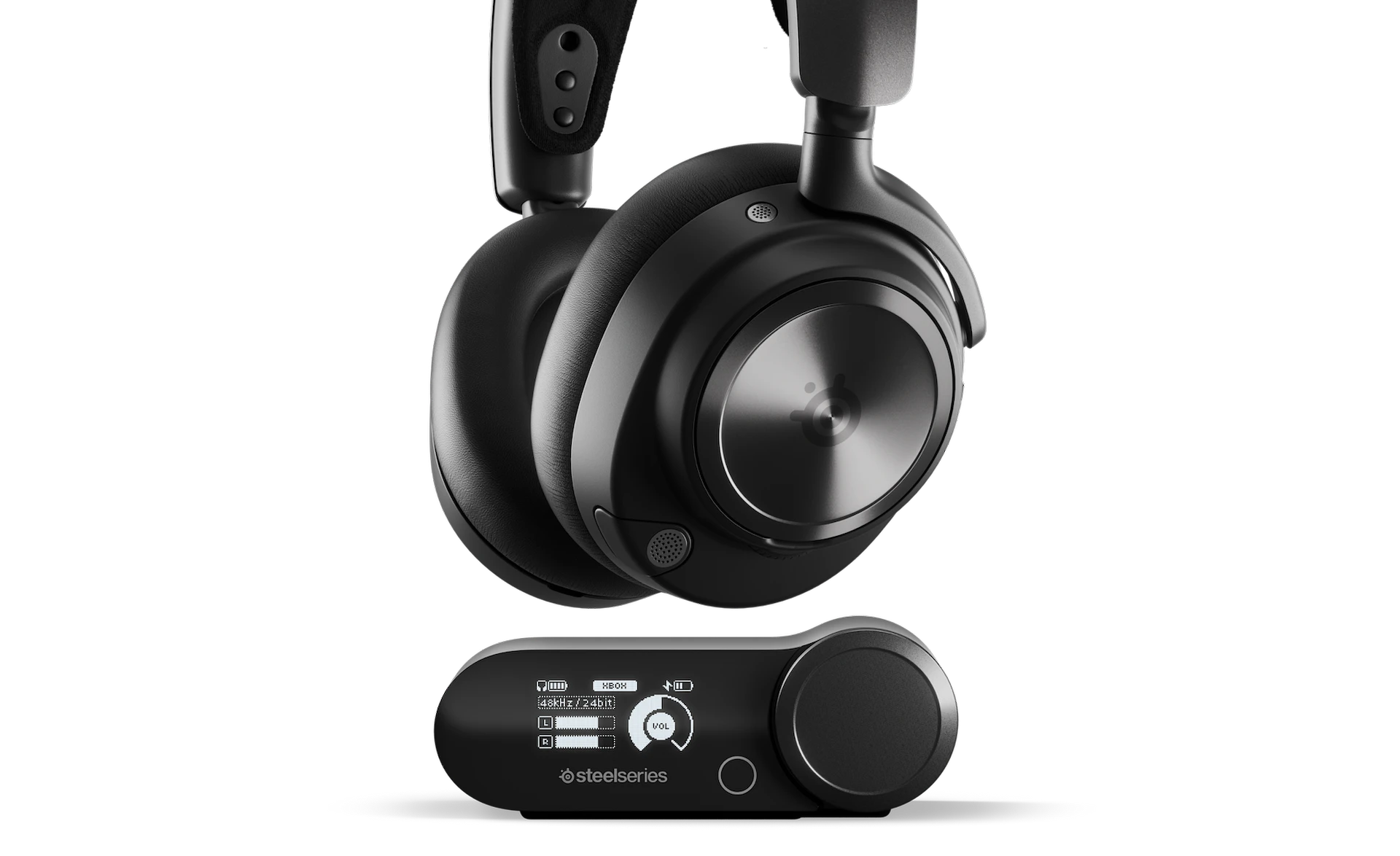
The Nova Pro Wireless was the flagship before the Omni and Elite arrived, and it remains excellent at $349.99: dual hot-swap batteries, simultaneous 2.4GHz + Bluetooth, a dual-USB DAC base station with OLED and ChatMix, and the retractable ClearCast Gen 2 mic. It's 337g and carries the same comfortable suspension headband design as the rest of the Nova line.
The main reason to choose it over the Omni is price — it's $30 cheaper — but the Omni adds a third USB-C input and LE Audio support. If you find the Nova Pro Wireless on sale, it's still one of the most complete headsets you can buy.
Audeze Maxwell 2 — the audiophile's choice

The Maxwell 2 is the headset that makes everything else sound a little thin. Its 90mm planar magnetic drivers deliver a level of detail, bass control, and low distortion that dynamic-driver gaming headsets can't touch, and the 80+ hour battery is remarkable for a planar. It supports LDAC, LE Audio, and Auracast over Bluetooth 5.3, plus 24-bit/96kHz over its USB-C dongle, and the detachable boom mic with FILTER AI noise cancellation is genuinely good.
The price of that sound is 560g on your head. It's the heaviest headset in this guide by a wide margin, and some owners find it fatiguing after an hour or two. There's no ANC, and the design is utilitarian rather than gamer-fancy. For music-first gamers with strong necks, it's unmatched; for marathon multiplayer sessions, lighter options are kinder.
Logitech G Astro A50 X — the multi-platform battlestation

The A50 X is a category of one: its base station doubles as a two-input HDMI 2.1 switcher, so one headset stays connected to a PC, PS5, and Xbox at once and swaps both audio and the TV's video input at the press of a button — with 4K 120Hz and VRR passing through at about 1.3ms of added delay, effectively replacing a standalone HDMI 2.1 switcher. The 40mm graphene drivers deliver excellent directional imaging for competitive play, the 48kHz boom mic is one of the best stock wireless mics available, simultaneous Bluetooth mixing keeps phone chat alongside game audio, and the magnetic dock keeps the 24-hour battery topped up between sessions.
The compromises: at $355.88 it's tethered to the base station — no travel use, no wired mode, and Bluetooth that barely reaches across a room — the stock fabric earpads run warm, and a small but persistent minority report occasional HDMI handshake dropouts. If your entire gaming life happens at one desk or TV with multiple platforms, nothing else does what it does; if it doesn't, the Nova Pro Wireless remains the smarter, more capable buy. Our full review scores it 8.4/10.
Honorable Mention: Razer BlackShark V3 Pro — the competitive specialist

The BlackShark V3 Pro remains the sharpest tool for pure competitive FPS: Razer claims 10ms latency on its HyperSpeed Wireless Gen-2 connection, the 50mm TriForce Bio-Cellulose drivers deliver the positional sound signature FPS players love, the detachable 12mm mic is one of the best in the category, and the 70-hour battery with 15-minute fast charging covers a full week of scrims — all at $249.99. It moved off the main list because the Astro A50 X's unique HDMI hub earns the premium slot, but if you never touch a console and winning matters most, it's still the pick. The aggressively bright tuning demands EQ for music, the hybrid ANC is mid-pack, and there's no simultaneous Bluetooth mixing — it's 2.4GHz OR Bluetooth, not both.
Mid-Range Tier ($100–250)
Turtle Beach Stealth 700 Gen 3 — the multiplatform champion

The Stealth 700 Gen 3's superpower is the CrossPlay dual-transmitter system: one USB dongle pairs with Xbox and PlayStation simultaneously, so you can switch consoles without touching a setting. On top of that it delivers an 80-hour battery, 60mm Eclipse dual drivers with strong, punchy game audio, Bluetooth 5.2, and a flip-to-mute mic with AI noise reduction — all at $149.99.
The costs: 408g is heavy, the build is mostly plastic, and the Swarm II software has a reputation for being finicky. Owner feedback also flags occasional connection quirks that firmware updates have mostly addressed. As a console-first, multi-platform headset, nothing at this price matches its flexibility.
Alienware AW Pro Wireless — the best all-rounder under $250

Dell's AW Pro Wireless is the quiet overachiever of the mid-range: 315g (the lightest wireless headset in this guide), hybrid ANC with transparency, a 75-hour battery, 50mm graphene-coated drivers, and one of the better mics in the category — all at $179.99. It works with PC, PS5, PS4, Switch, and mobile, and the 15-minute fast charge delivers 8 hours.
Early units had documented QC issues — mic crackle, static, battery quirks — that Alienware addressed via firmware and a mid-2025 hardware revision, and current owner sentiment is strongly positive. If you want one headset that does gaming, music, and work calls well without spending flagship money, this is the pick. Our full review scores it 8.5/10.
Fractal Design Scape — the desk-centric all-rounder

Fractal Design's first gaming headset is the surprise of the 2026 category: a 338g closed-back wireless set with clean, detailed sound and the best convenience feature in gaming audio — a magnetic wireless charging dock in the box. The dock tops the headset up whenever it's on the desk, auto-powers it on when lifted, and doubles as the dongle's home, and the web-based Adjust Pro EQ needs no install. Battery is rated at 40 hours with RGB off (RTINGS measured 46), the Super Wideband boom mic ranks among the best lab-tested mics in the category, and it covers PC, PS5, PS4, and Switch at $199.99.
The asterisks: firm clamp and thin headband padding make it genuinely uncomfortable for a minority of owners — larger heads and glasses-wearers should try before buying — the mic is lab-excellent but divisive in noisy rooms, and there's no ANC, no Xbox support, and no simultaneous Bluetooth + dongle mixing. For PC/PlayStation/Switch gamers who want one beautiful, always-charged headset for gaming and work calls, it's the best $199.99 in the mid-range; our full review scores it 8.5/10. If you need Xbox support or a lighter clamp, the Arctis Nova 7 Gen 2 (~$183) remains the versatile runner-up.
PlayStation Pulse Elite — the PS5 specialist

The Pulse Elite is the best-sounding PS5 headset under $200: planar magnetic drivers (the same tech as the $330 Audeze Maxwell) with genuinely impressive clarity, lossless PlayStation Link wireless, Bluetooth 5.3 for dual-device audio, and a 30-hour battery with a 10-minute fast charge for 2 hours of play. At $149.99 it undercuts every other planar option by a wide margin.
The asterisk is durability: a recurring headband-snap issue appears in owner feedback often enough that it's a real consideration, and the comfort is something of a lottery depending on head shape. PS5 players who want planar sound without Maxwell money should buy it — ideally with a retailer that offers easy returns.
HyperX Cloud III Wireless — the battery king

The Cloud III Wireless's party trick is a 120-hour battery — the longest in this guide — plus the legendary HyperX comfort: 342g with memory foam ear cups and an aluminum frame that's survived years of abuse in the Cloud line. The 53mm angled drivers deliver a neutral, honest sound that's excellent for competitive FPS positional audio, and the detachable 10mm mic is clear and reliable.
The trade-off: the neutral tuning is bass-light, which disappoints music and single-player players (EQ via NGENUITY helps), and there's no Bluetooth or ANC — it's 2.4GHz only, and no simultaneous phone mixing. At $129.99 with frequent sales, it's the best pure gaming value in the mid-range.
Budget Tier (Under $100)
Turtle Beach Stealth 600 Gen 3 — the sub-$80 default

At $79.99, the Stealth 600 Gen 3 is the battery-life king of budget wireless: RTINGS measured just over 85 hours of continuous playback, beating its own 80-hour rating. It adds 2.4GHz + Bluetooth 5.2, a genuinely good AI noise-cancelling mic, 50mm Nanoclear drivers with strong V-shaped game audio, and memory foam ear cups with ProSpecs glasses relief — plus a 10-band EQ via the Swarm II app.
What $80 doesn't buy: no ANC, no wired backup (USB-C is charge-only), and no simultaneous dual-device audio — switching sources means switching modes. For console and multiplatform gamers on a budget, it's the easy default; our full review scores it 8/10.
HyperX Cloud Jet — the dual-wireless bargain

The Cloud Jet proves dual-wireless is a budget feature in 2026: 2.4GHz via USB-A dongle plus Bluetooth 5.3, both usable simultaneously, at $61.99. It's a light 298g with the signature HyperX comfort, a swivel-to-mute boom mic, and up to 20 hours on 2.4GHz (25 on Bluetooth).
The asterisks: owner feedback shows a nagging reliability split — a minority report units with connectivity or charging issues — and the sound is tuned for gaming rather than music, so it's not the pick for audiophiles. For multi-platform gamers who want wireless without paying wireless money, it's an easy recommendation on sale; our full review scores it 8/10.
How to Choose
| Your situation | Pick |
|---|---|
| Multi-platform gamer, want the absolute best | SteelSeries Arctis Nova Elite |
| Multi-platform, want 90% of the flagship for less | SteelSeries Arctis Nova Pro Omni |
| PC + PS5 + Xbox sharing one desk or TV | Logitech G Astro A50 X |
| Music-first, sound quality above all | Audeze Maxwell 2 |
| Competitive FPS player, PC | Razer BlackShark V3 Pro |
| One headset for gaming + work calls + music | Alienware AW Pro Wireless |
| Desk-centric PC/PlayStation, want dock charging | Fractal Design Scape |
| Xbox + PS5 in one setup | Turtle Beach Stealth 700 Gen 3 |
| PS5 player, planar sound on a budget | PlayStation Pulse Elite |
| Want the longest battery and best comfort per dollar | HyperX Cloud III Wireless |
| Budget console/multiplatform, need 80+ hours | Turtle Beach Stealth 600 Gen 3 |
| Tight budget, need 2.4GHz + Bluetooth | HyperX Cloud Jet |
FAQ
Is 2.4GHz wireless as good as wired? For gaming, yes. Sub-20ms latency over a 2.4GHz dongle is indistinguishable from wired in practice — the gap is a few milliseconds, meaningful only at the very top of competitive play. Bluetooth remains a casual connection: fine for music and calls, noticeably laggy for rhythm games and fast shooters.
Do I need ANC on a gaming headset? Only if you game in noisy environments. ANC cancels low-frequency rumble (fans, HVAC, traffic) and is a premium-tier feature; mid-range headsets rely on passive isolation from the ear cups, which works fine in a quiet room. You can't add ANC later, so if you need silence, buy it upfront.
How much battery life do I actually need? At least 30 hours for daily use — a week of sessions without charging. Above that, the differences matter mostly for peace of mind: 80-hour headsets (Stealth 600/700, Cloud III Wireless) effectively eliminate the charging ritual, and hot-swap battery systems (Nova Pro line, Elite) eliminate it entirely.
Why is the Xbox version more expensive or different? Xbox requires a licensed wireless chip for 2.4GHz audio, which is why many headsets ship as separate Xbox and PlayStation variants, or exclude Xbox entirely. Turtle Beach's CrossPlay system and SteelSeries' base stations sidestep this; a plain 2.4GHz headset from Audeze or HyperX won't work on Xbox.
Are budget wireless headsets worth it in 2026? Yes — the $62–100 tier now delivers dual-wireless, 80+ hour batteries, and AI-noise-cancelling mics. The gaps versus premium are ANC, build materials, sound refinement, and mixing features, not basic competence.
Verdict
The wireless gaming headset market in 2026 rewards patience and honesty about your needs. If you want the best money can buy, the Arctis Nova Elite is the complete package — but the Nova Pro Omni delivers most of it for $220 less. Multi-platform battlestations get a category of one in the Astro A50 X, competitive FPS players still get the sharpest tool in the BlackShark V3 Pro, and music-first gamers get something special in the Maxwell 2. In the mid-range, the Fractal Design Scape is the new standout and the HyperX Cloud III Wireless the best value, and the Stealth 600 Gen 3 remains the easy budget default. Every pick above is a product we've reviewed in full — the linked reviews carry the detailed testing, press scores, and community sentiment behind each recommendation. Prices checked August 2026.
Related Guides
Buying Guide
Best Gaming Headsets 2026: Buying Guide for Every Budget
From planar magnetic champs and open-back sleepers to budget wired bargains — what actually matters when buying a gaming headset in 2026.
Buying Guide
Best Gaming Headsets for Glasses Wearers 2026: The Comfort-First Buying Guide
The glasses-comfort problem, solved with data. Every headset we have reviewed that genuinely works with glasses — the Turtle Beach Stealth 600 Gen 3 with its ProSpecs glasses-relief cushions as the best overall pick, the HyperX Cloud III for wired comfort, the featherweight Logitech G435, the premium SteelSeries Arctis Nova 7 Gen 2, and the budget Cloud Stinger 2 — plus what actually matters (memory foam depth, clamping force, weight, over-ear design) and the headsets glasses wearers should skip.
Buying Guide
Best Wired Gaming Headsets 2026: The Complete Buying Guide
The wired category delivers the best sound-per-dollar in gaming audio, and this hub covers every wired headset we've reviewed: the HyperX Cloud III as the best overall wired pick, the Cloud Stinger 2 for budget comfort, the Logitech G432 as the lab-backed PC all-rounder, and the Razer Kraken V3 X for bass and mic on PC. Platform compatibility, durability, and mic quality — the three things that actually decide whether a wired headset works for you.