Best Gaming Headsets for Glasses Wearers 2026: The Comfort-First Buying Guide
The glasses-comfort problem, solved with data. Every headset we have reviewed that genuinely works with glasses — the Turtle Beach Stealth 600 Gen 3 with its ProSpecs glasses-relief cushions as the best overall pick, the HyperX Cloud III for wired comfort, the featherweight Logitech G435, the premium SteelSeries Arctis Nova 7 Gen 2, and the budget Cloud Stinger 2 — plus what actually matters (memory foam depth, clamping force, weight, over-ear design) and the headsets glasses wearers should skip.
By GamepadSquire — August 8, 2026Verified
Best Gaming Headsets for Glasses Wearers 2026: The Comfort-First Buying Guide
If you wear glasses and game for more than an hour, you already know the exact problem this guide exists to solve. The ear cups press your frames into the side of your head, the pressure builds behind your ears, and what starts as mild annoyance turns into a headache that follows you off the PC. It is the single most common comfort complaint in gaming audio — and it has almost nothing to do with sound quality. A headset that sounds great is useless if you can only stand it for 45 minutes.
The good news is that this is a solved problem. The 2026 market has headsets with ear cushions deep and soft enough to swallow your frames without pressure, lightweight builds that stop gravity from working against you, and — in one notable case — dedicated glasses-relief channels cut into the foam itself. This guide covers every headset we have reviewed that genuinely works with glasses, organized by what each one does best, with the real owner feedback surfaced up front. If you wear glasses, this is the fastest way to stop shopping blind.
The glasses-comfort search space is dominated by thin blog content that recycles the same five headsets without any real data. Our angle is different: every pick below is a headset we have reviewed in depth, with verified specs (weight, cushion material, clamping design) and thousands of owner ratings behind it. No guesswork, no affiliate-only filler.
Quick Picks
| Tier | Headset | Street Price | Weight | Key Glasses Feature |
|---|---|---|---|---|
| Best for glasses overall | Turtle Beach Stealth 600 Gen 3 | ~$79 | ~300g | ProSpecs glasses-relief ear cushions + 80h battery |
| Best wired comfort | HyperX Cloud III | $64.99 | 308g | Memory foam pads praised by glasses wearers |
| Best lightest wireless | Logitech G435 LIGHTSPEED | ~$50 | 165g | Featherweight frame, near-zero temple pressure |
| Best premium multi-platform | SteelSeries Arctis Nova 7 Gen 2 | ~$183 | 326g | Suspension headband + rotating ComfortMAX earcups |
| Best budget wired | HyperX Cloud Stinger 2 | ~$30 | 275g | Signature HyperX memory foam at half price |
How We Picked
Every pick in this guide rests on the same three legs as our other headset coverage. Lab data: RTINGS' standardized test bench anchors the audio and comfort measurements — their clamp-force and comfort testing is the reference point for where headsets actually land. Owner feedback: thousands of Amazon ratings plus community threads on Reddit (r/GirlGamers, r/HeadphoneAdvice, r/steelseries, r/HyperX) form the early-warning system for glasses pressure, hotspot issues, and QC failures that no spec sheet reveals. Hands-on press: outlets including IGN, TechRadar, Tom's Guide, and SoundGuys provide the independent impressions.
The question this guide tries to answer for every headset is the one that matters six months after purchase: what will annoy you about it if you wear glasses?
What Actually Matters When You Wear Glasses
The physics of the problem is simple. Your glasses arms sit exactly where a headset's ear cups clamp. Every headset presses on that point; the question is how much. These five factors decide the answer:
Memory foam ear cushions are non-negotiable. Memory foam conforms around the arms of your frames instead of pushing them into your skull. Stiff or shallow foam is the #1 cause of "this headset hurts my glasses" complaints — it transfers all clamping force onto the frame arm. Deep, plush memory foam creates a de facto channel around your glasses. Every pick in this guide uses it.
Low clamping force matters more than weight. A light headset with a death grip is worse than a heavier one with gentle clamping. Community consensus across headset subreddits puts the comfort sweet spot around 2.5-4.5 Newtons of clamp — enough to stay put, not enough to dig in. Headsets with adjustable or naturally light clamps are consistently the ones glasses wearers report wearing for hours.
Over-ear (circumaural) cups, never on-ear. On-ear cups sit directly on your ears and push your frames straight into the side of your head. Over-ear cups surround your ears entirely, giving your frames room to sit without being crushed. This is a hard rule: glasses wearers should not buy on-ear headsets, period.
Weight is the silent multiplier. Every gram of headset weight presses down through the cups into your frames. The difference between a 165g headset and a 560g one is the difference between forgetting you're wearing it and feeling every minute. Under ~340g is the glasses-comfort zone; anything over ~400g starts working against you.
Dedicated glasses relief is the cheat code. Only one mainstream manufacturer cuts actual channels into the ear cushion for glasses arms: Turtle Beach's ProSpecs system. Instead of relying on memory foam to conform around your frames, ProSpecs cushions have a pre-cut relief zone that leaves your glasses arm a clear path. It is the only design feature in gaming audio built explicitly for glasses wearers.
Best Overall for Glasses: Turtle Beach Stealth 600 Gen 3 — ~$79
The Turtle Beach Stealth 600 Gen 3 is the only headset in our catalog with a feature built specifically for you: ProSpecs glasses relief. The ear cushions are memory foam with an athletic-weave fabric cover, and the foam has dedicated relief channels where your glasses arms sit — so your frames get a clear channel instead of being pressed into your temples. Community and press feedback consistently flags this as the difference between tolerable and genuinely comfortable for glasses wearers. Turtle Beach's own testing positions ProSpecs as the answer to the frames-under-cups problem, and it is the rare marketing claim that matches what owners report.
The rest of the package backs it up. The 50mm Nanoclear drivers deliver strong, V-shaped game audio with real punch, and the battery is the class leader: 80 hours advertised, with RTINGS measuring just over 85 hours continuous — weeks of nightly sessions between charges. The flip-to-mute mic with AI noise reduction is one of the better budget mics around, and at ~300g the weight is moderate — lighter than the 408g Stealth 700 flagship, so gravity isn't pressing the cups into your frames as hard as it does on heavier headsets. Swarm II software adds a 10-band EQ, though it's Windows/mobile only.
The trade-offs are the usual budget-wireless ones: the build is plastic, there's no ANC, and audio is tuned for game impact rather than music fidelity. Owner feedback also shows a minority reporting the AI mic or Bluetooth quirks. But for glasses wearers specifically, nothing in this price range addresses the actual problem more directly. This site's review scored it 8/10, and it is the easiest recommendation in this guide for spectacle-wearing gamers.
Buy it if you wear glasses and want the only mainstream headset with dedicated glasses-relief cushions, plus class-leading battery life. Skip it if you need noise isolation or a headset that doubles as a music headphone.

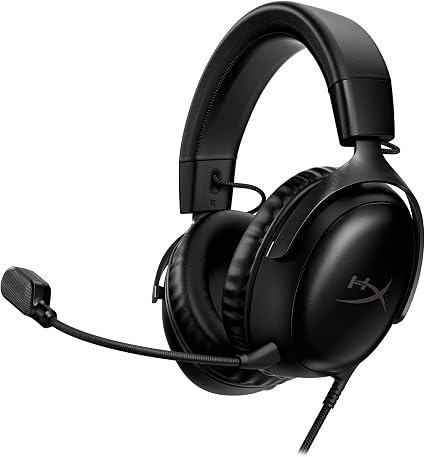
Best Wired Comfort: HyperX Cloud III — $64.99
The HyperX Cloud III is the best-selling wired PC gaming headset in the world, and for glasses wearers it holds a special place: the HyperX Cloud line is the most consistently recommended headset family in glasses-comfort threads across Reddit. In r/GirlGamers' recurring "best headset for glasses" discussions, HyperX models are the repeated answer — owners describe wearing them for hours without the frame pressure they got from other headsets, and long-term owners confirm the comfort holds up for years. The Cloud III continues that tradition with the same memory foam cushions and a moderate, forgiving clamping force.
At 308g it's not the lightest headset here, but the aluminum-reinforced frame and wide, deep ear cups more than compensate. The cups are large enough that glasses arms sit inside without touching the driver housing — a detail that matters more than any spec. The 53mm angled drivers deliver clean, detailed positional audio, and the detachable 10mm mic is one of the best in the sub-$100 class. Connectivity is universal: 3.5mm, USB-C, and USB-A cover PC, PS5, PS4, Xbox Series X|S, Switch, Steam Deck, and mobile.
The trade-off is the sound signature: neutral-to-bass-light tuning that's excellent for competitive clarity but won't rumble for music or single-player immersion — and the EQ only works over USB via NGENUITY. A minority of newer units also report QC issues, most commonly low mic volume. None of it changes the core equation: if you want the safest, most proven glasses-comfortable wired headset, this is it. This site's review scored it 8.2/10; TechRadar rates it 5/5 and PC Gamer scored it 77/100.
Buy it if you want the most proven glasses-comfortable wired headset at a sane price, with universal platform support. Skip it if you want bass-heavy sound out of the box or a wireless headset.
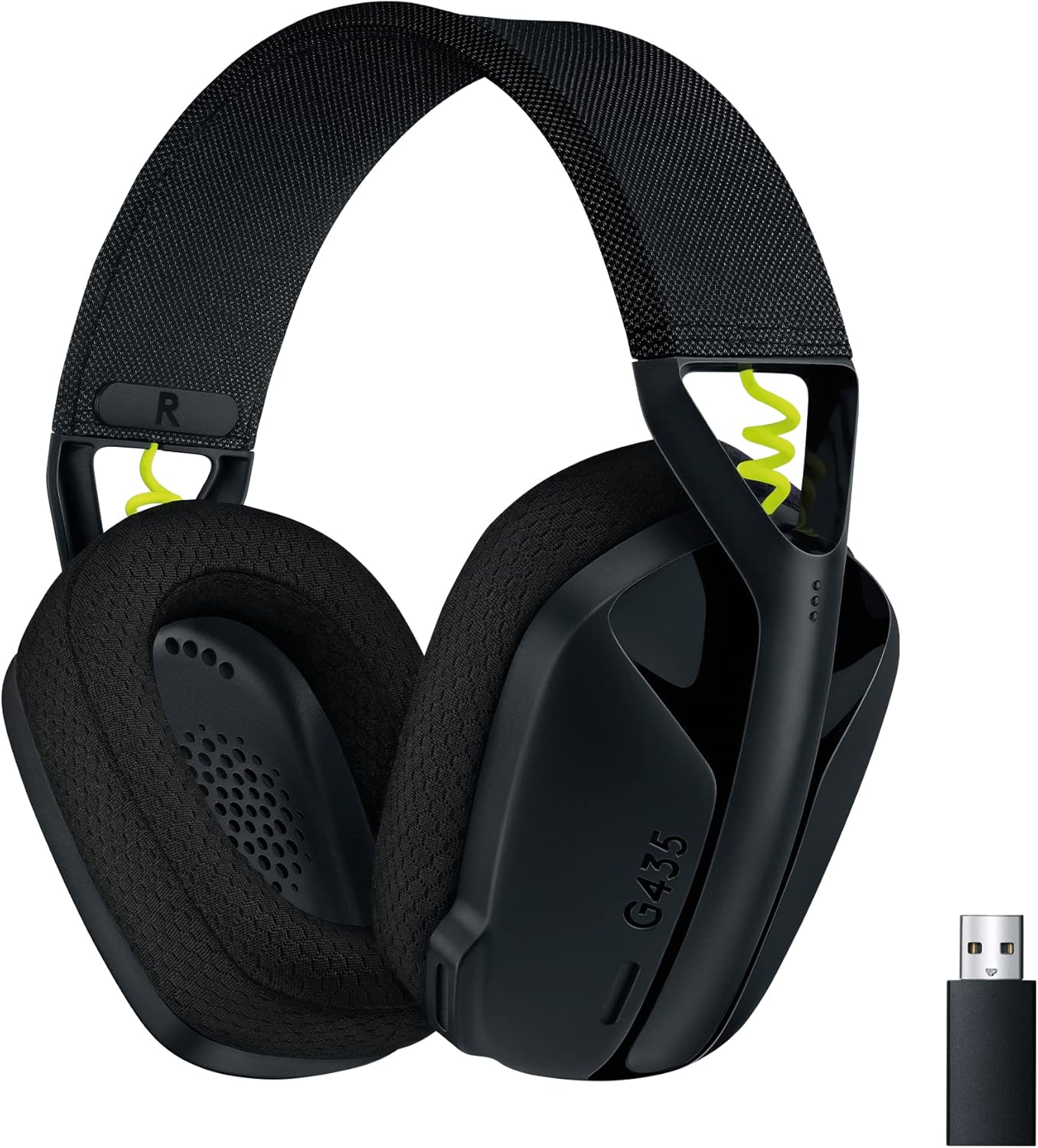
Best Featherweight Wireless: Logitech G435 LIGHTSPEED — ~$50
The Logitech G435 attacks the glasses problem from the physics side: at 165g, it is one of the lightest wireless gaming headsets ever made — roughly half the weight of most rivals. There is simply less mass pressing down on your frames, and glasses-wearing owners consistently report near-zero temple pressure. Reddit recommendations for glasses-comfort headsets regularly cite the G435 as the lightest comfortable option, with owners noting it's comfortable "for hours" in threads specifically about glasses. For anyone whose glasses bother them even with good pads, dropping 150-200g of headset weight is the most immediate fix available.
It's dual-wireless (LIGHTSPEED 2.4GHz + Bluetooth 5.1), works on PC, Mac, PS4/PS5, Switch, and mobile, and has an 18-hour battery. The built-in dual beamforming mic (no boom) is fine for Discord but not streamer-grade. The 40mm drivers are clean and neutral — good enough for gaming, not remarkable for music. It's also the only headset here built from 22% post-consumer recycled plastic, if that matters to you.
The catches: there's no boom mic and no 3.5mm jack, the fit skews small (it's explicitly designed for smaller heads), and the volume limiter defaults to a conservative 85dB setting you'll want to switch. If you have a larger head, the fit may be too snug regardless of weight. But for small-to-medium heads with glasses, the G435 is the comfort pick that no spec sheet can fully convey. This site's review scored it 8/10.
Buy it if glasses pressure is your #1 problem and you want the lightest wireless option money can buy. Skip it if you need a boom mic, a big-head fit, or audiophile sound.
Best Premium Multi-Platform: SteelSeries Arctis Nova 7 Gen 2 — ~$183
The SteelSeries Arctis Nova 7 Gen 2 is the premium pick for glasses wearers who game across platforms, and its comfort design is the reason. The suspension headband (the ski-goggle-style elastic band) floats the weight across the top of your head instead of concentrating it, and the ComfortMAX earcup system — height-adjustable, rotating ear cups with deep memory foam — lets you position the cups so they clear your frames rather than sit on them. That adjustability is the key glasses feature: being able to rotate and raise the cups shifts pressure away from your glasses arms entirely. Press reviews consistently describe the Nova line as among the most comfortable gaming headsets available, and glasses-wearing owners on r/steelseries report wearing it without complaint — one Reddit user who switched from the clamp-heavy Astro A50 and Logitech G935 specifically praised the Nova's glasses compatibility.
At 326g it's mid-pack on weight, but the suspension band makes it feel lighter than it is. Audio is clean and well-tuned via the 40mm drivers, with 360° Spatial Audio through Sonar on PC and 3D Audio on PS5. The ClearCast Gen 2 retractable mic is excellent, battery life is 50+ hours with a 15-minute fast charge for ~6 hours, and simultaneous 2.4GHz + Bluetooth mixing covers every platform including Switch 2 and mobile.
The downsides: no ANC at this price (the Nova Pro line adds it for significantly more), the mic is software-dependent for its noise reduction on PC, and $183 is real money. For glasses wearers who want premium comfort and multi-device flexibility without going to the Nova Pro's $300+ price, this is the pick. This site's review scored it 8/10.
Buy it if you want premium glasses-friendly comfort, a suspension headband, and true multi-platform wireless mixing. Skip it if you need ANC or your budget stops well under $150.

Best Budget Wired: HyperX Cloud Stinger 2 — ~$30
The HyperX Cloud Stinger 2 brings the Cloud line's signature memory foam comfort to a ~$30 street price — and it's the headset that started the "HyperX is comfortable with glasses" reputation. In r/GirlGamers' glasses threads, the Cloud Stinger is a recurring recommendation, with owners calling it the most comfortable headset they've owned specifically because it works with their frames. At 275g it's the lightest wired headset in this guide, and the leatherette-wrapped memory foam cushions are the same comfort material family as HyperX's premium Cloud line.
The 50mm drivers deliver surprisingly rich, layered sound for the price, and the swivel-to-mute boom is a design reviewers consistently praise. Platform coverage is the quiet superpower: a single 3.5mm cable with an included PC splitter works on PC, PS4/PS5, Xbox One/Series, Switch, and mobile, and a two-year DTS Headphone:X spatial audio code is in the box.
The compromises are the price of the price: an entirely plastic frame with loose-feeling swivels, a mic that a notable minority find too quiet or tinny, and the standard budget-headset durability split — a small but persistent minority report units developing dead ear cups or audio cutouts within months. And if you wear thick, heavy frames, the Stinger 2's shallower cups won't be as forgiving as the Cloud III's. But as a first glasses-friendly headset or a backup, at $30 there's nothing close. This site's review scored it 7.5/10.
Buy it if you're on a strict budget and want HyperX's proven glasses-friendly comfort on every platform. Skip it if mic quality is critical or you wear very thick frames.

Also Strong: HyperX Cloud III Wireless, Cloud Alpha Wireless, Razer Kraken V3 X
Three more reviewed headsets deserve a mention depending on your priorities. The HyperX Cloud III Wireless ($129.99) gives you the Cloud III's proven glasses-friendly memory foam comfort in a 120-hour wireless package — the longest battery life of any wireless headset we cover. If the wired Cloud III is right but you want to cut the cable, this is the direct upgrade.
The HyperX Cloud Alpha Wireless ($119.99) is the battery-life king of the entire market — 300 hours claimed, with SoundGuys measuring 327 hours — and it shares the Cloud family's comfort DNA. The dual-chamber 50mm drivers sound excellent, and the aluminum frame adds durability. It's dongle-only (no Bluetooth, no wired), so check your platforms first, but for marathon-session glasses wearers who never want to think about charging, it's a standout.
The Razer Kraken V3 X (~$40) is the budget PC pick for glasses wearers who also want bass. The 285g frame with hybrid fabric-and-memory-foam cushions breathes better than leatherette and conforms around frames well, and the HyperClear cardioid mic is genuinely excellent at the price. It's USB-only (PC, PS4, PS5) with a permanently attached cable and a plastic frame, but for a bass-forward, glasses-friendly budget option on PC, it delivers.
Headsets Glasses Wearers Should Skip
Two headsets in our catalog are popular, excellent products — and both are bad fits for glasses wearers. The Audeze Maxwell 2 ($329.99) is the best-sounding gaming headset we've reviewed, with planar magnetic drivers and 80+ hours of battery. It also weighs 560g — nearly twice the G435 — and owner feedback is consistent that the weight presses frames into the head over time. Community threads about the Maxwell regularly mention glasses discomfort as a real limitation. If you wear glasses, the Maxwell 2 is a skip regardless of how good it sounds. The Turtle Beach Stealth 700 Gen 3 (408g) has ProSpecs glasses relief but its bulky frame adds the weight the ProSpecs channels are compensating for; most glasses wearers will be happier with the lighter Stealth 600 Gen 3 at half the price.
How to Make Any Headset More Comfortable with Glasses
If you already own a headset that presses your frames, these four fixes address the most common causes before you spend any money:
- Extend the headband fully. Most people wear headsets too tight. Extending the headband lowers the cups and reduces clamping pressure at the temples — the single most effective free fix.
- Rotate and reposition the ear cups. Headsets with rotating cups (like the Nova 7's ComfortMAX system) let you shift the cup angle so it clears your frames. A few degrees of rotation often eliminates the pressure point entirely.
- Wear thinner frames for gaming. If you have a spare pair with slimmer arms, gaming with those reduces the contact area dramatically. This is the fix glasses-wearing streamers most commonly use.
- Stretch the headband overnight. For metal-band headsets, gently stretching the band over a stack of books overnight reduces clamping force. Memory foam aftermarket ear pads (like Wicked Cushions or Brainwavz) also deepen the cup and add a glasses channel to most headsets.
Mistakes to Avoid in 2026
- Buying on-ear headsets. On-ear cups press directly on your glasses arms. Over-ear (circumaural) cups give your frames room. If you wear glasses, on-ear is out.
- Ignoring weight. A 400g+ headset adds constant downward pressure on your frames. Under ~340g is the glasses-comfort zone; under 200g (the G435) is near-invisible.
- Assuming "memory foam" means glasses-friendly. Shallow, stiff foam still transfers pressure. Depth and softness matter — look for thick, plush cushions and (ideally) a relief channel design.
- Buying the Audeze Maxwell 2 for the sound. It's exceptional audio, but at 560g it will press your glasses in within an hour. Sound quality doesn't help if you can't wear the thing.
- Skipping the headband adjustment. Most "this headset hurts my glasses" complaints are fixed by extending the headband. Try that before returning anything.
Final Verdict
The glasses-comfort market in 2026 is stronger than it's ever been, and the picks in this guide cover every budget and platform. The Turtle Beach Stealth 600 Gen 3 at ~$79 is the best headset for glasses wearers overall — the only mainstream headset with dedicated ProSpecs glasses-relief cushions, plus class-leading 80-hour battery life and strong game audio. The HyperX Cloud III at $64.99 is the best wired pick, with the most proven glasses-friendly comfort in the industry and universal platform support. The Logitech G435 at ~$50 is the featherweight champion for anyone whose main problem is pressure, and the SteelSeries Arctis Nova 7 Gen 2 is the premium multi-platform choice with the most adjustable comfort system we've tested.
Our recommendations by use case:
- Best overall for glasses: Turtle Beach Stealth 600 Gen 3 — read the review
- Best wired comfort: HyperX Cloud III — read the review
- Best featherweight wireless: Logitech G435 LIGHTSPEED — read the review
- Best premium multi-platform: SteelSeries Arctis Nova 7 Gen 2 — read the review
- Best budget wired: HyperX Cloud Stinger 2 — read the review
For the full market picture — including the sub-$50 tier and the wired specialists — see our wired headsets guide, the wireless roundup, or the under-$100 guide. If you're glasses-free, most of our other headset reviews apply without the comfort filter.
The rule for 2026 is simple: if you wear glasses, buy memory foam, buy over-ear, buy under ~340g — and if you can, buy the one headset with a channel cut out for your frames. The Stealth 600 Gen 3 is that headset, and it's the easiest recommendation in this guide.
Related Guides
Buying Guide
Best Gaming Headsets 2026: Buying Guide for Every Budget
From planar magnetic champs and open-back sleepers to budget wired bargains — what actually matters when buying a gaming headset in 2026.
Buying Guide
Best Wired Gaming Headsets 2026: The Complete Buying Guide
The wired category delivers the best sound-per-dollar in gaming audio, and this hub covers every wired headset we've reviewed: the HyperX Cloud III as the best overall wired pick, the Cloud Stinger 2 for budget comfort, the Logitech G432 as the lab-backed PC all-rounder, and the Razer Kraken V3 X for bass and mic on PC. Platform compatibility, durability, and mic quality — the three things that actually decide whether a wired headset works for you.
Buying Guide
Best Gaming Headsets Under $100 in 2026: The Mid-Budget Buyer's Guide
The $50-100 headset band decoded: the Turtle Beach Stealth 600 (Gen 3) as the RTINGS-verified best overall now at $89.99 street, the HyperX Cloud III as the wired value benchmark, plus the Cloud Jet, the sub-30ms Soundcore VR P10 earbuds, and the G435 (whose street price has drifted up toward $70) — with the compatibility traps, battery realities, and mic differences that actually decide whether a mid-budget headset works for you.