SteelSeries
SteelSeries Arctis Nova Pro Omni Review
Excellent
$379.99
The most complete wireless gaming headset you can buy: unmatched OmniPlay four-source mixing, hot-swap batteries, certified hi-res wireless audio, and a top-tier mic. The bright default tuning, plastic-heavy build, and $400 price demand justification - but for multiplatform gamers, nothing else does what this does. 8.5/10.
As an Amazon Associate we earn from qualifying purchases made through links for SteelSeries Arctis Nova Pro Omni.
Drivers
40mm neodymium, 10Hz-40kHz, 98 dBSPL
Connectivity
2.4GHz (GameHub) + Bluetooth 5.3 LE (SBC, LC3, LC3+)
Hi-Res
96kHz/24-bit wireless, Japan Audio Society certified
ANC
Active noise cancellation + transparency mode
Pros & Cons
Pros
- OmniPlay is unmatched: up to four simultaneous audio sources mixed from PC, PS5, Xbox, Switch, and mobile - no platform-specific SKUs
- Hot-swap dual 670mAh batteries eliminate charging downtime; roughly 27-30h per pack and ~60h combined
- Hi-Res Wireless certified 96kHz/24-bit audio over 2.4GHz plus LC3+ Bluetooth support
- Meaningfully stronger ANC than the Nova Pro Wireless (81% vs 49% measured attenuation by SoundGuys), with transparency mode
- ClearCast Pro mic is a major upgrade: 50Hz-16kHz response, AI noise rejection, auto-mute retraction
- Sonar software offers parametric EQ, spatial audio, and a mixer - among the best headset software suites in gaming
- Comfortable 339g suspension-band design that holds up through multi-hour sessions
Cons
- $399.99 MSRP is steep, and Amazon buyers are visibly split - several reviews bluntly call it not worth $400
- Default tuning is bright and sibilant, especially for music; EQ adjustment is effectively mandatory
- No AAC or AptX Bluetooth codecs - iPhone users are limited to SBC/LC3
- Plastic-heavy build and grating earcup sliders versus the Elite's metal construction
- Pleather pads run warm and are not large enough for bigger ears; no IP rating
- ANC crackles in strong wind
- Early reliability reports: volume wheel failures, mic failures, USB compatibility quirks, and Xbox connection issues among a minority of owners
- OLED base station screen risks burn-in from years of static display
- No 3.5mm cable included, and the headset's aux jack only works passively while powered off
- Battery swaps drop the wireless link for a few seconds
Overview
The SteelSeries Arctis Nova Pro Omni is the follow-up to the Arctis Nova Pro Wireless, the headset that spent years as the default "everything headset" for serious gamers. Launched May 5, 2026 at $399.99, it sits deliberately between the aging Nova Pro Wireless ($349.99) and the audiophile-grade Nova Elite ($599.99) — borrowing the Elite's upgraded connectivity stack (three USB ports on the base station, 96kHz/24-bit wireless audio, LC3+ Bluetooth, a stronger ANC system) while keeping the older model's more affordable 40mm neodymium drivers and plastic-heavy construction.
The result has been near-universal critical acclaim: PCMag named it its Editors' Choice for wireless gaming headsets with a 4.5/5 "Outstanding" rating, SoundGuys gave it an 8.4/10 Editor's Choice award, T3 scored it 5/5, and Windows Central called it "a headset perfected" — the review that finally retired its author's 2015 Astro A50. On Amazon it holds a 4.5/5 across 175 ratings with 900+ units bought in the past month. The pitch is simple: one headset that connects to your PC, console, phone, and Switch all at once, mixes audio from up to four sources simultaneously, and never needs to be plugged in thanks to hot-swappable batteries.
For multiplatform gamers, the Omni is arguably the most complete wireless headset on the market. But at $399.99, "complete" comes with compromises worth understanding before you buy — a bright, sibilant default tuning, a $200 gap in driver quality versus the Elite, and a handful of recurring reliability complaints in early customer feedback.
Build Quality and Design
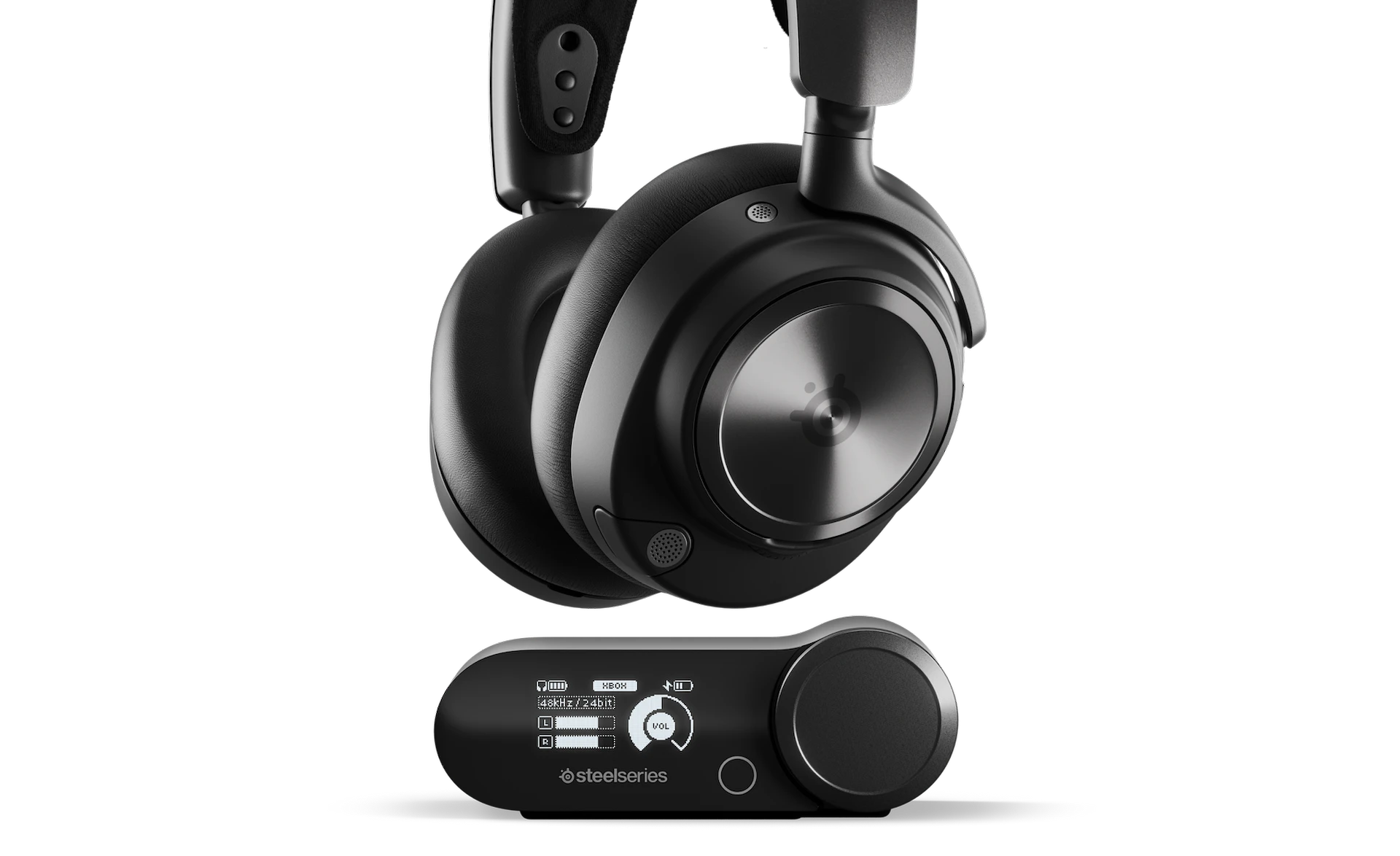
The Omni inherits the Arctis Nova frame wholesale: a flat metal headband strip with a rubberized underside, a lower elastic suspension band that auto-adjusts fit, and matte plastic earcups that swivel 90 degrees to lay flat. At 339 grams (87 x 172 x 210 mm), it's middleweight for a wireless flagship — lighter than the Audeze Maxwell 2's punishing 560g, heavier than featherweight esports sets. The suspension headband distributes weight evenly, and both RTINGS and SoundGuys rate the fit as genuinely comfortable for long sessions, including with glasses.
This is where the Elite price gap shows up, though. RTINGS describes the Omni's build as "plastic-heavy," and SoundGuys notes the earcup height sliders "feel like they're grating the inside of the headband and stop abruptly" compared to the Elite's smooth, dampened adjustment. The Elite adds metal struts and nicer vegan leather; the Omni uses the same materials as the older Nova Pro Wireless. None of this feels fragile — reviewers consistently describe the construction as solid — but it's a deliberate cost cut, and the Elite's advantage is only obvious when holding both.
The earpads are thick memory foam wrapped in pleather. They're plush, but they trap heat: SoundGuys found them "noticeably warm after just an hour" (though not uncomfortably warm until roughly eight hours), and RTINGS flags them as a sweat trap with no IP rating for protection. Notebookcheck warns the cushions aren't large enough to fully surround bigger ears, so some wearers will feel the drivers pressing. The retractable ClearCast Pro boom mic is a highlight — it tucks flush into the left earcup and auto-mutes when retracted, with a red mute indicator when deployed.
The base station (which SteelSeries calls the GameHub) is a 1.4 x 4.5 x 3.2-inch black box with a monochrome OLED screen, a large volume knob, and a battery charging slot on the side. The knob clicks through input switching, source mixing, EQ, and settings. It's functionally identical to the Elite's hub — a big upgrade over the Nova Pro Wireless's two-port version — though SoundGuys raises a fair long-term concern: the OLED shows mostly static elements (volume, battery, source levels) and is prone to burn-in over years of always-on desk duty.
Key Features
OmniPlay: four simultaneous audio sources. This is the headline feature. The base station has three USB-C ports plus 3.5mm line-in/line-out, and the headset adds Bluetooth 5.3. You can connect PC, PS5, Xbox, and a phone all at once and mix audio from up to four sources — game audio, Discord, console chat, and music — with per-source volume control on the headset or hub. Crucially, this is the one headset (alongside the Elite, Astro A50 X, and Astro A50) that supports PlayStation and Xbox simultaneously without committing to a platform-specific version. There's no more PS/PC vs Xbox/PC SKU split.
Hi-Res Wireless audio, 96kHz/24-bit. The 2.4GHz link is certified by the Japan Audio Society for Hi-Res Audio Wireless — the first time this certification has applied wirelessly on this price tier. Bluetooth gets SBC plus LC3 and LC3+ codecs (LC3+ delivers noticeably better fidelity than SBC, per PCMag). Note the omissions: no AAC and no AptX support, which matters for iPhone and some Android users. Also worth knowing: 96kHz isn't automatic — PCMag had to manually set the Windows output to 96kHz outside the SteelSeries software, and the hub's OLED shows the actual sample rate so you can verify.
ANC and Transparency. The Omni's ANC is a genuine step up from the Nova Pro Wireless — the same system used in the Elite. SoundGuys measured an average of 81% ambient noise attenuation versus just 49% for the Nova Pro Wireless, and Reddit reviewer HiFiOasis (who tested both) calls it "a pretty big improvement... 30-40% better overall, less white noise and hiss." SteelSeries claims it blocks "40% more background noise than the competition" (lab-tested against key competitors, Oct 2025). It's not Sony XM6-class, and PCMag notes the ANC "crackles in strong wind," but it's legitimately effective for constant low-frequency noise like fans, airplane drone, and office chatter. Transparency mode is included for hearing your surroundings.
Infinite Power System. Two 670mAh hot-swap batteries: one powers the headset while the other charges in the base station. Per battery, expect up to 30 hours on 2.4GHz or 50 hours on Bluetooth with ANC off (PCMag's figures), about 27 hours as measured by RTINGS, or up to 19 hours with ANC enabled — roughly 60 hours combined with both packs. A 15-minute quick charge yields four hours of play. RTINGS calls the design "over 50 hours of use with ANC enabled" across two packs. The one catch: there's no backup capacitor, so you lose the wireless link for the few seconds it takes to swap batteries — annoying mid-raid, trivial otherwise.
ClearCast Pro microphone. The retractable, omnidirectional boom mic covers 50Hz–16kHz (the Nova Pro Wireless's mic only managed 100Hz–6.5kHz) with built-in AI noise rejection. PCMag calls it "top-tier... among the top boom mics in gaming headsets, easily clean enough for casual recording and streaming," noting it completely killed a 3D printer's buzz in testing. SoundGuys is far less impressed, describing the voice reproduction as "unnatural sounding." That split is worth flagging: most sources rate the mic very good to excellent, but it's not universally loved.
Software. SteelSeries GG with Sonar provides parametric EQ, spatial audio (PCMag found the surround effect genuinely useful in Apex Legends for pinpointing footsteps), a mixer, and per-game presets; the companion mobile app mirrors most controls. Notebookcheck's only complaint here: Sonar is "overwhelming" for newcomers, and Reddit's SteelSeries community has long grumbled about Sonar quirks across the whole product line.
Performance
Sound quality is the Omni's most contested attribute. The 40mm neodymium drivers (10Hz–40kHz, 98 dBSPL) share the Nova Pro Wireless's DNA, and the tuning is V-shaped — RTINGS measured +3dB of bass and +3dB of treble emphasis. PCMag calls the sound "fantastic... powerful bass and clear highs," richer and more balanced than the Nova Pro Wireless, with LC3+ adding detail over Bluetooth. Amazon buyers echo the gaming upside: footsteps are easier to hear, positional audio is accurate. But SoundGuys found it "painfully sibilant at times" at default settings — harsh 'S' sounds that fatigue ears during music listening — and RTINGS community threads echo that the default EQ wants adjustment. Every reviewer's advice converges: spend ten minutes in Sonar's parametric EQ, and the sibilance largely disappears. This is a gaming-first tuning, not a music-first one.
Latency is a non-issue on 2.4GHz — this is SteelSeries's low-latency wireless implementation, the same one trusted for competitive play across the Arctis line — and LC3+ keeps Bluetooth reasonably tight. RTINGS measured 0.2ms analog latency when wired. Battery life is the class benchmark; no other flagship matches the hot-swap system's practical uptime.
ANC performance sits between "good" and "great": clearly better than the Nova Pro Wireless (81% vs 49% measured attenuation), clearly behind dedicated noise-cancelling headphones like the Sony WH-1000XM6, and prone to wind crackle. Fine for a noisy household or flights; not a substitute for a Sony on a plane if ANC is your primary need.
The mic's AI noise rejection gets consistent praise across Amazon and professional reviews for killing background noise, though SoundGuys's "unnatural" verdict and scattered Amazon reports of mic failures (more on that below) mean it's not flawless.
Pros and Cons
Pros:
- OmniPlay is unmatched: up to four simultaneous audio sources mixed from PC, PS5, Xbox, Switch, and mobile — no platform-specific SKUs
- Hot-swap dual batteries effectively eliminate charging downtime; ~27–30h per pack, ~60h combined
- Hi-Res Wireless certified 96kHz/24-bit audio over 2.4GHz plus LC3+ Bluetooth
- Meaningfully stronger ANC than the Nova Pro Wireless (81% vs 49% measured attenuation), with transparency mode
- ClearCast Pro mic is a big upgrade: wider frequency response, AI noise rejection, auto-mute retraction
- Sonar's parametric EQ, spatial audio, and mixer are among the best headset software suites in gaming
- Comfortable 339g suspension-band design that holds up in multi-hour sessions
Cons:
- $399.99 is a lot, and Amazon buyers are visibly split — several reviews bluntly say it's "not worth $400"
- Default tuning is bright and sibilant, especially for music; EQ adjustment is effectively mandatory
- No AAC or AptX Bluetooth codecs — iPhone users get SBC/LC3 only
- Plastic-heavy build and grating earcup sliders vs the Elite's metal construction
- Pleather pads run warm and aren't large enough for bigger ears; no IP rating
- ANC crackles in strong wind
- Early reliability reports: Amazon's review summary flags volume wheel failures, mic failures, USB port compatibility quirks, and Xbox connection issues among a minority of owners
- OLED base station screen risks burn-in over years of static display
- No 3.5mm cable in the box, and the headset's own 3.5mm jack doesn't work while powered on — wired use is passive-only
- Battery swaps drop the connection for a few seconds
Who Should Buy This
Buy the Arctis Nova Pro Omni if you live across multiple platforms — PC plus PS5 and/or Xbox, with a phone and Switch in the mix — and you're tired of swapping headsets or juggling dongles. It's the best tool in existence for the "game audio on console + Discord on PC + music on phone" power-user scenario, and its ANC, mic, and battery make it a strong daily driver for streamers, competitive players, and anyone who works from a desk for hours. The hot-swap batteries are a genuine quality-of-life win: you will simply never think about charging a headset again.
Skip it if you game on a single platform — the Nova 7 line or Turtle Beach Stealth 600 covers you for a fraction of the price. Skip it if your priority is music fidelity (the Elite and the Audeze Maxwell 2 both outplay it), or if you have larger ears and found Arctis pads snug in the past. And if $400 stings, wait for a sale — the Nova Pro Wireless, its direct predecessor, routinely drops to ~$300 or less, and the Omni has already appeared at $379.99 on Amazon.
Alternatives to Consider
SteelSeries Arctis Nova Elite ($599.99) — The Omni's big sibling. Carbon fiber drivers with brass surrounds (101 dBSPL vs 98 dBSPL), a slightly better ANC system, metal build quality, and marginally better music detail. Reddit reviewers are blunt that the sound-quality gap "cannot be understated" for audiophiles — but the Omni actually has the better microphone, so Elite's premium is purely about drivers and materials.
SteelSeries Arctis Nova Pro Wireless ($349.99) — The model this replaces. Same comfort and battery system, but only two USB ports, 48kHz wireless max, noticeably weaker ANC, and the older, narrower mic. It's frequently discounted and remains a superb headset — buy it on sale; the Omni's upgrades are worth the delta if you want simultaneous triple-device mixing.
Audeze Maxwell 2 ($329.99) — The sound-quality pick: planar magnetic drivers with genuinely audiophile detail and 80+ hour battery life. But it weighs 560g, has a mediocre mic, and can't mix Bluetooth and 2.4GHz audio simultaneously the way the Omni does.
Razer BlackShark V3 Pro ($249.99) — Cheaper FPS-focused alternative with good ANC and simultaneous wireless + Bluetooth, but no hot-swap batteries, a worse base station, and Razer Synapse's own software quirks.
Verdict
The Arctis Nova Pro Omni is the most complete wireless gaming headset you can buy, full stop. No other product mixes four simultaneous audio sources across PC, PlayStation, Xbox, Switch, and mobile with hot-swap batteries, certified hi-res wireless audio, genuinely useful ANC, and a top-tier mic — and PCMag, SoundGuys, T3, and Windows Central all landed on essentially the same conclusion. The compromises are real but specific: a bright default tuning that demands EQ work, cheaper materials than the $599 Elite, no AAC/AptX, and scattered early reliability complaints from a minority of Amazon owners.
At $399.99 it's expensive, and it only earns that price if you'll actually use the multi-platform connectivity — if you're a single-console gamer, it's overkill. But for the multiplatform player, the streamer, or anyone who has ever kept three headsets on a desk, the Omni does something nothing else does, and does it well. It's a 9/10 product at an 8/10 price, which nets out to one of the easiest flagship headset recommendations of 2026. 8.5/10
What the Experts Say
Professional review consensus for this product
Full Specifications
| Drivers | 40mm neodymium, 10Hz-40kHz, 98 dBSPL |
|---|---|
| Connectivity | 2.4GHz (GameHub) + Bluetooth 5.3 LE (SBC, LC3, LC3+) |
| Hi-Res | 96kHz/24-bit wireless, Japan Audio Society certified |
| ANC | Active noise cancellation + transparency mode |
| Microphone | ClearCast Pro, retractable omnidirectional, 50Hz-16kHz, AI noise rejection |
| Battery | 2x 670mAh hot-swap packs; ~30h per pack 2.4GHz (ANC off), ~19h with ANC; 15-min quick charge = 4h |
| Base Station | 3x USB-C + 3.5mm line-in/out, OLED display, volume knob, battery charger |
| Mixing | OmniPlay - up to 4 simultaneous sources (2 USB + Bluetooth + line-in) |
| Compatibility | PC, PS4/PS5, Xbox Series X|S, Mac, Switch/Switch 2, Android, iOS, Meta Quest 2/3 |
| Weight | 339g (87 x 172 x 210 mm) |
| Colors | Black, White, Midnight Blue (Graphite Amazon exclusive) |
| In Box | Headset, GameHub, 2x USB-C to USB-A cables, 2nd battery, pop filter, carry pouch |
The Verdict: Excellent
The most complete wireless gaming headset you can buy: unmatched OmniPlay four-source mixing, hot-swap batteries, certified hi-res wireless audio, and a top-tier mic. The bright default tuning, plastic-heavy build, and $400 price demand justification - but for multiplatform gamers, nothing else does what this does. 8.5/10.
— GamepadSquire, August 2026
As an Amazon Associate we earn from qualifying purchases made through links for SteelSeries Arctis Nova Pro Omni.
Related Buying Guide
Buying Guide
Best Gaming Headsets 2026: Buying Guide for Every Budget
From planar magnetic champs and open-back sleepers to budget wired bargains — what actually matters when buying a gaming headset in 2026.
Buying Guide
Best Gaming Earbuds 2026: Low-Latency Picks for PC, PS5, Switch, and Mobile
Gaming earbuds have arrived: the SteelSeries Arctis GameBuds lead the category, the Soundcore VR P10 are the budget low-latency value pick, and the 1MORE Penta Driver P50 serve wired audiophiles. Latency explained, 2026 picks compared.