Best Lightweight Gaming Mice 2026: The Esports & FPS Buyer's Guide
The ultralight revolution explained: weight-class-by-weight-class picks from the 35g Pulsar X2 CrazyLight to the 60g Superlight 2, backed by RTINGS lab data and the gear choices of 2,100+ pro players.
By GamepadSquire — August 5, 2026Verified
Best Lightweight Gaming Mice 2026: The Esports & FPS Buyer's Guide
The ultralight mouse revolution has reshaped competitive gaming faster than any other peripheral trend of the decade. Fifteen years ago, a 100g mouse was considered light. Today, the mainstream esports tier starts at 60g, flagship ultralights hover around 49g, and boutique models push below 30g. Weight is the single most visible spec in the category — but it is also the most misunderstood one.
This guide cuts through the weight-weenie discourse to answer one question: which lightweight mouse should you actually buy in 2026? It is organized the way the enthusiast community actually thinks — by weight class — and backed by three sources: RTINGS' standardized test bench (400+ mice tested, updated July 14, 2026), pro player gear data from EsportsMice (tracking over 2,100 professional players), and the consensus of thousands of owners across r/MouseReview and Amazon. Every mouse with a linked review has been covered in depth on this site; the rest are cited directly from the data.
Quick Picks
| Tier | Mouse | Weight | Price | Polling | Best For |
|---|---|---|---|---|---|
| Best overall | Razer Viper V4 Pro | 49g | $159.99 | 8,000Hz | The complete ultralight flagship |
| Best value | MCHOSE L7 Ultra | 46g | $64.99 | 8,000Hz | Flagship-tier performance at half price |
| Best budget | VXE R1 Pro | 48g | $34.99 | 1,000Hz (4K dongle opt.) | The cheapest real ultralight |
| Most used by pros | Razer Viper V3 Pro | 54g | $159.99 | 8,000Hz | 21% of tracked pros run it |
| Best ergonomic | Razer DeathAdder V4 Pro | 56g | $149.99 | 8,000Hz | Palm-grip lightweight |
| Lightest mainstream | Pulsar X2 CrazyLight | 35–39g | $129.95 | 8,000Hz | Sub-40g FPS specialists |
| Best standard-light | Logitech G Pro X Superlight 2 | 60g | $144.99 | 2,000Hz | The esports default shape |
How We Picked
Every recommendation here is triangulated from three sources. Lab data: RTINGS measures click and sensor latency with a Beagle 480 USB analyzer, switch force with a Mecmesin force tester, and verifies weights on their own scale — their lightweight roundup was refreshed in July 2026 with the Razer Viper V4 Pro installed as the top pick. Pro usage data: EsportsMice tracks the mice of 2,100+ professional players across 14 major titles, which tells you what the people whose income depends on aim actually choose. Community feedback: r/MouseReview is the earliest warning system for QC issues, coating wear, and firmware problems in the entire peripheral industry.
The question this guide tries to answer for every mouse: what will annoy you about it six months after you buy it?
Why Weight Matters (and Why It Doesn't)
The physics is real: a lighter mouse requires less force to accelerate, which measurably reduces the effort of flicks and micro-corrections. Studies cited across r/MouseReview show most people achieve better precision with lighter mice — but the effect size is small, and it is swamped by two far bigger factors: shape and sensor consistency.
The 2026 consensus, from both pro usage data and community sentiment, is that 45–60g is the practical sweet spot. EsportsMice's own analysis is blunt: most pros prefer the 50–58g band because it balances speed with control, and mice under 45g can feel too fast and twitchy for some players. That nuance matters, because the marketing war has pushed several flagships below 40g — and a significant slice of owners report coming back to ~50g after a few months.
The second thing every buyer should internalize: weight is a preference, not a score. r/MouseReview is full of "I can't go back" threads from ultralight converts, but just as many players find sub-45g mice unstable and prefer the settled feel of 60g. If you're coming from a 100g+ mouse, plan for a recalibration period — longtime owners consistently report needing to adjust their DPI and aim for days or weeks after the switch.
Ultralight Class (Under 50g)
This is the class the marketing wars are fought in. Sub-50g is genuinely competitive territory now, but the extremes come with real compromises.
Best Overall: Razer Viper V4 Pro ($159.99, 49g)
RTINGS' best lightweight mouse of 2026 and our top-scoring mouse on the site at 9/10. The V4 Pro is the rare ultralight that gives nothing up: 49g (48.9g measured), the Focus Pro 50K Gen-3 sensor — among the most accurate RTINGS has ever tested — 8,000Hz polling out of the box with no extra dongle purchase, and a 180-hour battery at 1,000Hz. It is optical-everything: Gen-4 optical switches rated for 100 million clicks and an optical scroll encoder that sidesteps the mechanical encoder failures that plague other mice. Amazon owners rate it 4.7/5 across 340+ ratings.
The trade-offs are consistent with the rest of Razer's optical line: clicks are very loud and tactile (RTINGS flags it; Reddit users confirm it's audible in a quiet room), and there's no Bluetooth — dongle or cable only. At $159.99 it is also firmly flagship-priced. But as a complete package — weight, sensor, battery, warranty (two years, the longest on RTINGS' lightweight list) — nothing else in the class matches it.

Best Value: MCHOSE L7 Ultra ($64.99, 46g)
The most important mouse of 2026 that most gamers haven't heard of. RTINGS named it the best mid-range gaming mouse of the year, and its testing shows near-identical raw performance to the $160 flagships: a PAW3950 sensor up to 42,000 DPI, true 8,000Hz wireless polling out of the box, tri-mode connectivity, and a 46g weight that undercuts every big-brand flagship. At $64.99 it delivers roughly 95% of the Viper V4 Pro's measurable performance for 40% of the price.
The honest picture: the shell is thin and flexes under moderate pressure, the dyed PTFE feet glide less smoothly than premium skates, the shape skews small (great for small-to-medium hands with claw or fingertip grip, less so for large hands), and the warranty is one year versus two from Razer and Logitech, with mixed customer-service reports in community threads. If you want flagship-tier ultralight performance without the flagship price and accept the build compromises, this is the pick.

Best Budget: VXE R1 Pro ($34.99, 48g)
RTINGS' "best cheap lightweight mouse" — and it's hard to argue. The R1 Pro is the poster child of the Chinese ultralight wave: 48g, a PAW3395 sensor (the same flagship-class component found in $100+ mice), a symmetrical shape that accommodates a wide range of hands, and wireless performance that RTINGS says approaches the Viper V4 Pro. At $34.99 it is the cheapest genuine ultralight on the market.
The downsides are the class's usual ones: the smaller 250mAh battery (75 hours rated) can't match the 150–180 hours of the flagships, the stock 1,000Hz polling needs the optional 4K dongle to go higher, and ATK/VXE's one-year warranty is shorter than the big brands'. Availability can also be inconsistent outside Asia — it's most reliably bought direct from ATK or via AliExpress and MaxGaming. But at this price, the risk is easy to absorb.
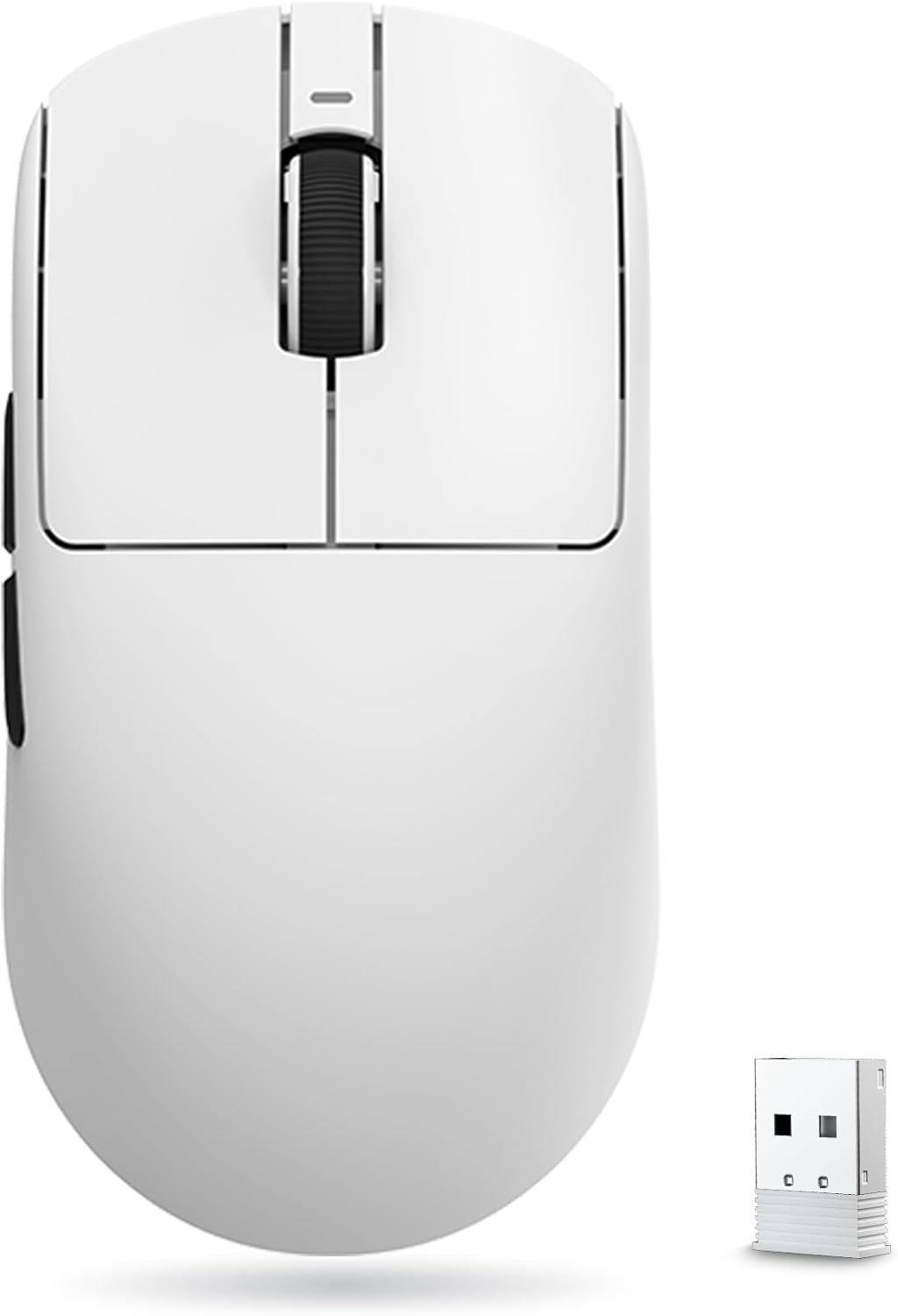
The Lightest Mainstream: Pulsar X2 CrazyLight ($129.95, 35–39g)
For weight weenies: 35g (Mini) and 39g (Medium) — among the lightest wireless mice ever made, built around a custom PAW3950-derived XS-1 sensor with up to 8,000Hz polling. The X2 CrazyLight is a legitimate engineering flex, and its flick speed is the fastest in our catalog.
The compromise is structural, and r/MouseReview is clear about it: a tiny 65-hour battery means weekly charging, and the open chassis design lets dust in over time. Community consensus describes it as an FPS specialist's tool — incredible in aim trainers and tactical shooters, high-maintenance as a daily driver. Buy it because you want the lightest thing that still has flagship tracking, not because you need a do-everything mouse.

Lightweight Class (50–60g)
This is the band most pros actually play on — and for good reason. It keeps most of the ultralight benefit while retaining structural integrity and battery life.
Most Used by Pros: Razer Viper V3 Pro ($159.99, 54g)
The single most popular mouse among professional players in 2026: EsportsMice data shows 21% of its 2,100+ tracked pros run the Viper V3 Pro — nearly double the second-place Superlight 2 at 17%. That dominance is no accident. At 54g with a Focus Pro 35K Gen-2 sensor, 8,000Hz via the HyperPolling dongle, and roughly 95 hours of battery, it's the mouse that replaced the Superlight as the competitive default.
The V4 Pro has since superseded it on paper — lighter, faster polling stock, better encoder, longer battery — and the V3 Pro is frequently discounted to $100–130, at which point it becomes one of the best performance-per-dollar wireless mice available. RTINGS still calls it a tremendous value at discount. If you want the shape and platform that half the pro scene grew up on, this is it.

Best Ergonomic: Razer DeathAdder V4 Pro ($149.99, 56g)
The iconic DeathAdder shape — the most copied ergonomic design in gaming — finally went ultralight. At 56g, the V4 Pro is the most complete ergonomic esports mouse on the market: Focus Pro 45K Gen-2 sensor, true 8,000Hz wired and wireless, 150 hours at 1,000Hz, optical-everything internals, and a smooth-touch finish that r/MouseReview users report holds up well. RTINGS recommends it as the palm-grip alternative to the Viper V4 Pro for larger hands. EsportsMice puts pro adoption at 6% — the highest of any ergonomic shape on the circuit.
The trade-offs: loud clicks (a Razer optical family trait), strictly right-handed, and $150 for a mouse that competes with symmetrical ultralights at the same price. For palm and claw-palm grippers who game for hours, the shape comfort justifies the premium.

Best Budget Wired: Glorious Model O 2 ($39.99, 59g)
The wired lightweight class is thin in 2026 — most of the innovation went wireless — but the Model O 2 remains the best value in it. At 59g with a BAMF 2.0 optical sensor (26,000 DPI), a paracord-style cable that genuinely feels wireless, and 100% PTFE skates, it's a sub-60g FPS mouse for $40. It caps at 1,000Hz and the software is basic, but you get a two-year warranty and zero battery anxiety. If you want ultralight performance on a budget and don't care about wireless, this is the safest buy in the class.

Standard-Light Class (60–70g)
The weight that was "ultralight" two generations ago is now the sensible default — and it's where the most-proven mouse of all time lives.
The Esports Default: Logitech G Pro X Superlight 2 ($144.99, 60g)
The Superlight 2 remains the shape benchmark — the mouse that defined the modern competitive category and still anchors 17% of pro rosters per EsportsMice. At 60g with a HERO 2 sensor (32,000 DPI), 2,000Hz polling stock, 95-hour battery, and LIGHTFORCE hybrid switches, it does nothing flashy and everything right. Its symmetrical shape is the most accommodating in the business — the reason so many players never need to try anything else.
It now faces real pressure: the Viper V4 Pro is lighter, polls faster out of the box, and lasts nearly twice as long at the same price, and RTINGS notes the Superlight 2 doesn't feel quite as sturdy and its stock feet glide less smoothly. But if you want the shape that pros spent a decade building muscle memory on — and don't care about spec-sheet bragging rights — this is still the one. When it dips toward $120 on sale, it's a no-brainer.

The Tech Flagship: Logitech G Pro X2 Superstrike ($179.99, 61g)
RTINGS' best gaming mouse of 2026, and the most innovative mouse Logitech has shipped in a decade. The Superstrike pairs the proven Superlight 2 platform (61g, HERO 2 up to 44,000 DPI, 8,000Hz wireless) with the Haptic Inductive Trigger System: magnetic haptic actuators that replace mechanical switches, adjustable actuation distance, and Rapid Trigger for faster follow-up inputs.
The honest community picture is more nuanced than the hype. At the lowest actuation settings the buttons trigger easily in-game; the haptic feedback is responsive but mushy compared to crisp mechanical clicks; and at $179.99 it's expensive for a measurable-but-small latency advantage. It's a click-timing specialist's tool for CS2 and Valorant, not a universal upgrade — most players should take the Viper V4 Pro for $20 less.

Notable Mentions Worth Knowing
- Hitscan Hyperlight (~$110): RTINGS' best mid-range lightweight, just over 40g with excellent build quality and a medium hump that suits most grips. It's actually lighter than the V4 Pro, but the open bottom plate collects dust, and it's only sold direct from Hitscan — no Amazon, no retail.
- Keychron M3 Mini (~$70): RTINGS' best budget lightweight pick: a PAW3395 sensor in a Viper-like shape, plus a genuinely rare convenience — both USB-A and USB-C receivers. Slightly scratchy feet and mushy buttons keep it out of the top tier, and the 4,000Hz variant costs $20 more.
- Finalmouse UltralightX ($189): 36g and famous — but RTINGS flags inconsistent build quality between variants, and limited-drop availability means you'll pay reseller markups. The enthusiast halo is real; the value proposition is not.
- Scyrox V8 (~$70): Among the best-performing mice RTINGS has tested at a fraction of flagship cost, but the small shape is claw-grip specific and the software experience is sketchy.
- Endgame Gear OP1 8k (~$80): The wired alternative for latency purists — 8,000Hz, SPDT switches with incredibly low click latency, and a narrow shape with a supportive rear hump. Pricey for a wired mouse, but a favorite in r/MouseReview.
How to Choose Your Lightweight Mouse
Weight class first, then shape. The classes in this guide map to real preferences: sub-40g is a competitive niche for FPS specialists; 45–50g is the flagship ultralight zone; 50–60g is where most pros live; 60–70g is the comfortable default. Pick the band that matches your game and tolerance — then choose within it by shape. r/MouseReview's most repeated advice: shape is 80% of the buying decision, and a shape that fits beats a lighter mouse that doesn't.
Grip type decides everything. Palm grippers with medium-large hands should look at the DeathAdder V4 Pro (ergonomic) or Superlight 2 (symmetrical). Claw and fingertip grippers have the widest selection — nearly every symmetrical ultralight on this list works, with smaller shapes (X2 CrazyLight Mini, MCHOSE L7 Ultra) favoring smaller hands. If you're unsure of your grip, the medium-hump symmetricals (Viper V3/V4 Pro, Superlight 2) are the safest bets.
8K polling is real but situational. 8,000Hz measurably lowers input latency versus 1,000Hz — RTINGS' tests confirm it — but it taxes your CPU and drains batteries: the Viper V4 Pro drops from 180 hours at 1K to 45 hours at 8K. On a 240Hz+ monitor in a competitive shooter it matters; at 144Hz it's largely imperceptible. Every 2026 flagship does 8K natively, but 1,000Hz is still fine for most players.
Battery philosophy is a real spec. Flagships ship with 95–180 hour internal batteries (Viper V4 Pro: 180h; DeathAdder V4 Pro: 150h; Superlight 2: 95h). The budget ultralights cut this to 65–75 hours (X2 CrazyLight: 65h; VXE R1 Pro: 75h) — fine if you dock weekly, annoying if you travel. Wired options like the Model O 2 eliminate the question entirely.
Warranty is the hidden differentiator. Razer and Logitech offer two-year warranties with established RMA processes; MCHOSE, ATK/VXE, and most Chinese brands offer one year with mixed support reports. At $35 that risk is trivial; at $150+ it's a real factor.
Mistakes to Avoid in 2026
- Chasing the lowest gram number. Sub-40g mice come with real costs — battery life, dust ingress, structural flex — and many owners return to 50g. The EsportsMice data is the proof: pros overwhelmingly choose 50–58g, not the lightest thing available.
- Ignoring shape for weight. The X2 CrazyLight is lighter than the Viper V4 Pro, but if the shape doesn't fit your hand, the weight advantage is worthless. Buy the shape that fits; optimize weight within it.
- Assuming lighter = better aim. The precision studies show a small average benefit, but individual results vary wildly, and the recalibration period is real. If you're happy with a 70–80g mouse, there's no urgent reason to switch.
- Paying flagship prices for a mouse you'll use at 1,000Hz on a 144Hz monitor. The MCHOSE L7 Ultra at $65 delivers the same experience for most players.
- Buying limited-drop mice at reseller prices. Finalmouse and Razer's Signature Edition models are cool, but the markup over retail rarely buys you performance you can't get from a Viper V4 Pro or Superlight 2.
Final Verdict
The 2026 lightweight mouse market is the strongest it has ever been, and the sweet spot has shifted: 45–60g is now the performance norm, 8,000Hz is standard on flagships, and the Chinese brands have made genuine ultralight performance available from $35.
Our recommendations by use case:
- Best overall: Razer Viper V4 Pro — read the review
- Best value: MCHOSE L7 Ultra — read the review
- Best budget: VXE R1 Pro — read the review
- Most used by pros: Razer Viper V3 Pro — read the review
- Best ergonomic: Razer DeathAdder V4 Pro — read the review
- Best esports default: Logitech G Pro X Superlight 2 — read the review
- Lightest mainstream: Pulsar X2 CrazyLight — read the review
If you want the complete mouse market picture beyond the lightweight niche — including the budget tier under $30 and general-purpose heavyweights — see our Best Gaming Mice 2026 guide and the Best Budget Gaming Mice Under $50 guide.
The rule for 2026 is simple: don't buy the lightest mouse, buy the lightest mouse that fits your hand — then stop reading spec sheets and go play.
On a Budget?
Our picks above assume you can spend flagship money. If you're shopping with $50 or less, the best lightweight gaming mice under $50 guide covers the budget ultralight tier — the 48g VXE R1 Pro, ATTACK SHARK X3, HyperX Pulsefire Haste 2 Mini, and Glorious Model O 2 — where flagship-tier sensors now cost half as much.
Related Guides
Buying Guide
Best Gaming Mice 2026: The Complete Guide for Every Budget
The 2026 gaming mouse market explained tier by tier: RTINGS-lab-verified picks from the $25 G203 to the $180 haptic Superstrike, with the Viper V4 Pro, DeathAdder V4 Pro, the $35 VXE R1 Pro budget flagship-killer, and the Chinese mid-range revolution covered in depth.
Buying Guide
Best Gaming Mice for FPS 2026: The Esports & Competitive Buyer's Guide
The competitive FPS mouse market decoded: what 1,600+ Valorant and CS2 pros actually use, what RTINGS' lab bench measures, and the real-world owner sentiment behind every pick — now including the solid-shell ASUS ROG Harpe II Ace and the $30 Razer Cobra as the cheap-wired pick, from the $35 VXE R1 Pro to the $180 Logitech Superstrike.
Buying Guide
Best Lightweight Gaming Mice Under $50 in 2026: The Budget Ultralight Buyer's Guide
The ultralight revolution has reached the budget tier. The best lightweight gaming mice under $50 in 2026 — from the 48g VXE R1 Pro to the ATTACK SHARK X3 — with specs, measured weights, and the QC trade-offs real owners talk about.