Best Lightweight Gaming Mice Under $50 in 2026: The Budget Ultralight Buyer's Guide
The ultralight revolution has reached the budget tier. The best lightweight gaming mice under $50 in 2026 — from the 48g VXE R1 Pro to the ATTACK SHARK X3 — with specs, measured weights, and the QC trade-offs real owners talk about.
By GamepadSquire — August 12, 2026Verified
Best Lightweight Gaming Mice Under $50 in 2026
The ultralight mouse revolution has officially reached the budget tier. Three years ago, a sub-60 gram wireless gaming mouse with a flagship sensor cost $130 or more. In 2026, the same class of hardware — PixArt PAW3395 sensors, 48-gram shells, 1,000Hz wireless — routinely sells for under $50, and the enthusiast community's favorite budget picks are barely more than half the price of a premium flagship.
That collapse in price is the story of this guide. We've pulled together specs, lab data, and community feedback from r/MouseReview and owner reviews to find the lightweight mice under $50 that genuinely deliver — and to flag the ones that only look good on paper. If you play low-sensitivity FPS, drag your mouse across a big pad, or just hate the feeling of a heavy brick dragging your wrist down, this is the tier that gives you the most performance per dollar in the entire mouse market.
Quick Picks
| Mouse | Price | Weight | Sensor | Wireless | Best For |
|---|---|---|---|---|---|
| VXE R1 Pro | ~$49 | 48g | PAW3395 | Yes | Best overall value |
| ATTACK SHARK X3 | ~$34-40 | 49g (54g measured) | PAW3395 | Yes (tri-mode) | Ultra-budget ultralight |
| HyperX Pulsefire Haste 2 Mini | ~$50 | 59g | HyperX 26K | Yes (dual) | Best compact build |
| Glorious Model O 2 | ~$40 | 59g | BAMF 2.0 | No (wired) | Best wired ultralight |
| VGN Dragonfly F1 Pro | ~$40-50 | 49g | PAW3395 | Yes | Small-hand pick |
What "Lightweight" Actually Means Under $50
Before the picks, a quick frame. "Lightweight" in the enthusiast community now means roughly under 65 grams, with the current sweet spot for competitive FPS between 45 and 60 grams. That's a huge shift from even five years ago, when 90-100 grams was considered normal for a gaming mouse and 80 grams was "light."
Why does it matter? For low-sensitivity shooters like Valorant or Counter-Strike, you're moving the mouse with your whole arm across large sweeping motions. Every gram of weight is mass you have to start, stop, and reverse thousands of times per match. Players who switch from a 100g mouse to a 50g one consistently describe the same sensation: the mouse feels like it's "disappeared" from the desk, and micro-adjustments that required a conscious flick become effortless. The counterpoint — and it's a real one — is that some players find extremely light mice harder to control at very low sensitivity, because there's less mass to absorb small hand tremors. The 45-60g band is where most competitive players land, and every pick in this guide sits in or near it.
The other thing worth knowing: weight is the spec that's most often exaggerated. Advertised weights are measured without cable (for wired mice), or with the lightest configuration (for wireless ones). Community teardowns and sites like RTINGS regularly measure 4-8 grams more than the marketing claims. We've used measured weights where available.
Our Top Pick: VXE R1 Pro
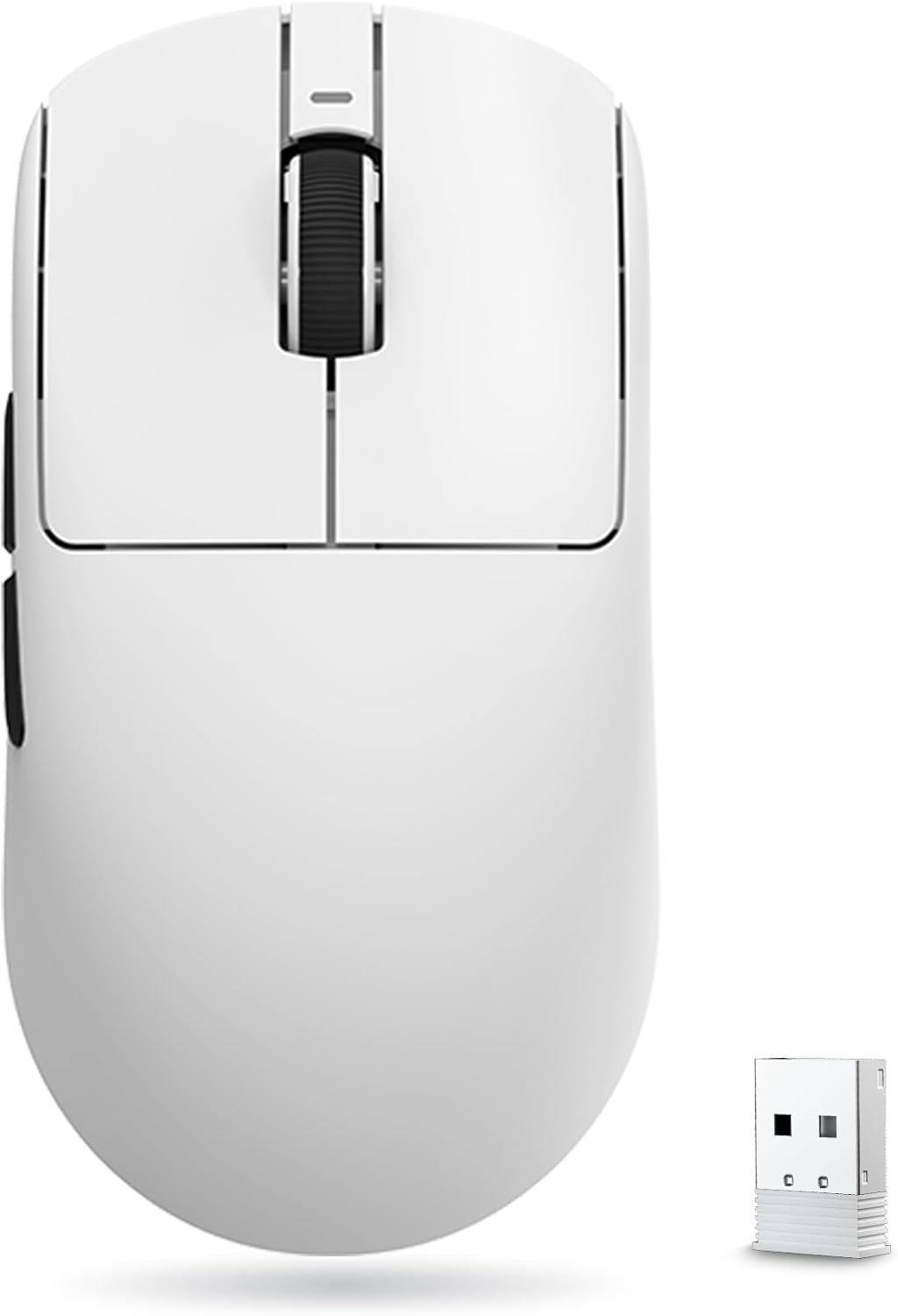
If there's one mouse that defines the lightweight-under-$50 category in 2026, it's the VXE R1 Pro. It's the pick that shows up in nearly every r/MouseReview "budget ultralight" thread, and the reason is simple: it pairs a flagship PAW3395 sensor with a 48-gram shell for around $49 — sometimes less on sale.
What Makes It Special
The R1 Pro's spec sheet reads like a $130 mouse: PixArt PAW3395 optical sensor with 26,000 DPI, 650 IPS tracking, and 50G acceleration; a solid (non-honeycomb) shell at 48 grams; RTINGS-verified click and sensor latency that rivals mice three times the price; and a 250mAh battery rated for about 75 hours at 1,000Hz, with fast charging that takes it from empty to full in roughly 15-30 minutes. It also supports 4,000Hz polling with a separately purchased dongle, and its companion software is browser-based — no install required, which community users consistently rate as a plus versus bloated desktop apps.
The shape is a symmetrical, medium-low profile ambidextrous design (120.6 × 64.1 × 37.6 mm) that works for claw and fingertip grips, with a smooth "ice-feel" coating that gets grippier as your hand sweats. In-box you get spare PTFE skates and grip tape, which is a genuinely nice touch at this price.
The Honest Trade-offs
Community feedback on the R1 Pro splits into two clear themes. The first is praise: owners consistently describe it as one of the best QC'd budget mice to come out of China, with several r/MouseReview users who own multiple budget rivals saying VXE's build quality control is a cut above the competition. The second is a persistent minority of reliability complaints — scroll-wheel or button failures within weeks of light use are reported often enough that they're worth knowing about before you buy. There's also no Bluetooth (2.4GHz and wired only), the mechanical Huano switches won't outlast optical ones, and the warranty is one year versus two from bigger brands.
Bottom line: at ~$49, the R1 Pro is the best performance-per-dollar ultralight on the market — flagship tracking in a 48g shell with elite latency. The reliability split is the only real hesitation, and for most buyers the value math still wins.
Best Ultra-Budget: ATTACK SHARK X3

If $49 is already more than you want to spend, the ATTACK SHARK X3 is the pick that keeps the core promise — flagship PAW3395 sensor, sub-55g weight, wireless — at closer to $34-40. It's the mouse that a lot of "cheapest good ultralight" discussions land on, and for good reason.
What Makes It Special
The X3 pairs the PAW3395 with a small symmetrical shell that's a near-clone of the Superlight's proportions scaled down (118.5 × 61 × 39.7 mm). Advertised at 49g, RTINGS measured 54.3g — still lighter than the Superlight 2 and Viper V3 Pro, which cost three times as much. It's tri-mode (2.4GHz, Bluetooth 5.2, USB-C wired), uses Kailh Black Mamba GM8.0 switches rated for 80 million clicks, and carries a 300mAh battery rated up to 200 hours. Owners consistently describe the build as surprisingly solid for the money.
The Honest Trade-offs
This is where the budget savings show up. The X3's click latency is measurably higher than the R1 Pro's — fine for casual and even most competitive play, but a real consideration if you're chasing every millisecond in aim-heavy shooters. Early production units also shipped with an aggressive sleep-timer firmware that caused stutter on wake; the fix (community-documented) is flashing Kysona M600 firmware, since the two mice share an identical motherboard. QC variance is real: some units have creaky sides, a thin scratchable coating, or a front-heavy balance. And the software is limited — no debounce adjustment, and it's a 32-bit app that wants a reboot.
Bottom line: the best true bargain ultralight. If you're on a tight budget and can live with firmware quirks and a minority QC lottery, the X3 delivers 90% of the flagship experience for ~$35.
Best Compact Wireless: HyperX Pulsefire Haste 2 Mini

For buyers who want a named brand, a 2-year warranty, and the best build quality in this tier, the HyperX Pulsefire Haste 2 Mini is the answer. At ~$50 it sits right at the budget ceiling, but it's the pick that feels the most "premium" of everything here — and the only one with a big-name support structure behind it.
What Makes It Special
The Haste 2 Mini is a compact symmetrical mouse (116.6 × 61.9 × 36.5 mm, 16% smaller than the full-size Haste 2) at 59 grams. It carries HyperX's flagship 26K optical sensor (26,000 DPI, 650 IPS, 50G), dual wireless (2.4GHz plus Bluetooth 5.1), a 370mAh battery rated up to 100 hours with USB-C play-while-charging, and HyperX switches rated for 100 million clicks. RTINGS-style testing and owner feedback both describe the build as dense, creak-free, and exceptionally well finished for the price. The box includes grip tape, spare PTFE skates, and a USB extension adapter. It also works on consoles — PC, Xbox, and PlayStation — which almost nothing else at this weight and price can claim.
The Honest Trade-offs
At 59 grams it's not the lightest mouse here — the R1 Pro and X3 both undercut it by about 10 grams — and the weight sits a bit center-heavy. The main clicks run firmer than the class average, which is a genuine preference divider (some owners love the crispness, others find them tiring). The NGENUITY software is minimal — remaps and DPI presets, nothing more. And despite the symmetrical shell, the side buttons are left-side only, so it's effectively right-handed.
Bottom line: the best-built lightweight mouse under $50, with a brand warranty and console support that the Chinese budget picks can't match. The extra grams and firmer clicks are the trade-offs.
Best Wired Ultralight: Glorious Model O 2

Prefer to skip wireless entirely? The Glorious Model O 2 is the best wired ultralight at the price: 59 grams, a BAMF 2.0 sensor (26,000 DPI, 650 IPS, 50G, Motion Sync), and a paracord cable that feels near-wireless in use. It street-prices around $40 — half its $64.99 MSRP, which you should never pay.
What Makes It Special
RTINGS measured the Model O 2 at 59.4g and rated its build quality excellent — no creaks, no flex, in a perforated honeycomb shell. The BAMF 2.0 sensor delivers outstanding, consistent tracking, the split-button design produces superb click latency, and the 80M-click-rated switches feel crisp. The Ascended paracord cable and 100% PTFE G-Skates make it genuinely hard to tell it's wired during play. It's also the only pick here with a full 2-year warranty and RGB lighting.
The Honest Trade-offs
Polling is capped at 1,000Hz — same-price rivals like the Pulsefire Haste 2 offer 8K. The honeycomb shell collects dust and won't suit everyone's aesthetic. Glorious' QC reputation is the recurring community concern, with a persistent minority reporting creaks or switch issues across generations. And it's effectively right-handed (left-side side buttons only). If you're set on wired, this is the pick; if you want wireless, the R1 Pro does more for ~$9 more.
Alternatives Worth Knowing
Beyond the four picks above, a few more sub-$50 ultralights show up regularly in community discussions. These are worth mentioning even though we haven't given them full reviews yet:
- VGN Dragonfly F1 Pro (~$40-50): The F1 series is VXE's sibling brand, and the F1 Pro is a 49g PAW3395 mouse with 4K polling support and 65-hour battery. Owners describe it as a slightly smaller, more fingertip-oriented R1 Pro. The F1 MOBA variant is 55g with a longer battery. Solid alternative if you find the R1 Pro's shape too big.
- Ajazz AJ159 Apex (~$45-50): The spec monster of the tier — a PAW3950 sensor with native 8,000Hz wireless polling in a 56g shell, plus a magnetic charging dock with a TFT color screen that shows the time or custom GIFs. It's the most feature-dense mouse under $50, though Ajazz's software and QC get mixed community reviews.
- Keychron M3 Mini (~$49): A 55g PAW3395 mouse from a brand with a strong reputation for keyboards and web-based configuration software (no install required). A safer-buy alternative for people who distrust unknown Chinese brands, with slightly less aggressive weight.
- Darmoshark M3 Pro Max (~$50): The large-hand pick — a 54g PAW3950 mouse with a Nordic 52840 chipset and a longer, wider profile for palm grippers. The TTC switches feel premium, and it's one of the few budget ultralights comfortable for big hands.
- Razer Cobra (wired) (~$40): A 58g wired mouse with Gen-3 optical switches and Razer Chroma RGB. The sensor (8,500 DPI) is modest by 2026 standards, but the optical switches and brand support make it a solid wired alternative to the Model O 2.
One to skip for lightweight: the Logitech G305 Lightspeed (~$40) is still the default budget wireless recommendation overall — but at 99 grams it is not a lightweight mouse, and it doesn't belong on this list. If your priority is proven reliability over low weight, see our best budget gaming mice under $50 guide instead.
How to Choose Your Lightweight Budget Mouse
By Grip Style
- Fingertip: VGN Dragonfly F1 Pro (smallest), ATTACK SHARK X3 (small symmetrical)
- Claw: VXE R1 Pro (medium-low profile), HyperX Haste 2 Mini (compact)
- Palm (small-medium hands): ATTACK SHARK X3, Glorious Model O 2
- Palm (large hands): Darmoshark M3 Pro Max (largest footprint here)
By Priority
- Best overall value: VXE R1 Pro
- Cheapest good ultralight: ATTACK SHARK X3
- Best build + warranty: HyperX Pulsefire Haste 2 Mini
- Best wired: Glorious Model O 2
- Most features (8K + dock): Ajazz AJ159 Apex
- Safest brand bet: Keychron M3 Mini
The Decision Frame
Under $50, sensor performance is essentially a solved problem — the PAW3395 in a $40 mouse tracks identically to the PAW3395 in a $150 flagship, because it's the same sensor. That means your decision should be driven by shape, weight, and reliability risk, in that order. Every mouse in this guide will track accurately; the differences that will actually annoy you after three months are the shape that doesn't fit your grip, the weight that's higher than advertised, and the QC lottery odds.
On reliability specifically, community sentiment is worth internalizing: budget ultralights from Chinese brands are mostly excellent, but the failure-rate minority is real, and the warranty support is thinner than what Logitech or Razer offer. If you're buying one as a daily driver for competitive play, the ~$10 premium for the HyperX (brand warranty, console support) is the cheapest insurance in this tier. If you're buying a second mouse to try ultralight weight, the ATTACK SHARK X3 at ~$35 is the lowest-risk way in.
Comparison Table
| Spec | VXE R1 Pro | ATTACK SHARK X3 | Haste 2 Mini | Model O 2 |
|---|---|---|---|---|
| Price | ~$49 | ~$34-40 | ~$50 | ~$40 |
| Weight | 48g | 49g (54g measured) | 59g | 59g |
| Sensor | PAW3395 26K | PAW3395 26K | HyperX 26K | BAMF 2.0 26K |
| Polling | 1K (4K opt.) | 1K | 1K | 1K |
| Wireless | 2.4GHz + wired | Tri-mode (2.4G/BT/wired) | 2.4GHz + BT + wired | Wired |
| Battery | ~75h | ~200h | ~100h | — |
| Warranty | 1 year | 1 year | 2 years | 2 years |
| Console support | No | No | PC/Xbox/PS | No |
FAQ
How light is "lightweight" for a gaming mouse?
The enthusiast consensus in 2026 is under 65 grams, with competitive FPS players clustering in the 45-60g band. Everything in this guide is at or under 59g.
Is a lighter mouse always better?
No. Lighter mice reduce fatigue and make direction changes faster, which helps in aim-heavy FPS. But some players — especially at very low sensitivity — find ultra-light mice harder to control because there's less mass to dampen hand tremors. The 45-60g band is the sweet spot most competitive players land in.
Do I need 8,000Hz polling under $50?
No. The jump from 1,000Hz to 8,000Hz is a measurable latency improvement but a subtle felt one, and it costs battery life and CPU. Under $50, a 1,000Hz mouse with a good sensor (like the R1 Pro) is the better value; the Ajazz AJ159 Apex is the one 8K-native option here if the spec matters to you.
Are Chinese-brand ultralights reliable?
Mostly yes, with caveats. The VXE R1 Pro has the best community QC reputation of the budget Chinese mice, while others (including the ATTACK SHARK X3) have documented firmware or QC quirks. The failure-rate minority is real across the category, so check the return policy and consider the warranty when you buy.
Wired or wireless at this price?
Wireless has crossed the quality threshold — the 2.4GHz connections in the R1 Pro and X3 are indistinguishable from wired in blind testing. Unless you specifically want zero battery management, the wireless picks are the better value; the Model O 2 and Razer Cobra are the wired options if you prefer them.
Verdict
The lightweight gaming mouse market under $50 is the most competitive tier in the entire peripheral industry in 2026. You can now buy a 48-gram wireless mouse with a flagship sensor and elite latency for the price of a pair of AAA games — hardware that would have cost $130+ just a few years ago.
For most buyers, the VXE R1 Pro is the pick: the best balance of weight, sensor performance, latency, and price in the category, backed by the strongest community QC reputation among the budget Chinese brands. Budget-first shoppers should grab the ATTACK SHARK X3 at ~$35 and accept the firmware quirks. Buyers who want a brand name, a 2-year warranty, and console support should spend the extra ~$10 on the HyperX Pulsefire Haste 2 Mini, and wired purists should look at the Glorious Model O 2 at ~$40.
The only wrong purchase here is paying premium prices for features this tier now includes for half the money — or buying a 99-gram "budget" mouse when 48 grams costs the same. The lightweight revolution has reached the budget aisle, and it's an incredible time to be shopping for a mouse.
Want the bigger picture? Our full lightweight gaming mice guide covers premium ultralights for players with no budget ceiling, and the best budget gaming mice under $50 guide covers the tier without the weight focus.
Related Guides
Buying Guide
Best Gaming Mice 2026: The Complete Guide for Every Budget
The 2026 gaming mouse market explained tier by tier: RTINGS-lab-verified picks from the $25 G203 to the $180 haptic Superstrike, with the Viper V4 Pro, DeathAdder V4 Pro, the $35 VXE R1 Pro budget flagship-killer, and the Chinese mid-range revolution covered in depth.
Buying Guide
Best Lightweight Gaming Mice 2026: The Esports & FPS Buyer's Guide
The ultralight revolution explained: weight-class-by-weight-class picks from the 35g Pulsar X2 CrazyLight to the 60g Superlight 2, backed by RTINGS lab data and the gear choices of 2,100+ pro players.
Buying Guide
Best Ergonomic Gaming Mice 2026: Sculpted, Vertical & Wrist-Saving Picks
Shape — not DPI — is what saves wrists. The best ergonomic gaming mice of 2026: the sculpted MX Master 3S benchmark, the 57° MX Vertical for existing wrist pain, the ergo-shaped Superlight 2 DEX for competitive play, and the Keychron M6 8K big-hand value pick, plus the vertical landscape (Pro Click V2 Vertical, Logitech Lift) explained.