Wooting
Wooting 80HE Review
Excellent
$199.99
The gold standard for Hall Effect keyboards. Fastest latency tier, best Rapid Trigger, best software, and pro adoption numbers that prove the performance. Wired-only and a plastic case at $199.99 are the trade-offs for a board engineered around one priority: competitive input speed. Score: 9/10.
As an Amazon Associate we earn from qualifying purchases made through links for Wooting 80HE.
Layout
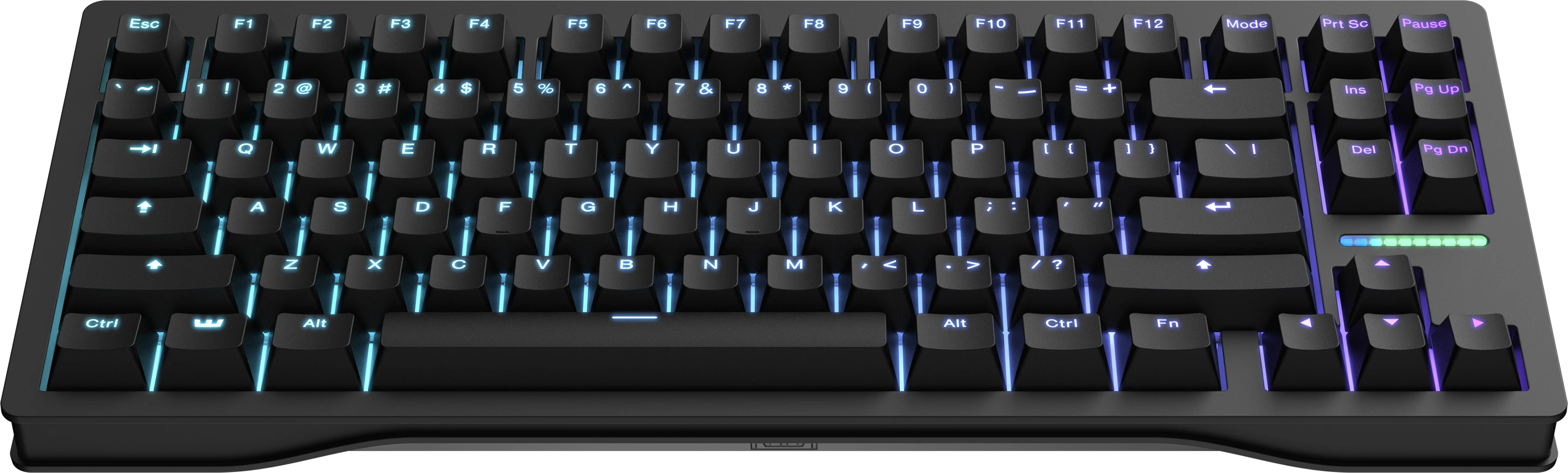
80%, 84 keys
Switch
Lekker V2 Hall Effect linear (L60: 40-60cN, L45: 30-45cN)
Actuation
0.1-4.0mm adjustable, per-key, 0.1mm increments
Polling rate
True 8000Hz (0.125ms), adjustable down to 1000Hz
Pros & Cons
Pros
- Best-in-class Rapid Trigger and analog input — per-key calibration makes aggressive settings reliable where budget boards produce phantom presses
- True 8kHz polling with measured latency in the elite tier, per RTINGS testing
- Wootility is the gold standard for keyboard software: browser-based, cross-platform, deep, and updated frequently
- Hot-swappable Lekker V2 switches with genuine analog output for racing and flight sims
- 4-year warranty, transparent launch-defect handling, and strong community support
- The most-used keyboard among CS2 and Fortnite pros — the ecosystem's default choice
Cons
- Wired-only — no Bluetooth or 2.4GHz option, ruling it out for wireless setups
- Plastic case at $199.99 feels less premium than aluminum rivals at the same price; the zinc case is a pricey add-on
- Typing feel and acoustics divide opinion — some owners find it hollow for daily typing despite excellent gaming performance
- Stock availability has been a recurring issue; restocks sell out fast
- Small but persistent reports of spacebar rattle developing over time
- The 8kHz advantage is marginal below top-tier play and can strain older USB controllers
Overview
The Wooting 80HE is the keyboard that made Hall Effect the default choice for competitive FPS players — and the clearest statement yet of what Wooting does better than anyone else. It takes everything that made the 60HE a phenomenon — Rapid Trigger, adjustable actuation, genuine analog input — and wraps it in an 80% layout with true 8kHz polling and a new anti-sync feature called Rappy Snappy. At $199.99, it sits at the top of the Hall Effect food chain, and two years after launch it remains the board every rival gets compared to.
The 80HE exists because the 60% form factor, for all its esports credibility, left a lot of players out: no F-row, no dedicated arrows, no nav cluster. The 80HE fixes that with an 84-key layout that keeps the function row and arrow keys while staying compact. It was funded to the tune of €7.45 million from 23,355 backers on Kickstarter — a sign of how much demand Wooting had built by 2024 — and has since become the most-used keyboard among Counter-Strike 2 professionals, with prosettings.net showing 27.51% of CS2 pros and 15.41% of Fortnite pros on it as of June 2026.
The short version: if you want the fastest, most customizable Hall Effect experience money can buy and you play on a desk where a wire is a non-issue, the 80HE is the benchmark. The longer version involves some genuine trade-offs — a wired-only design, a plastic case at a premium price, and a typing feel that splits opinion harder than the performance does.
Build Quality and Design
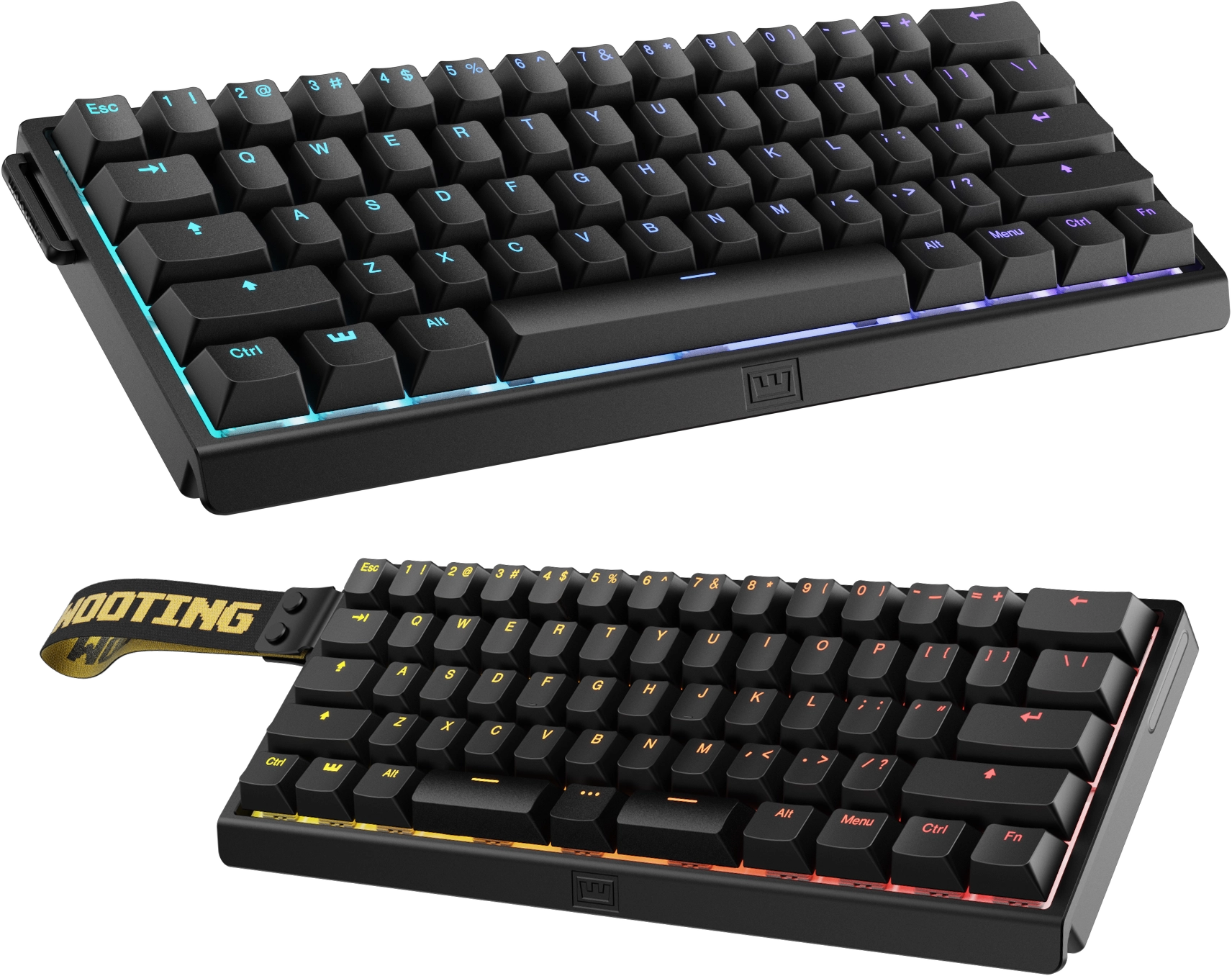
The 80HE is an 84-key, 80%-layout board measuring 346 x 142mm with a 19.4mm front height (28.4mm with keycaps). Two case options exist: a PCR ABS plastic case (65% recycled content) at 790g, and a zinc alloy case at a hefty 2160g. The zinc case is sold separately and can be swapped in later — a modularity play that Wooting owners clearly appreciate, with community feedback consistently noting the plastic case is perfectly fine in daily use and the zinc upgrade is about heft, sound, and stability rather than necessity.
Internally, the board is built to enthusiast standards: a silicone gasket mount, a polycarbonate switch plate tuned for a deeper "thock" profile, screw-in stabilizers that are replaceable with most third-party options, and an EPDM dampening foam layer in the case kit. Interchangeable silicone feet offer 2.8°, 6°, and 10° typing angles. The result, per press reviews and owner feedback, is a board that sounds and feels far more expensive than its plastic shell suggests — the gasket mount and foam do the heavy lifting.
The visual design is understated: per-key RGB plus a ten-square LED bar above the arrows that communicates profile state, Rappy Snappy status, or just adds character. Some community members find the 80% layout's spacing "common" compared to the clean 60HE, and the layout choice itself remains the most divisive thing about the product — a vocal minority argue a 75% with a unified cluster would have been the better use of Wooting's development time. That debate is about taste, not quality; nobody disputes the construction.
One transparency note worth knowing: the 80HE's original launch was delayed roughly six weeks in mid-2024 when a defect appeared in 0.5% of produced units (an ESD issue that could short-circuit the USB IC). Wooting published a detailed post-mortem, fixed the production line process, retested all assembled units, and shipped. It was handled about as well as a launch defect can be, and reliability reports since then are largely clean — though a small number of owners report spacebar rattle developing over time, a common enough Hall Effect board quirk that aftermarket stabilizer swaps are a known fix in the community.
Key Features
- Lekker V2 Hall Effect switches — Gateron-made magnetic switches with per-key calibration, available in L60 (40cN start, 60cN end) or L45 (30cN start, 45cN end) weights. Rated for 100 million presses. Hot-swappable, so switches can be replaced or upgraded without soldering.
- True 8kHz polling — 0.125ms input speed, scanning every key at the same rate, enabled via Tachyon mode in Wootility. Adjustable down to 1kHz for older systems.
- Rapid Trigger — the feature Wooting pioneered, now the industry standard. Keys reset and re-activate the instant you change direction, eliminating the physical reset distance that slows counter-strafing.
- Adjustable actuation — per-key actuation points from 0.1mm to 4.0mm in 0.1mm increments.
- Rappy Snappy — Wooting's latest: bind two keys that can never be active simultaneously; the deeper-pressed key wins. Built for movement games where holding both strafe keys should resolve predictably.
- Snappy Tappy (SOCD) — configurable last-input-wins resolution for simultaneous opposite cardinal directions.
- DKS (Dynamic Keystroke) — map multiple actions to one key: one action on half-press, another on full press, another on release.
- Wootility software — browser-based and desktop, running on Windows, Mac, and Linux. Per-key actuation visualization, real-time settings, and up to four onboard profiles stored on the keyboard itself.
- Analog input / gamepad mode — WASD can output proportional analog values for racing games, flight sims, and any title that reads controller input.
- 4-year warranty (excluding LEDs) plus Wooting's well-regarded support and community-driven firmware updates.
Performance
Performance is where the 80HE makes its case, and the data backs it up. Independent testing from RTINGS puts the 80HE's latency among the best measured on any keyboard, in the same elite tier as the Razer Huntsman V3 Pro 8KHz — with the Wooting offering more hardware customization (hot-swap switches, per-key calibration) than the Razer. The practical difference between 1kHz and 8kHz polling is measured in fractions of a millisecond, and even Wooting's own marketing is honest that the gap is small; but for players who have trained thousands of hours of muscle memory, that margin plus Rapid Trigger's instant reset behavior is the entire point.
The real-world evidence of performance is adoption. According to prosettings.net data from June 2026, the 80HE is the single most-used keyboard in CS2 (27.51% of pros) and Fortnite (15.41%), while the 60HE+ leads Valorant (20.6%) and Rainbow Six Siege (17.71%). No other Hall Effect brand comes close to that footprint — it is the default choice for players whose income depends on input consistency.
Two performance caveats worth flagging. First, 8kHz mode can cause issues on older USB controllers; Wooting documents compatibility clearly and the polling rate is adjustable down to 1kHz, which most owners on recent hardware won't need. Second, community feedback is consistent that the advantage is only meaningful for players already competing at a high level — Reddit discussions regularly note that a casual player will feel no difference between the 80HE and a $60 Hall Effect board, because the gap is in consistency and refinement, not a magic speed switch. Per-key calibration means every key actuates identically, which is what makes Rapid Trigger usable at aggressive settings without phantom inputs — the thing cheaper HE boards get wrong.
Pros and Cons
Pros:
- Best-in-class Rapid Trigger and analog input — per-key calibration makes aggressive settings reliable where budget boards produce phantom presses
- True 8kHz polling with measured latency in the elite tier, per RTINGS testing
- Wootility is the gold standard for keyboard software: browser-based, cross-platform, deep, and updated frequently
- Hot-swappable Lekker V2 switches with genuine analog output for racing and flight sims
- 4-year warranty, transparent launch-defect handling, and strong community support
- The most-used keyboard among CS2 and Fortnite pros — the ecosystem's default choice
Cons:
- Wired-only — no Bluetooth or 2.4GHz option, which rules it out for wireless setups (the Keychron Q1 HE covers that niche)
- Plastic case at $199.99 feels less premium than aluminum rivals at the same price; the zinc case is a pricey add-on
- Typing feel and acoustics divide opinion — some owners find it hollow or pingy for daily typing despite excellent gaming performance
- Stock availability has been a recurring issue; restocks sell out fast
- Small but persistent reports of spacebar rattle developing over time, plus early production units had a (fixed) ESD defect
- The 8kHz advantage is marginal below top-tier play and can strain older USB controllers
Who Should Buy This
Buy the 80HE if you're a competitive FPS player who wants the fastest, most consistent input available — particularly if you play movement-heavy titles like CS2, Valorant, or Fortnite where Rapid Trigger and Rappy Snappy pay off. It's also the right call for analog gaming enthusiasts who want throttle control in racing sims or flight sims without a controller, and for keyboard tinkerers who will actually use Wootility's depth and the hot-swap ecosystem.
Skip it if you need wireless (there's no workaround — the Q1 HE is the serious HE alternative there), if you want a premium aluminum chassis at this price, or if you're a casual player buying on the strength of the esports reputation — community sentiment is honest that the performance gap over a $60–100 HE board only shows up in ranked play.
Alternatives to Consider
- Wooting 60HE+ ($174.99) — the same Wooting tech in a 60% layout with a lower price. Pick this if you don't need the F-row or arrows and want the smaller footprint.
- Razer Huntsman V3 Pro TKL 8KHz ($219.99) — optical analog with onboard actuation adjustment, meaning you can tune it in-game without software. Faster to adjust mid-match, but switches aren't hot-swappable and the software is heavier.
- Keychron Q1 HE (~$199) — wireless (2.4GHz/Bluetooth) Hall Effect with an aluminum case and QMK/VIA support. The best pick if you need wireless or premium materials, though community consensus is its gaming performance and firmware refinement trail the Wooting.
- NuPhy Field75 HE (~$149) — a cheaper 8kHz Hall Effect option with its own rapid trigger implementation, for budget-minded buyers who still want the analog feature set.
Verdict
The Wooting 80HE is the gold standard for Hall Effect keyboards, full stop. It has the fastest measured latency tier, the best-implemented Rapid Trigger, the best software, and the pro adoption numbers to prove the performance is real rather than theoretical. The compromises — wired-only, a plastic case at a premium price, a typing feel that won't please everyone — are the price of a board engineered around a single priority: competitive input speed. For its intended audience, there is nothing better at any price. For everyone else, the alternatives above cover the gaps. If you compete and you can live with a cable, this is the one. Score: 9/10.
What the Experts Say
Professional review consensus for this product
Full Specifications
| Layout | 80%, 84 keys |
|---|---|
| Switch | Lekker V2 Hall Effect linear (L60: 40-60cN, L45: 30-45cN) |
| Actuation | 0.1-4.0mm adjustable, per-key, 0.1mm increments |
| Polling rate | True 8000Hz (0.125ms), adjustable down to 1000Hz |
| Rapid Trigger | Yes, with Rappy Snappy and Snappy Tappy (SOCD) |
| Keycaps | PBT double-shot (OEM profile) |
| Case | PCR ABS (790g) or zinc alloy (2160g), gasket mount, PC plate |
| Dimensions | 346 x 142mm, 19.4mm front height |
| Connectivity | USB-C wired, 2m braided cable |
| Software | Wootility (browser + desktop, Windows/Mac/Linux), 4 onboard profiles |
| Warranty | 4 years (excluding LEDs) |
| Release | July 2024 |
The Verdict: Excellent
The gold standard for Hall Effect keyboards. Fastest latency tier, best Rapid Trigger, best software, and pro adoption numbers that prove the performance. Wired-only and a plastic case at $199.99 are the trade-offs for a board engineered around one priority: competitive input speed. Score: 9/10.
— GamepadSquire, August 2026
As an Amazon Associate we earn from qualifying purchases made through links for Wooting 80HE.
Related Buying Guide
Buying Guide
Best Mechanical Keyboards 2026: The Complete Guide for Every Budget
The 2026 mechanical keyboard market mapped tier by tier: from the $37 Keychron C3 Pro and $42 EPOMAKER HE68 Lite to the Wooting 80HE and NuPhy WH80. RTINGS' top picks synthesized with Reddit community consensus, covering mechanical, Hall Effect, and TMR switches for every budget.
Buying Guide
Best Hall Effect Keyboards 2026: The Definitive All-Tier Roundup
Hall effect keyboards went from a $200 Wooting exclusive to a market that spans $42 to $400. This is the definitive all-tier roundup: the best budget, mid-range, and flagship magnetic boards of 2026, ranked by specs, lab data, pro adoption, and community feedback.