Wooting
Wooting 60HE v2 Review
Excellent
$179.99
The definitive 60% Hall Effect keyboard. True 8kHz polling, best-in-class software, and a friction-fit module that finally makes an analog board feel like a custom build. Wired-only and priced at a premium, but if you play tactical shooters seriously, it is the endgame. 9.2/10.
layout
60%, ANSI standard or split-spacebar
switch
Lekker Tikken Medium (Hall Effect linear, hot-swap, 42gf, 4mm travel)
actuation
0.1-4.0mm per key in 0.1mm steps
polling_rate
True 8000Hz in Tachyon mode (~0.125ms); 1000Hz default
Pros & Cons
Pros
- True 8kHz polling with ~0.125ms input speed in Tachyon mode — among the lowest, most consistent latency measured by RTINGS
- Friction-fit module on a standard GH60 layout: fits most aftermarket 60% cases and hot-swaps a growing list of KS-20 Hall Effect switches (Gateron, Geon, Owlab)
- Wootility remains the gold standard: browser-based, no install, Rapid Trigger, Rappy/Snappy Tappy, DKS, Mod Tap, and analog gamepad mode all explained in-app
- New Lekker Tikken switches cut stem wobble and deliver a deeper, muted sound profile that closes the gap with custom mechanical boards
- Aluminum case option (945g) with swappable bottom dampening (silicone/EPDM/none) and interchangeable strap mounts — real acoustic tuning out of the box
- Split-spacebar variant adds a third programmable key; no other top-tier gaming board offers it
- 4-year warranty, 30-day returns, and direct support; used by 146 pro players per ProSettings (f0rsakeN, Twistzz, Jinggg, device)
Cons
- Wired-only — no Bluetooth or 2.4GHz option at any price
- Premium pricing: $240 for the aluminum build, $180 ABS; the most expensive standard Wooting keyboard to date
- Spacebar noise is the one recurring unit-level gripe: RTINGS measured minor stabilizer rattle, PC Gamer heard a ping on the right-side spacebar, and Reddit threads cover sticky or uneven spacebars
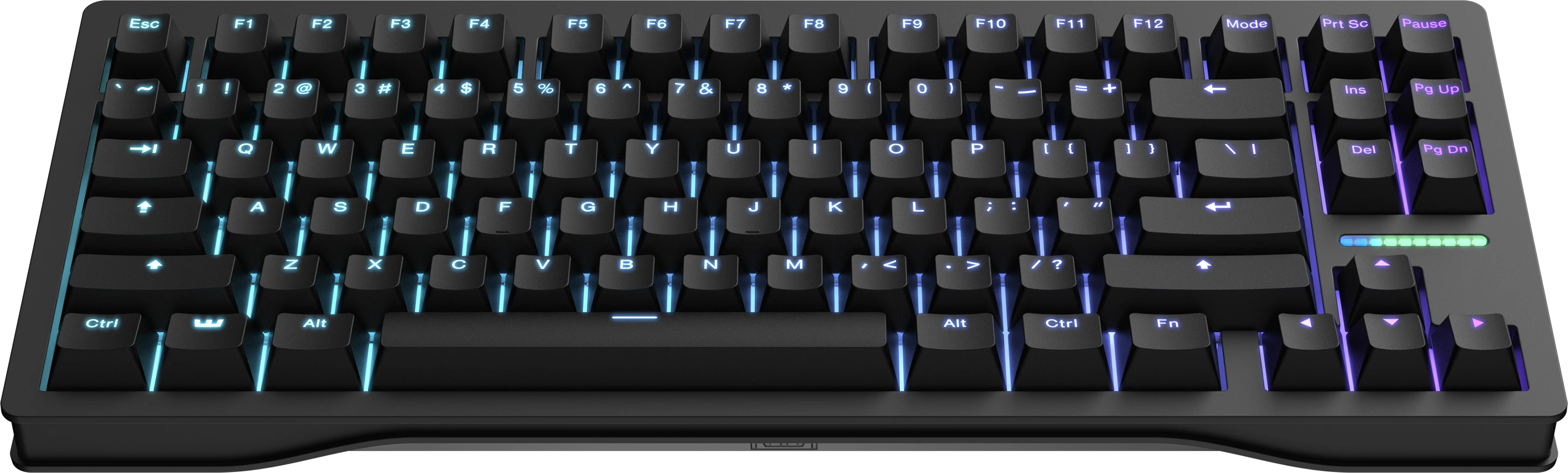
- 60% layout ships without arrow keys or a function row — Mod Tap mitigates it but there is a learning curve
- 8kHz only engages via Tachyon mode, which disables RGB; the gain over 1kHz is marginal below top-tier play
- Snappy Tappy (SOCD) is banned in CS2 and some other titles — needs a separate profile to stay safe
- Restocks sell out fast and it ships from Europe, so availability is inconsistent
Overview
The Wooting 60HE v2 is the third act of the keyboard that made Hall Effect gaming mainstream. The original 60HE, released three years ago, effectively invented the modern competitive keyboard category around analog input and Rapid Trigger. The v2 keeps that identity but rebuilds nearly everything around it: a new Lekker Tikken switch generation, a friction-fit module mount, a real aluminum case option, true 8kHz polling, and Wooting's signature browser-based Wootility software. It is the most complete 60% analog keyboard on the market in 2026, and the press consensus reflects it: WIRED calls it "peak keyboard perfection" (9/10), PC Gamer rates it 93/100 with an Editor's Pick, and ProSettings gives it a perfect 5/5.
This is a review of the Wooting 60HE v2 as a competitive gaming keyboard first and a typing instrument second, which is exactly how Wooting positions it. It sells in three configurations: the pre-built ABS case version at $180, the pre-built aluminum version at $240, and a module-only option at $140 for builders who want to drop the PCB into their own 60% case. The v2 is wired-only, compact, and unapologetically priced at a premium. Whether that premium is worth it depends entirely on how seriously you take the input side of competitive gaming.
Build Quality and Design
The v2's biggest physical upgrade over the original is the case. The original 60HE's plastic shell was its most-cited weakness, hollow, creaky, and acoustically dead. The v2 offers a machined aluminum case (945g fully built) in Black or Bright Silver alongside a refreshed ABS option (606g), and the difference is immediately apparent in the reviews. RTINGS, which bought its own unit, describes the build quality as "remarkably good," with pre-lubed switches and stabilizers from the factory. PC Gamer's Jacob Ridley, who has used every Wooting ever made, calls the v2 "the best keyboard that Wooting has ever made" and notes the aluminum case, FR4 plate, and Poron foam form "a rock-solid foundation."
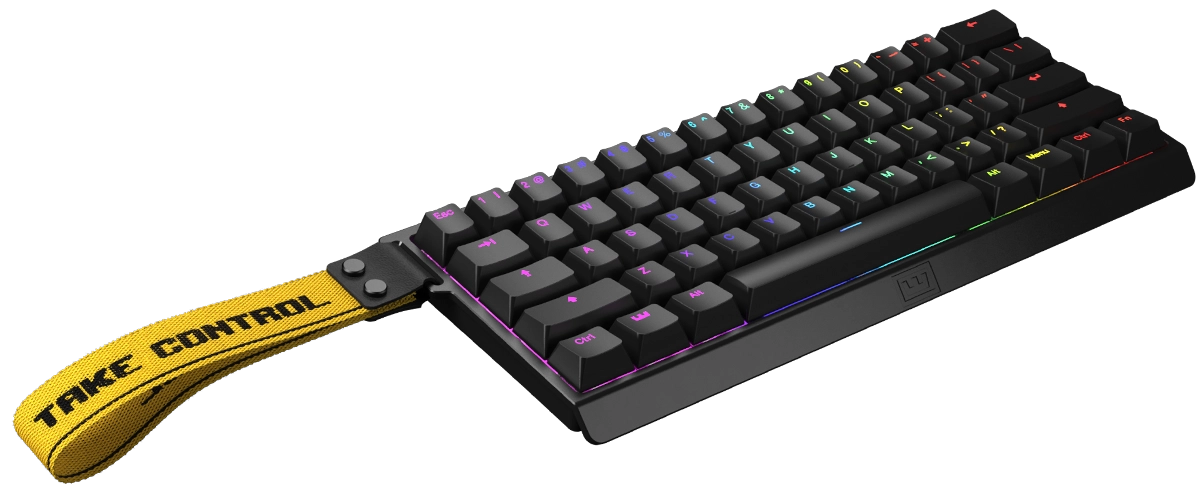
Wooting also overhauled the internal mounting. The v2 uses a friction-fit module: the PCB, plate, and switches drop into the case with a push and hold without a single screw, held by a silicone pad. ProSettings, which reviewed the aluminum split-spacebar edition, initially worried the module would feel loose, then concluded it "doesn't move unless you want to take it out." The design serves two purposes, easy disassembly for modding, and reduced case resonance for a cleaner sound. On the aluminum version, you can also swap bottom-case dampening inserts (silicone block, EPDM foam, or nothing) in about three seconds, and swap between one, two, or zero carrying straps.
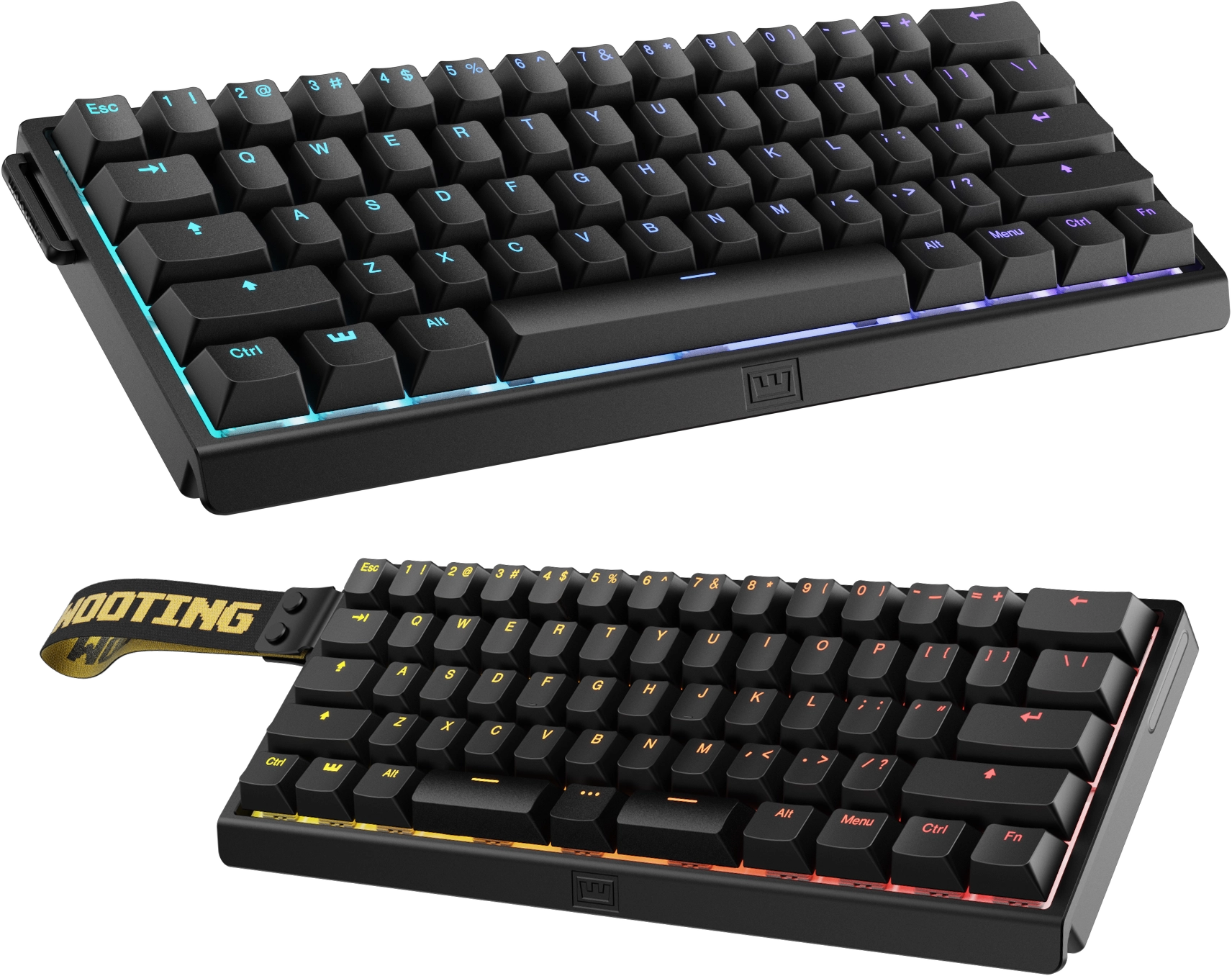
The switches are the new Lekker Tikken Mediums: Hall Effect linear switches with a full 4mm of travel, a closed bottom for a deeper, more muted sound, and noticeably less stem wobble than the previous Lekker generation. PC Gamer, comparing them to the older Lekker L60s, notes the new switches have "significantly less wobble" and far less rattle. The pre-built boards ship with PBT keycaps with clear shine-through legends, which Wooting's own community consistently praises for durability. There's also a split-spacebar variant, a layout option no other top-tier gaming keyboard offers, which replaces the single spacebar with two halves plus a third programmable key in the middle.
Key Features
- True 8kHz polling: The v2 scans every key at up to 8000Hz with an input speed of roughly 0.125ms in Tachyon mode, doubling the original's ceiling. RTINGS verified the 8000Hz polling rate as effective, with "exceptionally low and consistent latency" and near-perfect detection across the keystroke range.
- Rapid Trigger: Wooting's signature feature, keys reset and re-activate the instant your finger reverses direction, eliminating the physical release distance required by mechanical switches. Adjustable per key.
- Adjustable actuation: Set any key's actuation point from 0.1mm to 4.0mm in 0.1mm steps, per key. Combined with Rapid Trigger, this is the foundation of the competitive advantage.
- Analog input: Full per-key analog tracking. In games with controller support, WASD can act as a joystick with variable speed; in racing games you can map throttle, brake, and clutch to actual key depth. WIRED demonstrated this with full manual-transmission play in Forza Horizon 5 and Assetto Corsa.
- SOCD (Snappy Tappy / Rappy Snappy): Simultaneous opposing cardinal direction handling, the key pressed last or deepest wins. This is the counter-strafing advantage in CS2 and Valorant. Note: SOCD is banned in some competitive titles like CS2, and PC Gamer warns it should live on a dedicated profile.
- DKS (Dynamic Keystroke) and Mod Tap: DKS maps up to four actions to one key based on press depth; Mod Tap gives a key a tap action and a hold action. These are what make a 60% layout usable day-to-day, the Mod Tap arrow-key preset on the bottom-right cluster is the most-praised example.
- Gamepad mode and Toggle Key: Controller emulation for analog movement, plus a key that toggles between on/off states (e.g., crouch or walk).
- Wootility: The browser-based configuration tool remains the best keyboard software in the industry, no install, no telemetry, no account, instant profile changes, and four onboard profiles stored on the keyboard itself. digitalchumps calls it "the best keyboard configuration driver I have tested," full stop.
- Modular ecosystem: The PCB is standard GH60/Tofu60 layout, so it fits most aftermarket 60% cases. Switch compatibility now extends beyond Wooting's own line to KS-20 Hall Effect switches from Gateron, Geon, and others, a level of hardware openness no other analog keyboard matches.
Performance
Performance is where the v2 earns its reputation, and the measurements back it up. RTINGS' lab testing found "exceptionally low and consistent latency," with the 8000Hz polling contributing meaningfully to consistency even if the raw difference from 1000Hz is hard to perceive. RTINGS also measured highly accurate input granularity, extremely small dead zones, and near-perfect detection across the entire keystroke range, the combination that makes Wooting's actuation features reliable rather than gimmicky. SurvivalConfigs' counter-strafe benchmark put the v2 inside 4ms of perfect on their strafe test, versus 7ms for a Razer Huntsman V3 Pro Mini and 12ms for a SteelSeries Apex Pro Mini Gen 3.
On the pro scene, the adoption numbers are the strongest endorsement. Wooting is the most-used keyboard brand on ProSettings in Valorant (20.6% of tracked players), Rainbow Six Siege, and Counter-Strike 2, and the v2 specifically is tracked as the board of 146 professional players including f0rsakeN, Twistzz, Jinggg, and device. Reddit owners overwhelmingly report the same story, that in tactical shooters, Rapid Trigger's counter-strafe consistency is immediately noticeable, with one commonly repeated framing being that it's the rare peripheral purchase that "actually improved my performance."
The one performance caveat: 8kHz polling only engages via Tachyon mode, which disables RGB and drops brightness to maximize polling stability. It's a one-click toggle in Wootility, and most owners, PC Gamer's reviewer included, find the keyboard snappy enough at default and leave Tachyon off. There's also the question of whether 8kHz matters below top-tier play; RTINGS notes it has "no noticeable in-game impact" beyond consistency. For everyone but the most latency-sensitive players, the bigger wins come from Rapid Trigger and actuation tuning, which work at any polling rate.
Pros and Cons
Pros:
- True 8kHz polling with ~0.125ms input speed, among the lowest, most consistent latency measured by RTINGS
- Friction-fit module on a standard GH60 layout: fits most aftermarket 60% cases and hot-swaps a growing list of KS-20 Hall Effect switches
- Wootility remains the gold standard: browser-based, no install, every feature clearly explained
- Lekker Tikken switches cut stem wobble and deliver a deeper, muted sound that closes the gap with custom mechanical boards
- Aluminum case with swappable bottom dampening and strap mounts, genuine acoustic tuning out of the box
- Split-spacebar variant adds a third programmable key; no other top-tier board offers it
- 4-year warranty, 30-day returns, direct support, and a community that's unusually loyal
Cons:
- Wired-only, no Bluetooth or 2.4GHz option at any price
- Premium pricing: $240 for aluminum, $180 for ABS; the most expensive standard Wooting keyboard to date
- Spacebar noise is the one recurring unit-level gripe: RTINGS measured minor stabilizer rattle, PC Gamer heard a ping on larger keys (mostly the right-side spacebar), and Reddit threads cover sticky or uneven spacebars on some units
- 60% layout ships without arrow keys or a function row, Mod Tap mitigates it, but there is a real learning curve
- 8kHz only engages in Tachyon mode, which disables RGB; the gain over 1kHz is marginal below top-tier play
- Snappy Tappy (SOCD) is banned in CS2 and some other titles, needs a separate profile to stay safe
- Restocks sell out fast and it ships from Europe, so availability is inconsistent
Who Should Buy This
Buy the Wooting 60HE v2 if you play tactical shooters seriously, CS2, Valorant, Rainbow Six Siege, or any movement-heavy FPS where counter-strafing decides fights. This is the keyboard where Rapid Trigger, adjustable actuation, and SOCD stop being marketing terms and become measurable input advantages. It's also the right board if you want a compact 60% that's genuinely easy to live with: the Mod Tap arrow-key layer and four-profile Wootility setup solve most of the layout pain, and PC Gamer, a self-described full-size keyboard person, admits he stopped minding the size entirely.
Buy it too if you're a keyboard hobbyist who wants analog performance without giving up modding. The friction-fit module, GH60-compatible PCB, aftermarket case support, and KS-20 switch compatibility make it the only Hall Effect board that feels like a custom keyboard ecosystem, and the module-only option at $140 is a legitimate entry point for builders.
Skip it if you need wireless, there is no wireless version, period. Skip it if you need dedicated arrow keys, a function row, or a numpad for work; the 60% layout is a genuine trade-off no amount of software fully erases for spreadsheet-heavy work. And if you're a casual player who just wants the speed features without the premium, the sub-$100 Hall Effect market (MonsGeek FUN60 Ultra and similar) delivers most of Rapid Trigger's benefit, SurvivalConfigs and RTINGS both make the same point: the v2's value is in the complete package, not any single feature.
Alternatives to Consider
- Wooting 60HE+ (v1, ~$155): The previous generation still gets Rapid Trigger, adjustable actuation, and the same software, for $85 less than the aluminum v2. You give up 8kHz polling, the aluminum case, the friction-fit mount, and the acoustic tuning, but if you only care about the input features, it remains an outstanding value, and Wooting still supports it with firmware updates.
- Wooting 80HE (~$200): The same performance in a TKL form factor with arrow keys, navigation keys, and a function row. PC Gamer's own best-of list ranks the 80HE as the best Hall Effect keyboard overall, and Reddit's standard advice is: FPS-only players take the 60HE v2, everyone else takes the 80HE.
- Razer Huntsman V3 Pro Mini (~$180): Razer's analog optical 60% is the closest direct rival, similar latency tier, adjustable actuation, and Rapid Trigger. But RTINGS found the Wooting delivers slightly better latency, supports 8kHz, and is hot-swappable while the Razer's switches are soldered. Reddit owners also consistently prefer Wootility to Synapse.
- Keychron Q5 HE (
$230) or Keychron K2 HE ($111): Q5 HE is a strong typing-first Hall Effect board with a CNC case; the K2 HE is the budget wireless HE pick. Neither matches Wooting's software depth or analog feature set, and the K2 HE's Rapid Trigger implementation is less mature per RTINGS. - NuPhy Air60 HE (~$110): A low-profile budget alternative that PC Gamer lists as the best budget HE option, you get Rapid Trigger and adjustable actuation in a lighter, cheaper, low-profile package, minus the analog input, software depth, and build quality.
Verdict
The Wooting 60HE v2 is the most complete Hall Effect keyboard you can buy in 2026. It takes everything that made the 60HE legendary, Rapid Trigger, adjustable actuation, analog input, and the industry's best software, and fixes the original's real weaknesses: the hollow plastic case is gone, the switches are smoother and quieter, and the polling rate doubles to a true 8kHz. RTINGS rates it an outstanding gaming keyboard with essentially one measurable nit (minor stabilizer rattle on larger keys), and the press scores are near-unanimous: WIRED 9/10, PC Gamer 93/100 Editor's Pick, ProSettings 5/5, SurvivalConfigs 9.4/10.
The trade-offs are real and should be weighed honestly. It's wired-only, it's expensive (especially the aluminum build at $240), and the 60% layout demands a learning period. The spacebar noise complaints, rattle on some units, a ping on larger keys, are the one consistency issue that recurs across RTINGS measurements, PC Gamer's review, and Reddit threads, though it's minor and doesn't affect function. If you're a competitive FPS player, none of that changes the calculation: this is the keyboard the pros actually use, with the software and support that make the features usable. If you're not, the budget Hall Effect field has caught up enough that you don't need to pay the premium.
Score: 9.2/10, Excellent. The definitive 60% Hall Effect keyboard, and the competitive endgame for players who take input speed seriously.
What the Experts Say
Professional review consensus for this product
Full Specifications
| layout | 60%, ANSI standard or split-spacebar |
|---|---|
| switch | Lekker Tikken Medium (Hall Effect linear, hot-swap, 42gf, 4mm travel) |
| actuation | 0.1-4.0mm per key in 0.1mm steps |
| polling_rate | True 8000Hz in Tachyon mode (~0.125ms); 1000Hz default |
| features | Rapid Trigger, Rappy Snappy, Snappy Tappy (SOCD), DKS, Mod Tap, analog gamepad mode, Toggle Key, remap + layers |
| case | ABS (606g) or aluminum (945g) |
| plate | FR4 |
| mounting | Friction-fit module, HD Poron sandwich + PET film |
| dampening | Silicone block, EPDM foam, or none (aluminum case) |
| keycaps | PBT double-shot shine-through (prebuilt); ABS option |
| connectivity | Wired USB-C, 2m braided cable, USB-C to USB-A adapter |
| dimensions | 305 x 115mm, 28.6mm front height |
| software | Wootility (browser or desktop), 4 onboard profiles |
| compatibility | GH60/Tofu60 aftermarket cases; KS-20 switches (Gateron, Geon, Owlab Ti HE) |
| warranty | 4 years excluding LEDs |
| release | December 2025 (Founders campaign Nov 2025) |
The Verdict: Excellent
The definitive 60% Hall Effect keyboard. True 8kHz polling, best-in-class software, and a friction-fit module that finally makes an analog board feel like a custom build. Wired-only and priced at a premium, but if you play tactical shooters seriously, it is the endgame. 9.2/10.
— GamepadSquire, August 2026
Related Buying Guide
Buying Guide
Best Mechanical Keyboards 2026: The Complete Guide for Every Budget
The 2026 mechanical keyboard market mapped tier by tier: from the $37 Keychron C3 Pro and $42 EPOMAKER HE68 Lite to the Wooting 80HE and NuPhy WH80. RTINGS' top picks synthesized with Reddit community consensus, covering mechanical, Hall Effect, and TMR switches for every budget.
Buying Guide
Best Hall Effect Keyboards 2026: The Definitive All-Tier Roundup
Hall effect keyboards went from a $200 Wooting exclusive to a market that spans $42 to $400. This is the definitive all-tier roundup: the best budget, mid-range, and flagship magnetic boards of 2026, ranked by specs, lab data, pro adoption, and community feedback.