MonsGeek
MonsGeek FUN60 Ultra TMR Review
Good
$76.00
Best-value rapid-trigger keyboard: flagship latency and 8K polling, aluminum build, and unique MagMech switch mixing for under $100.
As an Amazon Associate we earn from qualifying purchases made through links for MonsGeek FUN60 Ultra TMR.
layout
60% (60 keys, US ANSI)
connectivity
Tri-mode: USB-C, 2.4GHz, Bluetooth 5.0
switch_type
TMR magnetic (Akko Glare)
polling_rate
8,000Hz (wired + 2.4GHz)
Pros & Cons
Pros
- Elite-level latency and 8K polling at a budget price
- CNC aluminum case with outstanding rigidity
- MagMech: mix magnetic and 5-pin mechanical switches on one PCB
- 0.01mm rapid trigger with per-key actuation tuning
- 8K polling over 2.4GHz wireless
- Quiet, thocky acoustics from pre-lubed Akko Glare switches
Cons
- Mode switch hidden under the Caps Lock keycap
- Battery drains fast at 8K wireless with RGB (~3 hrs)
- Desktop driver can hang over 2.4GHz
- No adjustable typing angle
- Tray-mount feel is stiff
Overview
The MonsGeek FUN60 Ultra TMR is a 60% compact gaming keyboard built around tunnel magnetoresistance (TMR) magnetic switches — the same sensing tech that has been quietly taking over high-end controllers and joysticks, now applied to a keyboard that costs roughly half of what the Wooting-class flagships demand. It''s the board that put MonsGeek on the competitive gaming map: an all-aluminum case, 8,000Hz polling in both wired and 2.4GHz wireless modes, per-key actuation tuning down to 0.01mm steps, and rapid trigger — all for under $100.
The pitch is simple: most rapid-trigger keyboards with this feature set cost $150 to $200 or more. The FUN60 Ultra TMR undercuts them while adding something almost none of them have — the ability to run magnetic and conventional 5-pin mechanical switches on the same board, in any mix you like. MonsGeek calls it "MagMech," and it''s the headline feature that separates this from every Hall-effect rival in its price band.
It earned a spot on IGN''s best gaming keyboards lists and a PC-WELT award in late 2025, but it''s not without friction. Press reviews are glowing on performance and build; owner sentiment is more complicated. Amazon reviewers average a lukewarm 3.8 to 3.9 stars across the two main listings, with battery life, the hidden mode switch, and driver quirks doing most of the damage. For anyone shopping a rapid-trigger board on a budget, this is the benchmark to beat — with the caveats spelled out below.
Build Quality and Design
The FUN60 Ultra TMR''s first impression is weight. At roughly 1,023 grams (about 2.4 lbs) for a 60-key board, it''s one of the heaviest compact keyboards you''ll find at any price, let alone under $100. That mass comes from a CNC-machined aluminum case backed by a steel base plate, and it translates directly into rigidity: the frame is torsion-resistant, doesn''t flex during intense sessions, and sits on the desk as if anchored. Reddit owners consistently describe the build as "solid as a rock," and multiple reviewers note the construction quality rivals boards costing twice as much. The trade-off is that this is not a keyboard you''ll happily toss in a backpack — it''s a desktop fixture.
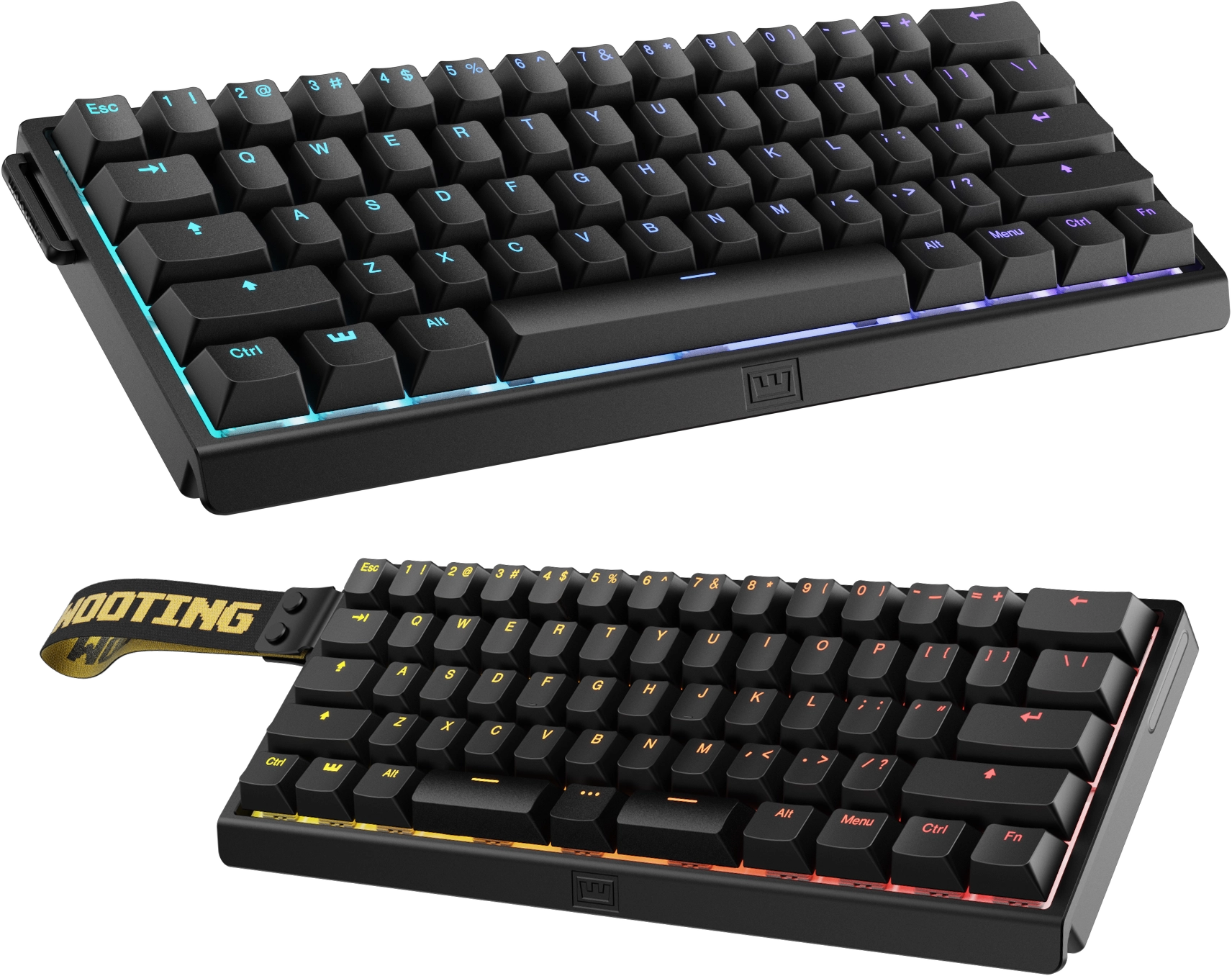
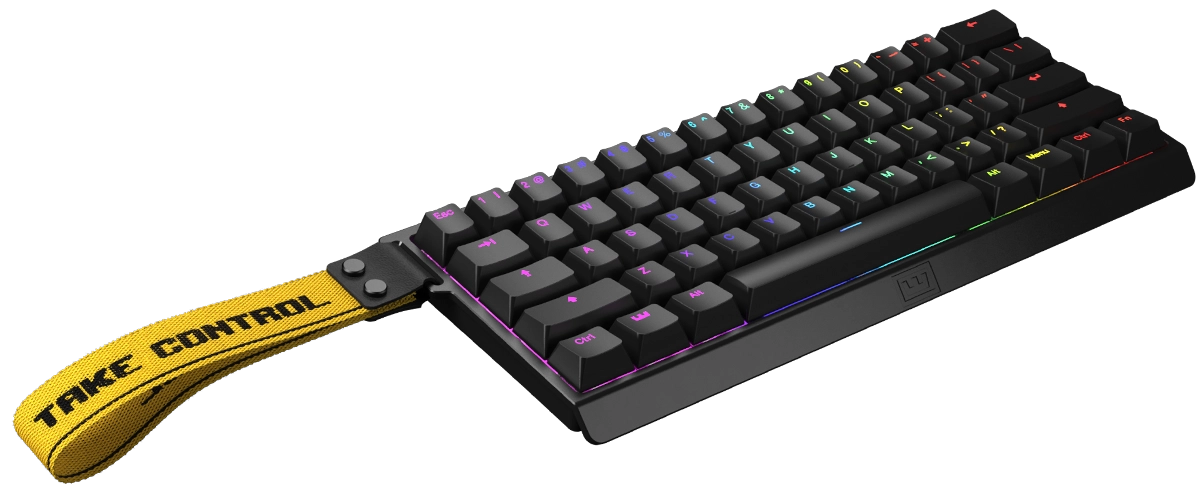
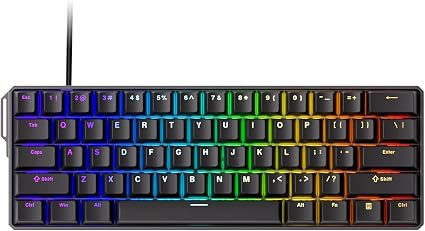
The layout is a pure 60%: 60 keys, US ANSI, no function row, no arrows, no navigation cluster, no numpad. Everything lives behind Fn layers. The case is a minimalist slab with a single USB-C port on the rear-left and an eyelet on the upper-left for an optional carrying strap — a mostly decorative touch that reviewers frequently call out as odd. The fixed typing angle sits around six to seven degrees, which most testers found comfortable, but there are no adjustable feet at all. Combined with the tray-mount construction (the PCB is screwed directly into the case), the typing feel is firm and direct — "stiff" is the word RTINGS uses — with noticeably less give than gasket-mounted boards. Fans of soft, bouncy flex need to look elsewhere; players who want every keypress to feel locked-in will appreciate it.
There''s one design decision that every single reviewer flags: the three-position connectivity switch (Mac / USB / Windows) lives underneath the Caps Lock keycap. Switching between wired and wireless means pulling the keycap off with the included tool every time. It''s the board''s most persistent annoyance, made worse by the switch being unlabeled and oriented differently than the manual illustrations. RTINGS, TechRadar, PCWorld, Notebookcheck, and Niche Gamer all independently singled this out — it''s the rare complaint that crosses every publication.
The keycaps are double-shot shine-through PBT in a Cherry profile with a slight grit that resists fingerprints. They show off the north-facing ARGB well, and the RGB itself is genuinely bright and smooth — 500Hz refresh, individually controlled LEDs, per-key effects. One long-term note from PCWorld''s testing: the heavily-used WASD caps tended to develop a shiny surface over months of play. It''s cosmetic, and standard layout means replacements are everywhere.
Key Features
TMR sensors with MagMech switch compatibility. This is the differentiator. The TMR (tunnel magnetoresistance) PCB senses switch position with finer resolution and lower power draw than Hall-effect sensors, and — uniquely for a magnetic board in this price range — it accepts both magnetic switches and standard 5-pin mechanical switches on the same hot-swap PCB. You can run magnetic switches on WASD and your favorite tactile mechanicals everywhere else, or go all-in on one type. The driver calibrates per-key after swaps. Compatible magnetic switches include Akko Glare (stock), Gateron Jade/Jade Pro/Jade Gaming, Uranus, and TTC King, with a caveat: switches with downward S-pole magnets (like Akko''s Creamy Yellow) aren''t compatible due to the N-pole design.
0.01mm rapid trigger with adjustable actuation. Actuation points are tunable from 0.1mm to 3.4mm in 0.01mm increments, and rapid trigger re-fires on as little as 0.01mm of key travel without requiring a full release. A "Turbo Mode" applies aggressive rapid-trigger settings to specific keys (WASD being the obvious target) with a visual indicator in the driver.
8,000Hz polling — wired and 2.4GHz wireless. The polling rate is the same 8K in USB-C and 2.4GHz modes, which is rare at this price; Bluetooth drops to standard rates. IGN''s testing measured roughly 0.6ms latency wired and 1.1ms over 2.4GHz, while RTINGS'' lab testing recorded about 0.5ms single-key and 0.7ms multi-key latency — statistically indistinguishable from far pricier flagships.
4,000mAh battery. The tri-mode version packs a 4,000mAh cell. The catch: at 8K wireless with RGB on, it drains fast — Notebookcheck measured around 3 hours, PCWorld "a few hours," and Niche Gamer 2-3 hours on 2.4GHz with lighting. With RGB off, IGN reported up to 200 hours of battery life, and Bluetooth mode stretches it to days. Realistically: wireless gaming at max performance means daily charging.
Snap Key, DKS, Mod-Tap, Toggle Key. The software suite includes Snap Key (MonsGeek''s SOCD implementation for counter-strafing in FPS titles — worth noting SOCD inputs are banned in some competitive games like Counter-Strike 2), Dynamic Keystrokes (multiple actions per key based on press depth), Mod-Tap, and Toggle Key.
Web-based and desktop drivers. Configuration runs through the MonsGeek V4 driver, available as a browser client (Chromium-based browsers required) or a downloadable desktop app, with on-board memory for saved profiles.
RT Stabilizer mode. A filtering option designed to prevent unintended inputs from hand tremors when rapid trigger is set to the aggressive 0.01mm precision — a thoughtful addition for the hyper-sensitive settings the board encourages.
Performance
The performance story is the reason this board exists, and it delivers. RTINGS'' testing puts the FUN60 Ultra TMR''s raw latency among the best they''ve measured: roughly 0.5ms single-key and 0.7ms multi-key, with a 4-chord split delay around 6ms at 4K polling (12ms at 8K). For context, that''s right on top of the Wooting 60HE (about 0.4ms/0.5ms) — a board that costs $100 more and isn''t wireless. Reddit users who dug into the RTINGS numbers reached the same conclusion: the FUN60 trades a hair of multi-key latency to the Wooting but matches or beats it on dead zones and input granularity, and it does it wirelessly.
In practice, reviewers across the board describe the same experience: rapid trigger on WASD makes counter-strafing and movement jitter in Valorant, CS2, and Fortnite feel dramatically more responsive, and the 8K polling keeps wireless play indistinguishable from wired. HLPlanet tested it in CS2 and The Finals and called wired performance on par with the Wooting 60HE. TechRadar noted it couldn''t perceive a difference between the TMR switches and Hall-effect rivals in blind feel — high praise phrased as a caveat — while praising the snappy, satisfying key response.
The stock Akko Glare switches are pre-lubed linear magnetic switches with 3.4mm total travel and a 40±5gf actuation force at 2.0mm. They''re smooth out of the box, and the closed-bottom design plus internal case dampening produces a deep, muffled "thock" that''s remarkably quiet for an aluminum board — PCWorld called the acoustics genuinely surprising for the price. The one consistent negative: some Reddit users describe the stock Glare switches as slightly wobbly and "cheap-feeling" compared to premium mechanicals, and the stabilizers, while lubed, can use an extra pass of lube for the spacebar. These are fixable complaints on a hot-swap board, but worth knowing going in.
Multi-key performance is the one measurable weak spot versus the elite tier. RTINGS recorded a slightly underwhelming chord split, and Reddit''s rhythm-game crowd (osu players especially) note the FUN60 trails boards like the MCHOSE Ace 60 Pro on multi-key input timing. For FPS play it''s a non-issue; for rhythm games and rapid chording it''s a real, if small, gap.
Battery is the other performance asterisk. The 4,000mAh cell is generous on paper, but 8K wireless with RGB eats it in a couple of hours — several reviewers describe the board becoming "a wired keyboard with extra steps" during testing. The workaround is obvious (drop to Bluetooth for general use, plug in for ranked sessions, or turn RGB off for a claimed 200 hours), but it''s a compromise that simply doesn''t exist on wired competitors.
Pros and Cons
Pros:
- Elite-level latency and 8K polling at roughly half the price of flagship rivals — RTINGS-measured 0.5ms single-key response that matches boards costing $100+ more
- Outstanding build: CNC aluminum case and steel base plate make it one of the most rigid 60% boards available at any price
- MagMech compatibility is unique in the price band — mix magnetic and 5-pin mechanical switches on the same PCB, with per-key calibration
- 0.01mm rapid trigger and per-key actuation tuning from 0.1mm to 3.4mm, plus Snap Key (SOCD), DKS, and Mod-Tap
- True wireless flexibility: 8K polling over 2.4GHz, tri-device Bluetooth 5.0, USB-C — rare for a high-performance magnetic board
- Surprisingly quiet, thocky acoustics thanks to case dampening and closed-bottom pre-lubed switches
- Web-based driver works on Chromium browsers with no install hassles, and firmware updates have steadily improved the software
Cons:
- The connectivity/OS switch under the Caps Lock keycap is a genuine design misstep — every major review flags it
- Battery life at 8K wireless with RGB is poor (roughly 3 hours per Notebookcheck; 2-3 hours per Niche Gamer), forcing daily charging for wireless gamers
- Desktop driver can hang or fail to initialize over 2.4GHz (Notebookcheck, Niche Gamer); the interface has a real learning curve
- No adjustable feet — fixed ~6-7° tilt only
- Tray-mount construction feels stiff compared to gasket-mounted competitors
- Stock switches are smooth but some owners find them wobbly; WASD keycaps can develop shine over time
- Multi-key (chord) latency trails the very top tier — relevant mainly for rhythm games
Who Should Buy This
The FUN60 Ultra TMR is for competitive FPS players who want rapid trigger, per-key actuation, and 8K polling without paying Wooting money. If you play Valorant, CS2, Fortnite, or Apex and want the movement-tech advantages of magnetic switches — counter-strafing with Snap Key, jitter-free strafe tapping — this delivers 90% of the flagship experience for half the price. It''s also a strong pick for keyboard enthusiasts who want the flexibility of MagMech: drop magnetic switches on your gaming keys and keep mechanicals everywhere else, then recalibrate in the driver.
Skip it if you need arrows, a function row, or a numpad — the 60% layout demands Fn layers and sacrifices keys like Delete and tilde outright (IGN''s reviewer couldn''t even map a usable arrow cluster). Skip it if you need a wireless board that lasts a work week on a charge: at maximum wireless performance this is a daily-charge board. And skip it if you want a soft, bouncy typing feel — the tray mount is deliberately firm. For office use it works, but you''ll be living with layers and a keycap-pull to switch modes.
Alternatives to Consider
Wooting 60HE / 80HE (~$175-200). The benchmark. Better build refinement, a friction-fit GH60-compatible mounting system, true analog output for driving games, and the industry''s best software with a proven update track record — plus a 4-year warranty versus MonsGeek''s 1-year. But it''s wired-only, roughly twice the price, and RTINGS measured the FUN60 within a whisker on raw latency. Choose Wooting for polish and analog output; choose MonsGeek for wireless and value.
MCHOSE Ace 60 Pro (~$60-70). A cheaper 60% Hall-effect alternative that Reddit''s rhythm-game crowd actually prefers for osu-style rapid tapping thanks to a faster actuation point. The MonsGeek wins on build quality and premium feel; the MCHOSE wins on price and multi-key timing. If you play mostly rhythm games, this is worth a look.
MonsGeek M1 V5 TMR (~$90-110). The same TMR platform in a 75% layout with arrow keys, a knob, a 32K device-side scan rate, and better battery life — the natural upgrade for anyone who wants the MagMech flexibility but can''t live with 60% compromises. It''s a small step up in price for a substantially more usable layout.
Keychron K2 HE / K4 HE (~$110-135). Keychron''s TMR boards offer a more mainstream 75%/96% experience with excellent wireless battery life and a more mature driver. They''re pricier, and unlike the FUN60 they only support magnetic switches — no MagMech mixing. Better daily drivers, less pure gaming value.
Verdict
The MonsGeek FUN60 Ultra TMR is the best value in rapid-trigger keyboards right now. It delivers flagship-level latency and polling, a genuinely premium aluminum build, and the category''s most flexible switch ecosystem — MagMech compatibility is something you simply cannot get from Wooting, Keychron, or Razer at any price, let alone for under $100. RTINGS rates it "excellent," IGN gave it a Great verdict, and TechRadar''s 4/5 review sums up the consensus: an analog keyboard that''s "all the more impressive given its low price."
But the asterisks are real, and they''re the reason the Amazon star rating hovers around 3.8-3.9 while the press score is far higher. The hidden mode switch is a daily annoyance. Wireless gaming battery life at 8K is genuinely poor. The software, while much improved since launch, still has rough edges on 2.4GHz. None of these stop the board from being exceptional at what it''s built for — competitive gaming with maximum responsiveness — and the wired version sidesteps half the complaints entirely. Buy it for FPS performance and the MagMech flexibility, plug it in for ranked play, and you''ve spent a third of a Wooting for near-Wooting results.
Score: 8.3/10 — excellent value and elite raw performance for competitive FPS players; the battery, mode switch, and software quirks keep it just short of a true flagship score.
What the Experts Say
Professional review consensus for this product
Full Specifications
| layout | 60% (60 keys, US ANSI) |
|---|---|
| connectivity | Tri-mode: USB-C, 2.4GHz, Bluetooth 5.0 |
| switch_type | TMR magnetic (Akko Glare) |
| polling_rate | 8,000Hz (wired + 2.4GHz) |
| rapid_trigger | 0.01mm |
| actuation | 0.1-3.4mm in 0.01mm steps |
| battery | 4,000mAh |
| weight | ~1,023g |
| case | CNC aluminum + steel base plate |
| hot_swap | MagMech (magnetic + 5-pin mechanical) |
| keycaps | Shine-through PBT, Cherry profile |
| software | Web-based + desktop driver |
The Verdict: Good
Best-value rapid-trigger keyboard: flagship latency and 8K polling, aluminum build, and unique MagMech switch mixing for under $100.
— GamepadSquire, August 2026
As an Amazon Associate we earn from qualifying purchases made through links for MonsGeek FUN60 Ultra TMR.
Related Buying Guide
Buying Guide
Best Mechanical Keyboards 2026: The Complete Guide for Every Budget
The 2026 mechanical keyboard market mapped tier by tier: from the $37 Keychron C3 Pro and $42 EPOMAKER HE68 Lite to the Wooting 80HE and NuPhy WH80. RTINGS' top picks synthesized with Reddit community consensus, covering mechanical, Hall Effect, and TMR switches for every budget.
Buying Guide
Best Hall Effect Keyboards 2026: The Definitive All-Tier Roundup
Hall effect keyboards went from a $200 Wooting exclusive to a market that spans $42 to $400. This is the definitive all-tier roundup: the best budget, mid-range, and flagship magnetic boards of 2026, ranked by specs, lab data, pro adoption, and community feedback.