Logitech
Logitech G Pro X TKL Rapid Review
Excellent
$189.99
Logitech's first Hall effect keyboard delivers real competitive advantages — 0.1mm actuation, Rapid Trigger, SOCD, and top-tier measured latency — in a sturdy wired TKL with the most approachable software in the category. The 1000Hz ceiling, loud typing, and wired-only design are the honest trade-offs at $189.99. Recommended for competitive FPS players. 8.5/10.
As an Amazon Associate we earn from qualifying purchases made through links for Logitech G Pro X TKL Rapid.
Switch
Logitech magnetic analog (Hall effect), linear, 35g actuation
Actuation
0.1-4.0mm per-key adjustable (0.1mm steps)
Rapid Trigger
Adjustable reset 0.1-2.0mm
Polling rate
1000Hz (wired)
Pros & Cons
Pros
- Outstanding measured latency — RTINGS confirms top-tier single-key and multi-key performance at the full 1000Hz polling rate
- Deep, genuinely useful analog feature set: 0.1mm actuation, Rapid Trigger with adjustable reset, SOCD Key Priority, and two-stage Multi-Point Actuation
- G Hub is the most approachable software in the magnetic-switch category — Reddit owners repeatedly cite it as the reason they chose this over QMK/VIA boards
- Sturdy aluminum-plate chassis with serious dampening; double-shot PBT keycaps with bright per-key RGB
- Volume roller, dedicated media keys, and a configurable Game Mode button — quality-of-life touches competitive rivals omit
- Under $200 with big-brand warranty and support; has been discounted as low as $99.99
Cons
- Wired-only with no wireless option at all — a deliberate trade, but one that makes the $189.99 MSRP harder to justify for some buyers
- 1000Hz polling ceiling; no 8000Hz mode when same-price rivals (Wooting 80HE, Razer Huntsman V3 Pro) offer it
- Measured actuation chatter at the lowest travel settings, plus occasional owner reports of double presses
- Loud for a linear board, with minor key wobble and stabilizer rattle — not a quiet option for shared spaces
- Rapid Trigger, SOCD, and Multi-Point can't run at the same time
- No wrist rest or carrying case in the box; the ultralight 35g switches take getting used to for typing
Logitech G Pro X TKL Rapid Review: Big-Brand Hall Effect, Done Right
Overview
The Logitech G Pro X TKL Rapid is the company's first keyboard built around magnetic analog switches — the same Hall effect technology that Wooting, Razer, and SteelSeries have spent the last few years turning into the default choice for competitive FPS play. Where Logitech's previous Pro X TKL stuck with conventional mechanical switches and wireless connectivity, the Rapid trades both away for a strictly wired board that leans entirely into speed: adjustable actuation down to 0.1mm, Rapid Trigger, per-key reset tuning, and SOCD-style Key Priority. It launched at $169.99 in early 2025 and now sits at a $189.99 MSRP, with frequent street discounts (the board has been spotted as low as $99.99 during deal cycles).
The pitch is simple: Logitech took the esports-credential chassis of the Pro X TKL, dropped in magnetic switches, and aimed squarely at players who want Wooting-class performance from a brand with retail presence, a mature software suite, and warranty support in every major market. It's a pitch that landed — IGN gave it a 9/10 Editors' Choice, Trusted Reviews handed over a 4.5/5 Recommended badge, and PCMag rated it 4.0/5 Excellent. Owner sentiment on Amazon holds at 4.7 stars across the colorways, and Reddit aggregates around 74% positive across the threads that mention it.
This is a keyboard that rewards configuration. Out of the box it's good; dialed in, it's genuinely excellent — but that setup requirement, plus a few build compromises, are exactly the things worth knowing before you buy.
Build Quality and Design
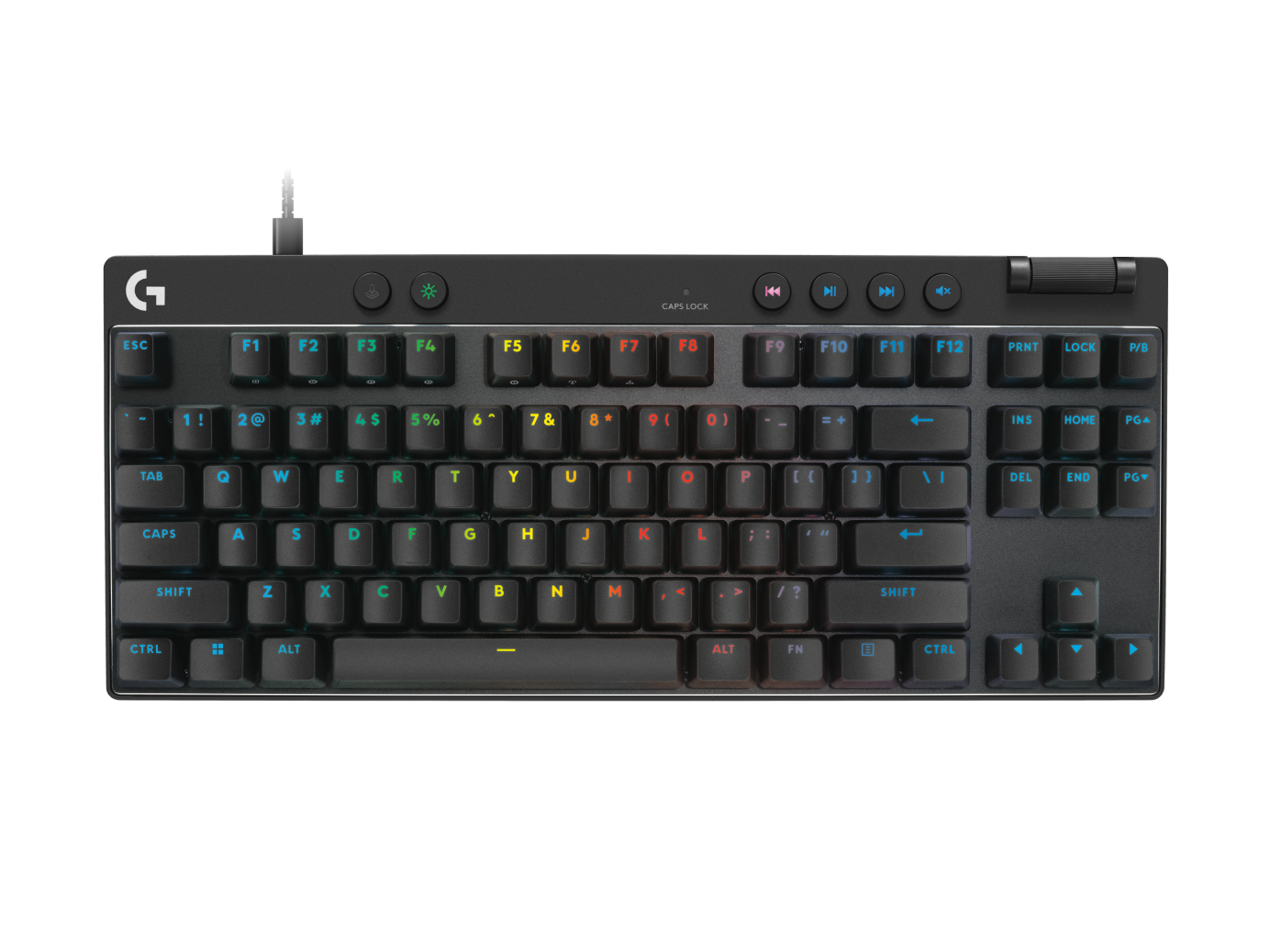
The Rapid inherits the Pro X TKL's clean, understated design language: a thin-bezel TKL rectangle with an aluminum top plate, recycled ABS frame, and a minimalist aesthetic that's all business. It comes in Black, White, and Pink colorways. At 357 x 150 x 38mm and 1.01kg, it's dense for a tenkeyless board — that heft comes from the metal plate and the dampening layers underneath, which include factory-lubricated switches, polyurethane foam inserts under the spacebar, and stabilizer bottom foam. The result is a chassis that doesn't flex and doesn't creak, and reviewers consistently describe the frame as sturdy. PCMag specifically noted you won't get the chattering-key feel of earlier Logitech boards like the Pro X 60.
The texture story is mixed. The stock keycaps are double-shot PBT with shine-through legends for the RGB — an upgrade over the ABS you find on most gaming boards at this price, and a detail Trusted Reviews called out as resistant to the greasy shine ABS develops over time. The RGB itself is per-key LIGHTSYNC, bright and clear through the translucent legends, which RTINGS rated among the strengths of the board.
The top edge carries a volume roller and dedicated media keys, plus a Game Mode button that disables the Windows and menu keys with a configurable allowlist. It's a small thing, but the volume roller is one of those quality-of-life details that competitive boards like the Wooting 80HE omit — and owners consistently mention it as a reason to pick the Logitech.
The compromises are real, though. There's no wrist rest in the box and no carrying case, which PCMag flagged as odd omissions at this price. RTINGS measured minor key wobble and stabilizer rattle, and multiple owner reviews describe the board as noticeably loud for a linear keyboard — more on that below. The USB-C port sits on the back with a detachable cable, and at least one owner raised a concern about the port's robustness, noting the included cable feels fragile compared to most. The board is also wired-only by design: no Bluetooth, no LIGHTSPEED receiver, no multi-device pairing. That's a deliberate trade to keep latency minimal, but it means this is a desk-bound peripheral.
Key Features
- Magnetic analog switches (35g): Logitech's first Hall effect switch, actuating at just 35g of force with a smooth, linear feel. The ultra-light force is a double-edged sword — it's great for rapid tapping, but some typists find it too easy to trigger accidentally.
- Adjustable actuation per key: Actuation point is programmable from 0.1mm to 4.0mm in 0.1mm steps, per key or globally. IGN's reviewer found the 2.0mm default too shallow for typing and settled around 3.0mm; in games, the 0.1mm floor is the whole point.
- Rapid Trigger: Keys reset based on travel distance rather than physical release, letting you re-press a key without returning it to the top. Reset distance is adjustable from 0.1mm to 2.0mm. This is the feature that makes counter-strafing in Valorant and CS2 feel dramatically snappier — the spec-sheet justification for the whole category.
- Key Priority (SOCD): Logitech's take on simultaneous opposing cardinal directions, with selectable priority modes (Key Travel Priority, Absolute Priority, and more). It enables jiggle-strafing and clean counter-strafes — and, as IGN and Trusted Reviews both noted, it's the kind of feature that can get you kicked from Valve matchmaking in CS2, where SOCD tools are banned.
- Multi-Point Actuation: Two actions per key, triggered by how far you press — light tap does one thing, full press does another. Useful for abilities with charge stages or single-key combos.
- KEYCONTROL and per-game profiles: G Hub lets you remap keys, build multi-action macros across layers, and bind per-game profiles that load automatically. Each key can be tuned individually for actuation and reset.
- 1000Hz polling with full N-Key rollover: RTINGS' testing confirmed the board takes full advantage of its 1000Hz polling with no latency bottleneck — outstanding single-key and excellent multi-key latency. Note the 1000Hz ceiling: there's no 8000Hz mode like the Wooting 80HE or Razer Huntsman V3 Pro offer.
- Onboard controls: Actuation and backlight settings can be adjusted with hotkey combinations directly on the keyboard, no software required — a nice fallback for tournament setups.
Performance
This is where the Rapid earns its keep, and the independent test data backs up the marketing. RTINGS measured outstanding single-key latency and excellent multi-key latency at the full 1000Hz polling rate, with no bottleneck from other input components — putting it in the top tier of wired gaming keyboards for raw responsiveness. Full N-Key rollover comes standard, so chorded inputs register cleanly. The one measured weakness is chord split: simultaneous inputs in rhythm games can drop, which RTINGS flagged as a limitation for that specific genre.
The analog feature set translates directly to measurable in-game behavior. Rapid Trigger at a 0.5mm reset made a visible difference in IGN's testing of fast-paced titles, and owner feedback echoes it — buyers coming from a Wooting 80HE describe the rapid trigger working excellently in CS2 and Valorant, with the response time feeling like a genuine upgrade over a standard mechanical board. Trusted Reviews reached the same conclusion in Counter-Strike 2 quick-draw scenarios.
The caveats matter. First, actuation accuracy at the lowest travel settings: RTINGS documented possible key chatter and actuation issues at the most sensitive settings (0.1mm-ish territory), and a minority of owners report double-press behavior. It's worth noting RTINGS later confirmed the switches are removable with a switch puller (they're REASHA magnetic switches in sockets), which is more serviceable than the "not hot-swappable" line in some early reviews — but Logitech doesn't market third-party switch compatibility, so treat the ecosystem as effectively closed. Second, the feature stacking limit: Trusted Reviews flagged that Rapid Trigger, SOCD, and Multi-Point Actuation can't all run simultaneously — it's one at a time, a constraint that's unusual for the category. Third, typing feel: the board is loud for a linear board, and RTINGS measured minor wobble and rattle that keep it from feeling as refined as the Wooting 80HE or NuPhy Field75 HE at similar prices.
The 1000Hz ceiling is the biggest spec-level asterisk. At $189.99, the Wooting 80HE ($199) delivers 8000Hz polling, better build quality, quieter operation, and what RTINGS describes as "tangibly better raw performance" — and RTINGS explicitly names the Wooting and NuPhy Field75 HE as stronger all-rounders at a similar price point. The Rapid's counter is a standard TKL layout (the Wooting's non-standard 80% layout isn't for everyone), dedicated media controls, a proper volume roller, and Logitech's retail and support infrastructure.
Pros and Cons
Pros:
- Outstanding measured latency — RTINGS confirms top-tier single-key and multi-key performance at the full 1000Hz polling rate
- Deep, genuinely useful analog feature set: 0.1mm actuation, Rapid Trigger with adjustable reset, SOCD Key Priority, and two-stage Multi-Point Actuation
- G Hub is the most approachable software in the magnetic-switch category — Reddit owners repeatedly cite it as the reason they chose this over QMK/VIA boards
- Sturdy aluminum-plate chassis with serious dampening; double-shot PBT keycaps with bright per-key RGB
- Volume roller, dedicated media keys, and a configurable Game Mode button — quality-of-life touches competitive rivals omit
- Under $200 with big-brand warranty and support; has been discounted as low as $99.99
Cons:
- Wired-only with no wireless option at all — a deliberate trade, but one that makes the $189.99 MSRP harder to justify for some buyers
- 1000Hz polling ceiling; no 8000Hz mode when same-price rivals (Wooting 80HE, Razer Huntsman V3 Pro) offer it
- Measured actuation chatter at the lowest travel settings, plus occasional owner reports of double presses
- Loud for a linear board, with minor key wobble and stabilizer rattle — not a quiet option for shared spaces
- Rapid Trigger, SOCD, and Multi-Point can't run at the same time
- No wrist rest or carrying case in the box; the ultralight 35g switches take getting used to for typing
- SOCD features can trigger anti-cheat bans in Valve matchmaking
Who Should Buy This
The G Pro X TKL Rapid is for one specific buyer: the competitive FPS player who wants magnetic-switch speed — Rapid Trigger, 0.1mm actuation, instant resets — from a brand they can buy anywhere, with software that doesn't require a Discord server archaeology project to configure. If you main Valorant, CS2, or any aim-heavy title and you're coming from a standard mechanical board, the difference is immediate and tangible.
It's also a strong pick if you're already in the Logitech ecosystem (Superlight mouse, G Hub installed) and want everything in one place, or if you want a standard TKL layout with a volume roller and media keys that the minimalist competitive boards skip.
Skip it if you need wireless — the previous Pro X TKL (or the low-profile G515 Rapid TKL) is the better Logitech pick for that. Skip it if you're a rhythm game player who needs rock-solid chord split, if you type in a shared office (this board is loud), or if you want 8000Hz polling and don't mind a non-standard layout — in which case the Wooting 80HE at $199 is the benchmark. And if you're a keyboard enthusiast who wants hot-swap flexibility and open-source firmware, this closed ecosystem will frustrate you.
Alternatives to Consider
- Wooting 80HE ($199): The category benchmark. 8000Hz polling, quieter, better build quality, best-in-class software, and a four-year warranty — but a non-standard 80% layout, no media keys, and a $10 premium. RTINGS rates it as tangibly better raw performance at a similar price. The right choice if layout isn't a dealbreaker.
- Razer Huntsman V3 Pro TKL (~$219): Razer's analog answer with Snap Tap (equivalent SOCD), 8000Hz polling, and a similar wired-only philosophy. The Rapid undercuts it on price while matching the feature set.
- NuPhy Field75 HE (~$169): Better build and typing quality than the Logitech per RTINGS, with higher max polling — but a busier design, a less polished software experience, and none of Logitech's retail footprint.
- Logitech G Pro X TKL (wireless): The Rapid's sibling keeps LIGHTSPEED wireless and hot-swap GX mechanical switches — the right pick if you want Logitech quality without the analog feature set or the cable.
Verdict
The Logitech G Pro X TKL Rapid is the best argument yet that Hall effect doesn't have to be a niche enthusiast purchase. It delivers genuine competitive advantages — rapid trigger, per-key actuation down to 0.1mm, top-tier measured latency — wrapped in a sturdy, understated chassis, with the most approachable configuration software in the category and the backing of a company that will actually support it. IGN's 9/10 and Trusted Reviews' 4.5/5 Recommended reflect exactly what it is: a new standard for dedicated PC gamers who want magnetic-switch speed without the enthusiast hassle.
It isn't flawless. The 1000Hz ceiling looks dated next to 8K rivals at the same price, the actuation chatter at the most sensitive settings is a genuine (if edge-case) flaw, it's loud, and the wired-only design means it lives and dies on that single USB-C cable. If you want 8000Hz polling and can live with a non-standard layout, the Wooting 80HE is still the better keyboard. But for the shooter player who wants the technology now, in a layout they already know, with software that just works — this is the one. At the $99.99-$150 street prices it regularly hits, it's a steal. At $189.99, it's still a fair deal for what it does. 8.5/10.
What the Experts Say
Professional review consensus for this product
Full Specifications
| Switch | Logitech magnetic analog (Hall effect), linear, 35g actuation |
|---|---|
| Actuation | 0.1-4.0mm per-key adjustable (0.1mm steps) |
| Rapid Trigger | Adjustable reset 0.1-2.0mm |
| Polling rate | 1000Hz (wired) |
| Layout | TKL (80%), 92 keys |
| Connectivity | Wired USB-C (1.8m detachable cable) |
| Keycaps | Double-shot PBT, shine-through |
| RGB | Per-key LIGHTSYNC |
| Software | Logitech G Hub |
| N-Key rollover | Full |
| Weight | 1.01 kg |
| Dimensions | 357 x 150 x 38mm |
| Colors | Black, White, Pink |
The Verdict: Excellent
Logitech's first Hall effect keyboard delivers real competitive advantages — 0.1mm actuation, Rapid Trigger, SOCD, and top-tier measured latency — in a sturdy wired TKL with the most approachable software in the category. The 1000Hz ceiling, loud typing, and wired-only design are the honest trade-offs at $189.99. Recommended for competitive FPS players. 8.5/10.
— GamepadSquire, August 2026
As an Amazon Associate we earn from qualifying purchases made through links for Logitech G Pro X TKL Rapid.
Related Buying Guide
Buying Guide
Best Mechanical Keyboards 2026: The Complete Guide for Every Budget
The 2026 mechanical keyboard market mapped tier by tier: from the $37 Keychron C3 Pro and $42 EPOMAKER HE68 Lite to the Wooting 80HE and NuPhy WH80. RTINGS' top picks synthesized with Reddit community consensus, covering mechanical, Hall Effect, and TMR switches for every budget.
Buying Guide
Best Hall Effect Keyboards 2026: The Definitive All-Tier Roundup
Hall effect keyboards went from a $200 Wooting exclusive to a market that spans $42 to $400. This is the definitive all-tier roundup: the best budget, mid-range, and flagship magnetic boards of 2026, ranked by specs, lab data, pro adoption, and community feedback.