Corsair
Corsair Vanguard PRO 96 Review
Good
$179.99
Superb wired hall-effect flagship hardware — excellent switches, class-leading latency, and genuinely useful extras — held back by software stability issues and a premium price. Buy for the typing feel and feature set; verify firmware and cable seating on arrival. 7.8/10.
As an Amazon Associate we earn from qualifying purchases made through links for Corsair Vanguard PRO 96.
layout
96% (US ANSI) — full arrow cluster and numpad in a TKL-sized frame
switches
Corsair MGX Hyperdrive V2 Hall Effect magnetic linear, pre-lubed, hot-swappable, 0.1-4.0mm adjustable actuation, 150M keystroke rating
polling_rate
Up to 8000Hz wired (RTINGS measured 2000Hz effective update rate)
connectivity
Wired USB-C to USB-A, 6-ft braided cable, under-board port with 5 routing channels
Pros & Cons
Pros
- Class-leading hall-effect performance: ~0.8ms latency, Rapid Trigger, FlashTap SOCD, dual actuation, per-key 0.1-4.0mm actuation tuning
- Excellent typing feel — pre-lubed MGX Hyperdrive V2 switches are smooth, quiet, and consistent, with thick double-shot PBT keycaps
- Genuinely useful extras: 1.9-inch IPS LCD, five angled G-keys, press-and-turn dial, and Elgato Virtual Stream Deck integration no rival bundles at this price
- Hot-swappable switches and 8MB onboard storage for 5 profiles — fully self-contained after setup
- Solid, rigid build with layered sound dampening, plus a bundled magnetic memory-foam wrist rest
- Wired 8,000Hz polling with full NKRO, and a Game Mode that drops to 1,000Hz for CPU-conscious players
Cons
- Software stability is the recurring complaint: Web Hub settings failing to save, browser- and port-dependent device detection, and a firmware saga that took months to settle; iCUE support only arrived in May 2026
- The included USB-C cable and under-board routing channels are a genuine weak point — RTINGS logged key chatter, disconnections, and data corruption with the stock cable; owners report routing nubs failing to hold the plug
- Premium $229.99 MSRP that value-focused reviewers and a chunk of owners say rivals undercut
- LCD is under-utilized: GIFs capped at 500KB, no animations at launch, and hard to read at typical seated angles
- 96% layout compromises — cramped arrow cluster and undersized right Shift
Overview
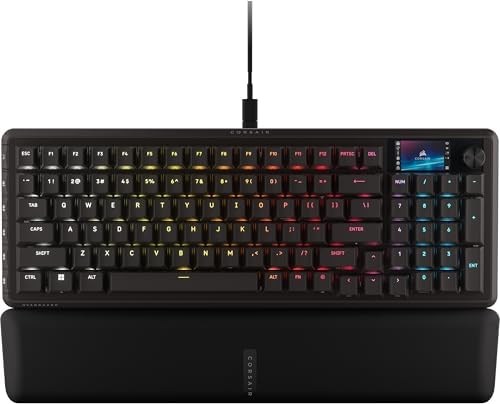
The Corsair Vanguard PRO 96 is Corsair's wired flagship for the magnetic-switch era: a 96% layout that squeezes a full numpad, five macro keys, a rotary dial, and a 1.9-inch IPS LCD into roughly the footprint of a tenkeyless board, built around the company's second-generation MGX Hyperdrive V2 Hall Effect switches. Launched September 25, 2025 at $229.99 (about $223.98 on the street, £209.99 in the UK), it was designed to do one thing Corsair hadn't managed in years: put the brand back at the top of the competitive keyboard conversation it once owned with the K70 and K100 lines.
On paper, it succeeds spectacularly. The Vanguard PRO 96 delivers the full modern hall-effect feature stack — per-key adjustable actuation from 0.1mm to 4.0mm, Rapid Trigger, FlashTap SOCD, and dual actuation — wrapped in hardware that press reviewers almost universally describe as excellent. IGN gave it 9/10 with an Editors' Choice badge and called it "the everything keyboard"; GamesRadar+ scored it 5/5 and later named it the best gaming keyboard it tested in 2026, saying it "takes the lead" over the SteelSeries Apex Pro TKL Gen 3. Wccftech (9.5/10) and ProSettings (5/5, Staff's Choice) followed suit, and it's already on the desks of pro players like shox and Gumayusi.
But the asterisk is impossible to ignore, and it isn't about the hardware. RTINGS — the most measurement-heavy outlet to test it — called the Vanguard PRO 96 "an outstanding gaming keyboard" with exceptionally low latency, then spent its cons section on instability: key chatter, random disconnections, and settings that wouldn't save, much of it traced back to the included USB-C cable. Amazon owners have pushed the aggregate rating to 3.9 out of 5 across 156 ratings — respectable, but notably below the 4.5-plus typical of genuinely trouble-free flagships — with a bimodal split of 54% five-star and 15% one-star reviews. That shape is the signature of a product where hardware praise and software frustration collide. This review is about both halves of that story: what the Vanguard PRO 96 does better than almost anything at its price, and what will annoy you about it after the honeymoon.
Build Quality and Design
The Vanguard PRO 96 is a dense, substantial board. It measures 388 x 141 x 43mm and tips the scales at roughly 1,090g — about 2.4 pounds with the wrist rest attached — which makes it heavier than most TKL rivals but stable on the desk in a way lighter boards aren't. The chassis is almost entirely plastic, which drew a mild complaint from ProSettings ("a bit less premium than it should be at this price point") and Tom's Hardware, but the plastic is thick, rigid, and backed by multiple layers of sound-damping foam. RTINGS rated build quality good, noting the board doesn't flex meaningfully in normal use, and owner feedback is even more emphatic: one r/Corsair regular called it "easily the best Corsair keyboard I've ever used" from a construction standpoint, and Amazon reviewers repeatedly describe the frame as sturdy enough to survive the occasional rage moment. The aluminum volume knob and the flared base give it a more mature look than older Corsair boards — ProSettings notes it looks "a lot less 'gamery'" than the K-series, which most reviewers count as a win.
The magnetic, memory-foam wrist rest is the most polarizing element of the package. IGN and GamesRadar+ both called it genuinely comfortable, and Wccftech singled it out as a highlight; ProSettings found the same rest "chalky" and uncomfortable, and at least one Amazon owner wished the magnets were stronger. It's a bundled accessory most rivals charge extra for or skip entirely, so the mixed reception is more about taste than value.
The 96% layout itself is the other design talking point. It keeps the arrow cluster and full numpad while compressing the gaps between clusters, which delights anyone who wants full-size function in a compact footprint — IGN's reviewer gushed about it, and Amazon owners upgrading from full-size K95s report the muscle-memory transition is far easier than expected. The trade-offs are real, though: the arrow keys are wedged under Enter and right Shift, the right Shift key itself is undersized, and the Home/End/PgUp/PgDn column sits in an unusual spot. GamesRadar+ listed "squished arrow buttons" as its main design con, and several Amazon reviewers needed time to adjust.
Key Features
- MGX Hyperdrive V2 Hall Effect switches. Pre-lubed linear magnetic switches rated for 150 million keystrokes, with per-key actuation adjustable from 0.1mm to 4.0mm in fine increments, dual-actuation support, and hot-swappable sockets so you can swap in any compatible magnetic switch without soldering. Wccftech notes the LCD shows actuation changes in real time as you tune.
- Rapid Trigger and FlashTap SOCD. Dynamic reset points let repeated keystrokes register without full key travel, and FlashTap enables last-input-wins opposing-direction movement (the "Snap Tap"-style feature Corsair brands FlashTap). The full competitive stack also includes Mod Tap and dual actuation.
- 8,000Hz polling via AXON. USB polling up to 8,000Hz with full NKRO and 100% anti-ghosting. Note: RTINGS measured the effective update rate at 2,000Hz despite the 8,000Hz USB polling — a distinction that matters on paper but that they describe as "negligible" in practice.
- 1.9-inch IPS LCD (320x170). A full-color screen that shows system info, actuation readouts, and custom images or GIFs, controlled on the fly via the keyboard's own menus — no software needed for basic tuning.
- Five angled G-keys plus an Elgato Stream Deck key. The G-keys sit on the left edge, angled outward so they add no width; a dedicated key beside right FN toggles Elgato Stream Deck functions like mute and record, and Corsair's Virtual Stream Deck integration turns the key into a mini macropad. Streamers and MMO players get the most out of these.
- Press-and-turn rotary dial. Volume by default, re-mappable to polling rate, lighting, and other settings; a dedicated Game Mode key drops polling to 1,000Hz, enables Win Lock, and switches the backlight to red.
- 8MB onboard storage with 5 profiles. Configurations live on the keyboard, so after setup the board is fully self-contained — a point Amazon owners upgrading from Razer's Huntsman specifically praised.
- Double-shot PBT shine-through keycaps. Thick, heavily textured, and quiet — though legend quality on the numpad drew complaints from one long-term owner.
Performance
Performance is where the Vanguard PRO 96 is genuinely elite — and where the review splits cleanly between what the hardware can do and what the software lets you do reliably.
On latency, the measurements are unambiguous. RTINGS rated the board's single-key and multi-key input latency among the best they've tested, describing performance as "exceptionally low" and "outstanding overall," with response times around 0.8ms in their testing. IGN's reviewer set actuation to 0.8mm and found jiggle-strafing and jump-crouch inputs in CS2 effortless; Tom's Hardware ran Battlefield without any perceivable latency and tuned keys 1-5 to 1mm actuation for faster weapon swaps. The MGX switches themselves earn consistent praise — smooth, consistent resistance from 30g to 55g across 4mm of travel, quiet for a hall-effect switch (Tom's Hardware notes they sound like a good Cherry clone rather than the clacky magnets of some rivals), with a softer bottom-out than typical linear switches. Typing feel is routinely described as excellent, with the layered sound dampening making it quiet enough for shared spaces. The switch specs are borne out by owner feedback: "the feel and sound of the keys are amazing" is a recurring Amazon refrain, and one 50-year computing veteran called it the best keyboard he'd ever used.
The performance story has two caveats. First, the effective 2,000Hz update rate behind the 8,000Hz marketing number — real, measured by RTINGS, and worth knowing even if it doesn't translate to a perceivable difference in play. Second, and far more important: RTINGS encountered key chatter, random disconnections, and settings that refused to save during testing, almost all of which traced to the included USB-C cable. Swapping to a different cable "subsided drastically" the problems. A Canadian Amazon reviewer documents the same failure mode — the keyboard frequently failing to be detected at PC startup — and reports that a firmware update resolved it. This is the thread that runs through the entire reliability picture: the hardware is fast and capable, but a meaningful minority of units shipped with cable, firmware, or software behavior that undermines the flagship experience until addressed. RTINGS' verdict wording is the fairest summary: it's difficult to wholeheartedly recommend at this price until the issues are addressed.
One practical note that surfaced repeatedly: 8,000Hz polling costs CPU. Owners with older or mid-range systems report meaningful load from the 8K setting and are advised to run 1,000-2,000Hz unless the CPU has headroom. It's free performance on a modern gaming rig and a real consideration on anything else.
Software
Software is the Vanguard PRO 96's known weak spot, and it deserves its own section because it's the difference between "best keyboard of the year" and "3.9 stars on Amazon."
At launch, the board was configurable only through Corsair's browser-based Web Hub — no iCUE, no local app. The browser approach itself won genuine praise: ProSettings called it "amazing" and an example other big brands should follow, and several Amazon owners love skipping vendor bloatware entirely. But the Web Hub experience has been rough around the edges since day one. Tom's Hardware's reviewer found the LCD's customization limited (GIFs must be under 500KB — a frustrating constraint) and couldn't access advertised animations or system-spec widgets at launch. Reddit owners describe a longer, uglier list: settings taking forever to save or load, custom GIF uploads freezing the app, profiles being wiped on firmware updates, browser compatibility quirks (Chrome and Edge work; Firefox often fails to detect the board at all), and keyboards that need a replug before Web Hub recognizes them. One r/Corsair owner reported factory-resetting the board just to get the app working again, and returned to his old Logitech in frustration — though the same thread includes owners declaring the hardware itself the best Corsair has made.
The iCUE saga was the most consequential gap. Corsair's ecosystem users were effectively locked out of their unified software for months — "Not having support for the Vanguard 96 Pro on iCUE was a big time let down and I was honestly considering returning it" is a representative r/Corsair sentiment from the launch window, echoed in 12 of the 156 Amazon reviews. RTINGS' review, updated in May 2026, confirms iCUE support finally landed in that update cycle, and a June 2026 Amazon reviewer confirms "iCUE support is now available" with no compatibility issues alongside other Corsair peripherals. Firmware has also been iterating — version 2.6.153 fixed a widely-reported RGB bug where the T or O key would stick on a single color. The trajectory is genuinely positive: as of mid-2026, the board supports both Web Hub and iCUE, and the most-reported launch bugs have fixes. But the pattern matters for buyers: this is a product that shipped with an immature software story and took roughly eight months to fully mature, and Reddit sentiment — roughly split between positive and negative mentions across 72 threads, with software bugs the single most-discussed negative feature — reflects that scar tissue.
Pros and Cons
Pros:
- Class-leading hall-effect performance: ~0.8ms latency, Rapid Trigger, FlashTap SOCD, dual actuation, per-key 0.1-4.0mm actuation tuning
- Excellent typing feel — pre-lubed MGX Hyperdrive V2 switches are smooth, quiet, and consistent, with thick double-shot PBT keycaps
- Genuinely useful extras: 1.9-inch IPS LCD, five angled G-keys, press-and-turn dial, and Elgato Virtual Stream Deck integration that no rival bundles at this price
- Hot-swappable switches and 8MB onboard storage for 5 profiles — fully self-contained after setup
- Solid, rigid build with layered sound dampening, plus a bundled magnetic memory-foam wrist rest
- 8,000Hz wired polling with full NKRO, and a Game Mode that drops to 1,000Hz for CPU-conscious players
Cons:
- Software stability is the recurring complaint: Web Hub settings failing to save, device-detection quirks (browser- and port-dependent), and a firmware saga that took months to settle; iCUE support only arrived in May 2026
- The included USB-C cable and its under-board routing channels are a genuine weak point — RTINGS logged key chatter, disconnections, and data corruption with the stock cable, and owners report the press-fit routing nubs failing to hold the plug, with braided cables fraying as a result
- Premium $229.99 price that value-focused reviewers and a chunk of owners say rivals undercut
- The LCD is under-utilized: GIFs under 500KB only, no animations at launch, and the display is hard to read at typical seated angles
- 96% layout compromises — cramped arrow cluster, undersized right Shift — plus G-keys that require a deliberate reach
Who Should Buy This
Buy the Vanguard PRO 96 if you want a wired competitive board with the full hall-effect toolkit and you actually use numpad-adjacent features: it's the rare flagship that pairs genuine esports-grade input performance with macro keys, an LCD, and Stream Deck integration, all in a footprint that leaves desk space for a big mousepad. It's an especially strong fit for streamers and MMO/RTS players who'll use the G-keys and Virtual Stream Deck every session, and for Corsair ecosystem owners now that iCUE support has landed. The typing feel is good enough that it doubles as a daily work board.
Skip it if you need wireless — this is wired-only by design, and anyone expecting 2.4GHz or Bluetooth should look at the Vanguard AIR 99 instead. Skip it if you want zero-troubleshooting ownership: the software and cable quirks documented above are real, and while firmware has improved them, a small but persistent minority of owners still hit setup friction. And if you're on an older CPU, budget for the fact that 8,000Hz polling is only free on hardware with headroom.
Alternatives to Consider
- Wooting 80HE (ABS, ~$199): The hall-effect reference point. RTINGS judged the Wooting superior on software and build, it carries a 4-year warranty (double Corsair's 2 years), supports full analog input, and it's cheaper — but it's a TKL with no numpad, LCD, or macro keys. If you don't need the extras, this is the value pick.
- Razer Huntsman V3 Pro 8KHz (~$250): The other pro-circuit favorite, with Razer's mature Synapse software and more customization depth, but ProSettings notes the Corsair sounds better and adds the LCD and side buttons the Razer lacks. Slightly pricier.
- Corsair Vanguard AIR 99 Wireless (~$200 street): Corsair's own wireless flagship pairs the same hall-effect/Stream Deck DNA with true 8K wireless; choose it for wireless freedom, the PRO 96 for peak wired performance and battery-free reliability.
- Corsair K70 Max RGB (<$200): Tom's Hardware's suggestion for buyers who want most of the features for less, with mature iCUE support and no LCD learning curve.
Verdict
The Corsair Vanguard PRO 96 is the most complete gaming keyboard Corsair has shipped in years — the hardware genuinely earns IGN's "everything keyboard" framing and GamesRadar+'s 5/5, with class-leading latency, superb switches, and a feature set no rival bundles at the price. But "most complete" only holds when the software cooperates. The launch story — Web Hub bugs, an eight-month iCUE gap, and cable/firmware gremlins that RTINGS could not ignore — kept owner sentiment (3.9/5 on Amazon, a roughly even split on Reddit) far below the press enthusiasm, and even as of mid-2026 the reliability picture is improved but not spotless. At $229.99, you're paying flagship money for a board that asks you to be patient with its firmware. For competitive players who want the numpad, the LCD, and the macros, and who are willing to verify firmware and cable seating on arrival, it's the best wired hall-effect board Corsair has ever made — worth 7.8/10 and a genuine contender for the best of 2026. For everyone else, the Wooting 80HE delivers most of the performance with none of the drama, for less money.
Score: 7.8/10 — Good, a hair below Excellent.
What the Experts Say
Professional review consensus for this product
Full Specifications
| layout | 96% (US ANSI) — full arrow cluster and numpad in a TKL-sized frame |
|---|---|
| switches | Corsair MGX Hyperdrive V2 Hall Effect magnetic linear, pre-lubed, hot-swappable, 0.1-4.0mm adjustable actuation, 150M keystroke rating |
| polling_rate | Up to 8000Hz wired (RTINGS measured 2000Hz effective update rate) |
| connectivity | Wired USB-C to USB-A, 6-ft braided cable, under-board port with 5 routing channels |
| keycaps | Double-shot PBT, shine-through |
| display | 1.9-inch IPS LCD, 320x170 |
| features | Rapid Trigger, FlashTap SOCD, dual actuation, Mod Tap, 5 angled G-keys, Elgato Virtual Stream Deck key, press-and-turn rotary dial, Game Mode, 8MB onboard storage (5 profiles), full NKRO |
| software | Corsair Web Hub (browser) + iCUE (added May 2026) |
| dimensions | 388 x 141 x 43 mm (15.28 x 5.55 x 1.69 in) |
| weight | 1090g / 2.4 lb |
| wrist_rest | Magnetic detachable memory-foam (included) |
| warranty | 2 years |
The Verdict: Good
Superb wired hall-effect flagship hardware — excellent switches, class-leading latency, and genuinely useful extras — held back by software stability issues and a premium price. Buy for the typing feel and feature set; verify firmware and cable seating on arrival. 7.8/10.
— GamepadSquire, August 2026
As an Amazon Associate we earn from qualifying purchases made through links for Corsair Vanguard PRO 96.
Related Buying Guide
Buying Guide
Best Mechanical Keyboards 2026: The Complete Guide for Every Budget
The 2026 mechanical keyboard market mapped tier by tier: from the $37 Keychron C3 Pro and $42 EPOMAKER HE68 Lite to the Wooting 80HE and NuPhy WH80. RTINGS' top picks synthesized with Reddit community consensus, covering mechanical, Hall Effect, and TMR switches for every budget.
Buying Guide
Best Hall Effect Keyboards 2026: The Definitive All-Tier Roundup
Hall effect keyboards went from a $200 Wooting exclusive to a market that spans $42 to $400. This is the definitive all-tier roundup: the best budget, mid-range, and flagship magnetic boards of 2026, ranked by specs, lab data, pro adoption, and community feedback.