AULA
AULA F75 HE Wireless Gaming Keyboard Review
Good
$79.99
The best-value wireless hall-effect keyboard of 2026 so far: genuine rapid trigger, tri-mode connectivity, and a 4000mAh battery for around $80 — if you can live with a plastic build, loud acoustics, and Windows-first software. 8.0/10.
As an Amazon Associate we earn from qualifying purchases made through links for AULA F75 HE Wireless Gaming Keyboard.
layout
75% (80 keys)
connectivity
Tri-mode: 2.4GHz, Bluetooth 5.0, USB-C
switch_type
Hall Effect magnetic (Black King / Dragon King, hot-swappable)
polling_rate
8000Hz wired / 1000Hz 2.4GHz
Pros & Cons
Pros
- Genuine rapid trigger with 0.01mm adjustment, per-key actuation, and SOCD at a wireless-friendly price
- Tri-mode connectivity (2.4GHz, Bluetooth 5.0, USB-C) with a 4000mAh battery — rare in the sub-$90 hall-effect tier
- 8000Hz polling wired with a 160KHz single-key scan rate
- Hot-swappable magnetic switches and five-layer dampening in a 75% layout that keeps the F-row, arrows, and an aluminum volume knob
- Cross-platform out of the box: Windows, macOS, iOS, and Android
- Owner sentiment on the core feature set is strongly positive — rapid trigger and wireless stability earn consistent praise
Cons
- Loud, clacky acoustics — not an office-friendly board
- Plastic, lightweight case; one detailed owner review alleges ABS keycaps and a rigid steel plate rather than the mechanical F75's gasket-mount, PBT build
- Full 8000Hz polling is wired-only; wireless tops out at 1000Hz, a distinction buried in the fine print
- Opaque keycaps without shine-through legends are hard to read in the dark
- AULA HUB software is Windows-first with a learning curve
- Too new for long-term reliability data
AULA F75 HE Review: Wireless Hall Effect on a Budget
Overview
The AULA F75 HE is the magnetic-switch reinvention of the F75, the budget mechanical keyboard that became one of the most recommended boards in enthusiast communities during 2024. AULA has taken that familiar 75% shell and dropped in Hall Effect switches, rapid trigger, adjustable actuation, and SOCD — the full competitive feature set — while keeping the tri-mode wireless connectivity and 4000mAh battery that the mechanical F75 was loved for. The result lands at roughly $80, which puts it squarely between the wired value kings like the ATTACK SHARK R85 HE and the premium wireless magnetic boards from Keychron and Lemokey.
This is a review for the player who has watched the hall-effect wave pass by, seen rapid-trigger keyboards win over FPS communities, and wondered whether they can get the real thing without spending Wooting money or giving up wireless. The short answer, based on the spec sheet and early owner feedback: yes — with caveats about build materials, acoustics, and software that this review will get into.
The F75 HE launched mid-2026 and is still early in its retail life. Professional press has not yet published scored reviews of the HE version specifically, so this review synthesizes the product documentation, verified owner reviews from Amazon, community discussion of the F75 family, and AULA's official specifications. The picture that emerges is of a board that delivers the headline magnetic-switch experience at a genuinely competitive price, wrapped in a shell that shows its budget origins.
Build Quality and Design
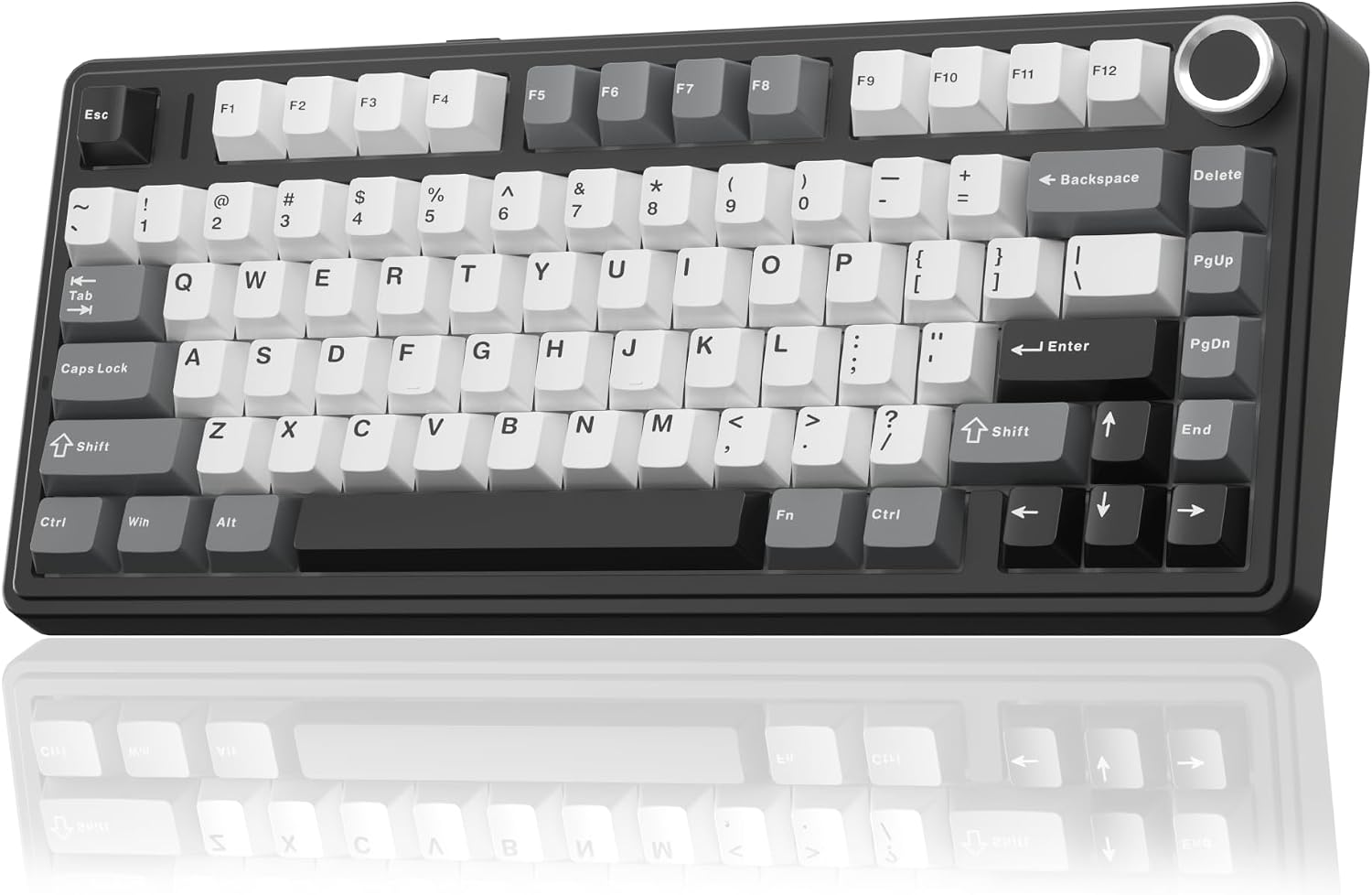
The F75 HE keeps the layout that made the original F75 popular: a compact 75% arrangement with 80 keys, retaining the function row, arrow keys, and a multifunction knob that the most aggressive 60% and 65% boards strip away. The knob is machined from aluminum and handles volume, media, and lighting duties; owners consistently rate it as a highlight, though a few note it could use a touch more weight for a truly premium feel.
The case itself is where the budget positioning shows. Owner feedback uniformly describes a plastic frame that is fairly lightweight — fine for desk use, less convincing if you judge quality by heft. The good news is that the five-layer sound-dampening design does its job in one respect: the board avoids the hollow ping that plagues cheap cases. The bad news is that the dampening does not translate into a soft, deep typing sound. Across the early review set, the most consistent acoustic observation is that the F75 HE is loud — a sharp, clacky voice that owners describe as pleasant rather than cheap, but unmistakably present. Multiple reviewers explicitly flag it as too much for a quiet office or a shared space.
The most significant design controversy concerns what is inside the case. The mechanical F75 earned its reputation partly on a gasket-mounted, flexible typing feel and PBT keycaps. AULA's promotional material for the HE leans on that heritage, but the F75 HE product page itself only promises the five-layer dampening and hot-swappable magnetic switches — it does not specify the plate material or keycap plastic. One detailed, verified-purchase review — the sharpest criticism the board has received — asserts that the HE version ships with a rigid steel plate rather than a gasket-slot PC plate, and low-quality ABS keycaps rather than PBT, and describes the resulting feel as stiff and rattly compared to the deep thocky cloud of the original. That is a single owner's teardown-level claim, and the majority of buyers describe the build as solid for the price, but the two reports are not in conflict: a rigid plate with louder acoustics is exactly what most reviewers describe. Anyone who is buying the F75 HE expecting the identical gasket feel of the mechanical F75 should treat that expectation with suspicion.
The keycaps are a related weak point. The RGB lighting is south-facing and bright, but the standard colorways use opaque caps without shine-through legends; owners say the lighting is visible enough to locate keys in a dim room, but the legends themselves are hard to read in the dark. If you game with the lights off, factor in a shine-through keycap set.
Key Features
- Hall Effect magnetic switches, hot-swappable: The F75 HE ships with AULA's magnetic switches (Black King and Dragon King variants are listed across configurations), all socketed, so failed or disliked switches can be replaced without soldering. Magnetic switches also carry the usual hall-effect longevity argument — no metal contact points to wear out.
- Rapid Trigger with 0.01mm adjustment: The headline competitive feature. Rapid trigger retriggers on the tiniest upward movement of the key rather than waiting for a full release, and the sensitivity is adjustable in 0.01mm steps. Owner reports are unanimous that it works as advertised — light taps register instantly, which is exactly what counter-strafing in Valorant and CS2 demands.
- Adjustable actuation and SOCD: Per-key actuation can be tuned across the key travel, and SOCD (simultaneous opposing cardinal directions) cleaning is supported, giving competitive players the same input-shaping tools the premium boards advertise.
- 8000Hz polling wired, with an asterisk: The F75 HE polls at 8000Hz over USB-C and at 1000Hz over 2.4GHz wireless, backed by a 160,000Hz single-key and 10,000Hz full-key scan rate. The marketing leans hard on the 8K number, and the Amazon listing's fine print is where you find that full 8K is wired-only. In practice, 1000Hz wireless is not a competitive liability — it matches the Keychron K2 HE and most rivals — but the discrepancy between marketing and fine print is worth knowing before you buy.
- Tri-mode connectivity and a 4000mAh battery: 2.4GHz dongle, Bluetooth 5.0, and USB-C wired, with a 4000mAh cell. Owners describe wireless as stable with no random disconnects, and battery life as good — comfortably a multi-day or multi-week proposition depending on RGB usage. The board also works with macOS, iOS, and Android, which is unusual at this price.
- AULA HUB software: Configuration runs through AULA's HUB, available as a web-based configurator and a downloadable Windows driver. It covers rapid-trigger tuning, per-key actuation, macros, and lighting. The recurring owner complaint is the learning curve — the menus take time to sort through — and one reviewer notes the desktop software is not as straightforward as they would like. It is functional rather than elegant.
Performance
The performance picture, assembled from owner feedback and the official specifications, is genuinely strong for the price tier. Rapid trigger behavior is the thing competitive players care most about, and the early consensus is that it performs exactly as intended: owners describe feather-light taps registering instantly, with the adjustable actuation making a noticeable difference between a light FPS trigger and a deeper typing press. That responsiveness is the whole point of the product, and it delivers.
Wireless performance holds up. The 2.4GHz connection is described as stable with no random disconnects across the early review set, and switching between the three modes is quick and reliable. Bluetooth works with phones and tablets as well as computers — one owner verified it on an Android device — which makes the F75 HE a genuinely multi-device board rather than a PC-only peripheral.
The latency question deserves precision. The F75 HE is too new to have accumulated independent lab data, so the marketing sheet's latency claims cannot be independently verified yet. What can be said: the family pedigree is good. RTINGS tested the mechanical F75 and F99 and found impressive latency performance suitable for competitive play, and the magnetic-switch architecture used here is the same technology the latency-focused hall-effect boards are built on. The honest summary is that the F75 HE feels fast — owners consistently describe it that way — and the 8K wired polling removes the last technical excuse at the desk, but hard latency numbers will have to come from the next round of professional testing.
Typing performance is where the F75 HE divides opinion. The magnetic switches themselves are smooth and consistent, and owners who use the board for long work sessions report no fatigue or inconsistency. But the loud clack is inescapable, and the stiff plate that some report makes it a sharper, less cushioned typing experience than the mechanical F75. For pure gaming, none of that matters; for a shared workspace, it does.
On reliability, the honest answer is that there is not enough data yet. The early Amazon review set skews heavily toward favorable verdicts, and the most detailed critical review is a materials and build complaint rather than a failure report. The broader AULA track record is reassuring — owners of older AULA boards report years of daily use without issues — but the F75 HE's own long-term story is still being written. Given the price, the risk is low; just keep the receipt.
Pros and Cons
Pros:
- Genuine rapid trigger with 0.01mm adjustment, per-key actuation, and SOCD at a wireless-friendly price
- Tri-mode connectivity (2.4GHz, Bluetooth 5.0, USB-C) with a 4000mAh battery — rare in the sub-$90 hall-effect tier
- 8000Hz polling wired with an exceptional 160KHz single-key scan rate
- Hot-swappable magnetic switches and five-layer dampening in a sensible 75% layout that keeps the F-row, arrows, and an aluminum volume knob
- Cross-platform: Windows, macOS, iOS, and Android support out of the box
- Owner sentiment on the core feature set is strongly positive — rapid trigger and wireless stability both earn consistent praise
Cons:
- Loud, clacky acoustics — the opposite of an office-friendly board
- Plastic, lightweight case, with one detailed owner review alleging ABS keycaps and a rigid steel plate rather than the mechanical F75's gasket-mount, PBT build
- Full 8000Hz polling is wired-only; wireless tops out at 1000Hz, a distinction the marketing buries in fine print
- Opaque keycaps without shine-through legends are hard to read in the dark
- AULA HUB software is Windows-first with a learning curve; the web configurator helps, but setup takes patience
- Too new for long-term reliability data
Who Should Buy This
The F75 HE is aimed squarely at competitive FPS players who want rapid trigger and hall-effect reliability without paying premium-board prices, and specifically those who want the flexibility of wireless. At around $80, it is effectively the cheapest way into a wireless hall-effect board with the full competitive feature set — the tri-mode connectivity and 4000mAh battery are the differentiators that justify the premium over wired value boards.
It is also a fine first hall-effect keyboard for someone who wants to try rapid trigger without committing $150-200, and a surprisingly good multi-device board for people who split time between a PC, a Mac, and a tablet, thanks to the cross-platform compatibility.
Skip it if you need a number pad — this is a 75% board, and the numpad complaint that appears in the review data is simply out of scope for the layout. Skip it if you need a quiet board for a shared office, if you play in a dark room and refuse to replace keycaps, or if you are a keyboard enthusiast who specifically wants the gasket-mounted, thocky typing feel of the original mechanical F75 — the HE is a different personality, and the community's most vocal critics are the people who expected a like-for-like upgrade. If you want a knob-equipped daily driver that doubles as a genuinely competitive gaming board, this is an easy recommendation.
Alternatives to Consider
- ATTACK SHARK R85 HE (~$62): The wired value king of the 75% hall-effect tier. Same rapid-trigger feature set with 8K polling and a proven community track record for about $18 less — but no wireless, no battery, and the same Windows-first software caveats. Buy it if you will never leave the desk cable.
- MonsGeek FUN60 Ultra TMR (~$90): The 60% alternative with a CNC aluminum case, TMR magnetic switches, and 8K polling over wireless. Significantly better build, but you give up the F-row, arrows, and knob for pure FPS focus.
- Keychron K2 HE (~$140): The premium wireless hall-effect option in the same 75% layout. Better build quality, web-based Launcher, and a proven reputation — but roughly 75% more money for the same headline features. This is the upgrade path when the F75 HE's plastic shell starts to feel limiting.
- Redragon K673 HE (~$51): If $80 is still too much, the K673 gets you genuine rapid trigger and 8K polling wired for about $51 — the cheapest real hall-effect experience in 2026, with a metal knob and a creamy sound profile, but wired-only and carrying a recurring RGB flicker QC complaint.
Verdict
The AULA F75 HE is the board that makes wireless hall-effect plausible for budget buyers. It delivers the features that matter — working rapid trigger, adjustable actuation, SOCD, tri-mode connectivity, a 4000mAh battery, and 8K wired polling — for around $80, which is roughly half the price of the established wireless magnetic boards. Owner sentiment on the core experience is strongly positive: the rapid trigger performs, the wireless is stable, and the layout is the sensible 75% arrangement that makes it a viable daily driver rather than a competitive-session-only peripheral.
What keeps it from the top tier is everything around the edges. The build is plastic and light, the acoustics are loud, the software is functional but clunky, the 8K polling only exists wired, and the board is too new to have a reliability track record. There is also a legitimate controversy about whether AULA quietly downgraded the plate and keycaps versus the beloved mechanical F75 — enthusiasts should buy it with eyes open, and everyone should buy it understanding that the marketing's 8K headline requires a cable.
If you want a genuinely wireless rapid-trigger board on a budget, this is the pick. If you are a keyboard purist chasing the F75's legendary typing feel, look elsewhere.
Score: 8.0/10 — the best-value wireless hall-effect keyboard of 2026 so far, held back by its budget shell and a loud personality.
Full Specifications
| layout | 75% (80 keys) |
|---|---|
| connectivity | Tri-mode: 2.4GHz, Bluetooth 5.0, USB-C |
| switch_type | Hall Effect magnetic (Black King / Dragon King, hot-swappable) |
| polling_rate | 8000Hz wired / 1000Hz 2.4GHz |
| scan_rate | 160KHz single-key, 10KHz full-key |
| rapid_trigger | 0.01mm adjustable, per-key actuation |
| socd | Yes |
| battery | 4000mAh |
| keycaps | Opaque, non-shine-through (material unconfirmed; ABS per one owner report) |
| knob | Aluminum multi-function knob |
| sound_dampening | 5-layer |
| dimensions | 373 x 183 x 75 mm (14.7 x 7.2 x 2.95 in) |
| software | AULA HUB (web configurator + Windows driver) |
| compatibility | Windows, macOS, iOS, Android |
| colors | 5 colorways |
The Verdict: Good
The best-value wireless hall-effect keyboard of 2026 so far: genuine rapid trigger, tri-mode connectivity, and a 4000mAh battery for around $80 — if you can live with a plastic build, loud acoustics, and Windows-first software. 8.0/10.
— GamepadSquire, August 2026
As an Amazon Associate we earn from qualifying purchases made through links for AULA F75 HE Wireless Gaming Keyboard.
Related Buying Guide
Buying Guide
Best Mechanical Keyboards 2026: The Complete Guide for Every Budget
The 2026 mechanical keyboard market mapped tier by tier: from the $37 Keychron C3 Pro and $42 EPOMAKER HE68 Lite to the Wooting 80HE and NuPhy WH80. RTINGS' top picks synthesized with Reddit community consensus, covering mechanical, Hall Effect, and TMR switches for every budget.
Buying Guide
Best Gaming Keyboard Switches 2026: Linear, Tactile, Magnetic & Hall Effect, Explained
Every switch type explained and ranked for 2026: linear vs tactile vs clicky mechanicals, Hall Effect and TMR magnetic switches, Rapid Trigger, adjustable actuation, and what competitive players actually use — with real recommendations at every price point.