Corsair
Corsair Virtuoso MAX Wireless Gaming Headset Review
Good
$179.19
Exceptional gaming audio and feature depth undermined by fit-dependent comfort, iCUE reliance, and a durability question mark. A strong buy at ~$250 street price if it fits your head.
As an Amazon Associate we earn from qualifying purchases made through links for Corsair Virtuoso MAX Wireless Gaming Headset.
driver
50mm graphene
frequency_response
20Hz-40kHz
impedance
32ohm
connectivity
2.4GHz wireless + Bluetooth (simultaneous)
Pros & Cons
Pros
- Outstanding game audio: exceptional detail retrieval, spacious closed-back soundstage, accurate positional cues
- Simultaneous 2.4GHz + Bluetooth with dedicated per-input volume wheels
- Best-in-class ANC for a gaming headset
- Premium aluminum construction with hard travel case included
- 60-hour battery life that holds up in real use
Cons
- Fit-dependent comfort: sub-10mm earpad padding over hard housings creates pressure points for many wearers
- EQ and settings not stored on-device; iCUE required for tuned sound
- No wired or USB audio mode
- Small minority of owners report headband breakage within months
- Controls not self-explanatory
Overview
The Corsair Virtuoso MAX Wireless is the company's attempt to reclaim the premium gaming headset crown. Launched in October 2024 at a $329.99 MSRP, it's a flagship in every sense of the word: 50mm graphene drivers, active noise cancellation, Dolby Atmos, Sonarworks SoundID personalization, simultaneous 2.4GHz and Bluetooth, and a six-zone RGB array. It's also Corsair's heaviest, most feature-dense headset ever, and, depending on who you ask, either the best-sounding wireless headset Corsair has made or an uncomfortable, software-dependent disappointment.
That split is the story of this headset. Reviews from major outlets landed within a narrow band, IGN scored it 7/10, PC Gamer 74/100, Tom's Hardware 3/5, and Basic-Tutorials 84/100, while Amazon's rating sits at a telling 3.5 out of 5 across roughly 855 ratings, with a stark 48% five-star versus 24% one-star split. Few gaming headsets generate that kind of polarization. The good news: by mid-2026 the street price has tumbled to around $250 (and routinely below), which changes the calculus significantly from the launch-day $330 ask.
This review synthesizes the full body of professional testing and owner feedback to answer the question that matters: what will annoy you about the Virtuoso MAX after you buy it, and is the remaining experience worth the money?
Build Quality and Design
There's no getting around it: the Virtuoso MAX feels expensive in the hand. The aluminum frame, brushed-metal earcup caps, and dense leatherette-and-mesh headband are a clear step up from the plasticky Virtuoso models of old, and press coverage is nearly unanimous that the construction quality is the best Corsair has shipped in this line. Basic-Tutorials scored workmanship 99/100 and noted the headset feels noticeably more robust than rivals in its price class. The earcups swivel to lie flat, the yokes are sturdy, and the whole assembly can be twisted without feeling fragile.
The trade-off is weight. The MAX tips the scales at roughly 420, 431g depending on who measured it (Tom's Hardware recorded 421.5g without the mic; PC Gamer 431g), making it heavier than virtually every mainstream wireless headset and second only to monsters like the Audeze Maxwell (490g) in its price tier. Weight alone wouldn't sink it, the Maxwell wears its heft comfortably, but the MAX combines that mass with a surprisingly stiff headband and earpads that look far thicker than they are.
Here's the design flaw that dominates the feedback: the earpads have less than 10mm of actual cushioning before you hit a hard plastic housing. Tom's Hardware described the padding as "less than half an inch of actual padding" beneath sculpted, thick-looking covers, and Basic-Tutorials measured the same sub-10mm figure before the frame. Combined with the rigid headband, this creates pressure points that professional reviewers felt within an hour, IGN reported persistent pressure around the ears and at the top of the jaw over a week of use, and Tom's Hardware hit painful headband pressure after roughly an hour of wear.
Crucially, comfort is the most divisive point in the entire review landscape. For every reviewer complaining about pressure, there's an owner describing six-hour sessions with no soreness at all, several Amazon five-star reviews explicitly push back on the comfort criticism, praising the fabric-covered pads and light clamp. The shape of your head and ears determines which camp you land in, which makes this a try-before-you-buy headset in a way most flagships aren't. Owners with larger ears are the most likely to hit the hard frame behind the thin pads.
Around the cups, the control layout is dense but logical once learned: power/connection switch and mic USB-C port on the left, ANC/transparency button, a media action switch, and charging port on the right. The standout touch is the pair of textured volume dials that ring each earcup, left controls 2.4GHz volume, right controls Bluetooth volume, enabling real-time mixing between two simultaneous audio sources. Tom's Hardware called it one of the best implementations of dual-input mixing they've seen. The main criticism here is that the controls aren't self-explanatory, reviewers needed the manual (QR-code only, in the box) to figure out the right dial and the hold-to-cycle ANC gesture.
Key Features
- 50mm graphene drivers with a 20Hz, 40kHz frequency response and 32Ω impedance, a wider range than the typical 20, 20kHz gaming headset, shared with the wired Virtuoso Pro.
- Simultaneous 2.4GHz + Bluetooth, connect to your PC over the low-latency dongle while Bluetooth audio plays from your phone at the same time, with per-input volume wheels. A feature many rivals have quietly dropped.
- Hybrid active noise cancellation and transparency mode, press and hold the custom button to cycle ANC on, transparency, and off.
- Dolby Atmos spatial audio and Sonarworks SoundID hearing personalization, both accessible through iCUE.
- Detachable omnidirectional boom microphone with physical mute, connecting via USB-C on the left cup, with an LED ring that glows white (live) or red (muted).
- Six-zone RGB (three per earcup), customizable individually in iCUE.
- 60-hour rated battery (with RGB off), roughly 1.5 hours to recharge.
- Hard-shell leatherette travel case included, with the dongle, cable, and mic, a welcome inclusion at this price.
- Platform support: PC, Mac, PS5/PS4, Nintendo Switch, and mobile over Bluetooth. An Xbox-specific variant exists separately.
One notable omission: there's no 3.5mm jack and no USB audio mode, the only wired option is charging. At the launch price that stung, since several rivals at the same tier still offer a wired fallback; at $250 it's more forgivable, but worth flagging if you ever need to plug in on a console or PC without the dongle handy.
Performance
The Virtuoso MAX's audio performance is where press and owners converge, it's genuinely excellent in games, and genuinely mediocre for music out of the box.
In-game, the graphene drivers deliver a level of detail that repeatedly surprised professional reviewers. Tom's Hardware described hearing ambient ocean sounds in Baldur's Gate 3 that other headsets simply didn't reproduce, and called the detail "impressive" across richly layered single-player titles. IGN praised the "full and balanced" presentation and, unusually for a closed-back design, a spacious soundstage that "rarely felt too busy" even in chaotic multiplayer. Directional audio in competitive shooters drew consistent praise, footsteps, gunfire, and reloads were accurately placed in Counter-Strike 2 testing, and Amazon owners frequently cite footstep clarity as a headline strength. The caveat: the default tuning is bright and bass-light, and the FPS-focused EQ preset in iCUE is widely recommended to get the most out of competitive play. A minority of owners report poor footstep audibility out of the box, which the EQ presets resolve.
That default tuning is the flip side of the coin. Out of the box the MAX is tuned for near-neutrality, which means weak bass and elevated, occasionally harsh highs for music, Tom's Hardware found tracks "tinny and thin" and needed EQ intervention, and Basic-Tutorials scored sound quality a middling 77/100 while praising the ANC as the best they'd seen in a gaming headset. The equalizer in iCUE (flat, movie, FPS, bass boost presets plus a 10-band custom EQ) fixes much of this, but here's the rub: the EQ and settings are not stored on the headset. You need iCUE running on the PC to get the tuned sound, and if you move to a PS5 or Switch, you're stuck with the default profile. That's the single most common professional complaint after comfort.
Software is the MAX's second major weak point. iCUE is required for firmware updates, EQ, RGB, and SoundID, and reviewers hit real friction: Tom's Hardware could not complete a firmware update at all, described the sidetone (hear-yourself monitoring) as "truly awful", nearly inaudible until 90% volume, then fuzzy, and Basic-Tutorials documented an inconsistent-volume bug and settings that don't persist on-device. None of this is catastrophic; the headset works without iCUE. But at this price tier, reviewers reasonably expect the software to stay out of the way.
The microphone splits opinion more than any component. PC Gamer was effusive, calling it clear and unwavering in squad comms and singling it out as a genuine differentiator for a wireless headset. IGN and Tom's Hardware were cooler, rating it merely fine-to-average, loud and clear, but not broadcast quality, with a so-so software sidetone. The truth is somewhere in the middle: it's a good, usable boom mic that's better than most built-ins, with the caveat that the sidetone experience is poor.
Battery life holds up to the 60-hour claim. IGN ran it roughly 10, 12 hours a day for five straight days before it died, and no professional review reported materially worse figures, though that's with RGB off, and the LED array will eat into it if you keep it lit. Charging is a quick ~1.5 hours via USB-C.
Wireless reliability and range drew no significant complaints, the 2.4GHz link held steady in testing, and the simultaneous dual-wireless implementation, the headset's signature feature, worked flawlessly across every review.
Pros and Cons
Pros:
- Outstanding game audio: exceptional detail retrieval, spacious closed-back soundstage, and accurate positional cues with the FPS EQ preset
- Simultaneous 2.4GHz + Bluetooth with dedicated per-input volume wheels, the best dual-device mixing implementation in a gaming headset
- Best-in-class ANC for a gaming headset, plus a usable transparency mode
- Genuinely premium aluminum construction and a quality hard travel case included
- 60-hour battery life that holds up in real use; fast USB-C charging
- Excellent wireless stability and range; Dolby Atmos and SoundID add genuine value
Cons:
- Comfort is a coin flip: sub-10mm earpad padding over hard housings and a stiff headband create pressure points for many wearers within an hour, and there's no way to know which camp you're in without wearing it
- iCUE dependence: EQ and settings aren't stored on-device, so the tuned sound only exists with the software running; firmware update and sidetone issues frustrated multiple reviewers
- Mediocre music performance out of the box (bright, bass-light) until you EQ it
- No wired/3.5mm or USB audio mode, charging cable only
- A small but persistent minority of owners report headband breakage within the first months, the durability question mark behind the 24% one-star share on Amazon
- Controls require the manual; the dual-dial layout and hold-gestures aren't discoverable
Who Should Buy This
The Virtuoso MAX is for the single-player immersion gamer and the dual-device multitasker. If you live in richly scored worlds, RPGs, horror, cinematic shooters, and want to hear environmental detail other headsets smother, this is one of the best wireless options at any price. The simultaneous 2.4GHz + Bluetooth mixing is a killer feature for anyone who games on PC while taking calls or listening to audio from a phone, and the ANC makes it a genuine all-day desk companion for noisy environments.
It is not for you if: you're sensitive to clamp force or head pressure (try it first, comfort is the entire ballgame here); you play across platforms and expect your EQ to follow you (it doesn't, the tuned sound is PC-only via iCUE); you want a wired fallback for consoles or dead batteries; or you expect set-and-forget peripherals. If you're strictly a competitive FPS player, the soundstage is great but the out-of-box tuning needs work, and lighter, cheaper options like the HyperX Cloud III Wireless cover that ground for half the price.
Alternatives to Consider
- Audeze Maxwell (~$329), the audio purist's pick: planar magnetic drivers that out-class everything in gaming, plus better mic quality. It's heavier (490g), lacks ANC, and has its own software quirks. Choose it for outright sound quality; choose the MAX for ANC, RGB, and dual-wireless mixing.
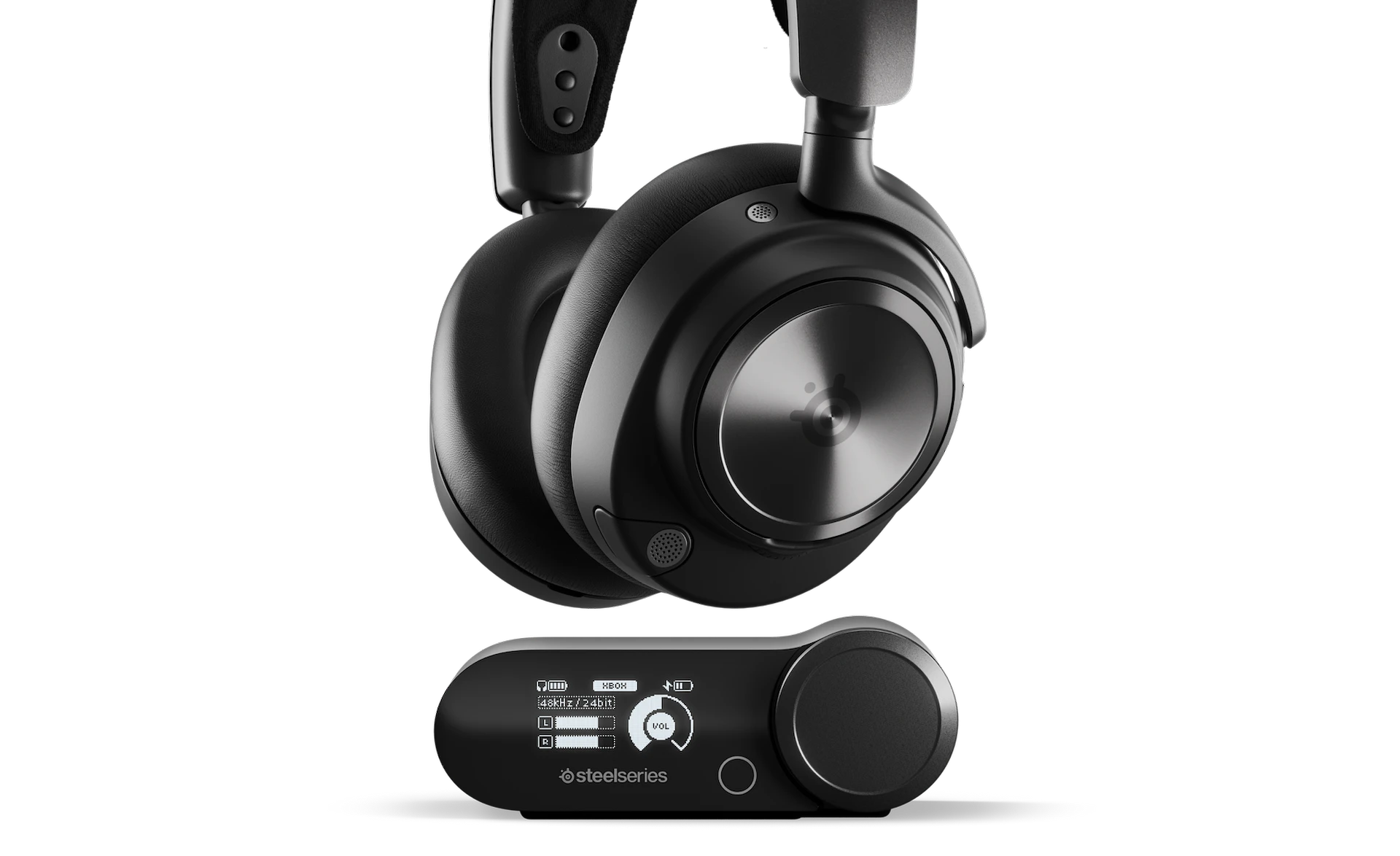
- SteelSeries Arctis Nova Pro Wireless (~$350), the feature-for-feature rival: hot-swappable batteries, a base station, ANC, and simultaneous wireless. It's more expensive and its default sound is less detailed, but the battery system and console flexibility are genuinely superior. It's the safer recommendation if comfort and ecosystem flexibility matter most.
- Razer BlackShark V3 Pro (~$250), lighter, more comfortable, and cheaper, with excellent FPS tuning and a great mic, but no ANC and single-input wireless. If competitive gaming comfort is your priority, this is the more sensible $250 spend.
Verdict
The Corsair Virtuoso MAX is a headset of stark contrasts: flagship-grade graphene audio that excels in games, best-in-class ANC, flawless dual-wireless mixing, and a battery that delivers, wrapped in a premium shell with a comfort lottery, software dependency, and durability question marks. At the $329.99 launch price it was a hard sell, and the market agreed: it's now routinely available near $250, and at that price the audio and feature set become genuinely compelling.
The verdict depends on your head. If the fit works for you, this is one of the best-sounding wireless gaming headsets under $300 and a rare headset that's genuinely excellent for immersive single-player play. If it doesn't, no amount of graphene fixes pressure points, and you'll know within an hour. Buy it on sale, buy it with a return window, and don't buy it expecting the software to stay out of your way. For everyone else, the Audeze Maxwell and Arctis Nova Pro Wireless remain the safer premium picks.
Score: 7.0/10, Good. Exceptional gaming audio and feature depth undermined by fit-dependent comfort, iCUE reliance, and a nagging durability question mark. A strong buy at ~$250 if it fits your head; risky blind purchase at MSRP.
What the Experts Say
Professional review consensus for this product
Full Specifications
| driver | 50mm graphene |
|---|---|
| frequency_response | 20Hz-40kHz |
| impedance | 32ohm |
| connectivity | 2.4GHz wireless + Bluetooth (simultaneous) |
| weight | 430g |
| battery | 60 hours (RGB off) |
| charging | ~1.5 hours USB-C |
| anc | Hybrid ANC + transparency |
| mic | Detachable omnidirectional boom |
| rgb | 6 zones |
| platforms | PC, Mac, PS5/PS4, Switch, mobile |
The Verdict: Good
Exceptional gaming audio and feature depth undermined by fit-dependent comfort, iCUE reliance, and a durability question mark. A strong buy at ~$250 street price if it fits your head.
— GamepadSquire, August 2026
As an Amazon Associate we earn from qualifying purchases made through links for Corsair Virtuoso MAX Wireless Gaming Headset.
Related Buying Guide
Buying Guide
Best Gaming Headsets 2026: Buying Guide for Every Budget
From planar magnetic champs and open-back sleepers to budget wired bargains — what actually matters when buying a gaming headset in 2026.
Buying Guide
Best Wireless Gaming Headsets 2026: The Complete Guide for Every Budget
From the $62 dual-wireless budget champ to the $600 four-source flagship — every wireless gaming headset worth buying in 2026, tier by tier, with battery life, connectivity, ANC, and mic quality compared.