Sony
Sony INZONE H6 Air Wired Open-Back Gaming Headset Review
Excellent
$199.99
The best open-back gaming headset of 2026: MDR-MV1-derived 40mm drivers, class-leading 199g comfort, and excellent sound for games and music. It demands a quiet room and tolerance for a mediocre companion app, and $199.99 is real money for a wired headset — but for immersive single-player and RPG gaming, nothing in the category comes close. 8.8/10 — Excellent.
As an Amazon Associate we earn from qualifying purchases made through links for Sony INZONE H6 Air Wired Open-Back Gaming Headset.
acoustic_design
Open-back over-ear
driver
40mm dynamic, adapted from Sony MDR-MV1 studio monitors
frequency_response
10Hz - 20,000Hz
weight
199g (approx. 211g with boom mic)
Pros & Cons
Pros
- Studio-grade 40mm drivers from the MDR-MV1 platform — balanced, detailed sound with genuine bass for an open-back, at roughly half the MV1's price
- 199g suspension-band frame among the most comfortable headsets in any category; all-day wear without fatigue is the near-universal owner consensus
- Wide, natural open-back soundstage with strong positional audio for gaming and excellent music performance
- Detachable cardioid boom mic renders voice clearly over both analog and USB-C, with automatic gain control
- Multi-platform: PC, PS5, Xbox, Switch, and mobile via 3.5mm, plus USB-C Audio Box for EQ and spatial sound on PC/PS5
- No battery, no dongle, no setup — plug in and play; EQ profiles save to the included audio box
Cons
- $199.99 is a premium price for a wired-only headset when capable wireless rivals cost the same or less
- Zero noise isolation and significant sound leakage — you hear your room, and your room hears your game; demands a quiet space
- INZONE Hub software underwhelms: 360 Spatial Sound mode sounds thin and harsh, and the EQ lacks fine-grained control
- Light clamping force means the headset rests on your head rather than gripping — some users will want a firmer fit
- Earcups are light plastic under the aluminum shells; no carrying case despite the fold-flat design
- Boom mic picks up background noise and struggles with plosives
Overview
The Sony INZONE H6 Air is the company's first open-back gaming headset, and it arrives with the kind of press consensus most gaming audio products never get close to: TechRadar handed it a perfect 5/5 and a Best in Class badge, WIRED scored it 9/10, PC Gamer gave it 85/100, Tom's Guide made it an Editor's Choice at 4/5, and SoundGuys added their own Editors' Choice with a 7.1/10. RTINGS recommends it across its Gaming, PC Gaming, and PS5/PS5 Pro lists. Amazon owners rate it 4.5/5. That is about as close to a clean sweep as this category produces, which makes the headline caveats worth stating up front: it is wired-only, it costs $199.99, and it is built on the physics of an open-back design, meaning it leaks sound both ways and isolates you from nothing at all.
What you are actually buying is Sony's studio-monitor pedigree repackaged for games. The H6 Air uses the same 40mm driver platform as the MDR-MV1, the $400 open-back reference headphone that audiophile-minded gamers have quietly adopted for its comfort and tuning. Sony took that driver, tuned it for gaming with a touch more bass, wrapped it in a 199g frame, and added the two things the MV1 lacks: a detachable boom mic and a USB-C audio box that unlocks EQ and spatial audio on PC and PS5. At $199.99, roughly half the MV1's price, that value proposition is the entire story of this headset, and it is a genuinely strong one.
The pitch is aimed at a specific player: someone who plays immersive single-player, action, and RPG games at a desk in a quiet room, cares about sound quality for music as much as games, and would rather never charge a headset again. For that buyer, the H6 Air is arguably the best thing in the category right now. For everyone else, wireless loyalists, competitive FPS players in loud houses, anyone who needs to hear their surroundings muffled rather than amplified, it is a product to admire from a distance.
Build Quality and Design
The first thing every reviewer and owner mentions is the weight, and for good reason. At 199g without the mic (about 211g with it), the H6 Air is among the lightest gaming headsets ever made, WIRED points out that its current favorite wireless headset, the SteelSeries Arctis Nova 3, weighs 260g, and the difference is immediately noticeable. Tom's Guide calls the design a 10/10 and the most ridiculously comfortable headset its reviewer has tested; the word "forget you're wearing it" appears across nearly every hands-on account.
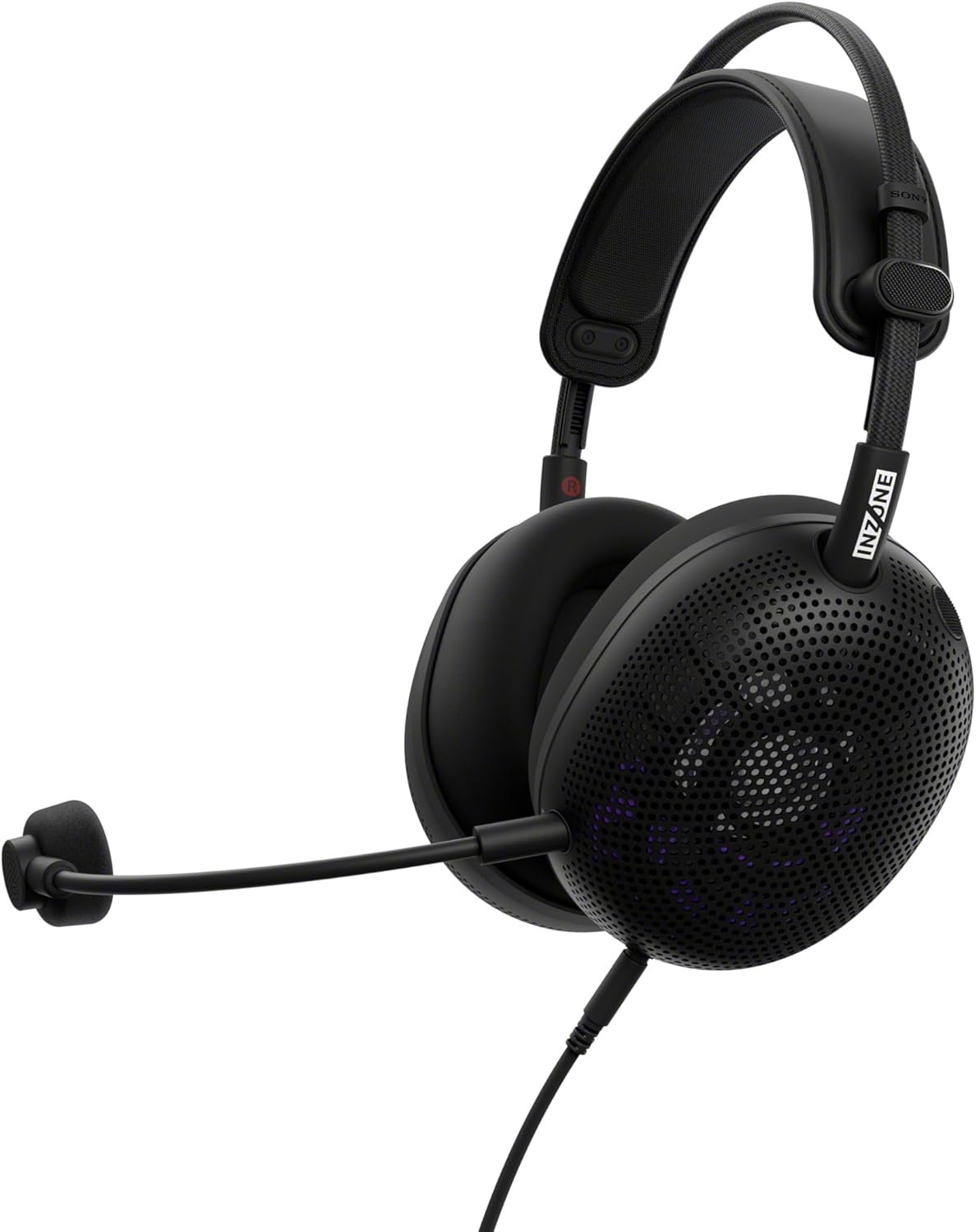
Sony achieves that with a two-piece suspension headband: a metal support band maintains side pressure while a padded strap distributes weight across the top of the head, paired with perforated aluminum outer earcup shells. The cups are ventilated, literally full of holes, which is the open-back design, and the whole thing folds flat for stowage.
That's the good news. The fine print is where the price-conscious engineering shows. Under the aluminum outer caps, the earcups themselves are light plastic, and WIRED notes they "don't feel particularly sturdy", it's a headset you'll want to treat with care. PC Gamer flags the clamping force as on the light side: the headset tends to rest on your head rather than grip it, which is wonderful for long sessions but means it can shift if you're moving around a lot, and the notched headband adjusters are fiddly, SoundGuys complains you can't feel which notch you're on. There's also no carrying case in the box, despite the fold-flat design, which is a strange omission for a $200 product.
Controls are minimal and all live on the left cup: a knurled mute switch with a red band that's visible in the muted position, a volume wheel, and two 3.5mm jacks, one for the detachable boom mic, one for audio. The mute switch's clicky tactility gets consistent praise; the volume wheel is the weakest part, with SoundGuys describing its action as dampened but abrupt, stopping rather than scrolling smoothly. It's a minor gripe, but at this price point it's the kind of detail you notice.
Key Features
MDR-MV1-derived 40mm drivers. The headline feature. Sony's studio monitor driver platform, retuned for gaming with enhanced bass while keeping the balanced, uncolored character that made the MV1 a favorite. Frequency response is rated 10Hz, 20,000Hz. Owners who also own the MV1 describe the H6 Air as having the same sound signature at half the price.
Open-back acoustic structure. The perforated cups create a wide, natural soundstage and let air flow around your ears, no heat buildup in long sessions. The trade-off is total lack of isolation: ambient sound passes straight in, and your game audio leaks out. RTINGS measurements confirm a balanced signature with slight bass emphasis (about +1dB) and a touch more treble (+2dB).
Detachable cardioid boom mic. A unidirectional cardioid mic that works over both the 3.5mm analog connection and the USB-C audio box, with automatic gain control in the companion software. Voice quality earns consistent praise, Tom's Guide calls it "a delight," and Amazon owners highlight how well it works with Discord, though it is not immune to background noise, and PC Gamer notes it struggles with plosives.
USB-C Audio Box. The included 3.5mm-to-USB-C adapter is a small DAC that does a lot of heavy lifting: it unlocks 360 Spatial Sound for Gaming, gives you access to the INZONE Hub software on PC (and PS5), and lets you save EQ profiles to the box itself so your tuning carries over to consoles. It's one of the few wired-only headsets that support any form of spatial audio natively.
INZONE Hub software. A 10-band EQ with presets, including an RPG/Adventure profile tuned in collaboration with PlayStation Studios' sound engineers, which TechRadar singles out as the highlight, plus mic AGC, app-sync settings that switch profiles when you launch different games, and a spatial sound personalization feature that scans your ears. Profiles save to the audio box rather than requiring the app at runtime.
Multi-platform by default. Because it's wired, the H6 Air works with everything with a headphone jack: PC, PS5, PS4, Xbox Series X|S, Xbox One, Nintendo Switch, and mobile devices. No platform-specific dongle versions, no compatibility matrix to memorize.
Performance
The H6 Air's sound is where its reputation was made, and the consensus across lab measurements and thousands of owner hours is that it's exceptional for a gaming headset, and merely very good against audiophile standards. RTINGS' measurements show a balanced signature with slightly emphasized bass and treble, and their verdict calls it "great for wired gaming," with explosions carrying weight and directional audio staying crisp. The open-back design produces that wide, airy soundstage that closed-back gaming headsets simply cannot replicate; reviewers describe bullet casings, footsteps, and environmental detail rendering with a natural sense of space rather than the synthetic surround effects most gaming audio leans on.
Competitive players are served too, even though that's not the target market. The H6 Air's positional imaging is strong enough that press reviews describe hearing enemy movement clearly in team shooters, and the low weight makes it a viable tournament-session headset, the only question is whether the light clamp and open design hold up in a loud, busy environment, where you'll hear everything around you.
Music performance is the sleeper strength. Because it's built on a studio monitor platform, the H6 Air is genuinely enjoyable for listening, WIRED's reviewer describes it as reminiscent of higher-end audiophile headphones and better-sounding than almost every wireless gaming headset on the market, especially on bass-forward material. The one recurring note of caution: the treble is emphasized, and headphones.com's review found vocals and cymbals can get sibilant on some tracks compared with the MV1's more refined tuning.
The microphone is better than most headsets' mics and a step below the best. It renders voice naturally and clearly, a frequent point of praise from owners, but it picks up background noise along with your voice, which is more noticeable than on closed-back rivals because the open design lets room noise reach the mic. PC Gamer's only real mic complaint is plosive handling, and SoundGuys notes the AGC does a good job of keeping levels steady.
The software story is the most divided part of the package. The 10-band EQ and RPG/Adventure preset are well regarded, and app-sync profiles are a genuinely useful idea. But the 360 Spatial Sound mode is widely panned, TechRadar calls the effect "tinny and weak," headphones.com describes the sound-field personalization as actively harmful to the midrange, and reviewers broadly agree the headset sounds best left in plain stereo, possibly with the treble dialed back in EQ. The app also lacks fine-grained control (no adjustable Q values) and only works on PC and PS5; on Mac, iOS, or Android you lose EQ entirely. None of this matters for pure 3.5mm plug-and-play use, which is likely how most owners will use it, wired means zero latency and zero battery anxiety, which is the point.
Pros and Cons
Pros:
- Studio-grade 40mm drivers from the MDR-MV1 platform deliver balanced, detailed sound with genuine bass for an open-back, at roughly half the MV1's price
- 199g suspension-band frame is among the most comfortable headsets in any category; all-day wear without fatigue is the near-universal owner consensus
- Wide, natural open-back soundstage with strong positional audio for gaming and excellent music performance
- Detachable cardioid boom mic renders voice clearly over both analog and USB-C, with automatic gain control
- Works with everything: PC, PS5, Xbox, Switch, and mobile via 3.5mm, plus USB-C Audio Box for EQ and spatial sound on PC/PS5
- No battery, no dongle, no setup, plug in and play; EQ profiles save to the included audio box
Cons:
- $199.99 is a premium price for a wired-only headset when capable wireless rivals cost the same or less
- Zero noise isolation and significant sound leakage, you hear your room, and your room hears your game; it demands a quiet space
- INZONE Hub software underwhelms: the 360 Spatial Sound mode sounds thin and harsh, and the EQ lacks fine-grained control
- Light clamping force means the headset rests on your head rather than gripping, some users will want a firmer fit
- Earcups are light plastic under the aluminum shells, and there's no carrying case despite the fold-flat design
- Boom mic picks up background noise and struggles with plosives
Who Should Buy This
Buy the INZONE H6 Air if you're the player it was designed for: you spend long sessions in immersive single-player, action, or RPG games at a desk; you care about how your games sound and also want a genuinely good music headset; you're tired of charging, pairing, and dongle management; and your gaming space is quiet enough that open-back leakage won't bother anyone, and that you don't need isolation from household noise. Multi-platform owners get a particular bargain, since one wired headset covers PC, PlayStation, Xbox, and Switch without any compatibility quirks.
Skip it if you need wireless freedom, if you game in a noisy environment or share a room, if competitive FPS is your primary genre in a loud setting, or if you want noise cancelling, the H6 Air has none, by design, and nothing in the open-back category will give it to you. Music purists who already own an MDR-MV1 won't find enough new here to justify a second headset, and mobile users should note the EQ features require the USB-C box on a PC or PS5.
Alternatives to Consider
DROP PC38X (~$169), The classic wired open-back gaming headset, tuned with the former EPOS team. Slightly cheaper, slightly more gaming-forward tuning, and a proven tournament pedigree. It doesn't have the H6 Air's music refinement or studio-monitor lineage, but it's the value pick if the H6 Air's price gives you pause.
Turtle Beach Atlas Air ($179.99 MSRP, often ~$130 street), The only mainstream wireless open-back gaming headset. If you want open-back soundstage but refuse to be tethered, this is the alternative; it's heavier at 301g and its software has rough edges, but it brings 2.4GHz wireless, Bluetooth, and up to 50 hours of battery to the same acoustic concept. We've reviewed it in full here.
Sony INZONE H9 II ($349.99), The wireless, noise-cancelling sibling in Sony's own lineup, built on the WH-1000XM6 driver platform with a best-in-class boom mic. If you want Sony's gaming audio but need ANC and wireless, this is the upgrade path, at nearly double the price, and with a more FPS-oriented tuning. See our full review.
Sony MDR-MV1 ($400), The reference headphone the H6 Air is built from, minus the mic, the gaming tuning, and $200 of the price. Only worth considering if you're an audiophile who will never use a boom mic and want the marginally more refined treble.
ASUS ROG Kithara ($299.99), The other notable open-back gaming headset of 2026, a HiFiMan-collaboration planar with audiophile credentials but, per press reviews, missing basic features like onboard controls and software support at a much higher price.
Verdict
The Sony INZONE H6 Air is the strongest argument yet that wired open-back audio is a feature, not a limitation, for a specific kind of gamer. It combines genuinely studio-grade sound, the MDR-MV1 driver platform at half the price, with class-leading comfort and a mic that's good enough to retire a separate desk microphone for most people. The press consensus is remarkable for the category: near-universal acclaim, with the harshest criticism being "it's a little pricey for a wired headset" and "the software's spatial modes are best switched off." Owner sentiment echoes that, with comfort, sound, and lightness dominating the positive feedback and value-per-dollar the only recurring doubt.
The score reflects what it is, not what it isn't. Against wireless headsets it trades convenience for audio fidelity, and $199.99 is real money for a cable. Against everything else in the open-back gaming niche, a niche where the alternatives are either cheaper and less refined, heavier and wireless but buggier, or $100+ more expensive planars with fewer features, the H6 Air is the reference point. If you game at a desk in a quiet room and care about sound, this is the headset to beat in 2026. 8.8/10, Excellent.
What the Experts Say
Professional review consensus for this product
Full Specifications
| acoustic_design | Open-back over-ear |
|---|---|
| driver | 40mm dynamic, adapted from Sony MDR-MV1 studio monitors |
| frequency_response | 10Hz - 20,000Hz |
| weight | 199g (approx. 211g with boom mic) |
| connectivity | 3.5mm TRRS wired + USB-C Audio Box (DAC) |
| mic | Detachable cardioid unidirectional boom |
| platforms | PC, PS5, PS4, Xbox Series X|S, Xbox One, Nintendo Switch, mobile |
| software | INZONE Hub (PC) — 10-band EQ, presets, 360 Spatial Sound; profiles save to USB-C box |
| controls | Left earcup: mic mute switch, volume wheel |
| model | MDR-G600/B |
| msrp | 199.99 |
The Verdict: Excellent
The best open-back gaming headset of 2026: MDR-MV1-derived 40mm drivers, class-leading 199g comfort, and excellent sound for games and music. It demands a quiet room and tolerance for a mediocre companion app, and $199.99 is real money for a wired headset — but for immersive single-player and RPG gaming, nothing in the category comes close. 8.8/10 — Excellent.
— GamepadSquire, August 2026
As an Amazon Associate we earn from qualifying purchases made through links for Sony INZONE H6 Air Wired Open-Back Gaming Headset.
Related Buying Guide
Buying Guide
Best Gaming Headsets 2026: Buying Guide for Every Budget
From planar magnetic champs and open-back sleepers to budget wired bargains — what actually matters when buying a gaming headset in 2026.
Buying Guide
Best Wired Gaming Headsets 2026: The Complete Buying Guide
The wired category delivers the best sound-per-dollar in gaming audio, and this hub covers every wired headset we've reviewed: the HyperX Cloud III as the best overall wired pick, the Cloud Stinger 2 for budget comfort, the Logitech G432 as the lab-backed PC all-rounder, and the Razer Kraken V3 X for bass and mic on PC. Platform compatibility, durability, and mic quality — the three things that actually decide whether a wired headset works for you.