Controllers With Built-In Screens 2026: Every Display Gamepad Worth Buying
Every controller with a built-in screen worth buying in 2026: the touchscreen Turtle Beach Stealth Ultra II ($199.99, TMR sticks, 8KHz polling), the Flydigi Apex 5 tuning cockpit (4.5/5 stars from GamesRadar), the app-free Manba One at ~$53 tracked, and the original Stealth Ultra as the clearance play - specs, battery costs, and which screen pad fits your platform.
By GamePadSquire Test Desk · Updated Nov 20, 2026
VerifiedWhy a screen on a controller is suddenly a thing
For thirty years, configuring a gamepad meant installing companion software on a PC, navigating a maze of tabs, and hoping the profile saved to the pad itself. The newest generation of controllers answers that the way phones answered button phones: put a display on the device. On-pad screens let you swap stick sensitivity, remap buttons, balance chat audio, and switch profiles between matches without touching an app — and in a couple of cases they have replaced companion software entirely.
It is a small niche with a fast-moving top end. Turtle Beach's Stealth Ultra proved the concept in 2023, Flydigi built a cult following around the Apex line's tuning displays, Manba shipped a $70 pad whose screen does everything its app competitors do, and in November 2026 Turtle Beach launched the Stealth Ultra II — a $199.99 flagship with a full touchscreen, TMR sticks, and 8KHz wired polling that turned the category from curiosity into arms race.
This guide covers every screen-equipped controller worth buying right now. Three of the four picks have full reviews on this site with verified specs and owner sentiment, and the fourth carries a 4.5/5 stars verdict from GamesRadar. The short version: the Stealth Ultra II is the category's new flagship, the Flydigi Apex 5 is the enthusiast's tuning station, the Manba One is the budget door into the format, and the original Stealth Ultra at clearance pricing is the value play — with one large caveat.
The screen pads at a glance
| Turtle Beach Stealth Ultra II | Flydigi Apex 5 | Manba One | Turtle Beach Stealth Ultra (2023) | |
|---|---|---|---|---|
| Price | $199.99 | $159.99 | $70 list, ~$53 tracked | $199.99 launch, ~$77 tracked |
| Screen | Connected Command full-color touchscreen | Full-color tuning display | 2-inch interactive settings screen | 1.5-inch full-color Connected Command display |
| Sticks | Anti-Drift TMR | Hall Effect | Hall Effect, two swappable heights | Hall Effect AntiDrift |
| Wireless | 2.4GHz + Bluetooth + USB-C | — | 2.4GHz + Bluetooth + wired | 2.4GHz + Bluetooth |
| Polling | 8KHz wired / 1KHz wireless (PC) | — | 800Hz+ wired | Standard wireless |
| Platforms | Xbox, PC, Android, smart TVs | PC-first | PC, Switch, Switch 2, iOS, Android | Xbox, PC, Android, smart TVs |
| Charging dock | Yes (Rapid Charge) | No | Yes | Yes |
| Weight | 322g | — | 295g | 246g |
| Our take | 8/10 | 4.5/5 stars (GamesRadar) | 7.5/10 | 8/10, buy on sale |
Turtle Beach Stealth Ultra II — the new flagship

The Stealth Ultra II launched November 12, 2026 at $199.99, and it is the most aggressively specified screen controller ever made. The headline numbers: Anti-Drift TMR thumbsticks (the more precise successor to Hall Effect), polling up to 8,000Hz wired and 1,000Hz wireless on PC, tactile microswitch face buttons, four mappable microswitch back buttons, and adjustable hair triggers with physical stops. The Connected Command display grew into an actual touchscreen — Turtle Beach's own launch messaging leans on it being bigger and brighter than the original — so profiles, audio, and stick tuning now happen by touch instead of button-pecking through menus.
Two design choices stand out beyond the spec sheet. GateShift gives the left stick three selectable gate profiles — short-throw for fighters, wide for shooters — a feature imported from arcade stick culture that no other mainstream pad offers. And the box is genuinely complete: Rapid Charge dock, wireless transmitter, a 10-foot cable, four thumbcap options, and a charge-through hard case.
The honest caveats from our full review: battery life is 12 hours in default mode (34 hours only if you drop to Eco), the pad weighs a hefty 322 grams, and — the big one — reliability is unproven. The original Stealth Ultra built a noisy failure record in its first year, and no independent testing or long-term owner data existed for the Ultra II at launch. Our verdict there still stands: pre-order only if day-one ownership matters; otherwise let first-owner reports land. Full analysis in our Stealth Ultra II review.
Buy it if you want the maximum-spec screen pad and Xbox licensing in one package. Wait if you are risk-averse — $199.99 is a lot to spend on an unproven first production run.
Flydigi Apex 5 — the enthusiast's tuning station
Flydigi Apex 5
$114.99
Flydigi's Apex line has spent years as the enthusiast answer to on-pad tuning, and the Apex 5 is the line's high-water mark. At $159.99 (frequently discounted below that), it pairs a full-color display with Flydigi's deepest settings suite — stick curves, deadzones, and trigger behavior all adjustable from the pad. GamesRadar scored it 4.5/5 stars in February 2026, calling it one of the reviewer's favorite controllers of the last few years and a night-and-day improvement over the brand's spottier mid-tier pads.
The Apex 5's signature trick is digital adaptive trigger resistance — the triggers emulate the PS5 DualSense's variable feel in software, with multiple resistance profiles, because there are no manual trigger-stop switches on the pad. The stick tops draw consistent praise for grip and precision. The same review flags reservations around accessibility options and soft edges in the software experience, which tracks with Flydigi's general reputation: brilliant engineering, occasionally rough polish.
There is no US retail presence comparable to Turtle Beach's, so buying usually means Amazon or an importer, and warranty support is thinner. Our site has not run a full review of the Apex 5 yet — the 4.5/5 stars verdict cited here is GamesRadar's, not ours.
Buy it if you live in menus, tune per-game profiles, and want PC-first hardware that treats the screen as a cockpit. Skip it if you need Xbox licensing or one-tap warranty service.
Manba One — the budget door into the format
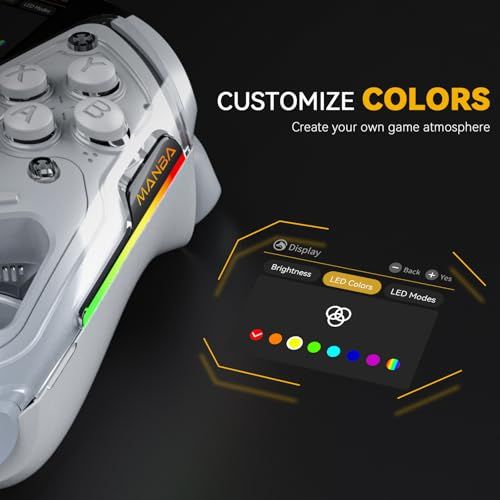
The Manba One is the cheapest controller that takes screens seriously. It launched at $70 and has tracked around $53 on Amazon recently, and its defining idea is radical: the 2-inch interactive screen replaces companion software entirely. There is no app. Stick deadzones, button remaps, macros for the four back keys, trigger tuning — everything happens on the pad, which makes it the only screen controller that is arguably easier to configure on a couch than at a desk.
The rest of the hardware is well-specced for the money: Hall Effect sticks (with two swappable stick heights in the box), linear Hall Effect triggers with stop switches, microswitch face buttons, ALPS bumpers, a 6-axis gyro, and a smart charging dock that stores the 2.4GHz dongle. Battery is 1,800mAh, good for roughly 12 hours. Platform support is broad — PC, Switch, Switch 2 (no wake), iOS, and Android.
Our full review scored it 7.5/10, and the deductions are ergonomic rather than conceptual: the grips divide owners, the triggers run short on travel, and at 295 grams it is heavier than it looks. But the screen-first design genuinely works — it is the most convincing argument yet that displays on controllers are a feature, not a gimmick. Details in our Manba One review.
Buy it if you want to try the screen format for the price of a stock first-party pad. Skip it if you have large hands or hate short trigger travel.
Turtle Beach Stealth Ultra (2023) — the clearance play
The pad that started the modern screen era is now the category's value play. The original Stealth Ultra launched at $199.99 with the 1.5-inch Connected Command Display, Hall Effect AntiDrift sticks, 5-million-click microswitches across the D-pad, face buttons, and bumpers, four mappable back buttons plus the Pro-Aim focus button, 2-position trigger stops, 10 onboard profiles, and the same magnetic rapid-charge dock and hard case formula the Ultra II ships with. At 246 grams it remains the lightest of the four pads here.
Pricing is the interesting part: it has tracked as low as about $77 in recent months, yet spiked past $210 in October when the Ultra II announcement triggered scarcity buying — evidence of how much demand this tier carries. The swing is a warning to watch the price rather than trust it.
Our review scored it 8/10 with a pointed caveat: the software was buggy at launch, and the reliability record grew noisy enough that we described it as a lottery ticket in a very nice case, best bought on sale. At $77 instead of $199.99 the risk math changes — a failure stings far less — but the advice stands. Full history in our Stealth Ultra review.
Buy it if you find it near its tracked low and want 80% of the Ultra II experience for 40% of the money. Skip it if you want TMR sticks, 8KHz polling, or a touchscreen — the gen-1 display is navigated with the pad's buttons, not touch.
What the screen actually costs you
Displays are the heaviest feature you can bolt onto a gamepad. The pattern across this table is consistent: the screenless versions of these shapes weigh less and run longer. The Ultra II is 322 grams against a 246-gram gen-1 that carried a smaller display and a smaller battery draw; its 12-hour default battery life versus 34 in Eco mode is a direct screen-and-wireless tax. The Manba One gives up roughly a third of its battery to powering a 2-inch panel and still only matches the Ultra II's 12 hours.
None of that makes screens a bad trade — swapping a profile mid-match or balancing chat volume without opening a menu is a real quality-of-life gain, and every pad here pairs its display with contactless sticks. But if you play competitive shooters where grams and battery hours matter more than configurability, a screenless specialist like the GameSir Tarantula 8K will serve you better than anything in this cluster. The screen is for players who configure; it is not for players who only play.
How we picked
Every pick here was screened on four axes: the screen has to do real configuration work, not just flash logos; the internals have to be drift-resistant (Hall Effect minimum, TMR preferred); pricing comes from our tracked Amazon data as of November 2026, with launch MSRP noted where they diverge; and owner sentiment comes from the full reviews published on this site — Amazon review patterns, Reddit threads, and press verdicts — rather than marketing claims. Products we have not fully reviewed (the Apex 5) are labeled as such and lean on the strongest available press verdict instead.
Screen controller FAQ
Do controller screens add input lag? No. The display is a configuration interface, not a stage in the input path — button and stick signals go to the console exactly as they would on a screenless pad. The Stealth Ultra II's 8KHz wired polling is measured on its inputs, screen or no screen.
Do screens drain the battery? Yes, measurably. The clearest receipt is the Stealth Ultra II: 12 hours in default mode versus 34 in Eco, with the display's brightness a major variable. The original Stealth Ultra advertised 30 hours and delivered 20 to 25 in real-world use with its smaller 1.5-inch panel.
Is there a screen controller for PS5? Not in this group. None of the four are PS5-licensed, and Sony's ecosystem restricts unlicensed pads, so PS5 players are limited to the DualSense and DualSense Edge — neither of which carries a configuration display. The PS5's own DualSense touchpad and adaptive triggers solve different problems.
Is the Turtle Beach Stealth Ultra II worth $199.99? On specification, yes — it is the most advanced screen pad made. Our 8/10 launch verdict holds one reservation: an unproven reliability record. If you buy at launch you are an early adopter; if you can wait 60 to 90 days for owner data, you lose nothing but day-one bragging rights.
Can you change settings while playing? On the pads with glanceable menus, yes — profile swaps and audio mix adjustments are the intended mid-match use. Anything involving deep menus naturally wants a pause. The touchscreen on the Ultra II makes the quick stuff genuinely quick.
What is the cheapest way to get a screen controller? The Manba One at its tracked price around $53. It is the only sub-$60 pad where the screen is the centerpiece rather than a decoration, and it ships with a dock. Flydigi's older Apex 4 sometimes dips below it on import, but support and availability are less predictable.
Are screen controllers good for competitive play? The internals can be — the Ultra II's TMR sticks and 8KHz polling are esports-grade. But screen pads skew heavy (295 to 322 grams here), and competitive players tend to prefer lighter, simpler, wired designs. A screen helps you set up faster; it does not help you aim.
The verdict
The controllers-with-screens category has sorted itself into clean tiers in 2026. The Turtle Beach Stealth Ultra II ($199.99) owns the top: a touchscreen, TMR sticks, 8KHz polling, and GateShift in an Xbox-licensed package — buy it if the spec sheet is the point, with the reliability wait as your only hedge. The Flydigi Apex 5 ($159.99) is the enthusiast alternative for PC players who want the deepest tuning cockpit and can live without console licensing. The Manba One ($53 tracked) is the rational entry point — the screen genuinely replaces an app at a first-party-pad price. And the original Stealth Ultra at its clearance low ($77) is the value play for Xbox players willing to accept gen-1 ergonomics and a spotty reliability record in exchange for most of the experience at 40% of the price.
For everyone else, the honest summary: screens have crossed from gimmick to legitimate feature, but they are still a luxury. If your budget stops at $80 and you do not configure, the best budget controllers and TMR sticks without a display will serve you just as well.
Related reading
- Best Xbox Controllers 2026 — where the Stealth Ultra II lands in the Xbox rankings
- Best TMR Controllers 2026 — the stick-technology deep dive behind the Ultra II
- Best Gaming Controllers 2026 — the master buying guide
- GameSir Cyclone 2 vs Tarantula 8K — what screenless pads do with the same money
Related Guides
Buying Guide
Best PC Controllers 2026: The Definitive Roundup
From the $19.99 budget king to the sub-millisecond esports monster — every PC controller worth buying in 2026, ranked by use case with verified specs and community sentiment.
Buying Guide
Best Gaming Controllers 2026: Every Budget, Every Platform — The Ultimate Buying Guide
The best gaming controllers 2026 has to offer at tracked prices — a $22.99 tracked Hall Effect pick, a $63.99 tracked TMR standout, the $199.00 tracked DualSense Edge — for PC, PS5, Xbox, Switch 2, and Steam Deck.
Buying Guide
Best Gaming Controllers for Mac 2026: Verified macOS Tahoe Picks
macOS Tahoe finally takes Mac gaming seriously - these six verified controllers pair, perform, and never fight the OS, from the $22.99 Hall Effect GameSir Nova Lite to the do-everything 8BitDo Pro 3.