Hogwarts Legacy Evil Ending: Complete Consequences and Sequel Theories
Introduction
Hogwarts Legacy presents players with a pivotal choice that feels monumental, but what are the real consequences of claiming the Ancient Magic for yourself? This complete breakdown cuts through the speculation to reveal exactly what changes - and what doesn't - when you choose the evil path, from immediate narrative fallout to long-term gameplay impacts and tantalizing sequel theories.
The Three Endings of Hogwarts Legacy: Complete Breakdown
The Evil Ending: Claiming Ancient Power for Yourself
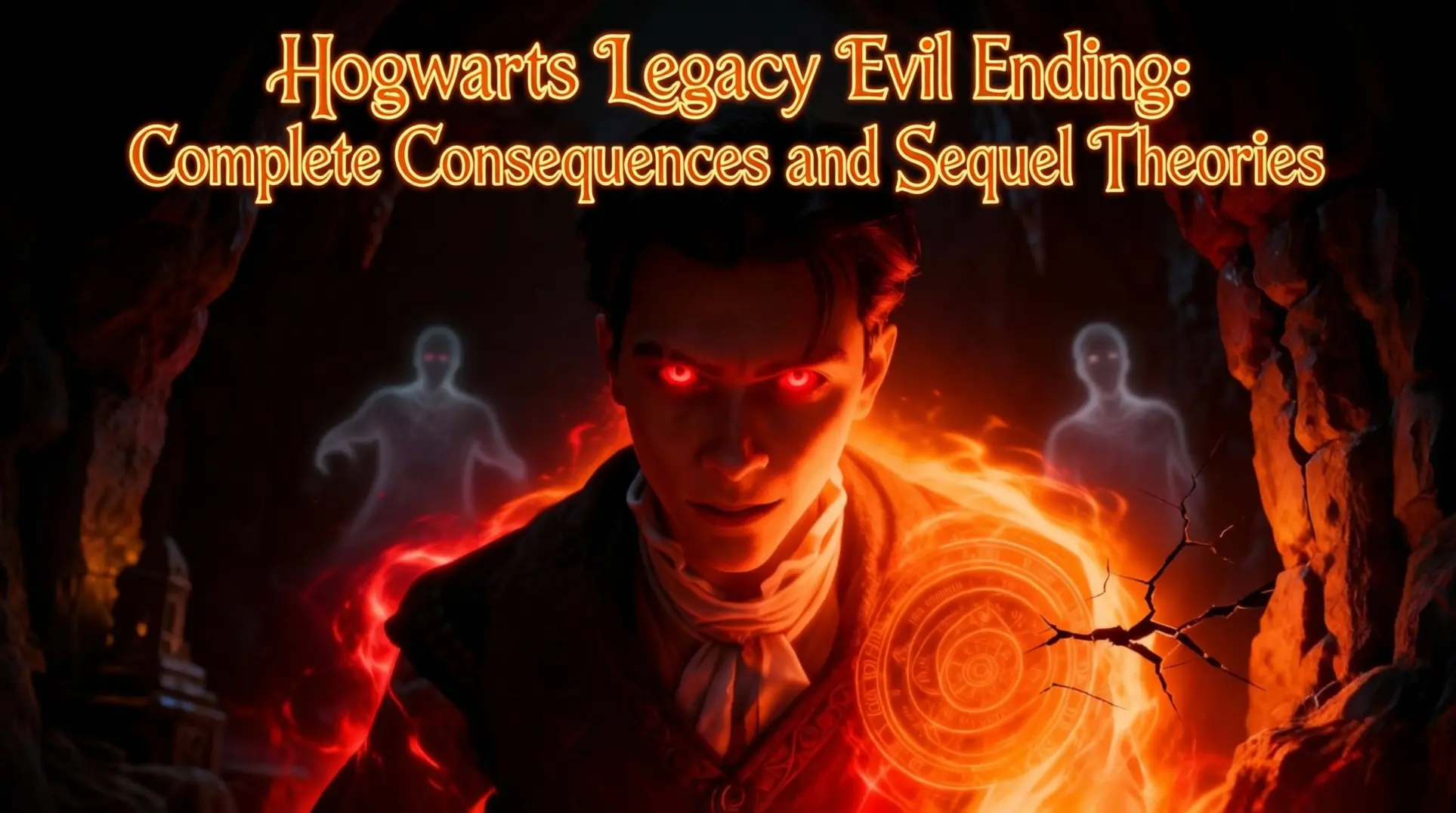
The evil ending hinges on one blunt choice during the 'Final Repository' quest. When the moment comes, you'll see the option 'I intend to open it' - and picking that is where everything goes sideways. Your character absorbs the Ancient Magic, which triggers a cinematic soaked in red lighting and those classic glowing red eyes, but here's the kicker: Professor Fig doesn't make it out, dying from falling debris as the cavern starts collapsing around you.
Unfortunately, this dark power trip is mostly cosmetic. Once the cinematic ends, that red aura and unique narration vanish, leaving your stats and gear completely untouched - you won't get any mechanical edge for being evil. You do, however, snag the silver trophy 'A Bit of a Fixer-Upper,' which is separate from the good ending's trophy, so at least there's that.
The Good Ending: Containing Ancient Magic
Taking the heroic path means picking 'I intend to keep it contained here' during that same pivotal moment. That choice seals the Repository, and your character becomes the new Keeper of Ancient Magic. Professor Fig still dies, but it's a noble sacrifice while sealing the magic - not the sudden debris strike from the evil path. The ending feels more narratively complete, and you get the silver trophy 'The Good Samaritan' to mark the occasion.
The True Ending: Post-Game Completion Requirements
Now, for the real capstone - the so-called 'true ending.' After you finish either main ending, there's one last hurdle: you need to hit Level 34 and complete all four Keeper Trials. Do that, and you'll unlock the 'House Cup' quest, which triggers an extended epilogue. This epilogue wraps up the school year and nods to your earlier choice, but here's the twist: the true ending is identical on both paths. Only the dialogue shifts slightly based on whether you contained or opened the Repository.
Post-Credits Scene: Sebastian vs Ominis Cameo
There's also a post-credits cameo that hinges on your Sebastian Sallow decision. To see it, you need to finish 'In the Shadow of Friendship' after completing 'In the Shadow of Fate.' Your earlier choice determines who appears: turn Sebastian in, and a remorseful Ominis shows up; lie to Ominis and spare Sebastian, and Sebastian himself makes an appearance. It won't alter your ending or give you any bonuses - it's purely a narrative epilogue for that specific storyline.
Sequel Theories: Narrative & Gameplay Consequences
Sequel speculation is where things get really juicy. One major theory suggests a 50-year jump to the 1940s, which would cast your evil protagonist - still unpunished and powerful - as a potential foil or mentor to a young Tom Riddle. That's a dark timeline. Other fans think Avalanche might revive a scrapped crime-and-punishment wanted system, finally making your Repository choice matter with real consequences like Ministry bounties. The 'Heir of Ranrok' theory is another favorite: surviving goblin loyalists hunt you relentlessly, pushing a fugitive narrative where you're constantly on the run. And then there's the wishlist stuff - like an internal-corruption mechanic where that absorbed Ancient Magic taints your spells permanently, turning Incendio into something twisted. Some folks even hope for a redemption-or-ruin fork, letting you either purge the darkness for an Auror skill tree or commit fully and unlock an Unforgivable-exclusive talent row.
Immediate Consequences of Choosing the Evil Path
Professor Fig's Fate: A Darker Demise
The biggest gut punch in the evil ending isn't what you see - it's what you don't. While the good ending gives you a proper goodbye with Professor Fig dying in your arms after sealing the Repository, the evil path just... cuts him out, literally. The camera fades to black after you choose those red dialogue options, and Fig never appears in the final cinematic. His fate is left unresolved, and that narrative absence hits harder than any separate death scene could. You're left alone with your ambition, and the game makes sure you feel that isolation.
Visual Changes: Dark Aesthetics & Cosmetic Rewards
If you were expecting to strut around Hogwarts looking like a full dark wizard, I've got some bad news. The only visual change is a brief red-eye effect that lasts about six seconds during the evil ending cutscene, and then it's gone. The game doesn't grant any permanent corrupted appearance or transmog for your character, so whatever robes you had equipped before the final battle - that's what you'll keep seeing. The Dark Arts Cosmetic Set stays locked behind its own DLC, and no, the game won't auto-equip it to match your new villain status.
Relationship Fallout: Who Abandons You
You'd think betraying everything your professors taught you would make your companions furious, right? Well, the game doesn't actually show any fallout. Poppy Sweeting and Natty Onai never call you out or abandon you, because they simply don't acknowledge your choice at all. There's no post-credit scene where Sebastian Sallow cheers you on either. In fact, companion reactions aren't tracked globally after the finale - you can reload your pre-final-battle save and chat with them like nothing happened. No unique dialogue, no awkward tension - nothing changes.
Achievement Unlocks: 'A True Slytherin' Trophy
On PlayStation, choosing evil does net you something tangible: the 'A True Slytherin' silver trophy. The name is a bit misleading since it isn't restricted to Slytherin characters - you can earn it as any house. It triggers during the post-credit stat screen once you've met all the requirements. You'll need to complete the main story, finish Sebastian's relationship quests, learn all three Unforgivable Curses, and then select that red dialogue option in the Repository. It's a checklist of darkness that rewards your betrayal.
Long-Term Gameplay Impacts: What Actually Changes
Post-Game World State: What Stays the Same
Here is the thing about Hogwarts Legacy: once you have seen the credits roll, the game quietly rewinds time to a few minutes before that final confrontation. This means you are dumped back into a post-story sandbox where every quest marker, collection log, and hidden cave remains exactly where you left it. The world does not move on without you, but it does get weirdly frozen in place.
Let us clear up what that actually looks like:
| What You Might Expect | What Actually Happens |
|---|---|
| NPCs acknowledge your epic victory | They return to their pre-finale routines, acting like nothing happened |
| The final dungeon stays open for farming | The map icon for the last dungeon re-locks itself completely |
| Seasons continue to cycle naturally | Snow is gone forever from the Highlands, and those Halloween decorations in Hogsmeade stay up indefinitely |
| The world empties out after you clear everything | Goblin camps, Ashwinder dens, and Poacher outposts respawn every 3 days, scaled to your current level |
So while the Main Story quests get marked as completed, the living world part is more of a time capsule. Your companions keep the same dialogue loops, vendors do not care about your achievements, and the seasonal weather is locked permanently. That can feel immersion-breaking if you are the type who wants your actions to matter. Luckily, the combat zones keep refreshing on that three-day timer, which means you will always have something to fight if you are chasing challenge or just want to test new spell combos on scaled enemies.
Mechanical Parity: No Power Advantage
Let us kill a myth right now: choosing the evil ending does NOT turn you into some overpowered dark wizard. There is no hidden power spike, no secret spell list, and your save file does not even get flagged as 'evil.' Your character level stays exactly where it was, you will not unlock any hidden talent points, and all those spell damage values, cooldowns, and Ancient Magic meter speeds remain identical to what they were before touching the Repository.
Here is what that actually means in practice:
Spell Sets: You still cap out at six, not seven, so no extra loadout slot for your new corrupted spells
Gear: That level-40 ceiling does not budge, and you will not find any 'dark' legendary gear with boosted stats
World Reactions: Professors greet you the same way, vendors do not raise prices, and companions do not suddenly fear you
The only thing that changes is the final cutscene and maybe how you feel about your character. Mechanically speaking, you are controlling the exact same wizard you were before making that choice. So if you were hoping for a New Game+ style advantage where you start stronger, you will be disappointed. The system treats both endings as purely narrative choices with zero gameplay impact, which means your build and power level remain completely unchanged.
Map Chamber Lockout: Permanent Story Barrier
During the final boss fight, the Map Chamber's floor cracks open and reveals that cylindrical shaft leading down to the Final Repository. Once you descend, the game auto-saves and locks you into the endgame choice sequence, which feels appropriately final. But here is where it gets weird: after the credits roll and you respawn back in the castle, the Map Chamber itself is completely intact and you can revisit it anytime you want.
The only permanent damage is that circular fracture in the floor, but it does not actually block re-entry to the chamber. You can still walk around, admire the portraits, and use it as a fast travel point. What you cannot do is go back down into the Repository or replay that final confrontation without starting an entirely new save file. The shaft is effectively sealed off after your decision, so think of it as a one-way door.
This means the chamber remains accessible for nostalgia trips or screenshot sessions, but that epic final arena? It is a memory now. If you want to experiment with the other ending, you would need to load a manual save from before the descent or start fresh. The game makes sure you cannot flip-flop between choices on a whim, which keeps your decision feeling meaningful even if the mechanics do not change.
Sequel Theories: How Your Evil Choice Could Shape Future Games
The Corruption Arc: Ancient Magic as Narrative Poison
Here's the thing about Ancient Magic: the game already built a poison meter, then never switched it on. Dataminers dug up cut variables in the day-one build - a hidden morality tracker, escalating facial scar textures that get worse as you cast, and unique combat barks that only trigger when you hit 75% 'Ancient Magic saturation.' So the system was there, just dormant. That feels suspicious, especially when you look at what happened to Isidora Morganach. She started with good intentions, siphoning painful memories to heal others, but slowly escalated to extracting emotions from unwilling subjects until the Keepers decided she was too dangerous to live. Sound familiar? It should, because even if you never touch an Unforgivable, Professor Fig's ghost drops that line about how 'Ancient Magic will tempt you again… and next time there may be no one to stop you.' The voice file plays regardless of your choices, which means the writers baked in a warning they intend to pay off later. Fans have connected the dots and think repeated Ancient Magic triggers micro-fractures in your wand-brain barrier, causing personality drift that could eventually force companion ultimatums or worse. And here's where it gets wild: some theorize the castle itself is semi-sentient and could turn on you, overwriting protective enchantments to trap bullies or even forcing former friends into a living-staircase boss fight. It's a lot, but the precedent is right there in the code.
Timeline Possibilities: Riddle Era vs Grindelwald Gap
Picking a sequel setting is basically choosing between nostalgia and narrative freedom. If Avalanche wants to keep your fifth-year protagonist and their crew, the 1890-1900 window lets them finish dangling threads like Ranrok's allies while still giving Grindelwald a cameo, though he'd barely be a threat yet. But that's the safe play. The 1907-1914 era is more interesting: your cast stays fresh while showing Grindelwald's first quiet power-grabs across Europe, which means you could foil - or aid - a rising Dark Lord before he's infamous. Jumping to the 1920s-1945 opens the floodgates: wizarding Paris, Berlin, Ilvermorny exchanges, plus recognizable faces like young Dumbledore and Nicolas Flamel without rewriting history. That's the sweet spot for most fans because you get lore touchstones without being shackled to them. Then there's the 1930s-1940s option, which is darker but tempting - players could discover or even help create the artifacts that young Tom Riddle weaponizes decades later, giving the whole story a 'we made this monster' twist. The only timeline most people seem to hate is post-1998, since freeing the writers from lore handcuffs also makes Riddle and Grindelwald irrelevant, which defeats the point of playing in this world. Each choice carries weight, but the Grindelwald gap feels like the winner.
Datamined Evidence: 'HL2_Prologue' & Corruption Mechanics
The smoking gun isn't a rumor - it's right there in the code. Dataminers found an 'HL2_Prologue' flag sitting in the same section that gates the PlayStation-exclusive 'Haunted Hogsmeade' quest, which suggests it's either premium DLC or a free update acting as a bridge to the sequel. That alone is exciting, but the real meat is the 'Dark_Notoriety' variable. It runs from 0 to 5 and checks every single time you cast an Unforgivable, meaning a reactive morality system was at least partially implemented. At threshold 3, shopkeepers in Hogsmeade allegedly refuse service while black-market vendors slap a 20% 'fear markup' on their goods. Hit threshold 5, and Aurors start spawning in the open world to hunt you down. That's not just a reputation system - that's a gameplay shift. The prologue package also imports a new animation graph called 'Rookwood+' and spells like 'Protego_Duo' and 'Apparate_Short', neither of which exist in the 2023 release. And if that's not enough, there's a map icon labeled 'Ministry_Atrium_Level_2' that you can't access anywhere in the current game, fueling speculation that the prologue briefly puts you in an Auror's shoes before yanking you back to fifth-year. All of this points to a sequel that remembers exactly how evil you were.
Multi-Protagonist Theories: Portrait Network Trilogy
So how do you keep your original protagonist's choices intact while still moving to a new era and cast? The answer might be hanging on Hogwarts' walls. The theory goes that animated portraits become narrative hubs, where each new protagonist serves as the 'living anchor' for one portrait, letting you resume their story with all decisions preserved. You'd walk a gallery corridor where completed portraits chatter, offer side-missions, and unlock cross-era puzzles - like planting a seed in 1890 and harvesting it in 2020. This solves the sequel's biggest problem: it needs a fresh protagonist and time setting to introduce new companions without being tethered to the first game's canon, but fans don't want their evil choices erased. The portrait system lets you have both. Recent job listings back this up, calling for 'compelling backstories & growth arcs - goodbye, one-dimensional NPCs' while teasing canon characters with emotional depth across multiple eras. And thanks to Unreal Engine 5's Nanite and Lumen tech, each portrait can pre-stream its bespoke locale only when selected, keeping memory overhead sane. It's an elegant solution: your corrupted fifth-year isn't the main character anymore, but their portrait is still watching - and maybe still whispering dark suggestions to whoever stands in front of it next.
What the Evil Ending Means for Wizarding World Lore
Connection to Dark Wizards: Proto-Voldemort Parallels
Here's the thing about the evil ending - it gives you a taste of being a proto-Dark wizard, but you're not exactly building a Voldemort-style empire. You can sling Unforgivable Curses all day, but you're still stuck as a fifth-year student worrying about O.W.L.s. The game actually makes it pretty simple: at the very end, you just pick the ominous dialogue options with Professor Fig - tell him you intend to open the repository and claim the power for yourself. That's it. No elaborate betrayal montage, no recruiting followers.
The Voldemort parallels are mostly visual. The evil-ending cutscene bathes you in swirling red and black energy, which looks suspiciously like the Dark Lord's signature spell palette. It's a neat aesthetic nod, but that's where the similarities stop. You won't be declaring war on the Ministry or assembling a Death Eater cult. The hard limit is clear: you remain bound to the Hogwarts framework, and the game flat-out doesn't let you become canonically evil or rise as a proto-Voldemort, no matter how many Crucios you cast.
Ministry of Magic Implications: Pre-Auror Department Era
Now let's speculate on what your choice means for the Ministry of Magic. Hogwarts Legacy takes place in 1890-1891, a pivotal decade when the British Ministry's Auror Office was settling into Level Two of their new underground complex. These Aurors weren't just uniformed cops - they were elite, plain-clothes specialists who hunted Dark Arts practitioners, working alongside Hit Wizards, Magical Law Enforcement Patrol, and Witch Watchers.
Dark wizard factions are already crawling across the map. Groups like the Ashwinders and Victor Rookwood's loyalists drop Dark Arts reagents you can hand in at the Auror Office for bounties. The Ministry is on high alert, especially after the 1889 'Dark Artefacts Prohibition Amendment' gave Aurors power to conduct no-warrant searches if an Unforgivable gets cast nearby. That law alone pushed some spell-casters straight into Rookwood's camp, so imagine what would happen if the Ministry discovered a fifth-year student hoarding a living repository of Ancient Magic.
That would violate countless magical statutes and immediately draw scrutiny from the Department of Mysteries. It wouldn't just be a slap on the wrist - it could reshape Auror training entirely, pushing it toward the longer, more rigorous 36-month programs we see in later years. Your character wouldn't just be a troublemaker; they'd be a walking magical WMD in an era that's still figuring out how to regulate Dark Arts.
The Keepers' Legacy: Breaking Their Sacred Trust
The real weight of the evil ending lands on the Keepers' legacy. Percival Rackham, Charles Rookwood, Niamh Fitzgerald, and San Bakar formed a secret society specifically to guard Ancient Magic - they erased written records and concealed the repository beneath Hogwarts to protect it from exactly someone like... well, you.
When you choose those ominous dialogue options - 'I intend to open it' or 'This power should not be kept from the world' - you're not just being selfish, you're shattering their Unbreakable-level oath. The cutscene shows you absorbing a fragment of Ancient Magic directly, which frames the decision as morally grey. You're not necessarily a pure villain; you're asserting autonomy against centuries of paternalistic secrecy.
But here's the kicker: mechanically, nothing changes. Your spells, gear, and post-game exploration remain identical. The only real consequence is your title card shifting to 'Ancient Magic's NEW Keeper,' which implies possession rather than stewardship. It's a subtle but important distinction - you're not guarding the magic anymore, you're hoarding it.
And that choice doesn't exist in a vacuum. The game seeds several sequel hooks that never pay off: a potential Ministry investigation into a living repository, deeper goblin retaliation, and even Keeper ghost 'echoes' that could haunt you. None of it gets resolved, which makes the evil ending feel less like a conclusion and more like a dangerous loose thread in magical history.
Making the Choice: Practical Guide for Players
Save Strategy: How to Experience All Endings
If you want to see every ending without grinding through a whole second playthrough, here's the trick: make one manual backup right before 'The Final Repository.' The game autosaves beforehand, but here's the catch - hitting 'Continue' just reloads the ending you already picked, which means you're locked in unless you planned ahead.
On PS5, shove a USB drive in and copy your save data; on Xbox, make sure you're connected to the network for cloud backup; PC players, dig into your AppData folder and copy that folder somewhere safe. Label it 'Pre-Final-Choice' so you don't confuse it later. Once that's done, you're free to pick an ending, watch the credits, then reload your backup and try the next one. You can cycle through Normal, Evil, and True Dark in under 30 minutes this way.
Roleplay Alignment: Which House Benefits Most
You might think rolling Slytherin unlocks some secret evil path, but that's not how it works. Hogwarts Legacy doesn't have a morality system, which means your house choice is pure flavor - a Slytherin who spammed Avada Kedavra can still pick the good ending, and a Hufflepuff can absorb the Repository's power. There's no mechanical payoff for staying in-character.
The community's pretty split on this. A lot of players felt let down because even if you go full dark lord, the post-game world doesn't react. NPCs still treat you the same, which makes the evil ending feel hollow regardless of house. So if you're picking Slytherin hoping for a unique villain arc, you'll be disappointed.
True Ending Compatibility: Can You Get All Three?
Here's some good news: you don't have to agonize over missing the True Ending. Whether you contained the power or went full dark lord, 'The House Cup' quest unlocks either way - it's not locked behind the 'good' choice. Once you hit Level 34 after the main story, the quest appears.
The True Ending is basically a unified epilogue that pretends you saved the school no matter what. So if you're worried that picking the evil ending locks you out of the 'real' conclusion, don't be. You can have your dark-curious cake and eat it too.
Conclusion
Ultimately, the 'evil' ending in Hogwarts Legacy is a narrative choice with profound thematic weight but minimal mechanical impact. While it sets the stage for a potentially darker future, your current world remains largely unchanged. The true power of the choice lies in the story you tell and the legacy you might shape for a sequel.
More hogwarts-legacy-the-collected-edition Guides
Mastering the Room of Requirement - The Ultimate Gold & Potion Factory Guide
Transform your Hogwarts Legacy workshop into a hyper-efficient gold mine. Learn the 90-second circuit, vertical layouts, and beast breeding loops to maximize your conjuration budget and profit per minute.
Hogwarts Legacy Editions: The Complete Guide to Standard, Deluxe, and Collector's
Debunking the 'Collected Edition' myth. A definitive breakdown of every Hogwarts Legacy version, their real value, and how to get all the content.
Hogwarts Legacy Hard Mode Guide: Builds, Talents, and Survival Strategies
Master Hogwarts Legacy Hard Mode with essential talents, gear optimization, and S-tier builds like Dark Arts Curse Tyrant. Survive and dominate the toughest challenges.
AI Tactical Companion
Consult with our specialized tactical engine for hogwarts-legacy-the-collected-edition to master the meta instantly.