Turtle Beach
Turtle Beach Stealth 500 Review
Good
$69.98
The best-value wireless headset in Turtle Beach's Stealth line: featherlight comfort, bold 40mm sound, dual wireless, and a 40-hour battery at a $70-80 street price. A noisy reliability and connectivity record — plus no wired backup — is the price of entry. 7.5/10.
As an Amazon Associate we earn from qualifying purchases made through links for Turtle Beach Stealth 500.
connectivity
2.4GHz wireless (USB-A dongle) + Bluetooth 5.2 with QuickSwitch
drivers
40mm dynamic
frequency_response
20Hz - 20kHz
impedance
32 ohm
Pros & Cons
Pros
- Featherlight ~235g frame with near-absent clamp pressure — the consensus comfort standout across owners, Reddit, and every press review; lighter than the Stealth 600 Gen 3 and Arctis Nova 7X
- Dual 2.4GHz + Bluetooth 5.2 with one-touch QuickSwitch at a price where most rivals offer one connection or the other
- Bold, balanced 40mm game audio with strong spatial cues; dialogue stays clear over busy mixes
- Good built-in mic for the class — RTINGS' lab measurements praise recording quality and background-noise handling
- 40-hour battery with genuinely useful quick charge (roughly 15 minutes for several hours)
- Swarm II app offers 10-band EQ, four presets, and mic tuning — more software than headsets at twice the price
Cons
- Reliability is the elephant in the room: a persistent minority of owners report mics failing or self-muting, dongle dropouts, and units dying within months
- No wired mode at all — no 3.5mm jack, so a dead battery means no audio
- Battery halved versus the Stealth 600 Gen 3 (40h vs 80h); PC Gamer measured closer to 30 hours in practice
- Fixed one-piece headband with non-swiveling, non-adjustable earcups — larger heads may not fit, and leatherette cups run hot in long sessions
- Weak passive isolation with no ANC — shared spaces and open windows leak in
- Cluttered left-earch control cluster: five controls, two identical wheels side by side, easy to mis-press
- Audible static hiss over Bluetooth when audio is paused (Tom's Guide and TechRadar both reported it)
Overview
The Turtle Beach Stealth 500 is the entry point of the company's third-generation Stealth wireless lineup, launched in May 2024 alongside the Stealth 600 and 700 Gen 3. At a $79.99 MSRP that regularly drops to $69-75 at retail, it exists to answer one question: how much of the Stealth 600 experience survives a $20 haircut? Based on two years of press coverage and owner feedback, the answer is "most of it" — comfort, sound, and feature depth punch well above the price tag, but the corners that were cut are exactly the ones that matter for long-term ownership.
It ships in three platform flavors (Xbox, PlayStation, and PC), each pairing a low-latency 2.4GHz USB dongle with Bluetooth 5.2, 40mm dynamic drivers, a flip-to-mute omni-directional microphone, and a claimed 40-hour battery. The pitch is straightforward: entry-level wireless that doesn't feel entry-level in the hand. The Amazon listing for the Xbox version carries a 4.3-star average across nearly 4,800 ratings and an Amazon's Choice badge, with the headset sitting at #2 in Xbox Series X|S accessories — strong commercial validation for a $70-80 product.
Press reaction has been broadly positive with a consistent asterisk. IGN scored it 8/10, praising "bold and balanced sound" and comfort; Tom's Guide gave it 4/5 as "a wallet-friendly wonder"; PC Gamer landed at 78/100, calling it a budget headset that "makes many of the right sacrifices." The cooler takes — GamesRadar+ and TechRadar both at 3/5 — all point at the same suspects: clustered controls, cheap-feeling materials, and reliability quirks. That split is the story of this headset: a genuinely excellent value that you buy with your eyes open.
Build Quality and Design
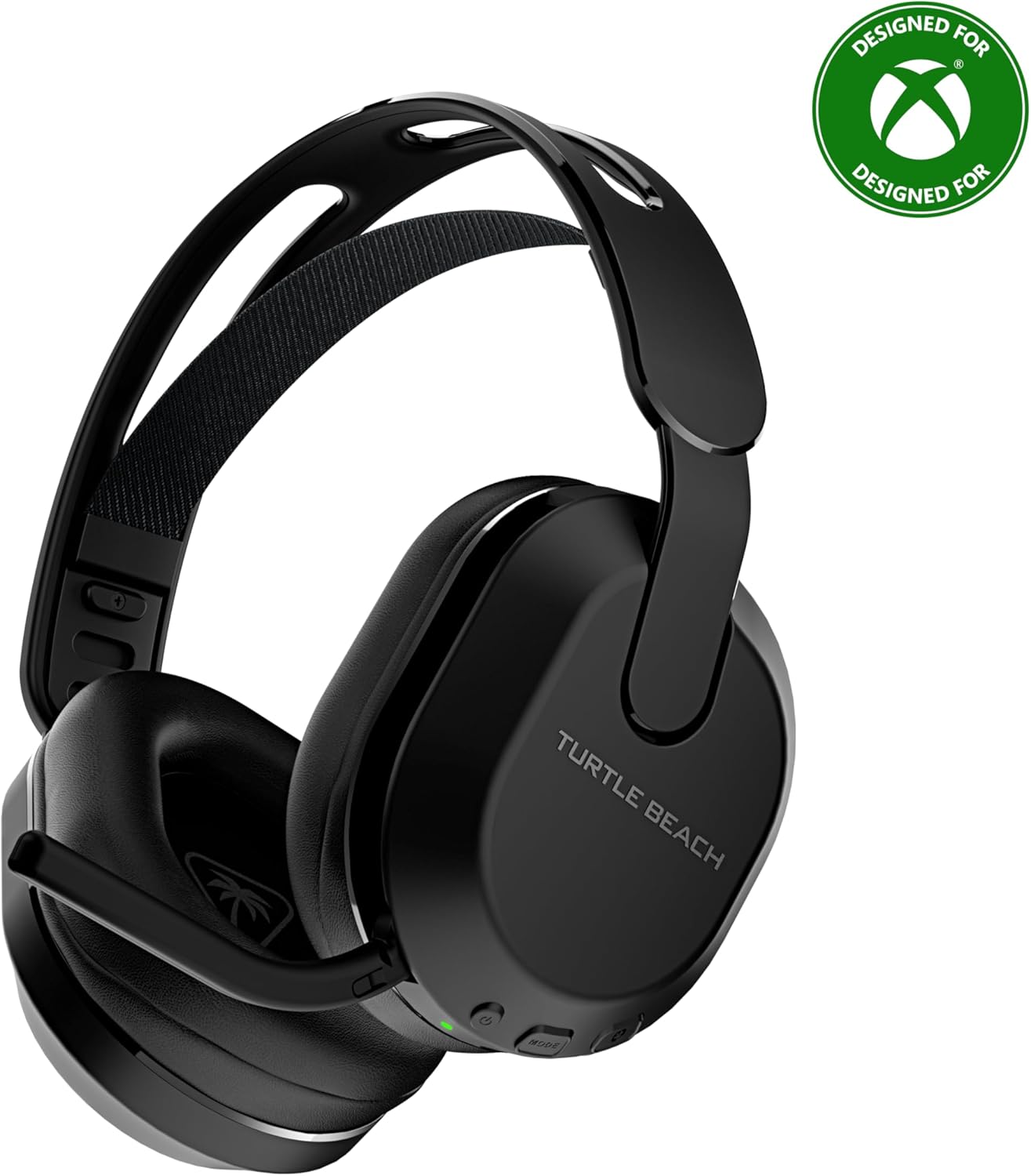
The Stealth 500's design DNA comes straight from the Stealth 600 Gen 3, but the cost-cutting shows up in the materials. The one-piece headband is plastic rather than metal, and instead of adjustable metal sliders you get a fixed frame with a floating elastic suspension strap clipped onto notched toggles on either side. The strap can be repositioned across three notches per side or removed entirely for larger heads, which Tom's Guide found easier to adjust than the SteelSeries Arctis Nova 5's equivalent. Once you've set it, though, that's it: the earcups do not swivel, there is no height adjustment, and the cups don't rotate to lay flat for travel. PC World's reviewer was blunt about the trade-off — the band is flexible enough to "do the splits without snapping," but the lack of adjustability means finding the perfect fit takes some negotiation.
What the design absolutely nails is weight. At roughly 235 grams (Amazon lists 230g), it's lighter than the Stealth 600 Gen 3 and even the SteelSeries Arctis Nova 7X, and the clamp force is unusually light for a gaming headset. PC World called the near-absent clamp pressure "a great paradox" — the cups hug rather than squeeze, yet still form an effective passive seal. The deep memory-foam earcups wrapped in breathable leatherette are the consensus highlight; IGN noted no ear discomfort even after three continuous hours. The flip side is that leatherette holds heat: Tom's Guide reported sweating after about three hours of wear, GamesRadar+ described the cups "growing hot and slightly claustrophobic" in longer sessions, and one Amazon reviewer wished the headband top were padded instead of elastic. If you run hot or play marathon sessions in a warm room, this is a real consideration — mesh-cup rivals like the Stealth 600 Gen 3 handle heat better.
The visual design is understated: a matte finish with a thin shiny ring around ear-shaped cups, in black, white, or Arctic Camo. PC Gamer's reviewer, normally allergic to gamer aesthetic, called it "subtle." It doesn't fold flat and ships without a case, so it's not a travel headset, and RTINGS flagged the bulky proportions for anyone considering it for commuting. But as a desk-and-couch companion, the build reads as exactly what it is: a well-designed budget product that will survive normal use, with the durability ceiling you'd expect at the price.
Key Features
- Dual wireless with QuickSwitch: A 2.4GHz dongle for low-latency console/PC play plus Bluetooth 5.2 for phones, tablets, and Switch — toggled with a single button on the left earcup. Turtle Beach lists the 2.4GHz audio latency at 15ms, and this dual-mode flexibility is a genuine rarity at $70-80.
- 40-hour battery with quick charge: Twice the runtime of the Razer BlackShark V2 Pro at nearly double that headset's price, per TechRadar's comparison. A roughly 15-minute top-up buys several more hours — PC Gamer singled out the fast charge as a standout. Note the asterisk: PC Gamer's testing put real-world runtime closer to 30 hours than the claimed 40.
- Swarm II companion app: Desktop and mobile versions offer a 10-band EQ, four audio presets (Signature Sound, Bass Boost, Bass + Treble Boost, Vocal Boost), Superhuman Hearing, microphone sensitivity and noise-gate controls, variable mic monitoring, and an auto-shutdown timer. Tom's Guide noted this feature set "puts some premium headsets to shame" — the Audeze Maxwell's app, at $299, adds far less.
- Flip-to-mute omni-directional mic: The boom tucks neatly into the left earcup edge, mutes when flipped up, and can be angled toward the mouth. RTINGS measured the recording quality as "very good" — a flat response across the vocal range with solid voice-versus-background separation.
- Superhuman Hearing: Turtle Beach's sound preset that amplifies footsteps or gunshots at the expense of everything else. Tom's Guide found the footsteps mode genuinely clutch in Alan Wake 2's stealth sections; IGN's reviewer called it artificial and of marginal competitive value. Optional either way.
- Four on-ear EQ modes: Signature Sound, Bass Boost, Bass + Treble Boost, and Vocal Boost are switchable without the app — the Signature Sound preset is the one press reviewers consistently recommend.
Performance
The Stealth 500's audio tuning is where it punches hardest. RTINGS' measurements describe a bright signature with bass slightly underemphasized (-1dB) and treble slightly emphasized (+1dB) — a V-shaped game-first tuning that press reviewers uniformly found lively. IGN's reviewer called the Signature Sound profile "bold and balanced," with clean bass and solid mids at reasonable volumes; Tom's Guide highlighted excellent dialogue clarity over busy battle music in Baldur's Gate 3 and effective spatial imaging in Alan Wake 2. The limits appear at the extremes: IGN heard highs get harsh at louder volumes, and GamesRadar+ noted a muddied lower mid-range in busy mixes. PC World's take was that the 40mm drivers deliver "an unpretentious sound that's not too overzealous" — well-suited to RPGs and adventure games rather than pure competitive twitch shooters, though Superhuman Hearing covers the footstep-hunting case.
Microphone performance splits opinion more than any other spec. RTINGS' lab testing was impressed — "very good" recording quality with strong background-noise handling. Tom's Guide found recordings muffled and unspectacular, adequate for squad chat but a tier below the Arctis Nova 5's mic, and PC Gamer described the mic connection as fragile. That's the press picture. The owner picture is noisier: across Amazon feedback and community threads, the mic is the most common failure point — reports of mics that stop working within weeks, self-muting flip switches, and teammates who "can't hear me" recur throughout low-star reviews, alongside a smaller group of owners who report the mic sounding great for years. The honest summary: when it works, it's a good mic for the class; when it doesn't, it's the most likely component to fail, and that split is the headset's biggest reliability concern.
Wireless performance is similarly two-faced. The 2.4GHz dongle delivers the low-latency, stable connection you'd expect — PC Gamer praised "great wireless connectivity," and RTINGS rated the control scheme very good. But the dongle is USB-A only, which means awkward console placement (PS5's front port is USB-C) and an adapter needed for handheld Switch play. Tom's Guide experienced two full audio dropouts mid-game that took about five minutes to auto-reconnect, and Amazon reviewers describe dongle quirks like two headsets occasionally grabbing each other's connection. Bluetooth adds a known quirk: both Tom's Guide and TechRadar reported an audible static hiss over Bluetooth when audio is paused — Tom's Guide confirmed it across two separate units, so treat it as a firmware-level trait rather than a defective sample.
Battery life mostly delivers. IGN's reviewer ran roughly 30 hours of mixed use across three days and landed at 17%, calling the 40-hour claim accurate. PC Gamer's unit came in closer to 30 hours. Either way, it's a strong result for the price — just don't expect the Stealth 600 Gen 3's headline 80 hours, and remember there's no wired fallback: the headset has no 3.5mm jack whatsoever, so a dead battery means silence until it charges.
Pros and Cons
Pros:
- Featherlight ~235g frame with near-absent clamp pressure — the consensus comfort standout across owners, Reddit, and every press review; lighter than the Stealth 600 Gen 3 and Arctis Nova 7X
- Dual 2.4GHz + Bluetooth 5.2 with one-touch QuickSwitch at a price where most rivals offer one connection or the other
- Bold, balanced 40mm game audio with strong spatial cues; dialogue stays clear over busy mixes
- Good built-in mic for the class, with RTINGS' lab measurements praising recording quality and noise handling
- 40-hour battery with genuinely useful quick charge
- Swarm II app offers 10-band EQ, four presets, and mic tuning — more software than headsets at twice the price
Cons:
- Reliability is the elephant in the room: a persistent minority of owners report mics failing or self-muting, dongle dropouts, and units dying within months — Amazon's own review breakdown sits near a coin-flip on reliability
- No wired mode at all — no 3.5mm jack, so a dead battery means no audio
- Battery is halved versus the Stealth 600 Gen 3 (40h vs 80h), and PC Gamer measured closer to 30 hours in practice
- Fixed one-piece headband with non-swiveling, non-adjustable earcups — larger heads may not fit, and the leatherette cups run hot in long sessions
- Weak passive isolation with no ANC — RTINGS rated noise isolation poorly, so shared spaces will leak in
- Cluttered left-earch control cluster: five controls, two identical wheels side by side, and a QuickSwitch button easy to hit when reaching for power
- Audible static hiss over Bluetooth when audio is paused, reported by both Tom's Guide and TechRadar
Who Should Buy This
Buy the Stealth 500 if you want a sub-$80 wireless headset for console or PC and comfort is your top priority — it is, by a wide margin, the lightest and least clamp-heavy wireless option in its price tier, and the dual-wireless setup lets you hop between console, PC, and phone without unplugging anything. It's an especially strong fit for casual and mid-level multiplayer players who want good positional audio and reliable chat without spending Stealth 600 money.
Skip it if you need any of the following: a wired backup for dead-battery emergencies (there is no 3.5mm jack), active noise cancellation or strong isolation for loud households (there is neither), more than 30-40 hours between charges (the Stealth 600 Gen 3 doubles that), or a fit that accommodates very large heads (the fixed band tops out quickly). Anyone whose last headset died young should also weigh the reliability reports carefully — most units are fine, but the failure stories cluster in the first months of ownership. If the mic and dropouts are deal-breakers, a wired headset like the HyperX Cloud Stinger 2 removes both failure modes for less money.
Alternatives to Consider
- Turtle Beach Stealth 600 Gen 3 ($79-90 street): The 500's big sibling and the site's top-rated budget wireless pick at 8/10. For roughly $10-20 more you get double the battery (80 hours, RTINGS-measured at 85+), a better AI noise-cancelling mic, easier controls, and mesh earcups that stay cooler. The 500 only wins on weight and price — if the budget stretches, the 600 is the better buy, which is exactly why GamesRadar+ framed the 500 as "a plug for those who can't quite meet that $99.99 price tag."
- Logitech G535 LIGHTSPEED (~$70): RTINGS' go-to comparison — the G535 is more comfortable for long sessions and cheaper, with better build quality, but loses to the Stealth 500 on microphone quality, Bluetooth (the G535 is dongle-only), battery, and app support. If you're PC-only and never use Bluetooth, it's the value play; multiplatform users should take the Turtle Beach.
- HyperX Cloud Stinger 2 (~$40-50 wired): The budget wired alternative Tom's Guide compared directly, praising its more intuitive controls. It trades away wireless entirely for lower price and none of the connectivity failure modes — the right call for players who hate charging and want maximum reliability per dollar.
Verdict
The Turtle Beach Stealth 500 is the best-value headset in Turtle Beach's current Stealth line, and one of the better sub-$80 wireless headsets money can buy — full stop. The comfort is class-leading, the 40mm sound is bold and well-tuned for games, the dual-wireless setup is a genuine feature at this price, and the Swarm II app embarrasses more expensive competitors. On its own terms — an entry-level wireless headset that redefines what entry-level means — it largely succeeds, which is why IGN and Tom's Guide both recommend it without hesitation.
The hesitation comes from the record, not the first impression. The reliability split in owner feedback — mics that die, dongles that drop, units that fail within months — is real and persistent enough that Amazon's own sentiment breakdown treats it as a coin flip. The battery is half of its sibling's, there's no wired fallback, and the fixed headband won't fit everyone. None of these are disqualifying for the right buyer; all of them are worth knowing before you click buy.
At $69-80, the Stealth 500 earns a 7.5/10. It's the pick for budget-conscious console and multiplatform gamers who prioritize comfort above all — just buy from a retailer with a good return window, and if the budget can stretch $20 further, the Stealth 600 Gen 3 remains the safer, longer-lasting upgrade.
What the Experts Say
Professional review consensus for this product
Full Specifications
| connectivity | 2.4GHz wireless (USB-A dongle) + Bluetooth 5.2 with QuickSwitch |
|---|---|
| drivers | 40mm dynamic |
| frequency_response | 20Hz - 20kHz |
| impedance | 32 ohm |
| latency | 15ms (claimed, 2.4GHz) |
| battery | 40 hours claimed (PC Gamer measured ~30h); quick charge |
| microphone | Omni-directional flip-to-mute with variable mic monitoring |
| weight | 230-235g |
| ear_cushions | Memory foam, leatherette (non-swiveling, non-adjustable) |
| compatibility | Xbox Series X|S / PS5 / PC / Nintendo Switch / mobile via Bluetooth (varies by version) |
| app | Swarm II (10-band EQ desktop, streamlined mobile) |
| headphone_jack | None — wireless only |
| noise_control | Passive only; no ANC |
The Verdict: Good
The best-value wireless headset in Turtle Beach's Stealth line: featherlight comfort, bold 40mm sound, dual wireless, and a 40-hour battery at a $70-80 street price. A noisy reliability and connectivity record — plus no wired backup — is the price of entry. 7.5/10.
— GamepadSquire, August 2026
As an Amazon Associate we earn from qualifying purchases made through links for Turtle Beach Stealth 500.
Related Buying Guide
Buying Guide
Best Gaming Headsets 2026: Buying Guide for Every Budget
From planar magnetic champs and open-back sleepers to budget wired bargains — what actually matters when buying a gaming headset in 2026.
Buying Guide
Best Gaming Earbuds 2026: Low-Latency Picks for PC, PS5, Switch, and Mobile
Gaming earbuds have arrived: the SteelSeries Arctis GameBuds lead the category, the Soundcore VR P10 are the budget low-latency value pick, and the 1MORE Penta Driver P50 serve wired audiophiles. Latency explained, 2026 picks compared.