SanDisk
SanDisk Extreme 1TB microSDXC (Steam Deck) Review
Excellent
$209.99
The boringly correct Steam Deck storage answer: saturates the slot, near-SSD load times, lifetime warranty. 8.5/10.
As an Amazon Associate we earn from qualifying purchases made through links for SanDisk Extreme 1TB microSDXC (Steam Deck).
capacity
1TB
interface
UHS-I
read_speed
up to 190MB/s (SDSQXAV)
write_speed
up to 130MB/s
Pros & Cons
Pros
- Saturates the Steam Deck UHS-I slot (~90MB/s real-world) with headroom to spare
- Load times within striking distance of the internal SSD in real game tests
- A2 rating and 130MB/s sustained writes handle installs and shader caches
- Lifetime limited warranty from the most established flash brand
Cons
- 2026 flash crunch has roughly doubled street price - $200-$250 against a sub-$100 pre-crunch norm
- Most counterfeited card tier — marketplace sellers carry real risk
- Rated 190MB/s is unusable inside a UHS-I handheld slot
- 2TB SKU exists but is scarcity-priced ($290–$570 in 2026); useless for Nintendo Switch 2 (needs microSD Express)
Overview
Every Steam Deck owner hits the same wall eventually: the internal SSD fills up, and the expansion path is a microSD card slipped into the slot under the thumbstick. The SanDisk Extreme 1TB microSDXC is the default answer to that problem: the card that shows up on virtually every "best microSD for Steam Deck" list, not because it's exotic but because it's the safest intersection of speed, capacity, price, and brand trust. It's a UHS-I card rated for up to 190MB/s reads in the current SDSQXAV generation (earlier SDSQXA1 stock advertises 160MB/s), with 130MB/s writes, A2 app performance ratings, and a lifetime limited warranty from the company that invented the format.
The catch every Deck owner should understand before buying: the Steam Deck's card reader is UHS-I, which caps real-world throughput around 90MB/s no matter what the box says. That's not a SanDisk problem: every card in this class hits the same ceiling, but it reframes the purchase. You're not buying 190MB/s; you're buying a card whose rated speed comfortably saturates what the Deck can deliver, with enough headroom to also serve cameras, drones, and the Nintendo Switch (the original, not the Switch 2, which requires microSD Express cards).
At a street price that 2026's flash-memory crunch has pushed to roughly $200-$250 for the 1TB size - against a sub-$100 norm before the spike - it now commands a clear premium over the Samsung PRO Plus at the same capacity, a premium for a difference in load times measured in fractions of a second. Whether that premium is worth paying is the honest question this review answers.
Build Quality and Design
There's not much to a microSD card's industrial design, but the details that exist matter for a card that will live inside a handheld for years. The Extreme line is rated for water, temperature, shock, and X-ray resistance, and carries an A2 rating, which certifies it for appDirect gaming-style workloads, sequential steadiness plus the random read performance that installed games and shader caches actually demand. SanDisk backs it with a lifetime limited warranty, which the company has historically honored without drama, and the card ships with a full-size SD adapter for readers and cameras.
Capacity verification deserves a mention because the 1TB tier is where counterfeits concentrate. The Extreme's brand recognition makes it the most-cloned card on the market, a persistent problem across Amazon and marketplace listings, where fake cards report 1TB and deliver a fraction of it, corrupting data when the real capacity runs out. Community guidance is consistent: buy shipped-and-sold-by-Amazon (or another first-party retailer), run a verification tool like h2testw or F3 on arrival, and treat steep below-market discounts as a red flag rather than a bargain. The genuine article's 4.8-star average across hundreds of thousands of Amazon ratings is the real card's reputation; the one-star tail on those same listings is overwhelmingly counterfeit victims, not SanDisk failures.
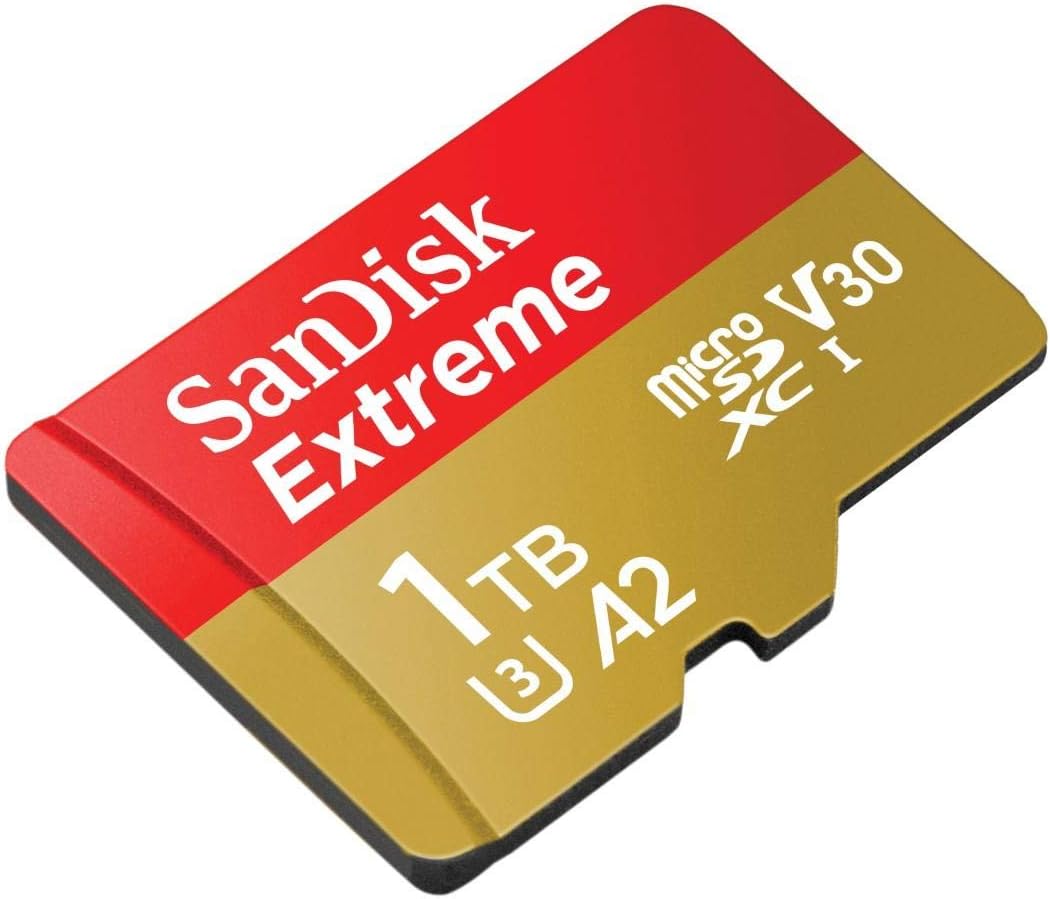
One design note specific to this generation: SanDisk refreshed the line, so two versions coexist on shelves. The SDSQXA1 (red/grey, "160MB/s" print) is the older SKU; the SDSQXAV (red/gold, "190MB/s") is current. Both perform essentially identically inside a Deck's UHS-I slot; don't pay extra for the newer print, and don't pass on a genuine deal of the older one.
Key Features
- 1TB capacity in microSDXC format, enough for roughly 15, 25 modern AAA games or a very large emulation library
- Up to 190MB/s sequential read, 130MB/s write (SDSQXAV generation; earlier SDSQXA1 stock is rated 160/110)
- UHS-I, U3, V30, A2, Class 10, the full modern spec stack for 4K video recording and app/game workloads
- Steam Deck load times within a few percent of internal SSD in community testing, the slot, not the card, is the bottleneck
- Water, temperature, shock, and X-ray resistant, with a lifetime limited warranty
- Ships with a full-size SD adapter; works in the original Nintendo Switch, ROG Ally's microSD slot, cameras, and drones
Performance
Inside a Steam Deck, the honest headline is that the Extreme performs like every other top-tier UHS-I card: superbly, and identically, because the reader caps the party. Community benchmarking threads and the dedicated Steam Deck testing from outlets like Rock Paper Shotgun consistently land the card around 85, 90MB/s sequential reads and roughly 50, 90MB/s writes in the Deck's slot. Rated speed above that is purely headroom.
What that means for actual play is better than the numbers suggest. Storage review testing across the line has long shown that once you're on a quality U3/V30 card, game behavior on the Deck is dominated by the card's random access and sustained steadiness rather than peak sequential figures, and the Extreme's A2 rating covers exactly that profile. In Rock Paper Shotgun's Deck-specific load-time benchmarks, cards in this tier launched Aperture Desk Job in the high-10-second range and loaded Shadow of the Tomb Raider levels within a second or two of the 512GB Deck's internal SSD, with the Extreme Pro variant, in fact, occasionally edging past the SSD in individual runs. The standard Extreme trades a few fractions of a second to its Pro sibling, an amount no human perceives.
Against its real rival, the picture is a near-draw. The Samsung PRO Plus matches the Extreme inside a Deck slot almost exactly in community tests; the Extreme carries a marginal, sometimes-visible edge in some load benchmarks, and the Samsung carries a reliably lower price tag. The pragmatic conclusion from aggregated testing: both are excellent, neither will ever be the reason a game stutters, and the choice between them is mostly about which is on sale the week you're buying.
Write speed matters more than most guides admit, because the Deck writes constantly, game downloads, shader pre-caching, and save sync all hammer the card. The Extreme's 130MB/s rated writes hold up well under sustained install loads, better than budget tiers like Samsung's EVO line, which is where cheaper cards actually start to feel slow in daily use.
Pros and Cons
Pros:
- Elite UHS-I performance that fully saturates the Steam Deck's slot, no wasted speed, no bottleneck from the card
- Load times within striking distance of the internal SSD in real game testing
- A2 rating and strong sustained writes handle installs, shader caches, and emulation random-access loads without the slowdowns budget cards show
- Genuine 1TB from the most established brand in the format, with a lifetime limited warranty
- Broad usefulness beyond the Deck: original Switch, ROG Ally, cameras, drones
Cons:
- 2026's flash crunch has roughly doubled its street price ($200-$250 against a sub-$100 pre-crunch norm); the Samsung PRO Plus matches its Deck performance for less
- Counterfeits are rampant at this popularity tier; marketplace sellers and too-good pricing carry real risk
- A 2TB SKU (SDSQXAV-2T00) does exist, but 2026's memory crunch has it priced anywhere from roughly $290 to $570, a scarcity premium that keeps 1TB as the sensible ceiling for single-card expansion
- Rated 190MB/s speeds are irrelevant in a UHS-I handheld slot, useful only for camera use
- Useless for Nintendo Switch 2, which requires microSD Express; buying this for a Switch 2 is a waste
Who Should Buy This
This is the card for a Steam Deck (LCD or OLED) owner who wants a set-and-forget terabyte from a brand they'll never think about again, especially anyone who already trusts SanDisk, wants the adapter and camera utility, or catches one of its rare post-crunch price dips. ROG Ally and Legion Go owners with UHS-I slots get the same value. Skip it if you're buying for a Nintendo Switch 2 (you need microSD Express, our Samsung microSD Express review covers that card), if you want the absolute lowest cost per gigabyte (the Samsung PRO Plus or a sale-price EVO Plus wins that), or if your instinct is to chase the 190MB/s figure in a device that can't use it.
Alternatives to Consider
Samsung PRO Plus 1TB, the value rival: functionally identical performance in a Deck slot, typically the cheaper card even after its own crunch-era price rise, and equally well-reviewed. If it's meaningfully cheaper on your buying day, it's the smarter purchase.
SanDisk Extreme Pro 1TB, the step-up sibling with 200MB/s reads and 140MB/s writes, and the card Rock Paper Shotgun crowned fastest in the Deck; the margin over the standard Extreme is fractions of a second, for more money.
Lexar Play PRO / PNY Pro Elite 1TB, budget-adjacent alternatives with the same U3/V30/A2 spec floor, less Steam Deck-specific testing behind them, and correspondingly lower confidence in sustained random performance.
Verdict
The SanDisk Extreme 1TB is the boringly correct answer to Steam Deck storage expansion, and that is a compliment. It saturates everything the Deck's slot can deliver, keeps pace with the internal SSD in real load times, survives years of pocket-and-handheld abuse, and comes from the one brand in flash storage that never makes anyone read warranty fine print twice. Its only real flaws are contextual: it's priced above an equal performer, it's the most counterfeited card in existence, and half its rated speed is theater inside a UHS-I device. None of that changes what it does, which is work flawlessly for years. Buy it on sale with confidence; buy the Samsung instead if the sale's on the other side. 8.5/10, Excellent as a Steam Deck storage upgrade, with value the only mark against it.
Full Specifications
| capacity | 1TB |
|---|---|
| interface | UHS-I |
| read_speed | up to 190MB/s (SDSQXAV) |
| write_speed | up to 130MB/s |
| ratings | U3, V30, A2, C10 |
| steam_deck_real_world | ~85-90MB/s read |
| warranty | Lifetime limited |
| includes | SD adapter |
The Verdict: Excellent
The boringly correct Steam Deck storage answer: saturates the slot, near-SSD load times, lifetime warranty. 8.5/10.
— GamepadSquire, August 2026
As an Amazon Associate we earn from qualifying purchases made through links for SanDisk Extreme 1TB microSDXC (Steam Deck).
Related Buying Guide
Buying Guide
Best PC Gaming Handhelds 2026: The Definitive Buyer's Guide
The 2026 handheld PC market explained tier by tier: Steam Deck OLED, ROG Xbox Ally X, Legion Go S, ROG Ally X, Legion Go, and MSI Claw 8 AI+ — with the new Z2 Extreme flagship, SteamOS off-Valve for the first time, and who each device is for.
Buying Guide
Best Controllers for Steam Deck 2026: The Definitive Buyer's Guide
The Steam Deck is the most controller-friendly handheld ever made — but the right pad depends on how Bluetooth, 2.4GHz dongles, gyro, and Steam Input actually behave on SteamOS. From the $29.99 8BitDo Ultimate 2C to Valve's own Steam Controller revival, every controller worth pairing with a Deck in 2026, ranked and explained.


