Xbox Elite Series 2 vs DualSense Edge: Which Should You Buy in 2026?
Microsoft's Xbox Elite Series 2 ($179.99) and Sony's DualSense Edge ($199.99) are the only first-party pro controllers — and the matchup is lopsided. Gamepadla-verified testing shows the Edge at 3.46ms wired (1000Hz, Wired A+) versus the Elite 2's 7.93–9.13ms at 125Hz; the Edge adds user-replaceable stick modules while the Elite 2 counters with four paddles, a 40-hour battery, and stick tension tuning. The catch: neither works on the other's console. Here's which one to buy.
By GamepadSquire — August 9, 2026Verified
The matchup in one paragraph
These are the two flagship "pro" controllers of the console generation — Microsoft's Xbox Elite Wireless Controller Series 2 ($179.99, launched 2019 and refreshed in 2024) and Sony's DualSense Edge ($199.99, 2023) — and they remain the only first-party premium gamepads on their respective platforms. Both sell the same promise: premium materials, extra inputs, trigger locks, and swappable hardware for players who have outgrown the stock pad. But six-plus years of community feedback and independent latency testing have turned this into one of the most lopsided technical matchups in the category. The Elite 2 still reports at 125Hz in every connection mode — Gamepadla's hardware-verified tests show roughly 8–13ms of button and stick latency — while the Edge runs 1000Hz over USB with about 3.5ms measured latency, a Wired A+ rating, and jitter under half a millisecond. The Edge also answers the category's biggest reliability complaint with user-replaceable stick modules, while the Elite 2 keeps the same drift-prone potentiometer sticks that fuel the most-litigated QC thread on Reddit. Yet the Elite 2 counters with a 40-hour battery, four paddles to the Edge's two, adjustable stick tension, and — decisively for most buyers — native Xbox compatibility. Neither controller works on the other's console. For most people, the platform you play on decides this matchup before the first spec table.
The contenders at a glance
| Xbox Elite Series 2 | DualSense Edge | |
|---|---|---|
| Price | $179.99 (street ~$150–160; Core trim ~$130) | $199.99 (often ~$180; sales to ~$169) |
| Released | 2019 (2024 refresh) | 2023 |
| Platforms | Xbox, PC, Android, iOS, macOS, Linux | PS5, PC, Android, iOS, Linux |
| Sticks | Potentiometer, 3-level tension, 6 caps | Potentiometer modules, 4 caps, no tension |
| Drift mitigation | Tension + swappable caps only | User-replaceable stick modules (~$20 each) |
| Extra inputs | 4 paddles | 2 back buttons (2 styles) |
| Trigger locks | Yes (3 positions) | Yes (3 positions) |
| On-device profiles | 3 | 4 |
| Polling (Gamepadla) | 125Hz all modes | 1000Hz wired; ~655–743Hz Bluetooth |
| Wired button latency | 7.93ms (Gamepadla) | 3.46ms (Gamepadla) |
| Wired stick latency | 9.13ms (Gamepadla) | 3.46ms (Gamepadla) |
| Bluetooth button latency | 10.86ms (Gamepadla) | 5.41–6.65ms (Gamepadla) |
| Battery | ~40h rated (30–35h measured) | ~1,050mAh (5–7h measured) |
| Weight | 345g | 325g |
| Haptics + adaptive triggers | No | Yes (PS5 only) |
| Gyro | No | Yes |
| Headphone jack | Yes | Yes |
| Charging dock | Yes (full version) | No (works with DualSense station) |
| Software | Xbox Accessories app | PS5 system settings |
Xbox Elite Series 2: the gold standard with a QC asterisk

The Elite 2 is the controller every other pro pad has been measured against for the better part of a decade. CNET still calls it the industry's gold standard, while noting it's "overkill for most people"; IGN was harsher at launch, scoring it 7/10 on the grounds that it was "very expensive" and didn't do enough to justify nearly the price of a console. Both takes are fair, because the Elite 2's strengths and weaknesses are unusually easy to list. The full $179.99 package is the most complete accessory bundle in the category: a hard-shell carrying case, a magnetic charging dock, four paddles, six thumbstick caps, two D-pads, and a tool for adjusting stick tension. The Core trim ($129.99–139.99) strips out the dock, case, and half the accessories for players who just want the pad itself.
What owners consistently praise is the feel. At 345g it's the heaviest flagship controller on the market — some call that heft premium, others call it fatigue — but the diamond-textured rubber grips, the three-level stick tension adjustment, and the hair-trigger locks are features no licensed rival has fully matched. Microsoft rates the battery at 40 hours; independent testing puts real-world endurance in the low 30s, which is still two to three times anything Sony offers. The adjustable tension deserves special mention: a small tool turns each stick between three resistance levels, which is the only hardware-level feel tuning in the entire first-party category and remains genuinely useful for players who switch between racing and shooters.
The problems are just as well documented, and they're the reason the price feels defensive in 2026. The face buttons are the same membrane design as the stock Xbox pad — mushy by pro-controller standards, with IGN's launch review noting sticking A/X presses. More seriously, the QC reputation is the worst in the category: bumper failures, peeling rubber grips, and stick drift show up across long-term owner threads, with the "broke after 17 months" report on r/xbox and a ResetEra owner whose left stick drifted after four years being typical of the pattern rather than outliers. Reddit's recurring advice is to buy with a warranty and treat the first failure as a lottery outcome. And the latency story is 2019-era: Gamepadla's hardware-verified tests measure 125Hz polling in every mode, with 7.93ms average button latency and 9.13ms stick latency wired (13.22ms with the sticks fully tightened), plus Bluetooth button latency of 10.86ms. Community testing on r/CompetitiveHalo found the Elite 2 wireless delivered roughly double the input lag of a standard Series controller over the official Xbox Wireless Adapter. There's also no gyro, and the Bluetooth connection forgets paired devices when you switch platforms — a CNET-flagged annoyance for multi-device players.
DualSense Edge: Sony's modular answer
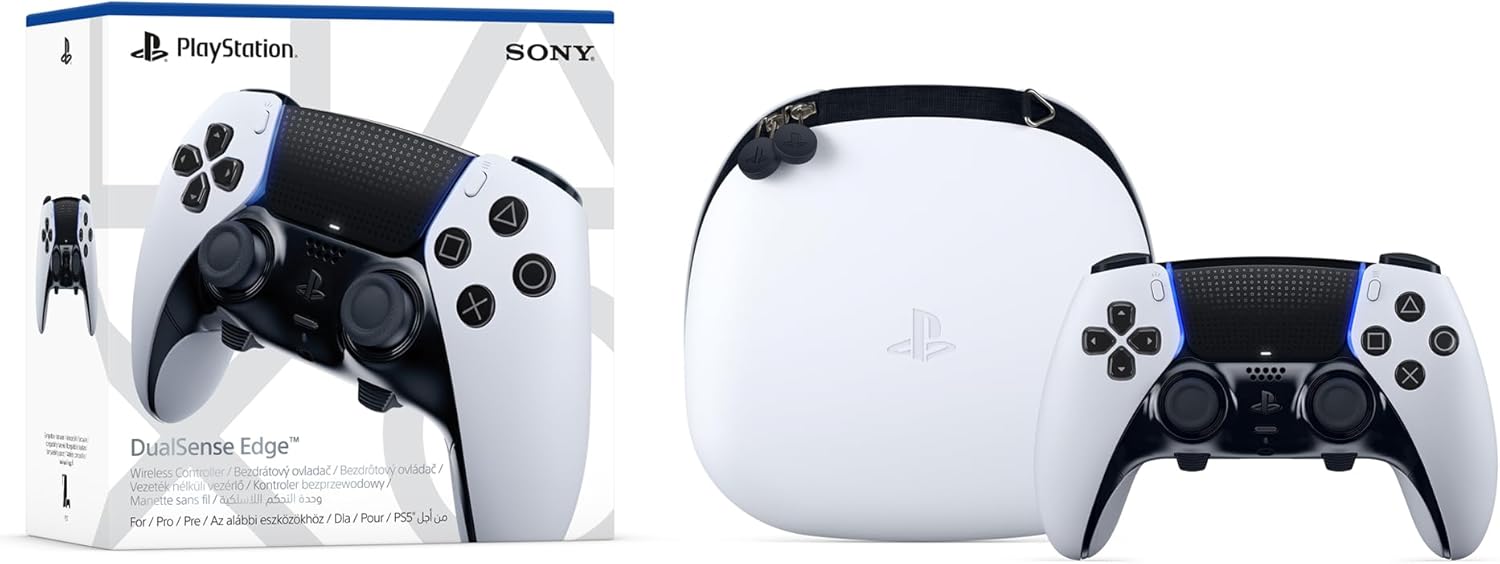
Sony's first pro controller arrived three years after the Elite 2, and the press consensus was that it was worth the wait. IGN scored it 9/10 with an Editor's Choice badge — "finally giving PlayStation owners an answer to the venerated Xbox Elite" — and PCMag called it "the best premium controller for the PlayStation 5" at 4/5, with the battery as the caveat. The Edge is the only first-party PS5 pad with back buttons, and the only way to get Sony's signature haptics and adaptive triggers alongside pro features, because third-party PS5 controllers are locked out of both.
Its killer feature is the one Elite owners have been begging for: fully replaceable stick modules. A latch on the back pops the faceplate off, and each stick unit slides out for a $20 swap — no soldering, no sending the controller to a repair shop, roughly two minutes of work. The catch is that the modules are the same potentiometer technology as the stock DualSense, so they can still drift; IGN wished aloud for Hall Effect sensors. But when drift does arrive, the Edge turns what is normally a $200 paperweight into a $20 repair. Community threads treat the module system as the single best reason to own the Edge, and owners who've replaced modules describe the process as genuinely painless.
The rest of the package is well-executed but leaner than the Elite's. Two magnetic back buttons (lever and half-dome styles) are widely praised as among the best in the business — Digital Trends called them "fantastic" — but two is two: the Elite offers twice as many inputs for games that want jump, crouch, reload, and interact all at once. The three-position trigger stops are there, plus four on-device profiles swapped instantly via the FN buttons, a 2.8m braided cable with a lock mechanism, and a hard case that charges the pad through a flap. There's no stick tension adjustment — a capability the Elite has and the Edge simply doesn't — and the stick caps offer only two heights. Weight lands at 325g, lighter than the Elite but noticeably denser than a stock DualSense.
Then there's the battery, which is the most consistently cited complaint in the entire category. The Edge packs a 1,050mAh cell — two-thirds the size of the stock DualSense's — and every outlet that tested it landed between five and seven hours: PCMag measured 5–6, TechRadar around 7, Digital Trends about 6. The r/playstation refrain is brutal and uniform: "my Elite 2 lasts over a week on one charge; the Edge dies in 5 hours." Owners who play wired or dock the pad between sessions shrug it off; everyone else is tethered to a charging routine. On a $200 product in 2026, that is a genuine flaw, not a nitpick.
The latency gap, quantified
This is the section that makes the matchup lopsided. All figures are Gamepadla's independent hardware-verified tests — the Elite 2 measured with the Prometheus 82 rig, the Edge verified in March 2025 with follow-up tests through mid-2026:
| Metric | Xbox Elite Series 2 | DualSense Edge |
|---|---|---|
| Button latency, wired | 7.93ms (jitter 2.26) | 3.46ms (jitter 0.39) |
| Stick latency, wired | 9.13ms (jitter 2.19) | 3.46ms (jitter 0.34) |
| Button latency, Bluetooth | 10.86ms (jitter 3.56) | 5.41–6.65ms (jitter 2.5–4.1) |
| Stick latency, Bluetooth | — | 6.76–7.29ms |
| Polling rate (measured) | 125Hz in all modes | 1000Hz wired; ~655–743Hz Bluetooth |
| LatScore | Wired B | Wired A+ / Wireless B |
Two numbers explain the whole gap. The Elite 2 reports at 125Hz even plugged in — an 8ms report interval that the Xbox wireless firmware carries over to USB — while the Edge hits 1000Hz wired with sub-3.5ms latency and jitter under 0.4ms, some of the tightest figures measured on any first-party pad. The Elite 2's jitter of 2.2–5.3ms is the quietly damning part: its latency isn't just higher, it's wildly variable, which is exactly the profile players describe as "floaty" in fast games. On the wireless side the gap narrows — the Edge's Bluetooth sits at 5.4–7.3ms with occasional spikes — but the Elite 2's Bluetooth is slower still, and community testing adds 2–8ms on top for the Xbox Wireless Adapter. For competitive play on PC, the wired Edge is measurably the fastest first-party controller you can buy, and the Elite 2 is the slowest pro pad at any price.
Sticks and drift: modules vs tension dials
Both companies shipped 2026 hardware with 2019 sensor tech — potentiometers that wear into drift — which is remarkable when $60 third-party pads now ship drift-proof Hall Effect and TMR sticks. The difference is what happens when the wear shows up. The Elite 2's answer is prevention-adjacent: three tension levels and six caps, but no way to replace the sensor assembly; drift means a $180 replacement or a $30–80 repair job, which is precisely why "my Elite 2 drifts" threads are the category's longest-running saga. The Edge's answer is the escape hatch: a $20 module swap that any owner can perform in minutes. Neither is as good as never drifting in the first place — and the Edge's lack of any tension adjustment is a real feature gap versus the Elite — but if you're choosing between the two failure philosophies, replaceable modules are the more honest engineering answer, and owners treat them as such.
Buttons, paddles, and extra inputs
The Elite 2 wins the input-count war outright: four magnetic paddles against the Edge's two back buttons, and the paddles can be removed when unwanted. The Edge's buttons are better hardware — metal levers and half-domes that Digital Trends and PCMag both rate among the best back inputs they've used, with the half-domes doubling as natural finger rests — but the two-button ceiling is real for players who want simultaneous jump, crouch, reload, and item inputs. Face buttons flip the script: the Edge inherits the DualSense's crisp buttons, while the Elite 2's mushy membrane ABXY is a running complaint. Trigger locks are a wash — both offer three positions — though the Edge adds software-tunable trigger deadzones on PS5.
Battery: the Edge's one disqualifying flaw
There is no fair fight here. The Elite 2 is rated for 40 hours and measures 30–35 in practice, with a dock that makes charging automatic; the Edge squeezes five to seven hours from a 1,050mAh cell that's smaller than the stock DualSense's, and haptics plus adaptive triggers drain it faster. It's the one spec where the $20-cheaper controller is categorically better, and it's the reason PCMag's bottom line is "keep a charging cable close by." For couch-and-TV players who don't want a charging ritual, the Edge's endurance is disqualifying on its own. Wired players and dock-every-session players genuinely don't care — but they should know they're the exception.
Software and customization
The Edge has the better system by a mile on its home console: no app to install, with remapping, stick curves, trigger deadzones, and four profiles all living in the PS5's system settings, and the FN buttons swapping profiles mid-match. On PC, the Edge loses most of that — no haptics, no adaptive triggers, and remapping requires Steam's controller config or third-party tools. The Elite 2's Xbox Accessories app (Windows and Xbox) is older and clunkier, with a Shift layer but no macros, yet it works identically on console and PC, which is more than the Edge can claim. Profiles store on-device for both, so your configs travel.
Which one should you buy?
Buy the Xbox Elite Series 2 if you play on Xbox or PC with Xbox muscle memory and you want the full pro package: four paddles, 40-hour endurance, adjustable stick tension, and the complete dock-and-case bundle. Buy it with a warranty and from a retailer with easy returns — the QC lottery is real, and the 125Hz polling means you're paying for feel and features, not speed.
Buy the DualSense Edge if you're a PS5 player who wants back buttons, profile hot-swapping, and the only true stick-drift escape hatch in the category — or if you're a PC competitive player who wants the fastest wired first-party pad ever measured. Accept the battery ritual or plan to play wired.
PC players, buy neither at full price. The wired Edge is technically excellent but $200 is a lot for a PC-only pad with no haptics; the Elite 2's latency and drift profile are hard to justify against the TMR generation — the GameSir G7 Pro (2.43ms wired, $79.99), the Flydigi Vader 5 Pro (2.07ms wired sticks, $79.99), or the officially licensed 8BitDo Ultimate 3 Wireless ($99.99, drift-proof TMR sticks, 20-hour battery, and true Xbox wireless support) all beat both flagships on value per dollar.
Buy neither if your priority is drift-proof hardware (Hall Effect and TMR pads have made the $100–150 pro tier obsolete on that axis), or if you need haptics on PC (no controller delivers them outside PS5 games).
Verdict
This is the rare X-vs-Y where the platform question decides everything before the hardware does. On Xbox, there is no first-party alternative: the Elite 2 is the pro option, and its four paddles, 40-hour battery, and tension tuning still out-feature every licensed rival — but you're paying $180 for 125Hz polling, mushy ABXY buttons, and the category's worst QC reputation. On PS5, the Edge is the only pro pad with haptics and adaptive triggers, and its replaceable modules are the most consumer-friendly drift answer in the business — but five to seven hours of battery on a $200 product is indefensible. Measurably, the Edge is the better controller: roughly twice as fast wired, dramatically more repairable, and better-reviewed (9/10 IGN versus 7/10). Practically, most buyers' console makes the choice for them. If you play both ecosystems on PC and want one of these two, the Edge is the one to buy — ideally on sale, and ideally wired. If you're on Xbox, the Elite 2 remains the standard despite its age — just buy the warranty.
Related Guides
Buying Guide
Best PC Controllers 2026: The Definitive Roundup
From the $19.99 budget king to the sub-millisecond esports monster — every PC controller worth buying in 2026, ranked by use case with verified specs and community sentiment.
Buying Guide
Best Xbox Controllers 2026: Elite Series 3, Hall Effect & Budget Picks
From the new Xbox Elite Series 3 to drift-proof Hall Effect and TMR pads like the 8BitDo Ultimate 3 and GameSir G7 Pro — the best Xbox Series X|S and PC controllers for every budget in 2026.
Buying Guide
GuliKit KK3 vs KK3 Max: Which KingKong Controller Should You Buy?
GuliKit's KK3 Max flagship and the stripped-back 2025 KK3 look like siblings but aim at different buyers: the Max brings 992Hz wired polling, four magnetic back paddles, trigger locks, NFC and a replaceable battery, while the $35 KK3 counters with newer TMR sticks and macOS support — and measurably slower wireless. Full latency-table comparison, stick verdict, and QC reality check.