Sony
Sony DualSense Edge Review
Good
$199.99
The DualSense Edge is the best PS5 controller you can buy — the only first-party pro pad on the console, with the only true stick-drift escape hatch in the category. Back-button converts call it transformative; the 4-6 hour battery and white-unit grip yellowing are the asterisks. Best value at the frequent $169 sale price. Score: 8/10.
As an Amazon Associate we earn from qualifying purchases made through links for Sony DualSense Edge.
connectivity
Wireless (Bluetooth) + USB-C wired
weight
325 g (vs 280 g standard DualSense)
battery
~4-6 hrs with features on; Sony confirms 'moderately shorter' than standard DualSense
back_buttons
2 slots; lever paddles and half-dome buttons included
Pros & Cons
Pros
- Tool-free swappable stick modules — the only flagship controller with a $20 fix for drift instead of a $200 one
- Best-in-class profile system on console; Function buttons make customization effortless mid-game
- Retains every DualSense strength: haptics, adaptive triggers, mic, gyro, 3.5mm jack
- Premium construction, excellent carrying case, works with the existing DualSense charging dock
- Back buttons that owners consistently describe as gameplay-changing
- Works across PS5, PS5 Pro, and PC (with Steam Input or DS4Windows)
Cons
- Battery life is worse than the standard DualSense — roughly 4-6 hours with features on
- White units' soft-touch grips yellow, bubble, and peel over time; a recurring QC theme in owner reports
- Only two back buttons, versus four on the Xbox Elite Series 2 at a lower price
- Stick modules are still potentiometer-based and can drift themselves, when rivals at this price offer Hall-effect sensors
- $199.99 remains a hard pill even with frequent $169 sale pricing
Overview
The DualSense Edge is Sony's first officially branded pro controller, the answer to a question PlayStation owners had been asking since the Xbox Elite Series 2 arrived: where is our premium pad? It launched January 26, 2023 at $199.99, and three-plus years later it remains the only first-party PS5 controller with serious competitive credentials. Rather than reinvent the DualSense, Sony took the pad widely considered the best controller of its generation and bolted on the pro trimmings: remappable back buttons, tool-free swappable analog stick modules, trigger travel stops, and a slick profile system controlled by two new Function buttons.
The pitch is straightforward: for roughly three times the price of a standard DualSense, you get a controller you can tune to your hands and your game, and one you never have to throw away when the sticks wear out. The harder question: the one every review circles back to, is whether $200 is a fair price for that tuning. Owner feedback gathered across thousands of ratings and years of community discussion suggests the answer is a qualified yes: the Edge is the best PS5 controller money can buy, but it is not the best value, and it ships with two compromises (battery life and grip durability) that you should know about before you spend.
On Amazon the Edge holds a 4.6 out of 5 star rating from more than 6,000 ratings, among the strongest showings of any pro controller on the platform. Press reviews split sharply, which tells you everything about the value debate: IGN awarded it 9/10 with an Editors' Choice badge while The Verge settled on 7/10, with the rest of the press split between strong scores for the hardware and harsher ones for the price. Everybody agrees on what the controller is. They disagree on what it should cost.
Build Quality and Design
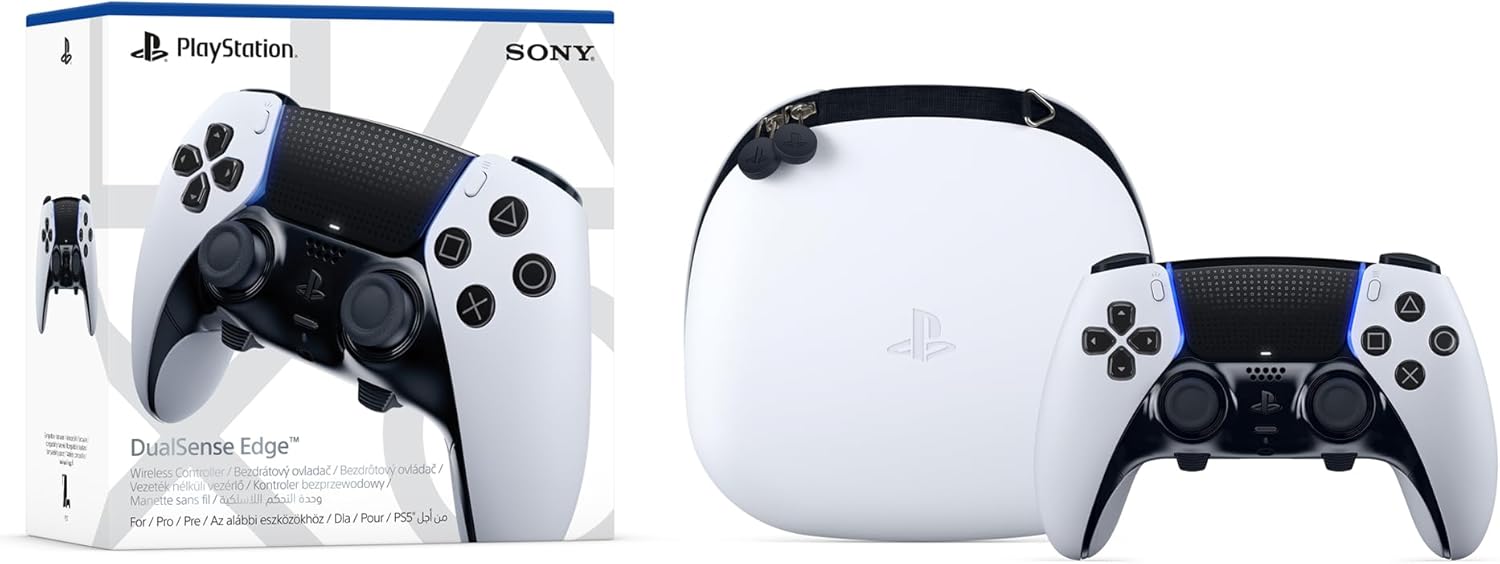
The Edge is unmistakably a DualSense, which is both its greatest comfort and its most conservative decision. The silhouette, button layout, and overall ergonomics are unchanged, so anyone coming from a standard pad will feel at home in seconds. What's different is the substance: at roughly 325 grams the Edge is about 16 percent heavier than the standard DualSense's 280 grams, and that extra heft reads as confidence rather than bloat. The added weight is distributed well, and owner feedback consistently describes the Edge as feeling more "premium" and "solid" than the pad in the PS5 box.
The details are where the Edge earns its price tag. The rubberized grips on the inner handles carry a fine texture stamped with tiny PlayStation symbols, and the ends of the L2/R2 triggers get the same treatment for extra purchase. The face buttons, D-pad, and touchpad are all blacked out, giving the controller a stealthier look that owners largely prefer to the standard two-tone. The touchpad itself feels firmer and more substantial. Two metallic back-button cradles sit behind the triggers, and the whole package ships in a two-tone hardshell case with a molded interior, a flap on the back that lets you charge the controller while it's zipped up, and storage for the swappable parts. The Edge even works with the existing DualSense charging dock, a small courtesy that avoids forcing yet another accessory purchase.
There are two build complaints worth surfacing up front, because both come from the owner base rather than the press. First, the soft-touch grips on white units have a documented tendency to yellow, bubble, and eventually peel, Tom's Guide flagged discoloration in its review, and years of community threads confirm it, including owners who describe clean, dry hands still seeing stains within months. The white coating is the problem; the newer Midnight Black finish has a more durable texture and far fewer reports. Second, the faceplate release mechanism feels flimsy by comparison to the rest of the controller, TechRadar described the unlockable faceplate as the one weak point in an otherwise solid construction. Neither issue is a dealbreaker, but the grip situation is real enough that an entire aftermarket exists just to replace Edge grips and shells.
Key Features
Swappable stick modules. The headline feature, and the one that makes the Edge unique among first-party pro pads. Each analog stick is a tool-free module that slides out with a press of a latch; replacements cost around $20 apiece. If a stick develops drift or wear, you swap a $20 module instead of a $200 controller. It is the single most convincing argument for the Edge's existence, and it's the feature owners cite most often when asked why they bought one.
Two back buttons, two shapes. The Edge ships with lever-style paddles and half-dome pebbles, both metallic, both magnetically seated. The levers sit naturally under the middle fingers and are easy to reach; the domes require more deliberate presses but are nearly impossible to trigger accidentally. Community consensus is that even two back buttons permanently change how you play, owners repeatedly describe binding dodge, jump, or parry to the paddles and never touching a face button again, to the point that "I can't use my other controllers anymore" is a recurring refrain.
Trigger travel stops. Three-position sliders on the rear cut L2/R2 travel from full to a short hair-trigger throw for shooters, while still preserving the adaptive trigger mechanism in games that use it.
Function buttons and profiles. Two new buttons flank the stick bases and open the controller's software magic: up to four custom profiles stored on the pad, each with remapped buttons, stick sensitivity curves, dead zones, trigger zones, and vibration intensity. Profiles switch on the fly mid-match, and the PS5's integration is so clean that third-party pro controllers can't match it, IGN called the Function buttons "second nature."
Everything else. All standard DualSense features survive intact, haptic feedback, adaptive triggers, built-in mic, gyro, 3.5mm jack, plus a 9.1-foot braided USB-C cable with a locking clip so the cable can't be yanked out mid-game.
Performance
On the fundamentals, the Edge is a DualSense with identical haptics, adaptive triggers, and stick hardware, so the performance ceiling is the same high bar the standard pad set. Wireless latency is a non-issue for the vast majority of owners; the few input-lag reports that surface in community threads trace mostly to Bluetooth interference or TV game-mode settings rather than the controller itself. Wired play is a popular option among competitive owners, who note the connection feels immediate and rock-solid.
The one genuine performance weakness is battery life, and it's the complaint that appears in nearly every long-term owner discussion. Sony itself confirmed the Edge's operating time is "moderately shorter" than the standard DualSense, because the extra hardware had to fit the same form factor. In practice, owners report 4 to 6 hours of real play with haptics and adaptive triggers at full intensity, roughly half of what a standard DualSense manages, and players with multi-hour sessions describe charging mid-day or simply playing tethered. If you game in 1- to 2-hour blocks, it's a non-issue; if you marathon, budget for a cable or a second pad. There is an active community around replacing the Edge's cell with higher-capacity batteries, which tells you how much this stings for heavy users.
On stick drift, the Edge's answer is honest but incomplete. The replaceable modules are a genuine fix for the worst part of controller ownership, no more shipping a whole pad to Sony for a $20 part's failure. But the stock modules use the same potentiometer-based sensors as the standard DualSense, so a module can still drift over time, and a minority of owners describe drift recurring across multiple replacement modules. The community's workaround of the moment is swapping in aftermarket TMR or Hall-effect modules, which are drift-immune and have become a popular mod. The Edge is the only first-party PS5 controller you can do that on without soldering, which is exactly the point: but it's also true that at this price tier, several rivals ship with Hall-effect sensors from the factory, so the Edge is solving a problem it could have prevented.
On PC, the Edge performs better than most owners expect. Steam Input handles it natively, DS4Windows covers everything else, and the back buttons register as four fully independent inputs rather than clones, a genuine advantage over PS5 use, where back buttons can only mirror existing buttons. The catch is that haptic feedback and adaptive triggers are PlayStation-exclusive in practice, and a small number of games need Steam Input disabled to avoid double inputs. Community guidance for PC buyers is consistent: it works, it's excellent, but you're paying for PS5 features you won't fully get.
Pros and Cons
Pros:
- Tool-free swappable stick modules, the only flagship controller with a $20 fix for drift instead of a $200 one
- Best-in-class profile system on console; the Function buttons make customization effortless mid-game
- Retains every DualSense strength: haptics, adaptive triggers, mic, gyro, 3.5mm jack
- Premium construction, excellent carrying case, works with the existing DualSense charging dock
- Back buttons that owners consistently describe as gameplay-changing
- Works across PS5, PS5 Pro, and PC (with Steam Input or DS4Windows)
Cons:
- Battery life is worse than the standard DualSense, roughly 4-6 hours with features on
- White units' soft-touch grips yellow, bubble, and peel over time; a recurring QC theme in owner reports
- Only two back buttons, versus four on the Xbox Elite Series 2 at a lower price
- Stick modules are still potentiometer-based and can drift themselves, when rivals at this price offer Hall-effect sensors
- $199.99 remains a hard pill even with frequent $169 sale pricing
Who Should Buy This
The DualSense Edge is for PS5 players who live on the sticks, competitive shooters, fighting-game players, soulslike veterans who want dodge and parry off the face buttons, and anyone who has watched a standard DualSense die of stick drift and resented paying $70 to replace it. If you'll use the back buttons daily and the profiles weekly, the Edge earns its money; owner sentiment from that group is close to unanimous, with many calling it the best controller they've ever owned.
Skip it if you mostly play casually, the standard DualSense delivers 90 percent of the experience for 35 percent of the price. Skip it if your sessions routinely run past four hours away from a charger, or if you refuse to play tethered. Skip it if you want four back buttons, or if Hall-effect, drift-impossible sticks are a must-have rather than a nice-to-have. And if you're buying for a white PS5 setup, factor in the grip durability reports, or hold out for the Midnight Black finish, which doesn't share them.
Alternatives to Consider
Xbox Elite Series 2 ($180), The Edge's direct rival, though for Xbox/PC rather than PS5. Four paddles, adjustable stick tension, and a ~40-hour battery that embarrasses the Edge's endurance. But it lacks haptics and adaptive triggers, and its own reliability reputation is arguably worse than the Edge's. PS5 owners can't use it natively anyway; PC buyers choosing between the two should weigh four paddles and battery against haptics and module swaps.
Scuf Reflex Pro ($220), The best-known third-party PS5 pro controller, and the Edge's closest competitor on the console. Remappable paddles and premium build, but priced above the Edge with no swappable sticks, no profiles, and a longer lead time. Community comparisons generally favor the Edge on features-per-dollar.
Standard DualSense ($70), The value pick and the Edge's biggest competitor in practice. Same haptics, same triggers, same latency, none of the customization, and a longer battery life. For most players this is the rational buy; the Edge is the upgrade you make when the standard pad's limitations actually cost you games.
Nacon Revolution 5 Pro ($200), A licensed PS5 pro controller that goes the Hall-effect route out of the box, with a swappable module system and back buttons. It's the strongest argument against the Edge on paper, though its ergonomics and software divide opinion in a way the Edge's don't.
Verdict
The DualSense Edge is the best PS5 controller you can buy, the only first-party pro pad on the console, with the only true stick-drift escape hatch in the category, wrapped around a controller that was already generation-best. Whether it's the right $200 for you depends entirely on how much of it you'll actually use. Owners who click with the back buttons and profiles describe it as transformative and refuse to go back; owners who bought it for the status report a $200 pad with a 5-hour battery and, on white units, a grip that yellows within months.
Press consensus captures the split perfectly: IGN's 9/10 versus The Verge's 7/10 aren't disagreeing about the hardware, they're disagreeing about the price. At the frequent $169 sale price, the value equation closes hard in the Edge's favor. At full MSRP, it's a premium purchase that only makes sense if you know exactly what you're buying it for.
Score: 8/10, An excellent, category-defining pro controller for PS5's most dedicated players. Buy it for the back buttons and the swappable sticks; accept the battery life and buy the Midnight Black version if grip durability worries you.
What the Experts Say
Professional review consensus for this product
Full Specifications
| connectivity | Wireless (Bluetooth) + USB-C wired |
|---|---|
| weight | 325 g (vs 280 g standard DualSense) |
| battery | ~4-6 hrs with features on; Sony confirms 'moderately shorter' than standard DualSense |
| back_buttons | 2 slots; lever paddles and half-dome buttons included |
| stick_modules | Tool-free swappable; ~$20 replacement modules |
| trigger_travel | 3-position stop sliders |
| cable | 9.1 ft braided USB-C with locking clip |
| platforms | PS5, PS5 Pro, PC |
| profiles | 4 custom profiles, switchable via Function buttons |
The Verdict: Good
The DualSense Edge is the best PS5 controller you can buy — the only first-party pro pad on the console, with the only true stick-drift escape hatch in the category. Back-button converts call it transformative; the 4-6 hour battery and white-unit grip yellowing are the asterisks. Best value at the frequent $169 sale price. Score: 8/10.
— GamepadSquire, August 2026
As an Amazon Associate we earn from qualifying purchases made through links for Sony DualSense Edge.
Related Buying Guide
Buying Guide
Best PC Controllers 2026: The Definitive Roundup
From the $19.99 budget king to the sub-millisecond esports monster — every PC controller worth buying in 2026, ranked by use case with verified specs and community sentiment.
Buying Guide
Xbox Elite Series 2 vs DualSense Edge: Which Should You Buy in 2026?
Microsoft's Xbox Elite Series 2 ($179.99) and Sony's DualSense Edge ($199.99) are the only first-party pro controllers — and the matchup is lopsided. Gamepadla-verified testing shows the Edge at 3.46ms wired (1000Hz, Wired A+) versus the Elite 2's 7.93–9.13ms at 125Hz; the Edge adds user-replaceable stick modules while the Elite 2 counters with four paddles, a 40-hour battery, and stick tension tuning. The catch: neither works on the other's console. Here's which one to buy.


