TMR vs Hall Effect Controllers: What's the Difference in 2026?
TMR (tunnel magnetoresistance) is the magnetic stick sensor taking over premium controllers in 2026. Here is how it differs from Hall Effect, what real users report, and which controllers to buy.
By GamepadSquire — August 1, 2026Verified
For two years, "Hall Effect" was the magic phrase on every controller box — a promise that stick drift, the failure that ended countless gamepads, was finally gone. Magnetic sensors measured the stick's position without physical contact, so there was nothing to wear out. Then, just as Hall Effect went mainstream, a newer technology started appearing in flagship third-party controllers: TMR, or tunnel magnetoresistance. The GameSir Cyclone 2, GameSir G7 Pro, 8BitDo Ultimate 2, 8BitDo Pro 3, and the 2026 Steam Controller all ship TMR sticks. Razer sells two nearly identical Wolverine V3 Pro models — a Hall Effect version at $159.99 and a TMR version at $199.99 with 8,000Hz polling — making the two technologies directly comparable.
The problem for buyers: the sensors look identical on the shelf, some brands still print "Hall Effect" on boxes that actually contain TMR sensors, and even experienced reviewers disagree on how much TMR really matters. This guide explains how each sensor works, what the measurable differences are, what real owners complain about, and which controllers are worth your money in 2026.
TL;DR: the short answers
- Both Hall Effect and TMR sticks are magnet-based and contact-free — neither develops sensor drift. If drift is your only problem, either technology fixes it.
- TMR is the newer, more sensitive tech. It reads the direction of the magnetic field instead of its strength, which yields higher resolution, less jitter, and more consistent readings.
- TMR feels closer to a traditional ALPS stick, especially around center. Hall Effect sticks can feel loose or floaty by comparison.
- Competitive FPS players are the main audience for TMR. Casual players will rarely notice the difference.
- TMR uses less power than Hall Effect, but independent testing puts the real-world gain at roughly 12 extra minutes per 12-hour session — a nice bonus, not a reason to upgrade.
- The price gap has basically closed: drift-free TMR controllers now sell for $55–$80, undercutting first-party pads like the Xbox Elite Series 2.
How Hall Effect sticks work
A Hall Effect stick mounts a magnet on the stick mechanism with a fixed sensor beside it. As the stick moves, the magnetic field over the sensor changes, and the sensor translates the field's strength into a position reading. Because the magnet never touches the sensor, the sensing path cannot wear out — the core cause of potentiometer drift is gone. (For the full breakdown of why traditional sticks drift and how Hall Effect fixes it, see our guide on Hall Effect vs Traditional Sticks.)
The catch with first-generation Hall Effect implementations: sensitivity. Field-strength readings are subtle, so the signal needs amplification, which adds noise and power draw. Cheap modules also struggled with centering — returning to a slightly-off "zero" that manufacturers masked with a center deadzone.
How TMR sticks work
TMR — tunnel magnetoresistance, sometimes written tunneling magnetoresistance — keeps the same basic architecture: a magnet moves past a fixed sensor. The difference is physics. Instead of measuring field strength like a Hall Effect sensor, a TMR sensor measures how the magnetic field changes the sensor's electrical resistance. TMR sensors are dramatically more sensitive — a point sensor makers like Coto Technology are happy to cite — which means finer position readings with less amplification, less noise, and lower power draw. GameSir claims its TMR sticks use roughly one-tenth the power of mainstream Hall Effect sticks.
That sensitivity is what makes the difference in practice. Controllers like the 8BitDo Ultimate 2 and 8BitDo Pro 3 pair TMR sticks with 12-bit ADC sampling chips, giving 4,096 steps of resolution per axis — a far cry from the 8-bit, 256-step sensing of older budget pads. More resolution steps mean smoother, more granular inputs, which matters when you're making small aiming corrections.
The real differences: Hall Effect vs TMR
| Feature | Hall Effect | TMR |
|---|---|---|
| Sensor principle | Measures magnetic field strength | Measures magnetic field direction (resistance change) |
| Stick drift risk (sensor) | None | None |
| Accuracy / resolution | Very good | Excellent |
| Jitter / noise | Low | Very low |
| Center feel | Can feel loose / floaty | Closer to traditional ALPS sticks |
| Micro-adjustments (FPS aiming) | Moderate | Excellent |
| Power draw | Moderate | Slightly lower (roughly 12 extra min per 12h session) |
| Typical price impact | Moderate | Slightly higher — gap closing fast |
| Availability | Everywhere since 2023–2024 | Standard on most premium 2026 third-party pads |
Is TMR actually better? What the data and users say
The honest answer: it depends on who's playing.
For casual players: most people won't notice a difference. Across roundups and community threads, the consistent takeaway is that Hall Effect and TMR are indistinguishable in day-to-day gaming for the majority of users. Both are drift-free, both feel smooth, and both beat potentiometer sticks on longevity.
For competitive FPS players: this is where TMR earns its reputation. Reddit's r/Controller has hosted detailed technical breakdowns of stick precision — centering performance, sampling rate, resolution, polling rate — and the recurring finding is that early Hall Effect modules lag on centering. One widely-cited analysis measured a best-in-class Hall Effect module of its generation returning to center with roughly three to four times the error of a TMR-based esports pad (0.03 vs 0.008), and flagged Hall Effect's worse centering and higher power consumption as systemic traits. TMR's higher sensitivity translates into more sampling points across the stick's travel, which shows up as smoother resolution maps and finer micro-adjustments when you're tracking a target in a shooter.
The feel argument: Hall Effect sticks have a reputation for feeling light and floaty around center because there's no carbon film providing friction. Some players love it; others hate it. TMR's center return reads much closer to a traditional ALPS stick, which is why players migrating from a DualSense or Xbox pad often find TMR an easier transition. The flip side: TMR sticks feel different enough that some players report a genuine acclimation period. A ResetEra thread titled "Acclimating to TMR sticks is a nightmare" captured the phenomenon — though commenters there also noted that many TMR controllers ship with far higher polling rates and lower latency than the older pads people are coming from (roughly 2ms and 700Hz+ versus ~20ms and 100–250Hz). Part of the "weirdness" is simply that your inputs arrive faster and smoother than you're used to.
The caveat: the sensor is only part of the equation. CNET's comparison makes the point directly: a great TMR sensor inside a controller with a big deadzone, a strange response curve, or a low polling rate will lose to a well-tuned Hall Effect implementation. Deadzone calibration, response curves, polling rate, and stick tension matter as much as — sometimes more than — the sensor type.
What to watch out for (the problem-first list)
1. Marketing confusion is real. Some manufacturers label their TMR sticks as "Hall Effect" because the term is more widely recognized. If a listing specifically says TMR, it's the newer technology; if it only says Hall Effect, it might be either. Check the manufacturer's official spec page before buying.
2. Drift-free doesn't mean wear-free. The sensor won't drift, but the mechanical parts around it still age: the ring around the stick loses its smoothness, rubber grips wear off, springs and linkages loosen, and a stick that no longer returns to its resting position will still feel like drift even with a perfect sensor. CNET notes this explicitly — which is why a controller with serviceable or swappable stick modules can matter just as much as the sensor tech.
3. Stick tension varies wildly between models. Loose-feeling sticks are the single most common subjective complaint about Hall Effect controllers in Reddit threads — but in many cases it's spring tension, not the sensor. Controllers with adjustable tension dials, like the Flydigi Vader 4 Pro, sidestep the complaint entirely. TMR pads generally feel tighter around center, but individual models still differ.
4. Budget TMR quality control is uneven. Roundup testers who've cycled through many TMR pads report model-specific annoyances: the Gulikit KK3's sticks have a restricted travel range, the GameSir Tarantula Pro's membrane face buttons feel average, one tester's EasySMX D10 developed a squeaky right trigger after a month and has no PC software, and the Cyclone 2's back buttons are so light they can be pressed accidentally. None of these are dealbreakers on their own, but they're why reading reviews of the specific model matters more than the sensor type on the box.
5. Don't buy TMR for the battery. Yes, TMR draws less power — Razer rates its TMR-equipped Wolverine V3 Pro 8K at up to 36 hours versus 20 for the Hall Effect model on the same battery. But independent testing (Metal Plastic Electronics, cited by HLPlanet) measured the real-world difference at roughly 12 extra minutes across a 12-hour session in a DualSense conversion. The Razer gap is the outlier, driven by the power headroom that 8,000Hz polling needs — not a typical result.
Best TMR controllers in 2026
Best value: GameSir Cyclone 2 (~$56). The controller that made TMR mainstream. GameSir's Mag-Res TMR sticks, Hall Effect analog triggers with a hair-trigger microswitch toggle, 1,000Hz polling wired and over 2.4GHz, six-axis gyro, and an 860mAh battery — the Charging Station edition adds an aluminum dock. Community sentiment is overwhelmingly positive for the price. See our full GameSir Cyclone 2 review.

Best for Xbox: GameSir G7 Pro ($79.99). A native Xbox pad with TMR sticks, optical microswitch face buttons, four extra buttons (two back paddles plus two mini bumpers), 1,000Hz polling, four vibration motors, and swappable magnetic faceplates. The 1200mAh battery nets 8–12 hours. Read our GameSir G7 Pro review.

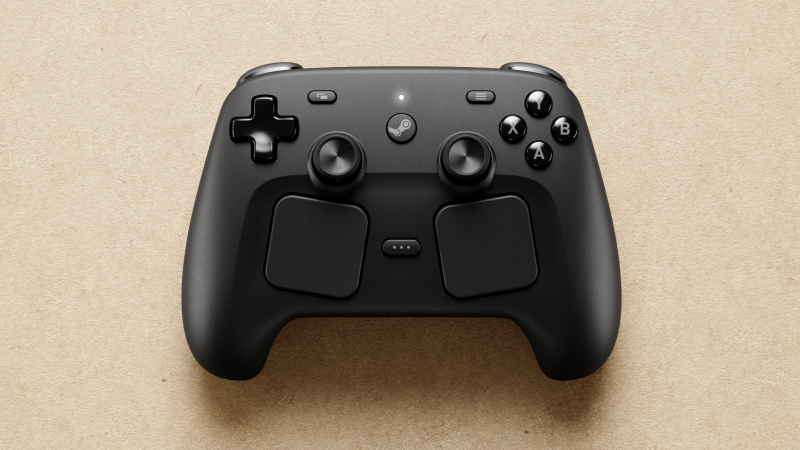
Best for PC: Steam Controller (2026) ($99.99). Valve's return to controllers pairs a TMR stick with capacitive touch, two 34.5mm haptic trackpads, a 6-axis gyro with Grip Sense activation, and four back buttons — 8.39Wh battery rated around 35 hours. GamesRadar+ names it the best TMR controller for PC games. Our Steam Controller (2026) review covers the details.
Best budget: 8BitDo Pro 3 ($69.99). TMR sticks with a 12-bit ADC, Hall Effect triggers with a mode switch, four remappable buttons, and an integrated charging dock — an absurd amount of hardware for the price.

Best for esports: Razer Wolverine V3 Pro 8K ($199.99). The TMR twin of our reviewed Wolverine V3 Pro: same chassis, but TMR sticks and 8,000Hz polling, with Razer claiming up to 36 hours of battery. We reviewed the Hall Effect version — the 8K swaps the sticks and adds the polling headroom for $40 more.

Also notable: 8BitDo Ultimate 2 Wireless. 8BitDo's official spec sheet lists TMR joysticks with a 12-bit ADC and switchable Hall Effect/tactile triggers — the first 8BitDo pad to ship TMR. Our full review covers the rest of the package.

Best Hall Effect controllers in 2026
Hall Effect remains the value play — and for a lot of players, it's plenty.
- Flydigi Vader 4 Pro (~$60) — Hall Effect sticks with adjustable tension dials (a direct fix for the "loose center" complaint), Hall Effect triggers with locks, six extra buttons, and 1,000Hz polling.

- Gulikit KK3 Max (~$80) — the original drift-free flagship: Hall Effect sticks and triggers, Smart Trigger modes, NFC Amiibo support, Maglev vibration, and a 950mAh battery rated at 28 hours.

- Razer Wolverine V3 Pro ($159.99) — premium Xbox pad with Hall Effect sticks, mecha-tactile face buttons, anti-friction stick rings, and four back buttons; ~20 hours battery at 1,000Hz wired.
- 8BitDo Ultimate 2.4G — the value king from our best PC controllers guide: Hall Effect sticks, back buttons, 1,000Hz polling, and a charging dock for well under first-party prices.
Which should you buy?
| Your situation | Pick |
|---|---|
| Competitive FPS, want maximum precision | TMR — GameSir Cyclone 2 or Razer Wolverine V3 Pro 8K |
| Coming from DualSense/Xbox, want familiar feel | TMR — center feel is closer to ALPS sticks |
| Casual player, just want drift-free | Either — buy the best deal; Hall Effect pads are cheapest |
| Xbox console native | GameSir G7 Pro (TMR) or Razer Wolverine V3 Pro |
| Budget under $60 | GameSir Cyclone 2 or 8BitDo Ultimate 2 |
| Want adjustable stick tension | Flydigi Vader 4 Pro (Hall Effect with tension dials) |
FAQ
Will TMR sticks drift? The sensor won't — there's no contact and nothing to wear in the sensing path. But the mechanical parts around the stick (springs, rings, rubber) still age, so a heavily used controller can eventually develop centering issues. It's far less common than potentiometer drift, which is a near-certainty over time.
Is TMR worth paying extra for? The premium has nearly vanished — TMR pads start in the mid-$50s. If you play shooters competitively, yes. Otherwise, buy on features and price; the sensor type is unlikely to be the deciding factor for you.
Should I replace my Hall Effect controller with TMR? No. If your current controller works and you like the feel, the difference isn't worth the upgrade. TMR matters most when you're buying new — there's no reason to pay twice for a marginal gain.
Does TMR improve battery life meaningfully? In most controllers, slightly — around 12 extra minutes per 12 hours in independent testing. The exception is high-end pads like the Razer Wolverine V3 Pro 8K, where the power headroom enables 8,000Hz polling without tanking battery life.
How can I tell if a controller actually has TMR sticks? Check the manufacturer's official spec page. Listings that only say "Hall Effect" may contain either technology — several brands use the more recognizable term for TMR sensors. A listing that specifically says TMR is the newer tech.
Verdict
TMR is the direction of 2026: nearly every premium third-party controller released this year uses it, and the price gap over Hall Effect has essentially closed. Hall Effect remains a perfectly good — and often cheaper — way to get drift-free sticks, and for casual play the two are effectively indistinguishable. If you play shooters seriously, buy TMR. If you just want a controller that never drifts, buy whichever magnetic pad fits your budget and your hands. Prices checked August 2026.
Related Guides
Buying Guide
Best PC Controllers 2026: The Definitive Roundup
From the $19.99 budget king to the sub-millisecond esports monster — every PC controller worth buying in 2026, ranked by use case with verified specs and community sentiment.
Buying Guide
Best PC Controllers with No Stick Drift in 2026: Hall Effect & TMR Picks
Tired of stick drift? Every drift-free PC controller worth buying in 2026 — Hall Effect and TMR picks from $20 to $100, ranked by use case with verified specs and community sentiment.
Buying Guide
Best Xbox Controllers 2026: Elite Series 3, Hall Effect & Budget Picks
From the new Xbox Elite Series 3 to drift-proof Hall Effect and TMR pads like the 8BitDo Ultimate 3 and GameSir G7 Pro — the best Xbox Series X|S and PC controllers for every budget in 2026.