Valve
Steam Controller (2026) Review
Good
$99.99
The best PC gamepad ever shipped - if your library lives in Steam. Brilliant TMR sticks, trackpads, gyro, and the Puck, but the Steam-only architecture is a hard dealbreaker outside the ecosystem.
Connectivity
2.4GHz Puck, Bluetooth, USB-C
Polling rate
250Hz (2.4GHz)
Latency
~8ms end-to-end (2.4GHz); higher over Bluetooth
Battery
8.39Wh Li-ion, ~35 hours rated
Pros & Cons
Pros
- Drift-resistant TMR sticks with capacitive touch - proven sensor family from the Steam Deck OLED
- Trackpads + gyro deliver mouse-grade input no other mainstream gamepad matches; Grip Sense is transformative once tuned
- The Puck is the best dongle design in the industry: 2.4GHz receiver, magnetic charging dock, four-controller support
- Roughly 35-hour battery that buries the DualSense and matches AA-powered rivals
- Deep Steam Input remapping with per-game profiles and community layouts
- Genuinely repairable - T6 Torx, no adhesives, official CAD files released
Cons
- Steam-only by design: no XInput mode, Steam client must be running, Xbox Game Pass games are unplayable
- Bluetooth latency is poor - the puck is effectively required
- Grip Sense triggers accidentally for some hand sizes; gyro setup is finicky and ships disabled
- Membrane face buttons and a glossy, low-grip D-pad feel below the $100 price point
- No dual-stage triggers, no 3.5mm audio passthrough
- 292g is heavy for a standard pad, and the strong magnets demand caution around metal
Overview
Eleven years after the original Steam Controller polarized the PC gaming world with its twin trackpads and a single joystick, Valve has returned with a dramatically different second act. The Steam Controller (2026), released May 4, 2026 at $99.99, is essentially a Steam Deck with the screen removed: dual analog sticks, a proper D-pad, two haptic trackpads, a 6-axis gyroscope, four rear buttons, and the capacitive "Grip Sense" grips. It sold out in roughly 30 minutes at launch, and the reception has been far warmer than its predecessor ever received. PCMag calls it an Editors' Choice with 4.0/5 stars, Polygon calls it a "near-perfect PC gamepad," and PC Gamer scored it 83/100.
But there is one enormous asterisk on the whole package: this controller only truly works inside Valve's ecosystem. There is no XInput mode, the Steam client has to be running, and Xbox Game Pass titles are entirely out of reach. That single design decision dominates both the praise and the complaints across Reddit, so it deserves to lead this review rather than hide in the cons section. For Steam-first players this is the best PC controller money can buy in 2026; for anyone who plays across storefronts, it is a frustrating walled garden.
Build Quality and Design
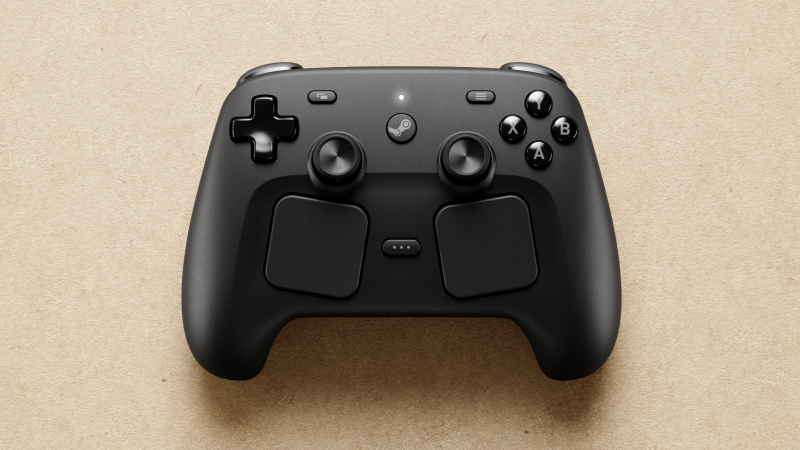
The 2026 Steam Controller weighs 292g (10.3 oz) and measures 111 x 159 x 57 mm, heavier than a DualSense (~280g) and noticeably more than a standard Xbox controller (~240g). The chassis is mostly matte black textured plastic that PCMag describes as "much more solid, comparable with an Xbox gamepad in heft and grip curve," a massive step up from the hollow, rattly original. The finish is textured enough to stay secure in sweaty hands, and the triggers have "smooth tension that doesn't feel remotely spongy."
The layout is a deliberate hybrid: PlayStation-style symmetrical sticks, Xbox-arranged ABXY face buttons, a plus-shaped D-pad up top, and the two square trackpads sitting in the center band below the sticks. Because so much real estate goes to the trackpads, the thumbsticks sit slightly higher than usual, and WIRED's reviewer noted having to adjust his grip, the pads "live where my thumbs naturally want to sit." PCMag, by contrast, found the pads positioned low enough that accidental brushes were not an issue. Hand size genuinely matters here; the thick grips suit large hands, while smaller-handed players may find it bulky.
The compromises are in the details. The face buttons are membrane, which multiple sources describe as a clear step below the mechanical-feeling buttons on Xbox and PlayStation pads. The D-pad is "entirely adequate, but lacking clean edges and suffering from a glossy finish that robs it of grip" per WIRED, a common thread in Reddit discussions, where several users wished for a circular or better-textured pad. And while the triggers are smooth Hall Effect units, Valve dropped the original's beloved dual-stage triggers; r/SteamController's top sentiment on the new pad is summed up by one heavily upvoted owner: "I absolutely love it! The only thing I'd change is bringing back the dual stage triggers from the original."
One genuinely unusual bright spot: repairability. The controller opens with a single T6 Torx driver, no clips, no adhesives, no proprietary fasteners, and Valve released full CAD files under a Creative Commons license days after launch. In an industry where controllers are increasingly glued shut, this is a meaningful long-term ownership advantage. The only physical quirk: both the controller and the puck contain strong magnets, and Valve explicitly advises keeping metallic objects away from them during pairing.
Key Features
- TMR analog sticks, Both sticks use tunnel magnetoresistance sensors, a contactless magnetic technology Valve says is more accurate and power-efficient than standard Hall Effect. The same sensor family has run in the Steam Deck OLED without widespread drift reports, and no reviewer or long-term owner has reported drift on the 2026 controller. The sticks are also capacitive and clickable (L3/R3), letting Steam Input use thumb-rest detection for gyro activation.
- Dual haptic trackpads, Two 34.5mm square pads can act as mouse, trackball, or joystick, with haptic feedback that fakes a physical click convincingly. Outside games, the right pad works as a laptop-style cursor; in games it can replace mouse aiming entirely.
- 6-axis gyro + Grip Sense, The IMU enables gyro aiming, and the capacitive grip sensors are designed to activate it the moment you squeeze, no button press. Valve engineers describe the intended philosophy as "gyro always on while holding," with a quick grip-release resetting the aim point.
- Four rear buttons, L4/R4/L5/R5 are remappable to anything Steam Input can emit, from keyboard keys to mouse clicks.
- Steam Input customization, Every input can be remapped per-game, with action layers, sensitivity curves from 25% to 3000%, half/full-pull trigger splits, and one-click community profiles for most popular titles.
- The Puck, A tiny USB dongle that doubles as a magnetic charging dock. It runs a proprietary 2.4GHz link, supports up to four controllers simultaneously, and snaps to the controller's rear connector for drop-in charging. WIRED calls it "a marvel for charging and connectivity."
- 35-hour battery, The 8.39Wh Li-ion cell is rated for roughly 35 hours, more than triple a DualSense. Charging works via the puck or USB-C.
- IR LEDs, Infrared emitters enable positional tracking when paired with Valve's upcoming Steam Frame VR headset, a future-proofing feature with no current use.
- Party trick, Drop it from sufficient height and it occasionally plays a Wilhelm scream.
Performance
Latency testing tells a clean story: over the 2.4GHz puck the controller polls at 250Hz (4ms) with roughly 8ms end-to-end latency, comfortably good for couch play, if not at the 1000Hz heights of competitive controllers. Bluetooth is the weak link. Gamers Nexus ran comparative benchmarks and their community roundly dubbed the Bluetooth results a "Bluetooth nightmare"; WIRED and Valve's own documentation agree that the puck is the intended connection, with Bluetooth carrying substantially higher latency. Wired USB-C is the third option.
Input accuracy gets near-universal praise. The TMR sticks track smoothly with no deadzone complaints, the trackpads convert to mouse input convincingly, and gyro aiming, once configured, is described by PCMag as "spot on," delivering "much more precise aiming than the traditional analog sticks usually afford." Tom's Hardware and PC Gamer were equally emphatic about the stick-plus-gyro combo for shooters. The caveat is a real learning curve: first-time gyro users should budget about a week before it feels natural, and configuration is mandatory, the gyro ships disabled.
Grip Sense is the most divisive feature in practice. PCMag's reviewer found himself constantly tripping the sensors due to his hand size, needing to consciously lighten his grip; WIRED's reviewer could not get the feature to calibrate at all across multiple games and resorted to mapping gyro to a button. Community feedback mirrors this split, owners who dial it in love it, but it is not the frictionless "squeeze to aim" Valve markets. It is fully remappable or disable-able, which softens the blow.
Battery life checks out. Valve rates 35 hours; independent testing (Gamers Nexus, Access-Ability) lands in the 30-35 hour range, with the low-power TMR sensors doing the heavy lifting. The firmware also optimizes for long-term battery health by capping charge over time.
Then there is the ecosystem tax. Gamers Nexus confirmed that even over Bluetooth the controller does not behave like a standard pad, "the right thumbstick isn't the right thumbstick" without Steam Input running, because the device must simultaneously function as mouse, keyboard, and gamepad. There is no XInput fallback mode. Reddit's reaction was sharp, "The controller doesn't support XInput? In 2026?" and, quoting GN's verdict, "If anyone other than Valve released a PC gamepad that needed their software running to work as a gamepad, they'd get a much stronger negative reaction." Xbox Game Pass on Windows is completely locked out (Windows 11 won't let Steam register those binaries). GOG and Epic games are workable but only through the "Add Non-Steam Game" dance: PCMag got The Witcher 3 (GOG) running perfectly, while WIRED's Epic attempts ended in scrambled inputs. An early Steam Input client update even broke existing configs in Kingdom Come: Deliverance 2 until a fix landed.
Pros and Cons
Pros:
- Drift-resistant TMR sticks with capacitive touch, the same sensor family proven in the Steam Deck OLED
- Trackpads + gyro deliver mouse-grade input that no other mainstream gamepad matches; Grip Sense is transformative once tuned
- The Puck is the best dongle design in the industry: 2.4GHz receiver, magnetic charging dock, and four-controller support in one
- ~35-hour battery that buries the DualSense (10-15h) and matches AA-powered rivals
- Deep Steam Input remapping with per-game profiles and community layouts
- Genuinely repairable, T6 Torx, no adhesives, official CAD files
Cons:
- Steam-only by design: no XInput mode, Steam client must be running, Xbox Game Pass games are unplayable
- Bluetooth latency is poor, the puck is effectively required
- Grip Sense triggers accidentally for some hand sizes; gyro setup is finicky and ships disabled
- Membrane face buttons and a glossy, low-grip D-pad feel below the $100 price point
- No dual-stage triggers, no 3.5mm audio passthrough
- 292g is heavy for a standard pad, and the strong magnets demand caution around metal
Who Should Buy This
Buy it if your library lives in Steam, especially if you play from a couch or bed, own a Steam Deck and want the identical control layout on the big screen, or have ever cursed stick aiming in a shooter. The trackpad-and-gyro combo genuinely replaces mouse input for strategy games, RTS titles, and desktop navigation, which is why so many owners describe it as the first controller that lets them put the keyboard down entirely ("Love not having to grab my keyboard and mouse whenever a popup or whatever kills my vibe," as one top r/SteamController comment puts it).
Skip it if you're a Game Pass subscriber, if you play across Epic/GOG and won't route everything through Steam, if you want a plug-and-play pad that behaves identically everywhere, or if you have smaller hands. This is a controller with strong opinions, and it demands that you share them.
Alternatives to Consider
- 8BitDo Ultimate 2 Wireless ($49.99), The sensible Steam-adjacent alternative: 1000Hz 2.4GHz, Hall Effect sticks and triggers, a proper charging dock, and Switch/PC/mobile support with zero ecosystem lock-in. No trackpads, gyro, or Grip Sense, but half the price.
- Sony DualSense (~$75), Excellent haptics, adaptive triggers, and gyro that works through Steam Input, all at a lower price. But battery life is 10-15 hours, there are no back buttons or trackpads, and its best features are ignored by most PC games.
- Xbox Elite Series 2 (~$180), Four paddles, adjustable tension sticks, and universal XInput compatibility with the best build in the business. No gyro, no trackpads, and at nearly twice the price it lacks the Steam Controller's feature density, plus its stick-drift reputation is well documented.
- Gulikit KK3 Max (~$70), The budget Hall Effect option with swappable sticks and back buttons, if drift immunity is your priority and Steam Input depth is not.
Verdict
The Steam Controller (2026) is the most capable PC gamepad ever shipped, and simultaneously the most constrained. For its intended audience, players who live in Steam, want couch-friendly mouse-grade input, and are willing to spend a week tuning gyro, it is a clear 9-out-of-10 purchase and the best $99.99 in PC gaming hardware this year. For everyone else, the Steam-only architecture is an unavoidable dealbreaker that no amount of TMR cleverness or Puck charm can talk around. It is a superb controller with a very specific owner. Score: 8/10, brilliant inside the walled garden, frustrating outside it.
What the Experts Say
Professional review consensus for this product
Full Specifications
| Connectivity | 2.4GHz Puck, Bluetooth, USB-C |
|---|---|
| Polling rate | 250Hz (2.4GHz) |
| Latency | ~8ms end-to-end (2.4GHz); higher over Bluetooth |
| Battery | 8.39Wh Li-ion, ~35 hours rated |
| Sticks | TMR (tunnel magnetoresistance), capacitive touch, clickable L3/R3 |
| Trackpads | 2x 34.5mm haptic touchpads |
| Gyro | 6-axis IMU with Grip Sense capacitive activation |
| Back buttons | 4 (L4/R4/L5/R5), remappable |
| Triggers | Hall Effect analog, no dual-stage |
| Weight | 292g (10.3 oz) |
| Dimensions | 111 x 159 x 57 mm |
| Compatibility | PC (Windows/macOS/Linux), Steam Deck, SteamOS, iOS/Android via Steam Link |
The Verdict: Good
The best PC gamepad ever shipped - if your library lives in Steam. Brilliant TMR sticks, trackpads, gyro, and the Puck, but the Steam-only architecture is a hard dealbreaker outside the ecosystem.
— GamepadSquire, July 2026
Related Buying Guide
Buying Guide
Best PC Controllers 2026: The Definitive Roundup
From the $19.99 budget king to the sub-millisecond esports monster — every PC controller worth buying in 2026, ranked by use case with verified specs and community sentiment.
Buying Guide
Stick Drift Test: How to Check Any Controller in 5 Minutes
Free browser test measures your stick drift on a 0.00-1.00 scale in five minutes — plus per-console recalibration paths for PS5, Xbox, Switch and Steam Deck, and the fix ladder from free recalibration to Hall effect replacement.


