GameSir G7 Pro vs G7 SE vs 8BitDo Ultimate 2C: Which Should You Buy in 2026?
GameSir's two licensed Xbox pads against 8BitDo's $29.99 wildcard: the G7 Pro's TMR sticks, 1000Hz tri-mode wireless and charging dock versus the G7 SE's wired Hall Effect value and on-pad audio controls versus the Ultimate 2C's Hall everything for PC and Switch. Platform compatibility decides this one - here's the full spec table, latency breakdown, and verdict.
By GamePadSquire Test Desk · Updated Nov 20, 2026
VerifiedThe matchup in one paragraph
This is the most common GameSir question of 2026 with an 8BitDo twist: three controllers, $23 to $80, all with drift-proof magnetic sticks, and none of them a bad buy. The GameSir G7 Pro ($63.99 tracked, $79.99 launch) is the fully-loaded one — Xbox-licensed, tri-mode wireless, TMR sticks, optical microswitch buttons, four extra inputs, and a charging dock in the box. The GameSir G7 SE ($34.99) is the wired minimalist — same Xbox licensing, Hall Effect sticks, on-pad audio controls, and a price under Microsoft's own controller. The 8BitDo Ultimate 2C Wireless ($22.99 tracked) is the outsider: it will never connect to an Xbox, but for PC players it delivers Hall Effect sticks and triggers plus 1000Hz wireless polling for a third of the G7 Pro's price. The right pick falls out of one question — which platform do you plug into? — and this guide walks the rest.
The contenders at a glance
| GameSir G7 Pro | GameSir G7 SE | 8BitDo Ultimate 2C Wireless | |
|---|---|---|---|
| Price | $63.99 tracked / $79.99 launch | $34.99 | $22.99 tracked / $29.99 list |
| Xbox support | Licensed (Series X|S, One) | Licensed (Series X|S, One) | None |
| Switch support | No | No | Yes (Bluetooth SKU) |
| PC support | Wired, 2.4GHz, Bluetooth | Wired USB-C | 2.4GHz, wired, Bluetooth (Android) |
| Sticks | TMR | Hall Effect | Hall Effect (GuliKit modules) |
| Triggers | Hall Effect + microswitch stops | Hall Effect | Hall Effect |
| Polling | 1000Hz wired & 2.4GHz (PC) | 250Hz default, 1000Hz via firmware | 1000Hz over 2.4GHz and USB |
| Extra buttons | 4 (two back paddles, two mini bumpers) | 2 back (quick-latch with locks) | 2 (L4/R4) |
| Face buttons | Optical microswitch | — | Membrane |
| Audio | 3.5mm jack | 3.5mm + on-pad volume, chat, mute | — |
| Charging dock | Included | No | No |
| Weight | 272g | 221g | 217.5g |
| Our score | 9/10 | 8.8/10 | 8.8/10 |
GameSir G7 Pro — the flagship argument

The G7 Pro earned a 9/10 in our review, and the reasoning survives every price movement since: nothing else at the price bundles TMR sticks, Hall Effect triggers with physical microswitch stops, 1000Hz polling over both wired and 2.4GHz, and optical microswitch face buttons that never debounce-flicker. It is, mechanically, an esports pad wearing a licensed-Xbox costume. The four extra inputs — two rear paddles plus two mini bumper keys (R5/L5) — give claw-grip and paddle players real options, and the tri-mode radio means one controller covers the Xbox, the desktop, and a phone.
The dock is the quiet killer feature. Wccftech's 8.8/10 review called the charging station the G7 Pro's most innovative touch, alongside the cable retainer built into the pad itself and a swappable D-pad; their deductions were the absence of RGB and swappable ABXY caps, features GameSir reserves for other lines. Our review's complaint list is shorter than most: the D-pad is merely good rather than great, and Bluetooth mode is for convenience rather than latency. Battery runs 8 to 12 hours depending on rumble intensity.
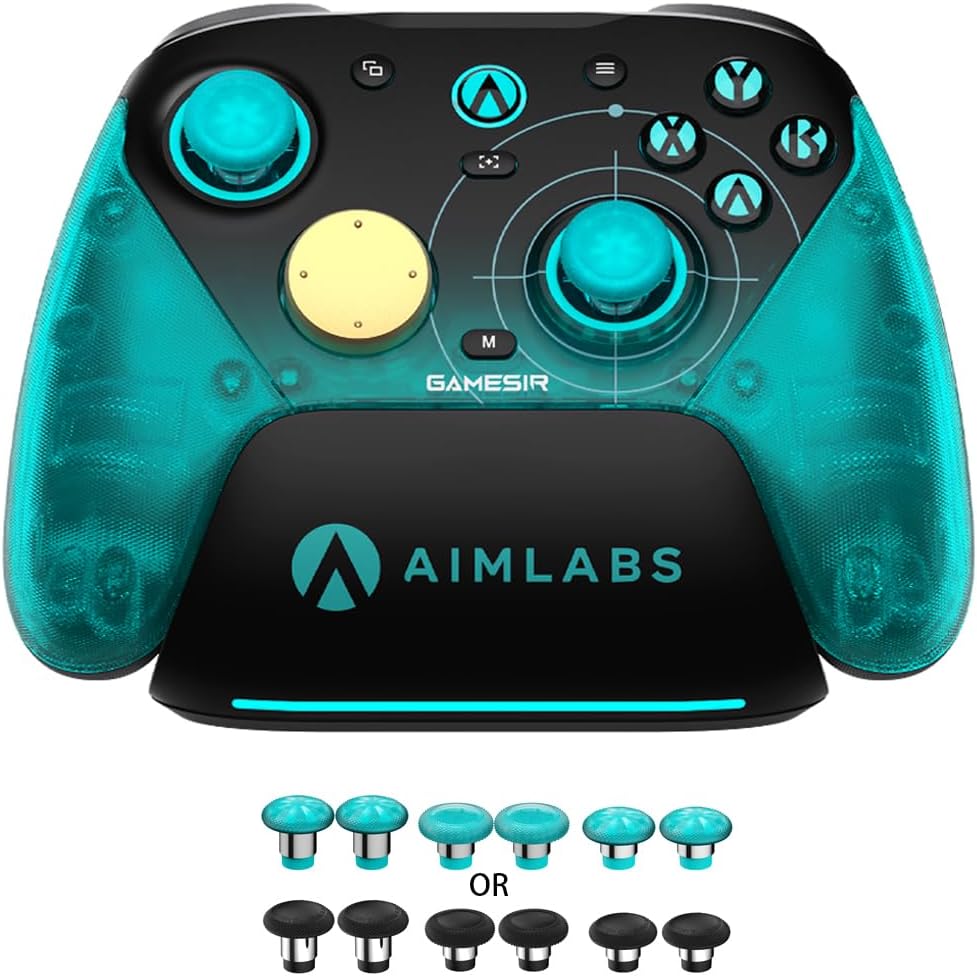
One wrinkle worth knowing: GameSir also sells the G7 Pro 8K (Aimlabs Edition) (~$72 tracked), which pushes polling to a genuine 8000Hz with Gen-2 TMR sticks — but it drops Xbox support entirely and is PC-only, scoring 8.8 in our review. If you are buying for a console household, the standard G7 Pro is the one; if you are PC-only and latency-obsessed, read that review before deciding.
Buy it if you want one controller for Xbox and PC that will still feel current in three years.
GameSir G7 SE — the value pragmatist
The G7 SE is the pad that made Hall Effect sticks normal in the licensed-Xbox world. At $34.99 — regularly under the $45 it launched at, and under Microsoft's own controller price — it delivers drift-proof Hall sticks, Hall triggers, two quick-latch back buttons that physically lock to avoid accidental presses, and the deepest on-pad audio control at any price: a 3.5mm jack with dedicated volume, chat mix, and mute controls on the controller itself. For anyone gaming with a headset plugged into the pad, that alone justifies the platform.
Our 8.8/10 review called it the best wired Xbox controller under $50, and the two trade-offs have not changed. First, it is wired-only — the 3-meter detachable USB-C cable is long, but it is still a leash. Second, the D-pad is soft, which matters for fighting games and precision platformers more than for shooters. Polling ships at 250Hz and reaches 1000Hz through a firmware update, which is the difference between fine and excellent on PC; on Xbox the distinction is academic.
At 221 grams it is the lightest pad of the three, and the simplicity has a durability upside: no radio, no battery, no dock contacts to fail. Owner sentiment tracks the reviews — the recurring praise is exactly what you would expect from a stick-spec-for-price champion.
Buy it if your controller lives in one room, plugged into one Xbox or PC, and you want to spend the difference on games.
8BitDo Ultimate 2C — the platform wildcard

The Ultimate 2C is the reason this comparison needs a platform check before anything else, and the one place where $30 beats $80 outright. The 2C Wireless — $22.99 tracked against a $29.99 list — runs a 2.4GHz dongle for Windows, USB-C wired, and Bluetooth for Android, with GuliKit Hall Effect stick modules, Hall Effect linear triggers, remappable L4/R4 buttons, 1000Hz polling over both dongle and cable, and a 19-hour battery in a 217.5-gram shell. Our full review scored it 8.8/10 and called it the budget wireless controller to beat; it has become the best-selling PC gamepad on Amazon, which tells you what the market decided. There is also a wired sibling, the 2C Wired, now tracked at $19.99 (8.5/10), and a Bluetooth SKU aimed at Switch and Switch 2. None of them will ever talk to an Xbox — 8BitDo does not hold that license — which instantly removes the line from consideration for Xbox households.
The compromises are the corners you would predict at the price: no charging dock, membrane face buttons rather than the G7 Pro's optical switches, a D-pad our review calls mediocre, Bluetooth limited to Android on the wireless unit, and a slim shape that does not suit every hand. None of that touches the core argument: Hall Effect sticks and triggers with flagship-grade 1000Hz wireless for $23 is the best raw value of this entire comparison. Our G7 Pro vs 8BitDo Ultimate 3 comparison covers the step-up 8BitDo line for buyers with more budget.
Buy it if you game on PC or Android and want Hall Effect everything for under thirty dollars. Skip it if there is an Xbox in the house.
Head-to-head: the platform question decides it
- Xbox Series X|S or Xbox One: the Ultimate 2C is out — no Xbox support, no exceptions. Between the GameSirs, the G7 Pro's wireless freedom and dock win if you can spend $64; the G7 SE wins on pure value if a cable does not bother you.
- Nintendo Switch or Switch 2: the 2C Bluetooth is the only native option of the three. Neither G7 model connects to a Switch.
- Windows PC: all three work, and the ranking inverts on use case. Desk-only and latency-focused: the 2C Wireless or the G7 Pro in wired mode at 1000Hz. Couch gaming: the G7 Pro's 2.4GHz and Bluetooth modes. headset-heavy gaming: the G7 SE's on-pad audio controls, cable notwithstanding.
- Android phone: G7 Pro (Bluetooth) or 2C Wireless. The SE cannot do it.
Performance and technology, compared
All three pads solve stick drift the same way — contactless magnetic sensing — at two fidelity levels. The G7 Pro's TMR sticks read finer gradations than the Hall Effect sticks on the other two, which in practice means smoother micro-corrections in aiming; our TMR vs Hall Effect guide covers the physics. Trigger architecture favors the G7 Pro again: its Hall triggers add physical microswitch stops, effectively converting to a mouse click for shooters, while the SE and 2C carry analog-only triggers.
Polling is closer than the price spread suggests. The G7 Pro runs 1000Hz wired and over its dongle; the 2C Wireless matches it at 1000Hz; the SE needs a firmware update to get there and is 250Hz out of the box. None of this matters on Xbox, where the console's input pipeline caps the benefit — it matters on a high-refresh gaming PC, where the G7 Pro and 2C pull (slightly) ahead.
Face buttons are the quiet differentiator. The G7 Pro's optical microswitches actuate on light interruption — no physical contact, no debounce delay, a crisp click every time. The SE's buttons are tuned to feel clicky but are conventional underneath, and the 2C is standard at its price. For fighting-game players this is a real gap; for shooter players it is barely perceptible.
What you give up at each step down
Dropping from the G7 Pro to the SE ($29 saved) costs you: wireless, the dock, four extra inputs down to two, TMR down to Hall, optical switches, the gyroscope, and Bluetooth/Android support. You keep: Xbox licensing, Hall sticks and triggers, 1000Hz (after firmware), and the best on-pad audio controls of the three.
Dropping from the SE to the 2C ($6 saved) costs you: Xbox support entirely, the 3.5mm audio jack and on-pad volume controls, and any dock option — the 2C has none at any price. What you gain instead: Switch and Switch 2 support (Bluetooth version), Hall Effect triggers at the entry price, and 1000Hz out of the box. For a pure-PC or Switch player, the 2C is not a downgrade from the SE at all; it is a different, equally rational purchase.
FAQ
What is the main difference between the GameSir G7 Pro and G7 SE? Wireless versus wired, and stick technology. The G7 Pro is tri-mode wireless (USB-C, 2.4GHz, Bluetooth) with TMR sticks, four extra buttons, optical microswitch face buttons, and a charging dock. The G7 SE is wired-only with Hall Effect sticks, two back buttons, and on-pad audio controls. Both are officially licensed for Xbox.
Is the GameSir G7 Pro worth twice the price of the SE? If you want wireless play, play fighting games (optical buttons, better D-pad ecosystem), or want the extra mini-bumpers and dock — yes, and our 9/10 review argues it is the value king of its tier. If you sit at a desk three feet from the USB port, the SE delivers roughly 85% of the experience for $29 less.
Does the 8BitDo Ultimate 2C work on Xbox? No. There is no Xbox-compatible version. The 2C Wireless is for Windows and Android via its 2.4GHz dongle; the 2C Bluetooth is for Switch and Switch 2. Xbox players should stay in the GameSir G7 family or look at our best Xbox controllers guide.
Do all three controllers have drift-proof sticks? Yes. All three use contactless magnetic sensing — the G7 Pro the more precise TMR variant, the G7 SE and 2C classic Hall Effect. None of them can develop the physical stick wear that causes drift on standard controllers.
Which one should I buy for a gaming PC? The G7 Pro if the budget allows — its wired 1000Hz mode, TMR sticks, and trigger stops make it the best pure performer of the three, and it doubles for Xbox. The 2C Wireless is the budget answer, and the SE makes sense only if the on-pad audio controls matter more to you than wireless.
Which should I buy for Nintendo Switch 2? The Ultimate 2C Bluetooth — it is the only one of the three with native Switch support, including motion controls and Hall Effect sticks at $29.99. Our Switch 2 controllers guide has the wider field.
Are there back buttons on all three? Yes, in declining count. The G7 Pro has four extra inputs (two rear paddles, two mini shoulder bumpers), the G7 SE has two quick-latch back buttons with physical locks, and the 2C has two L4/R4 buttons. All are remappable through their respective software or on-pad menus.
Verdict
The honest ranking depends on where you plug in, but the pattern across our reviews and owner sentiment is stable. For Xbox and multi-platform households, the GameSir G7 Pro at $63.99 tracked is the best buy of the three and one of the best values in controllers full stop — a 9/10 pad whose only real concession to the Elite tier is branding. For wired-only Xbox players and headset-first gamers, the G7 SE at $34.99 is the rational choice — an 8.8/10 pad that beats Microsoft's own on stick tech and price. For PC and Switch players, the Ultimate 2C Wireless at $22.99 tracked is the spoiler: Hall Effect sticks and triggers with 1000Hz polling at a price neither GameSir can touch, as long as Xbox is never in the picture.
If none of these fit — you want sub-$40 wireless, four back buttons on a budget, or PS5 support — the wider field is covered in our master buying guide and the budget controller roundup.
Related Guides
Buying Guide
Best PC Controllers 2026: The Definitive Roundup
From the $19.99 budget king to the sub-millisecond esports monster — every PC controller worth buying in 2026, ranked by use case with verified specs and community sentiment.
Buying Guide
GameSir G7 Pro vs 8BitDo Ultimate 3: Which Should You Buy in 2026?
The two best officially licensed Xbox controllers under $100: the GameSir G7 Pro's verified sub-3ms wired latency and optical microswitch buttons at $79.99 versus the 8BitDo Ultimate 3's officially licensed Xbox wireless, Force Ring adjustable TMR sticks, and 20-hour battery at $99.99. One is the PC value king, the other is the Xbox wireless answer — here's which one to buy.
Buying Guide
8BitDo Pro 3 vs Ultimate 2: Which Should You Buy in 2026?
The 8BitDo Pro 3 ($69.99, ~$50 street) and Ultimate 2 Wireless ($59.99) are 8BitDo’s two best 2026 controllers. Both have TMR sticks, switchable Hall Effect triggers, a charging dock, and four extra inputs. The Pro 3 is the Switch-first, symmetrical-layout all-rounder; the Ultimate 2 is the PC-first value king with true 1000Hz wireless and the deepest software in the category. Neither works on Xbox or PlayStation — here’s which one to buy.