GameSir
GameSir G7 Pro 8K (Aimlabs Edition) Review
Excellent
$89.99
The GameSir G7 Pro 8K is the most technically impressive controller under $100: verified sub-millisecond wired latency, real 8K polling, and Gen-2 TMR sticks. PC-only, mediocre D-pad, and some QC reports on trigger stops, but as a PC performance controller it sets the standard for the price. Score: 8.8/10.
As an Amazon Associate we earn from qualifying purchases made through links for GameSir G7 Pro 8K (Aimlabs Edition).
connectivity
Tri-mode (USB-C wired, 2.4GHz wireless, Bluetooth)
polling_rate
8000Hz wired and 2.4G on PC (default 1000Hz)
sticks
Gen-2 Mag-Res TMR (JS13 Pro), 15-bit real resolution
triggers
Hall Effect analog with microswitch trigger stops
Pros & Cons
Pros
- Class-leading verified latency: sub-millisecond stick response over cable, ~3.5ms wireless
- Gen-2 TMR sticks with 15-bit real resolution and near-zero dead zones
- Outstanding value at $89.99 with dock, swappable parts, and 8K polling
- 8K polling is real: sustained ~7,900Hz wired and 2.4G
- Deep GameSir Connect software with 4 profiles
- Excellent comfort and ergonomics
Cons
- PC-first: no Xbox or PlayStation support
- QC reports on trigger stops from a minority of owners
- D-pad remains wiggly and imprecise
- Dock seats the controller loosely
- 8K polling imperceptible for most players
- Middling 8-12 hour battery
Overview
The GameSir G7 Pro was already the value king of 2025's controller market — TMR sticks, Hall Effect triggers, and a charging dock at $79.99 earned it a 9/10 from us and glowing coverage elsewhere. The G7 Pro 8K is the follow-up aimed squarely at the competitive PC crowd: it keeps everything that worked and adds the headline feature — an 8,000Hz polling rate over both wired and 2.4GHz wireless — while nudging the price to $89.99.
There's an important catch before we go further. Unlike the standard G7 Pro, the 8K is a PC-first controller. GameSir dropped native Xbox compatibility (the console doesn't support 8K input anyway), so you get PC, Switch 1/2, and mobile over Bluetooth — but no Xbox, and no PlayStation. That's a deliberate trade-off rather than an omission: the 8K is built for competitive PC play, and on that narrow-but-deep mission it's arguably the most capable controller under $100.
The headline number deserves scrutiny, because "8K polling" has become 2026's most marketing-abused spec. The good news: the G7 Pro 8K actually delivers. Independent hardware testing from the Gamepadla community using the Prometheus 82 bench verified a sustained ~7,900Hz median with peaks at a clean 8,000Hz, and recorded the best stick-latency figures the site has ever measured — sub-millisecond over cable. Whether that translates into a feelable advantage is a separate question, and it's the one that splits opinion most.
Build Quality and Design
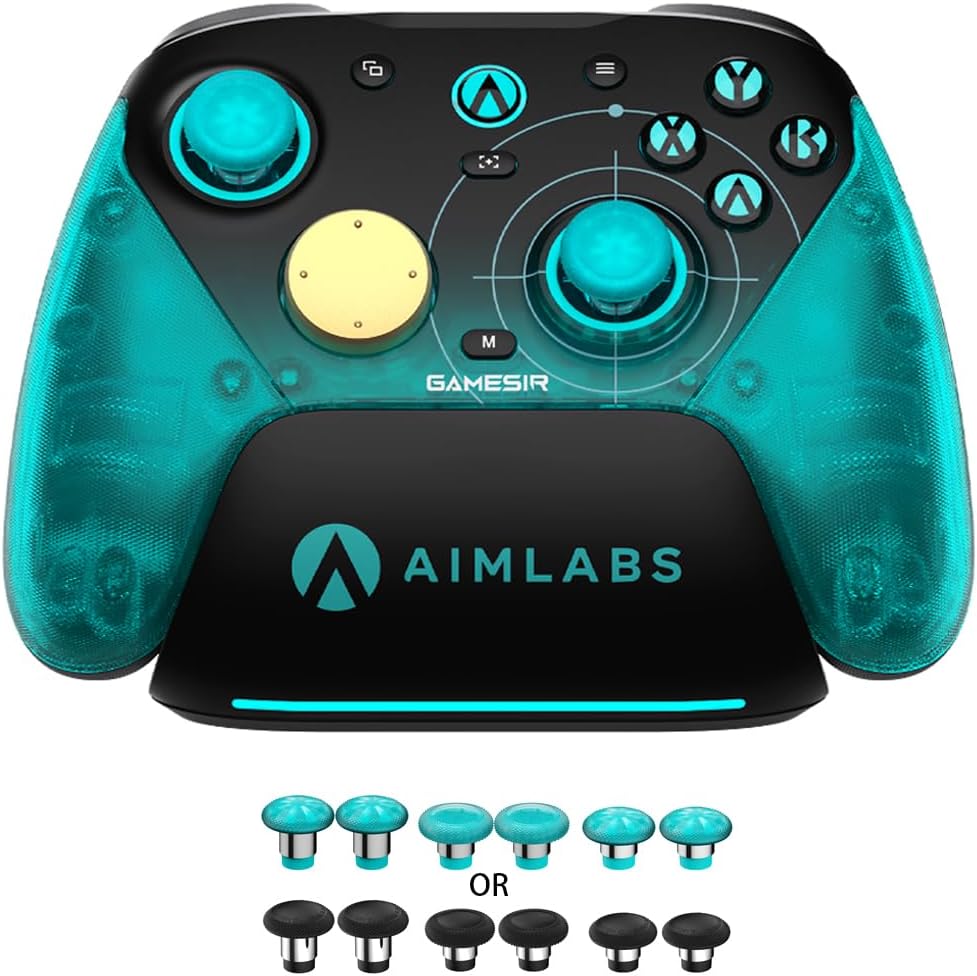
The 8K keeps the G7 Pro's proven chassis: an Xbox-layout body with textured, rubberized grips, a three-piece magnetic faceplate, and comfortable handles that Steam Deck HQ called the most comfortable it had ever used. The Aimlabs Edition reviewed by most outlets arrives in a teal-and-black scheme with gold D-pads and a semi-transparent shell that shows off the dual rumble motors spinning during vibration; the Champion Edition offers the same hardware in different colors. Build quality is solid for the price, with one caveat: the face button legends are printed rather than double-shot molded, and several reviewers and owners describe them as slightly blurry or dotted, with some units showing tiny bubbles in the print under close inspection. Purely cosmetic, but it's the first hint of cost-cutting.
The box is generous: a USB-C cable with a retainer clip, a charging dock with a hidden 2.4GHz dongle compartment, three sets of swappable stick caps, two extra D-pads, and the magnetic three-piece faceplate. Everything swaps tool-free. The dock is a genuine highlight — drop the controller on it and it turns off and charges; pick it up and it wakes. The one recurring complaint across reviews and Reddit is that the controller sits loosely on the dock and can slide off the charging contacts with a bump, so you'll occasionally find it still dead despite "docking" it.
The face buttons use optical microswitches and the D-pad a mechanical microswitch design, giving a clicky, immediate response. The dual-mode triggers combine Hall Effect analog travel with microswitch trigger stops you can flip for near-instant actuation — the same trick as far more expensive pads. On the back sit two remappable back buttons with physical locks to disable them entirely, plus two mini bumpers (R5/L5) up top and a mode switch for wired/2.4GHz/Bluetooth. The textured grips drew one note from Notebookcheck: they trap dust and grime over time, so they need the occasional clean.
Key Features
- 8000Hz Hyper-Polling (wired + 2.4GHz): Real, verified 8K polling on both connections — Gamepadla's P82 bench measured a ~7,936Hz median with clean 8,000Hz peaks and minimal jitter. Defaults to 1000Hz out of the box; switch it in GameSir Connect.
- Gen-2 Mag-Res TMR sticks: Contactless magnetic tech that eliminates the physical wear that causes stick drift. P82 testing measured real resolution of 15-bit (left) / 14-bit (right) — better than the advertised 12-bit — with essentially no inner dead zone and a 0.3mm outer dead zone.
- Dual-mode Hall Effect triggers: Full analog travel for racing and flight sims, or flip the trigger stops for microswitch-fast actuation in shooters.
- Four programmable buttons: Two lockable back buttons (R4/L4) plus two mini bumpers (R5/L5), each supporting macro recording up to 32 steps.
- Swappable everything: Three stick caps, two extra D-pads, and the three-piece magnetic faceplate — all tool-free, with G7-series faceplate compatibility.
- 6-axis gyroscope for motion controls (accuracy flagged as a weak point by The Shortcut), dual asymmetric rumble, and Turbo mode.
- 3.5mm audio jack that works wired and over 2.4GHz (not Bluetooth).
- GameSir Connect software with four onboard profiles, deadzone and stick-curve editing, button remapping, RGB control, and polling-rate switching.
Performance
The performance section is the whole story for this controller. Gamepadla's Prometheus 82 hardware bench — the most rigorous public latency testing in the controller space — measured stick latency of 0.69ms over cable in Xinput 8K mode and 0.63ms in Sony mode, with button latency around 1.3–1.5ms. Those are the best results the site has ever recorded, earning a Wired A+ / Wireless A+ LatScore — the maximum possible on both channels simultaneously. A second independent tester reproduced 0.68ms on different hardware and OS, cross-confirming the result. Wireless over 2.4GHz averages ~3.5ms with a tight spread, and Bluetooth sits around 3.45–3.58ms with rare interference spikes — figures that match the wireless performance GuliKit loudly markets with its Hyperlink 2 tech.
Notebookcheck independently verified the controller genuinely polls at 8K in both wired and 2.4GHz modes (it ships at 1000Hz), with latency averaging 1.1ms wired and 3.5ms wireless. Digital Foundry called it "objectively, a superior controller to pretty much anything on the market," pointing to the near-zero dead zones and sub-millisecond wired figure.
The nuance: 8K polling is largely imperceptible in practice. GamesRadar's review was built around the question of whether you can actually tell the difference, and TechRadar called the extra polling "a divisive extra" after 25 hours of testing — great for esports, irrelevant for most PC titles. Reddit sentiment mirrors this: even competitive players running 240Hz+ displays say you won't notice the jump from 1000Hz. What you do notice is the TMR sticks' precision and the near-zero dead zones, which several owners credit for improved aim and smoother strafing. The hardware is legitimately elite; the 8K headline is spec-sheet dominance more than a daily-feelable upgrade.
One quirk worth knowing: in 8K mode the controller emits heavy "tremor" in raw stick data — the P82 bench measured 92% informational spam at 8000Hz. It doesn't affect gameplay or crosshair stability, and dropping to 1000Hz cuts it to around 65% while adding only about 1ms of latency. Also note the Raw mode setting, which improved latency on older GameSir models, now slightly increases stick latency on this one — the default curve is the better choice.
G7 Pro vs G7 Pro 8K: What Actually Changed
Owners who upgraded from the standard G7 Pro report a short but meaningful list of changes: the new JS13 Pro TMR sticks (which the community describes as an immediate, noticeable improvement over the already-good originals), the 8K polling, a smaller 2.4GHz dongle, and native Nintendo Switch 1/2 support including wake-from-dock. The flip side: the 8K drops native Xbox support (a Brook XB3 adapter restores it for those who need it), loses trigger rumble, and moves from the Nexus software to GameSir Connect, since Nexus is reserved for Xbox-licensed models. Battery life is unchanged at 8–12 hours, and the D-pad carries over untouched — for better and worse.
Pros and Cons
Pros:
- Class-leading verified latency: sub-millisecond stick response over cable and ~3.5ms wireless — the best results Gamepadla has ever recorded
- Gen-2 TMR sticks with 15-bit real resolution and near-zero dead zones; drift-resistant by design
- Outstanding value: 8K polling, Hall Effect triggers, charging dock, and swappable everything for $89.99 — roughly half the price of first-party pro controllers
- The 8K polling is real, not marketing: sustained ~7,900Hz in both wired and 2.4GHz modes
- Deep, easy-to-use software with four profiles, deadzone and curve tuning, macros, and RGB
- Excellent comfort and ergonomics — widely praised across press reviews and owner feedback
Cons:
- PC-first: no Xbox or PlayStation support, so the headline features are locked to PC (Bluetooth covers Switch 1/2 and mobile)
- QC reports on the trigger stops: a small but persistent minority of owners report trigger stop failures, uneven trigger resistance, and creaky faceplates within weeks — the most common complaint across Amazon and Reddit
- The D-pad remains the weak point: wiggly and floaty with misclicks, and several owners grade it poorly for platformers and fighting games
- The dock doesn't seat the controller firmly and can slide off the charging contacts easily
- 8K polling is imperceptible for most players — you're paying $10 extra for spec-sheet dominance
- Middling battery life (8–12 hours) and printed face-button legends that look slightly cheap
- Gyro accuracy trails purpose-built motion controllers
Who Should Buy This
The G7 Pro 8K is for the competitive PC player — the person who wants the lowest-latency input available without spending $170+ on a first-party pro pad. If you play FPS, fighting, or racing games on Windows, or you use a handheld PC (Steam Deck, ROG Ally, Legion Go), and you're willing to spend ten minutes in GameSir Connect setting up profiles and deadzones, this is arguably the best performance-per-dollar controller on the market. Switch 1/2 support (including wake-from-dock) is a genuine bonus, and Steam Deck owners have reported good results with the back buttons exposed to Steam Input.
Skip it if you're an Xbox or PlayStation player — the standard G7 Pro remains the right buy there and is $10 cheaper. Skip it if you live on the D-pad for platformers or fighting games, or if you want premium materials and finishes; the plastic and printed legends won't satisfy an Elite Series 2 owner. And if you're a casual PC gamer who just wants a comfortable pad, the 1000Hz G7 Pro delivers 95% of the experience for less.
Alternatives to Consider
- GameSir G7 Pro ($79.99): The 1000Hz original — same TMR sticks, same dock, same comfort, plus native Xbox support. The sensible pick if you don't need 8K and want console compatibility.
- GameSir Cyclone 2 ($55.99): The budget TMR option — 1000Hz polling, Hall Effect triggers, and a similar feature set for $34 less. The value pick if 8K polling isn't the point.
- Razer Wolverine V3 Pro ($199.99): The premium alternative — mechanical face buttons, 1000Hz polling, six remappable buttons, and Xbox/PC support at more than double the price.
- 8BitDo Ultimate 2 / Ultimate 2C: Solid wireless options with docks in the same price band, though without 8K polling or TMR-level stick precision.
Verdict
The GameSir G7 Pro 8K is the most technically impressive controller you can buy for under $100. Independent hardware testing confirms the 8K polling is real and the latency is class-leading — sub-millisecond over cable, ~3.5ms wireless — and the Gen-2 TMR sticks deliver precision that rivals controllers costing twice as much. It's not perfect: the D-pad is mediocre, QC on the trigger stops is a genuine lottery, the dock is finicky, and the 8K headline is largely imperceptible outside esports. But as a PC performance controller, it sets the standard for the price. Score: 8.8/10.
What the Experts Say
Professional review consensus for this product
Full Specifications
| connectivity | Tri-mode (USB-C wired, 2.4GHz wireless, Bluetooth) |
|---|---|
| polling_rate | 8000Hz wired and 2.4G on PC (default 1000Hz) |
| sticks | Gen-2 Mag-Res TMR (JS13 Pro), 15-bit real resolution |
| triggers | Hall Effect analog with microswitch trigger stops |
| buttons | Optical microswitch ABXY, mechanical microswitch D-pad |
| extra_buttons | 4 (2 lockable back buttons + 2 mini bumpers) |
| battery | 1200mAh (8-12 hours) |
| platforms | PC, Nintendo Switch 1/2, Android, iOS (Bluetooth) |
| audio | 3.5mm headphone jack (wired + 2.4G) |
| gyroscope | 6-axis |
| rumble | Dual asymmetric motors |
| software | GameSir Connect |
| extras | Charging dock, 3 swappable stick caps, 2 extra D-pads, 3-piece magnetic faceplate |
The Verdict: Excellent
The GameSir G7 Pro 8K is the most technically impressive controller under $100: verified sub-millisecond wired latency, real 8K polling, and Gen-2 TMR sticks. PC-only, mediocre D-pad, and some QC reports on trigger stops, but as a PC performance controller it sets the standard for the price. Score: 8.8/10.
— GamepadSquire, August 2026
As an Amazon Associate we earn from qualifying purchases made through links for GameSir G7 Pro 8K (Aimlabs Edition).
Related Buying Guide
Buying Guide
Best PC Controllers 2026: The Definitive Roundup
From the $19.99 budget king to the sub-millisecond esports monster — every PC controller worth buying in 2026, ranked by use case with verified specs and community sentiment.
Buying Guide
GameSir G7 Pro vs 8BitDo Ultimate 3: Which Should You Buy in 2026?
The two best officially licensed Xbox controllers under $100: the GameSir G7 Pro's verified sub-3ms wired latency and optical microswitch buttons at $79.99 versus the 8BitDo Ultimate 3's officially licensed Xbox wireless, Force Ring adjustable TMR sticks, and 20-hour battery at $99.99. One is the PC value king, the other is the Xbox wireless answer — here's which one to buy.


