Best TMR Controllers 2026: The Definitive Roundup
TMR is the sensor technology taking over premium controllers in 2026 — higher resolution, better centering, and drift immunity for less than you think. Every TMR controller worth buying, ranked and explained, with verified specs and community sentiment.
By GamepadSquire — August 5, 2026Verified
TMR is the biggest thing to happen to controller sticks since Hall Effect — and in 2026, it has officially taken over. Tunnel magnetoresistance sensors measure the direction of a magnetic field instead of its strength, which translates into higher resolution, less jitter, and a stick feel that reads much closer to the traditional ALPS sticks most players grew up on. Nearly every premium third-party controller released this year ships TMR: the GameSir Cyclone 2, the 8BitDo Ultimate 2, the 8BitDo Pro 3, and Valve's Steam Controller (2026) all use it, and Razer now sells TMR and Hall Effect versions of the Wolverine V3 Pro at the same price.
The catch for buyers is that the sensors look identical on the shelf, some brands still print "Hall Effect" on boxes that actually contain TMR sensors, and marketing terms blur together. This roundup cuts through that: every pick below is a TMR controller we have reviewed in full — with verified specs, latency measurements, and community sentiment — organized by what you actually need it to do. For the deep dive on how TMR differs from Hall Effect at the physics level, see our TMR vs Hall Effect explainer; here, the focus is the buying decision.
Quick picks
| Use case | Pick | Price | Why |
|---|---|---|---|
| Best overall | 8BitDo Ultimate 2 Wireless | $59.99 | TMR 12-bit sticks, 1000Hz wireless, charging dock |
| Best value | GameSir Cyclone 2 | $55.99 | The controller that made TMR mainstream, hair-trigger system |
| Best budget | GuliKit ES Pro | $29.99 | TMR sticks + Hall triggers for under $30, ~30h battery |
| Best for Xbox (value) | GameSir G7 Pro | $79.99 | Licensed Xbox pad with TMR sticks at 1000Hz |
| Best for Xbox (premium) | 8BitDo Ultimate 3 | $99.99 | Force Ring adjustable TMR, wireless charging dock |
| Best esports (wired) | GameSir Tarantula 8K | $69.99 | Sub-millisecond latency, 8000Hz polling, 180g |
| Best for PC | Steam Controller (2026) | $99.99 | TMR stick + haptic trackpads, unmatched Steam integration |
| Best retro / Switch | 8BitDo Pro 3 | $69.99 | TMR 12-bit sticks, Hall triggers, dock, Switch 1/2 |
What actually matters with TMR
Resolution is the real story. TMR's sensitivity advantage shows up as resolution: the best TMR controllers pair their sensors with 12-bit ADC chips, giving 4,096 steps of position per axis — versus the 8-bit, 256-step sensing of older budget pads. More steps mean smoother, more granular inputs, which matters when you are making small aiming corrections in a shooter.
Centering feel. TMR reads closer to a traditional ALPS stick around center, which is why players migrating from a DualSense or Xbox pad often find TMR an easier transition than first-generation Hall Effect modules, which can feel loose or floaty. There is still a genuine acclimation period — community threads about "weird" TMR feel usually turn out to be players adjusting to inputs that arrive faster and smoother than they are used to.
The sensor is only half the story. A great TMR sensor inside a controller with a big deadzone, a strange response curve, or a low polling rate loses to a well-tuned Hall Effect implementation. Deadzone calibration, response curves, polling rate, and stick tension matter as much as — sometimes more than — the sensor type. That is why this guide leads with reviewed products and measured data rather than the sensor badge on the box.
"Drift-free" does not mean immortal. The sensor will not drift, but the mechanical parts around it still age: stick rings lose their smoothness, rubber grips wear, springs loosen. Buy on build quality and serviceability, not just sensor type.
Best overall: 8BitDo Ultimate 2 Wireless

The 8BitDo Ultimate 2 Wireless is the controller that makes the case that you no longer need to choose between drift immunity, wireless performance, and price. It pairs TMR sticks with a 12-bit ADC — 4,096 steps of resolution per axis — plus switchable Hall Effect triggers with a linear/tactile mode switch, 1000Hz polling over 2.4GHz, and the charging dock that made the Ultimate line famous. The 1000mAh battery rates around 14 hours with RGB on, and the dock keeps it topped up between sessions.
Owner sentiment is overwhelmingly positive, with the dock, the stick feel, and the software (Ultimate Software V2 with three onboard profiles) drawing consistent praise. The recurring trade-offs are the ones 8BitDo has always carried: no Xbox or PlayStation support, and no 3.5mm audio jack. For PC, Steam Deck, Android, and Apple players — the platforms it actually targets — there is no better all-rounder at the price. Our full review scores it 9/10. GamesRadar+ similarly names it the best TMR controller for smaller hands in its own roundup.
Best value: GameSir Cyclone 2

The GameSir Cyclone 2 is the controller that made TMR mainstream, and it remains the value benchmark in the $50–60 band. Its Mag-Res TMR sticks deliver excellent measured accuracy, the 2-in-1 trigger system switches between analog Hall Effect travel and a micro-switch hair trigger, and polling hits 1000Hz wired and over 2.4GHz. The Charging Station edition adds an aluminum dock with dongle storage — a package that keeps pace with controllers $20–30 more expensive.
Community sentiment is strongly positive, and it is the most common recommendation in r/Controller threads at this price. The honest caveats: the D-pad is serviceable rather than great, there are only two back buttons, and the back buttons are light enough that some owners report accidental presses. If those details matter, the Ultimate 2 Wireless is the safer all-rounder; if raw performance per dollar is the goal, the Cyclone 2 wins.
Best budget: GuliKit ES Pro

The GuliKit ES Pro is the budget TMR champion: TMR sticks with 4,000-level precision, Hall Effect triggers, a 950mAh battery rated around 30 hours, and six-axis gyro aiming — for $29.99. That is a spec list that would have been unthinkable for a magnetic-stick controller at this price two years ago, and it covers PC, Steam, Switch, Switch 2, Android, iOS, and macOS.
The trade-offs are the price's fingerprints: wireless polling sits around 730Hz rather than the 1000Hz of pricier pads, the plastic build feels more budget than the Ultimate 2, and there is no charging dock in the box. As a first drift-free controller, a travel pad, or a gift, it is the best value in the TMR category.
Best for Xbox (value): GameSir G7 Pro

Xbox players get a genuine answer to stick drift in 2026: the GameSir G7 Pro, a natively licensed Xbox controller with TMR sticks, Hall Effect analog triggers with micro-switch trigger stops, and 1000Hz polling wired and over 2.4GHz. It also brings optical micro-switch face buttons, four extra buttons (two back paddles plus two mini bumpers), four vibration motors, a 1200mAh battery, and swappable magnetic faceplates — features normally reserved for controllers twice the price.
The 8–12 hour battery is middling, and the gyro works on PC only, but as the only sub-$80 licensed Xbox pad with TMR sticks, it has no real competition. Our full review scores it 9/10.
Best for Xbox (premium): 8BitDo Ultimate 3

For Xbox players who want adjustable TMR, the 8BitDo Ultimate 3 is the pick: Force Ring adjustable TMR joysticks with a 12-bit ADC and a 216MHz processor, Hall Effect impulse triggers with two trigger stops, a disc D-pad, 1000Hz polling on PC (wired and wireless), and a wireless charging dock. The 1000mAh battery rates around 20 hours, and the bundle includes a travel case.
The main caveat: on Xbox consoles themselves, polling drops to 125Hz — the console's cap, not the controller's — and at $99.99 it costs more than the G7 Pro for the same platform coverage. But for PC-and-Xbox players who want the adjustable tension and the dock, it is the most complete TMR package for Microsoft platforms. If you want the even more feature-dense version, the Ultimate 3E ($149.99) adds swappable ABXY modules, swappable faceplates and D-pads, RGB Fire Rings, and a 1400mAh battery rated around 18 hours.
Best esports (wired): GameSir Tarantula 8K

For competitive PC players who want the lowest possible input latency, the GameSir Tarantula 8K is the fastest controller measured at any price point in our testing data: 0.49ms stick latency and 1.04ms button latency at 8000Hz polling, per Gamepadla. It pairs Gen-2 Mag-Res TMR sticks (12-bit ADC, 4096-level resolution) with a dual-mode trigger system, nine remappable buttons, 32-step macros, and a featherweight 180g symmetrical shell.
The trade-offs are deliberate: it is PC-only, wired-only, has no rumble motors, and the secondary switches feel mushier than the primary controls. None of that matters for the FPS player it targets — and at $69.99 it undercuts every competing 8K controller. Our full review scores it 9/10.
Best for PC: Steam Controller (2026)
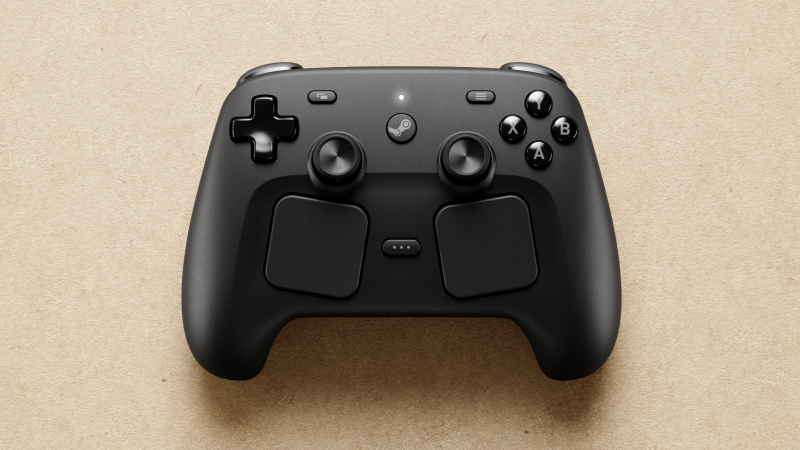
Valve's return to controllers pairs a TMR stick with capacitive touch, two 34.5mm haptic trackpads, a 6-axis gyro with Grip Sense activation, and four back buttons — an 8.39Wh battery rated around 35 hours. For Steam and Steam Deck players, it is the most deeply integrated controller on the market, and GamesRadar+ names it the best TMR controller for PC games in its 2026 roundup.
The caveats are the ones that come with any Steam Controller: it is PC/SteamOS-focused with no Xbox or PlayStation support, and the trackpad learning curve is real. But for the platform it targets, the TMR stick plus trackpad-plus-gyro combo has no equivalent. Our full review scores it 8/10.
Best retro / Switch: 8BitDo Pro 3

The 8BitDo Pro 3 is the Switch-first TMR pick: TMR sticks with a 12-bit ADC, Hall Effect triggers with a mode switch, four remappable buttons, six-axis gyro, and an integrated charging dock — an absurd amount of hardware for $69.99. It supports Switch 1 and Switch 2, Windows 10+, SteamOS, Android 13+, and Apple devices, making it the most platform-flexible TMR pad in this roundup.
The trade-offs: polling tops out around 250Hz wired XInput (fine for Switch and casual PC play, not ideal for competitive shooters), and the face buttons are on the loud side. For Switch players who want drift immunity and a dock, it is the pick.
Also worth considering
- GameSir Tarantula Pro ($69.99) — the tri-mode TMR all-rounder: Mag-Res TMR sticks at 1000Hz, Hall Effect plus micro-switch triggers, nine mappable buttons, NFC amiibo support, and a 1200mAh battery rated 12–14 hours. Our full review scores it 8/10.
- GuliKit TT MAX ($71.99) — 720-degree tension-adjustable TMR sticks with 4,000-level precision, four detachable metal rear paddles, APG macro recording, and three vibration modes, in a hard-shell case. The 14–15 hour battery and the $72 price keep it from the top of the list.
- 8BitDo Ultimate 3E ($149.99) — the feature-dense Xbox premium option: swappable ABXY modules (membrane or micro-switch), swappable faceplates and D-pads, 1400mAh battery, and a wireless charging dock. A lot of controller for the money, but priced like a premium pad.
How to choose
| Your situation | Pick |
|---|---|
| PC / Steam Deck / mobile, want the best all-rounder | 8BitDo Ultimate 2 Wireless |
| Competitive FPS, maximum performance per dollar | GameSir Cyclone 2 (wireless) or Tarantula 8K (wired) |
| Budget under $30 | GuliKit ES Pro |
| Xbox console, value | GameSir G7 Pro |
| Xbox + PC, adjustable tension and dock | 8BitDo Ultimate 3 (or 3E if you want swappable modules) |
| Steam / SteamOS power user | Steam Controller (2026) |
| Switch + PC, dock included | 8BitDo Pro 3 |
| Hate loose stick tension | 8BitDo Ultimate 3 (Force Ring adjustable) or GuliKit TT MAX |
| Just want a controller that never drifts, minimal fuss | Any of the above — buy the one that fits your platform and hands |
FAQ
Is TMR better than Hall Effect? For competitive FPS players, yes — TMR's higher resolution and better centering feel show up as smoother micro-adjustments. For casual players, the difference is rarely noticeable. Both are drift-free; the price gap has essentially closed, so if the choice is between two similar pads, prefer TMR.
Do TMR controllers drift? The sensor cannot drift — there is no contact and nothing to wear in the sensing path. The mechanical parts around the stick (springs, rings, rubber) still age, so heavily used controllers can eventually develop centering issues. It is dramatically less common than potentiometer drift.
How can I tell if a controller actually has TMR sticks? Check the manufacturer's official spec page. Listings that only say "Hall Effect" may contain either technology — several brands use the more recognizable term for TMR sensors. A listing that specifically says TMR is the newer tech.
Does TMR improve battery life? In most controllers, slightly — around 12 extra minutes per 12 hours in independent testing. The exception is high-end pads like the Razer Wolverine V3 Pro 8K, where the power headroom enables 8000Hz polling without tanking battery life.
Do I need 1000Hz polling? For wireless play, yes — it is the standard for 2.4GHz in 2026 and the difference over Bluetooth is noticeable. Beyond 1000Hz (4K/8K wired), the gains are measurable but only matter at the very top of competitive play.
Verdict
TMR is the direction of 2026: nearly every premium third-party controller released this year uses it, and the price gap over Hall Effect has essentially closed. You can now own a drift-immune TMR pad for under $30 and a TMR wireless controller with a charging dock for $60 — hardware that out-specs first-party controllers twice the price. Start with the 8BitDo Ultimate 2 Wireless for the best all-rounder, the GameSir Cyclone 2 for raw value, the GameSir G7 Pro if you are on Xbox, and the Steam Controller (2026) if you live in Steam. Prices checked August 2026.
Related Guides
Buying Guide
Best PC Controllers 2026: The Definitive Roundup
From the $19.99 budget king to the sub-millisecond esports monster — every PC controller worth buying in 2026, ranked by use case with verified specs and community sentiment.
Buying Guide
Best PC Controllers with No Stick Drift in 2026: Hall Effect & TMR Picks
Tired of stick drift? Every drift-free PC controller worth buying in 2026 — Hall Effect and TMR picks from $20 to $100, ranked by use case with verified specs and community sentiment.
Buying Guide
Best Hall Effect Controllers 2026: The Definitive Roundup
From the $25 drift-proof budget champ to the sub-millisecond esports king — every hall effect controller worth buying in 2026, ranked and explained.