Best Mouse for League of Legends 2026: The MOBA & Kiting Buyer's Guide
The LoL mouse market decoded: what 164 pro players actually use, why light, spammable clicks matter more than sensors or polling rates, and the best picks from $40 to $150 — every one linked to our full reviews.
By GamepadSquire — August 12, 2026Verified
Best Mouse for League of Legends 2026: The MOBA & Kiting Buyer's Guide
League of Legends is a different animal from the shooters that dominate mouse marketing. No one is flick-shotting in Summoner's Rift — instead, the game demands hours of right-click spam: kiting carries, last-hitting minions, and landing skillshots under pressure. The mouse that wins in LoL is the one you stop noticing. It stays comfortable at hour four of a ranked session, its clicks don't tire your hand after ten thousand right-clicks, and its sensor never betrays a drag or misregisters a click in a team fight.
The data backs up how specific the LoL mouse market is. ProSettings.net tracks the gear of 164 professional League players as of August 2026, and the picture is striking: Logitech alone holds 62.2% of the pro scene (102 players), with Razer at 26.2% (43 players). The single most-used mouse is the Logitech G Pro X Superlight 2, used by roughly 16-21% of pros depending on the tracker. Just as telling is what pros do not use: almost none of them touch MMO-style 12-button mice, despite the "MOBA mouse" marketing category built around them. League abilities are keyboard-bound, and two side buttons are plenty for actives, wards, and trinkets.
This guide is triangulated from three sources: pro usage data from ProSettings.net and EsportsMice, lab measurements from RTINGS, and the persistent community conversation on r/MouseReview — where "light clicking spammable mouse for League" is a question that resurfaces every few months. Every pick with a linked review has full in-depth coverage on this site.
Quick Picks
| Tier | Mouse | Weight | Price | Best For |
|---|---|---|---|---|
| Best overall | Logitech G Pro X Superlight 2 | 60g | $149.99 | The LoL pro default — safe shape, HERO 2, LIGHTFORCE clicks |
| Best for light clicks | Razer Viper V3 Pro | 54g | $119.99 | Spammable optical switches, 8K dongle in the box |
| Best ergonomic | Razer DeathAdder V4 Pro | 56g | $149.99 | Palm-grip comfort for marathon sessions, 150h battery |
| Best value | MCHOSE L7 Ultra | 46g | $64.99 | Flagship PAW3950 and dual 8K polling for half price |
| Best budget | VXE R1 Pro | 48g | $49.02 | The cheapest mouse with genuinely light, spammable clicks |
| Budget classic | Logitech G305 Lightspeed | 99g | $39.99 | Still on LoL pro rosters; 250-hour AA battery |
| Multi-button pick | Logitech G502 X PLUS | 104g | $149.99 | Actives, wards, and 13 buttons for utility players |
| Light-click specialist | Lamzu Maya X | 47g | $121.99 | Best-in-class main buttons, flagship performance for less |
What Actually Matters for League of Legends (and What Doesn't)
Click feel is the #1 spec — not sensor, not polling rate. League is a clicking game. A single kiting sequence on an ADC can mean a right-click every third of a second for twenty seconds, and a full game stacks thousands of clicks per hand. r/MouseReview's recurring "spammable mouse for LoL" threads make the consensus clear: switch actuation force and crispness matter more than anything else on the spec sheet. Lighter, crisper switches mean faster attack-move spam and less hand fatigue over a 45-minute game. Optical switches — Razer's Gen-3/Gen-4, Omron opticals, Logitech's LIGHTFORCE hybrid — also eliminate the debounce lag and double-click degradation of aging mechanical switches.
The nuance: the lightest click isn't automatically the best. Community feedback consistently describes a sweet spot — switches light enough to spam for hours, but with enough resistance that you don't accidentally re-click when you're nervous in a team fight. The names that keep coming up for that feel: the Razer Viper V3 Pro's opticals, VAXEE's implementations, the MCHOSE G3/A7/L7 line, and the VXE R1 Pro's Huano Ice Berry switches.
Ergonomics for sessions, not flicks. LoL matches run 30-45 minutes, and serious players chain ten of them. Shape and grip comfort dominate owner complaints in both directions: palm grippers gravitate toward ergonomic shapes (DeathAdder, G502), while claw and fingertip players overwhelmingly prefer the symmetrical ultralight generation. If you've never thought about your grip, the safest choice is a medium symmetrical shape that works for all three.
Sensor reliability is table stakes. Every mouse in this guide uses a flagship-grade sensor — HERO 2, Focus Pro 35K/45K, PAW3395, or PAW3950 — all of which are effectively flawless in real play. League simply isn't sensor-sensitive: you're not tracking fast flicks across a mousepad, you're making deliberate cursor movements. Do not pay extra for DPI numbers.
What does NOT matter: 8,000Hz polling (pros mostly run 1,000-4,000Hz; click latency matters more than cursor update rate in LoL), RGB, and 12 side buttons. On the last one, the pro data is unambiguous — MMO-style mice barely register in LoL pro play, because everything that needs a keybind fits on a keyboard and two side buttons.
The Picks
Best Overall: Logitech G Pro X Superlight 2

The Superlight 2 is the most-used mouse in professional League of Legends — ProSettings counts 26 of 164 players on it, and EsportsMice's tracker puts its LoL share around 21%. That dominance is earned: a 60-gram shell in a medium symmetrical shape that suits nearly every grip, the HERO 2 sensor, and LIGHTFORCE hybrid optical-mechanical switches that are crisper and more durable than the original Superlight's Omrons.
For League specifically, the shape is the star. It's the definition of a safe recommendation — if you don't know your grip or hand size, this is the mouse that works anyway. The 95-hour battery survives a week of ranked without charging, and 8K polling arrived via firmware update, with PowerPlay wireless charging for those who want it.
Owner feedback across thousands of reviews is overwhelmingly positive, but the persistent minority complaints are worth knowing: creaking shells on some units, and the occasional side-button or scroll-wheel issue over time. Buy from a retailer with easy returns. And one honest caveat for LoL players specifically: the LIGHTFORCE clicks are not the lightest in class — some r/MouseReview spam-clickers who found the GPX line's actuation a touch heavy should look at the Viper V3 Pro or the MCHOSE below instead. That's the only reason this isn't the pick for everyone.
Our verdict: 9.0/10 — The default LoL mouse, with a safe shape and zero meaningful weaknesses. Read the full Logitech G Pro X Superlight 2 review.
Best for Light Clicks: Razer Viper V3 Pro

If the Superlight 2 is the safe pick, the Viper V3 Pro is the enthusiast pick — and the r/MouseReview community's most consistent answer to "I need a spammable mouse for League." Its Razer Optical Gen-3 switches actuate fast and crisp with minimal force, which is exactly what kiting spam needs, and RTINGS' lab measurements verify elite click latency (3.1ms at 1,000Hz, 1.8ms at 4,000Hz). The 54-gram shell is lighter than the Logitech, and the 8K polling dongle ships in the box — no firmware hunt required.
It's also the value play in the flagship tier right now: the street price has dropped to about $119.99, which undercuts the Superlight 2 by $30 while matching or beating its headline specs. ProSettings' own 5/5 review praises the performance and coating while flagging mushy side buttons — a minor quibble for League, where the side buttons only handle actives.
The asterisks: the shape is slightly longer and lower than the GPX, which suits claw and relaxed claw grips better than pure palm; Razer Synapse is required for configuration; and a minority of owners report scroll-wheel QC issues — the site's review advises checking the wheel on arrival. Pro usage is strong (third-most-used LoL mouse per EsportsMice) and climbing.
Our verdict: 8.9/10 — The best mouse for LoL click-spam specialists. Read the full Razer Viper V3 Pro review.
Best Ergonomic: Razer DeathAdder V4 Pro

For palm grippers grinding ranked, comfort is the whole game, and the DeathAdder shape has been the ergonomic benchmark for over a decade. The V4 Pro brings that icon into the ultralight era: 56 grams, a Focus Pro 45K Gen-2 sensor, true 8K polling wired and wireless, and up to 150 hours of battery life — the longest in this guide by a wide margin.
League-specific strengths: the right-handed ergonomic shape supports your hand during marathon sessions instead of forcing a neutral grip, and the large PTFE skates track smoothly across any pad. The Gen-4 optical switches are fast and rated for 100 million clicks — relevant when every game involves thousands of them.
The trade-offs are real, though. The clicks are loud — a crisp, sharp actuation that some players love and others find fatiguing after hours of kiting; community feedback on this is genuinely split. There's no Bluetooth, and the $149.99 price sits at the top of the category. If you palm-grip, though, nothing in this guide matches its combination of weight, battery, and comfort.
Our verdict: 8.5/10 — The most complete ergonomic esports mouse, ideal for palm-grip LoL players. Read the full Razer DeathAdder V4 Pro review.
Best Value: MCHOSE L7 Ultra

The MCHOSE L7 Ultra is the case study in how fast the Chinese ultralight brands have closed the gap on Logitech and Razer. For $64.99 you get a 46-gram shell, a flagship PAW3950 sensor, dual 8,000Hz polling wired and wireless, and Omron optical switches — a spec sheet that reads like a $150 flagship from 2024.
For League, the L7's switch tuning matters most. The MCHOSE line has built a reputation in r/MouseReview for light, spammable optical switches — the sibling G3 model is specifically name-checked in "light clicking" threads — and the L7 Ultra carries that same feel in a more premium shell. The 500mAh battery and 7 programmable buttons cover a full day of sessions plus actives on the side.
The honest caveat is sizing: at 115.6 x 60.6 x 36mm, this is a small-to-medium mouse built for claw and fingertip grips. Medium-to-large palm grippers will find it cramped. If the shape fits, it's the best performance-per-dollar mouse on this list.
Our verdict: 8.8/10 — Flagship-tier performance and light clicks at half the price. Read the full MCHOSE L7 Ultra review.
Best Budget: VXE R1 Pro
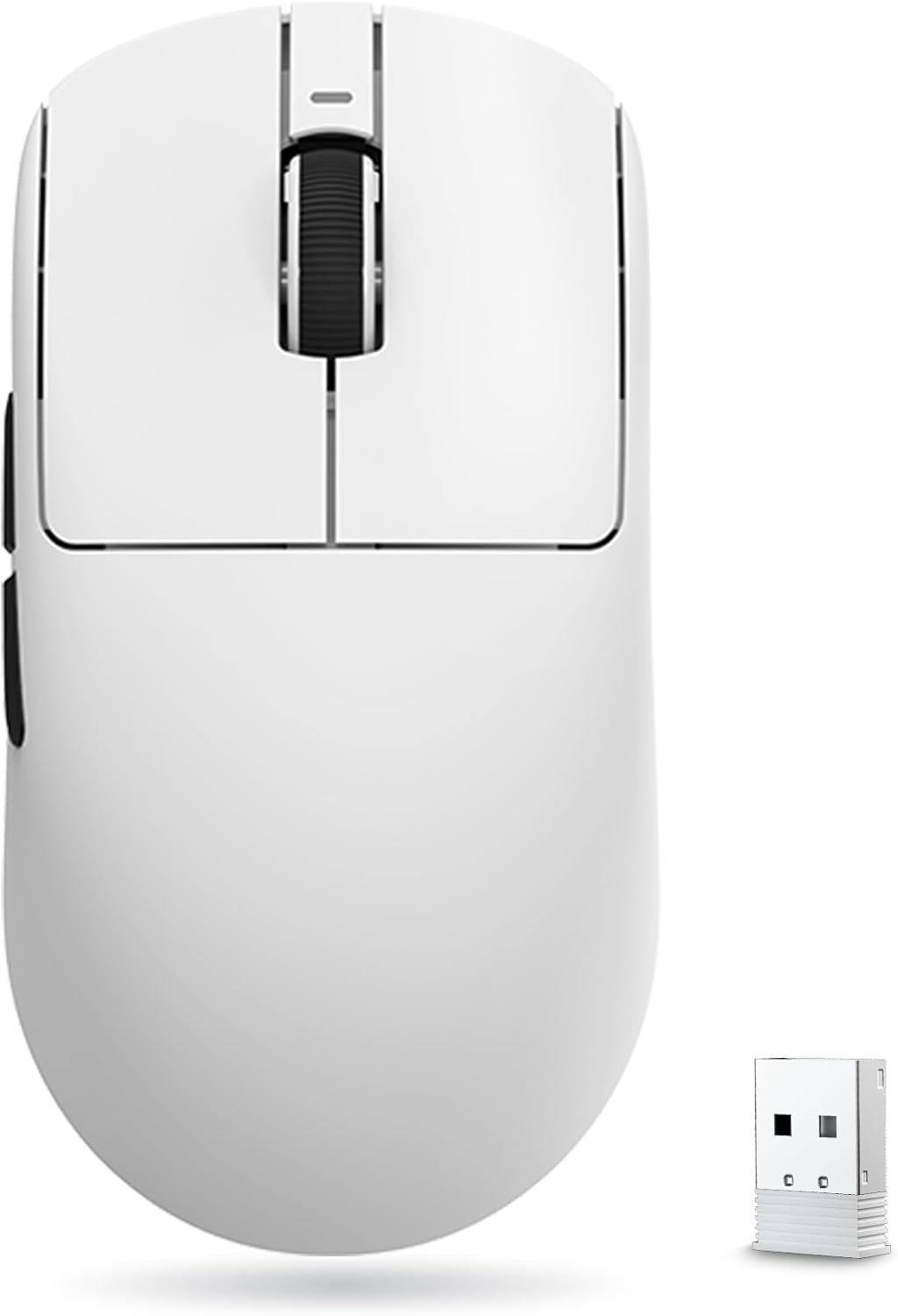
The VXE R1 Pro is the budget pick that doesn't feel like one. For around $49, it delivers a 48-gram shell, the flagship PAW3395 sensor, and — critically for League players — Huano Ice Berry Pink Dot switches, which the community consistently describes as light and spammable with a satisfying tactile pop. This is the cheapest mouse on the list whose click feel genuinely rivals mice three times its price.
RTINGS' measurements put its latency among the elite, and the 75-hour rated battery at 1,000Hz covers a full week of play. The 4K dongle is an optional upgrade for those who want it. Community sentiment is strongly positive, with two honest asterisks: early-batch units had QC wobble in the main buttons, and a small minority report scroll-wheel failures — both largely resolved in current batches, and both covered by the one-year warranty.
Our verdict: 8.8/10 — The best pure value in competitive mice, and the best budget click feel for LoL. Read the full VXE R1 Pro review.
Budget Classic: Logitech G305 Lightspeed

Here's a stat that tells you everything: the G305 — a $40 mouse with a AA battery inside — is still on professional League rosters, with 7 of the 164 players tracked by ProSettings using it. In a scene where most players could have any mouse they want, that's a genuine durability testament.
The G305's strengths are exactly what a budget LoL player needs: the proven HERO sensor with 1ms LIGHTSPEED latency, a legendary medium shape that suits most grips, and a 250-hour battery life measured in months, not days. It's the safest wireless purchase in the budget tier, and it regularly dips under $30 on sale.
The trade-offs are the weight and the switches. At 99 grams it's heavy by 2026 standards — noticeable when you're kiting for hours — and the mechanical Omron switches carry the double-click durability asterisk that has followed this mouse line for years. A small minority report it developing within the first year; most never see it. If $40 is your ceiling, buy this with confidence. If you can stretch to $49, the VXE R1 Pro is lighter with better switches.
Our verdict: 7.5/10 — The safest budget wireless buy in existence. Read the full Logitech G305 Lightspeed review.
Multi-Button Pick: Logitech G502 X PLUS

The G502 formula has been a League staple for a decade, and the X PLUS modernizes it: LIGHTFORCE hybrid switches, the HERO 25K sensor, and 13 programmable buttons — enough to bind actives, trinkets, wards, and even F-key camera snapshots without touching the keyboard. The infinite-scroll wheel is also the best in class for browsing between games.
The catch is physics: at 103.7 grams, the G502 X PLUS is more than twice the weight of the ultralights above, and after a long kiting session that weight is felt in the wrist. It's also $149.99 with an RGB tax — the non-RGB G502 X LIGHTSPEED delivers the identical shape and internals for less. This is the pick for hybrid players who use the same mouse for work and play, or who genuinely want actives and items on the mouse. For pure League, an ultralight is the better spend. The cheaper multi-button alternative is the Razer Basilisk V3 at $34.98, which offers the same ergonomic-plus-buttons philosophy at a fraction of the price.
Our verdict: 8.7/10 — The best hybrid work/play mouse, heavy for dedicated LoL. Read the full Logitech G502 X PLUS review.
Light-Click Specialist: Lamzu Maya X

The Lamzu Maya X is the dark horse of this guide: a 47-gram medium-large shell with Omron optical main buttons that multiple reviewers call the best-feeling clicks in the category, measured at 0.5ms click latency. At $121.99 it undercuts both the Superlight 2 and the Viper V3 Pro while delivering the same flagship class of performance — a PAW3950 sensor, true 8K wireless with the dongle included, and exceptional build rigidity.
For LoL players who are picky about click feel, the Maya X is the specialist answer: the buttons are light, crisp, and consistent across the entire surface, which matters when your finger position drifts during hours of clicking. The caveats are battery life (80 hours rated, shorter than the Razer and Logitech flagships) and an open-bottom design that lets dust in — a minor annoyance, not a defect. Community feedback is strongly positive, with the usual QC noise floor of the Chinese enthusiast brands.
Our verdict: 9.0/10 — Best-in-class main buttons at a flagship-beating price. Read the full Lamzu Maya X review.
Comparison Table
| Mouse | Weight | Sensor | Polling | Battery | Price | LoL Pro Usage |
|---|---|---|---|---|---|---|
| Logitech GPX Superlight 2 | 60g | HERO 2 | up to 8K | 95h | $149.99 | ~16-21% (most used) |
| Razer Viper V3 Pro | 54g | Focus Pro 35K | 8K (dongle incl.) | ~95h | $119.99 | ~6% |
| Razer DeathAdder V4 Pro | 56g | Focus Pro 45K | 8K | 150h | $149.99 | (V3 Pro: ~5%) |
| MCHOSE L7 Ultra | 46g | PAW3950 | 8K | 500mAh | $64.99 | — |
| VXE R1 Pro | 48g | PAW3395 | 1K (4K opt.) | 75h | $49.02 | — |
| Logitech G305 | 99g | HERO | 1K | 250h | $39.99 | ~4% |
| Logitech G502 X PLUS | 104g | HERO 25K | 1K | 130h | $149.99 | — |
| Lamzu Maya X | 47g | PAW3950 | up to 8K | 80h | $121.99 | ~1% |
Settings That Actually Matter
DPI: EsportsMice's tracker of 96 pro LoL players shows an average DPI around 1,440, with most pros playing between 800-1,600 DPI and adjusting in-game sensitivity to taste. There is no reason to run extreme DPI — every sensor in this guide is flawless at the settings you'll actually use.
Attack-move: The single biggest mechanical upgrade for League is binding attack-move click (A-click or Shift+right-click). This is where a light, crisp switch earns its keep — under pressure, a heavier or mushy switch is what produces the misclick that gets you killed.
Polling rate: 1,000Hz is genuinely plenty for League. The 8K modes are a nice-to-have, not a competitive edge — pros mostly run 1,000-4,000Hz.
FAQ
Do I need a 12-button "MOBA mouse"? No. Pro League players almost never use MMO-style mice — the tracking data shows barely any usage. Abilities are keyboard-bound; actives, wards, and trinkets fit comfortably on two side buttons. A 12-button grid adds weight and complexity you don't need.
Wireless or wired? Wireless, without question. Sub-1ms 2.4GHz links are indistinguishable from wired, the battery life on modern flagships spans a full week of play, and over 95% of LoL pros use wireless.
Are ultralight mice bad for MOBA? No — but the sweet spot is real. Most players find 45-65g ideal; below 40g, some report the mouse feels twitchy for deliberate cursor movements. The 39-gram Hitscan Hyperlight is a fine option for claw-grip players who want maximum lightness, but the 46-60g picks above are the safer middle ground.
What about the G502's infinite scroll? Excellent for browsing between games, marginal in-game — LoL doesn't use the scroll wheel for much beyond camera and spell leveling.
Verdict
The best mouse for League of Legends is the one that disappears: light enough to forget, clicks light enough to spam for hours, a shape that suits your grip, and a sensor you never think about. The Logitech G Pro X Superlight 2 remains the default — it's the most-used mouse in pro LoL for a reason, and its safe shape makes it the best blind recommendation. The Razer Viper V3 Pro is the enthusiast answer for players who want the lightest, crispest clicks in the flagship tier, now at a discount that makes it arguably the best value there. Palm grippers should start with the DeathAdder V4 Pro, budget players with the VXE R1 Pro or G305, and value hunters with the MCHOSE L7 Ultra.
Skip the 12-button MOBA mice, skip the RGB, and spend your money on switch feel and comfort — that's where League is actually won.
Related Guides
Buying Guide
Best Gaming Mice 2026: The Complete Guide for Every Budget
The 2026 gaming mouse market explained tier by tier: RTINGS-lab-verified picks from the $25 G203 to the $180 haptic Superstrike, with the Viper V4 Pro, DeathAdder V4 Pro, the $35 VXE R1 Pro budget flagship-killer, and the Chinese mid-range revolution covered in depth.
Buying Guide
Best Ergonomic Gaming Mice 2026: Sculpted, Vertical & Wrist-Saving Picks
Shape — not DPI — is what saves wrists. The best ergonomic gaming mice of 2026: the sculpted MX Master 3S benchmark, the 57° MX Vertical for existing wrist pain, the ergo-shaped Superlight 2 DEX for competitive play, and the Keychron M6 8K big-hand value pick, plus the vertical landscape (Pro Click V2 Vertical, Logitech Lift) explained.
Buying Guide
Best Wired Gaming Mice 2026: The Cable-Is-Value Buyer's Guide
Wireless won the convenience war, but wired mice quietly became the best value in gaming: the G502 X at $79.99, the OP1 8k v2's 8K polling under $90, and the Basilisk V3 — a $70 mouse at a $35 price. Seven lab-tested wired picks, honest latency talk, and who should still buy a cable in 2026.