Best 8K Polling Controllers 2026: G7 Pro 8K vs Wolverine V4 Pro vs Raikiri II Pro
Every 8,000Hz controller you can actually buy in 2026, bench-verified where the data exists — plus the honest math on when 1,000Hz polling is already enough.
By GamePadSquire Test Desk · Updated Nov 24, 2026
Verified8K polling, briefly
Polling rate is how often a controller tells the PC what its sticks and buttons are doing. A standard 1,000Hz pad reports every millisecond; an 8,000Hz pad reports every 0.125 milliseconds. On paper the average input-to-registration wait drops from about half a millisecond to about six hundredths of one — a rounding error against the 8-16 milliseconds a game frame takes to render, but a real number for the last competitive inch of input latency.
For most of controller history this was a keyboard-and-mouse spec. 2026 is the year it reached gamepads at retail: Razer shipped the Wolverine V4 Pro, ASUS answered months later with the ROG Raikiri II Pro, and GameSir brought the price down to where normal people buy things. This guide covers the three headliners, the wired wildcard that outruns all of them on the bench, and the honest question underneath the spec sheet — whether 1,000Hz is already enough. All prices were verified live on Amazon US on November 24, 2026, Black Friday week.
The 8K pads at a glance
| GameSir G7 Pro 8K | Razer Wolverine V4 Pro | ASUS ROG Raikiri II Pro | GameSir Tarantula 8K | |
|---|---|---|---|---|
| Price | $71.99 | $199.99 | $219.99 | $69.99 |
| Platforms | PC, Switch, mobile (no Xbox) | Xbox (licensed), PC | PC only | PC only |
| Wireless | 2.4GHz, Bluetooth, wired | 2.4GHz (HyperSpeed), wired | 2.4GHz (SpeedNova), wired, Bluetooth | None (wired) |
| 8K polling | Wired + 2.4GHz | PC only (250Hz on Xbox) | Wired + 2.4GHz | Wired only (250/1000/4000/8000) |
| Sticks | TMR (15/14-bit measured) | Capacitive anti-drift | Hot-swappable TMR modules | Gen-2 Mag-Res TMR |
| Extra inputs | 2 back buttons + 2 mini bumpers | 4 removable back buttons + 2 claw bumpers | 4 removable back buttons + 2 bumpers | 2 back buttons + 2 mini bumpers |
| Triggers | Hall + microswitch stops | Hall with trigger locks | Dual-mode micro-switch/TMR | Hall + micro-switch toggle |
| Charging dock | Included | No | Charging case + stand | No |
| Battery | Dock-supported | ~27h rated (20-24h real) | 79h at 1K polling (fine print) | None |
| Weight | ~272g class | ~290g class | ~300g class | 180g |
| Amazon rating | 4.3/5 (1,085 ratings) | 4.3/5 (39 ratings) | 4.1/5 (329 ratings) | — |
| Our score | 8.8/10 | Not yet rated | Not yet rated | 9/10 |
G7 Pro 8K — the value flagship
The GameSir G7 Pro 8K is the reason 8K polling stopped being a $200 feature. At $71.99 on Amazon it delivers genuine 8,000Hz polling over both wired and 2.4GHz — the only wireless pad under $100 that does — and it backs the headline number with hardware that survived the most rigorous public latency testing in the controller space. The Gamepadla community's Prometheus 82 bench measured a sustained ~7,900Hz median with clean 8,000Hz peaks, stick latency of 0.69 milliseconds over cable, and real stick resolution of 15-bit left / 14-bit right — better than the advertised spec, with essentially no inner dead zone. Two independent testers reproduced the wired figure on different hardware. Digital Foundry's takeaway: "objectively, a superior controller to pretty much anything on the market."
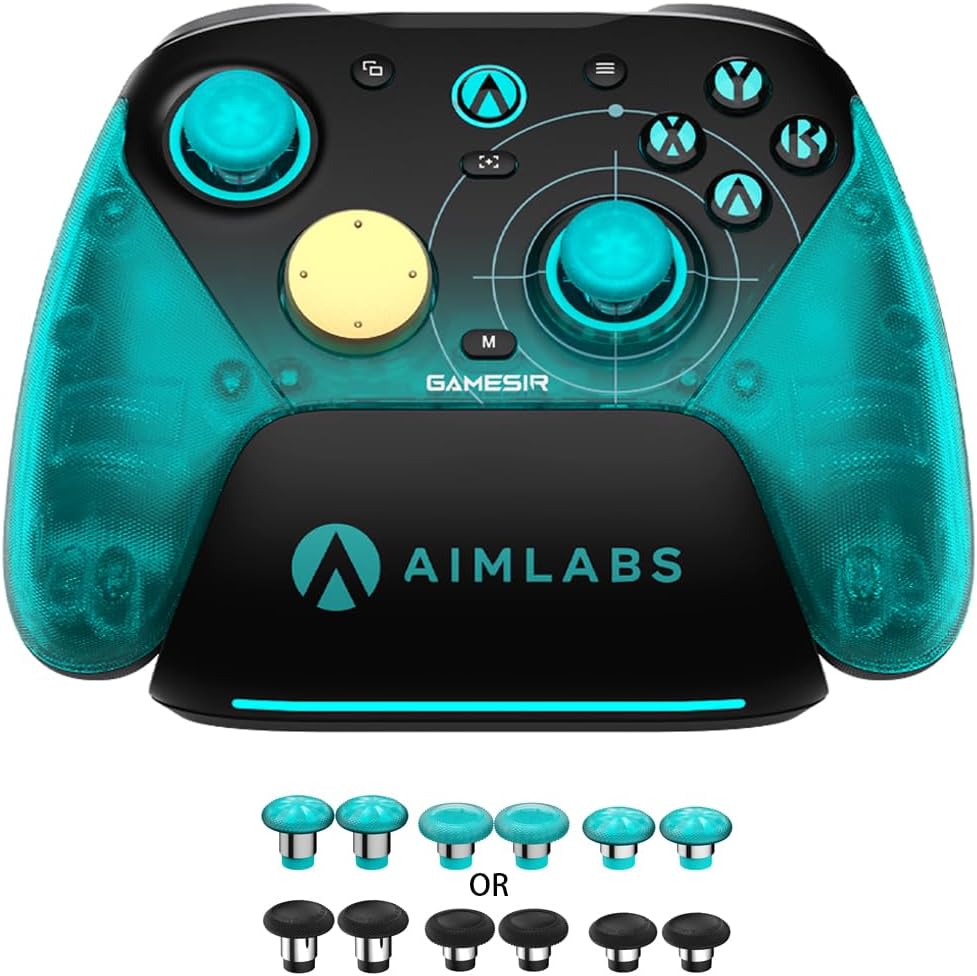
The rest of the pad is the standard G7 Pro formula with the pro additions: dual-mode Hall Effect triggers with physical microswitch stops, optical face buttons, two lockable back buttons plus two mini bumpers, a charging dock that stores the dongle, a 3.5mm jack that works wired and over 2.4GHz, and GameSir Connect software for the four onboard profiles, stick curves, and the polling-rate switch itself (it ships at 1,000Hz — the 8K mode is opt-in).
Know what you're buying, though. Xbox support is deliberately gone — the console can't use 8K input, and GameSir aimed this at competitive PC play — so this is a PC pad that moonlights on Switch and mobile over Bluetooth. The recurring owner complaints are small and specific: the controller sits loosely on its dock and can slide off the charging contacts, the gyroscope's accuracy drew criticism in press testing, and the textured grips collect grime. The larger question — whether anyone can feel 8,000Hz — is the subject of the section below, and it applies here with full force. Our full review scored it 8.8/10 as the most capable sub-$100 competitive pad on the market.
Wolverine V4 Pro — the licensed 8K
Razer's Wolverine V4 Pro (launched October 2026, $199.99, Amazon listing) is the only 8K-class controller that also connects to an Xbox — a real differentiator now that Microsoft has opened its wireless protocol to third parties. On PC it polls at a verified 8,000Hz through the bundled HyperSpeed dongle; on Xbox it settles for 250Hz, the platform's radio ceiling. The stick sensors are capacitive and contactless — Windows Central's testing describes them as resolving more position steps than typical TMR — which is the same anti-drift family Microsoft has yet to ship on its own flagships.
The competitive kit is deep: four removable back buttons in the Elite style, two programmable claw bumpers at the shoulders, trigger locks for rapid actuation, a magnetic swappable faceplate, and dynamic switching between Xbox and PC modes on the same dongle. Razer rates the battery around 27 hours, with real-world use landing closer to 20-24. Windows Central scored it 4.5/5 and called it "might just be the best Xbox controller I've ever used" — high praise from the site that covers the Xbox platform closest — while flagging the same gaps our table shows: no charging dock and no Bluetooth, and a dongle that has to physically move between platforms. The reviewer's honest framing of the price: the 8K radio does much of the heavy lifting on the $199.99 sticker, making this a niche buy for esports-grade play rather than an all-rounder.
Two timing notes for buyers. The rating base is small (39 ratings at 4.3 stars — the pad is weeks old), and an Xbox Elite Series 3 is widely rumored to be imminent; our day-one prep piece for the Elite Series 3 tracks what's known. If you want 8K on both PC and a console today, this is the only listing in the table that does it. If you only need the PC half, everything below $100 matches the number.
ROG Raikiri II Pro — the tuner's 8K
Announced July 9, 2026 and now on Amazon US at $219.99 (4.1 stars across 329 ratings), the ASUS ROG Raikiri II Pro is ASUS's answer to the 8K question, aimed squarely at PC. It runs 8,000Hz in both wired and 2.4GHz modes through ASUS's SpeedNova stack — positioning itself directly against Razer's esports line — and it is the only pad of the three built to be reconfigured rather than just remapped.
The headliner is the hot-swap system: the TMR joystick modules pop out and replace without tools, and the box ships with two spare modules, a removal tool, four rear-button cover plates, and two detachable stick caps. Where Razer sells a charging dock as an extra you don't get, ASUS bundles a portable protective charging case plus a desktop charging stand — the most complete accessory kit at any 8K price. Then there's the full-color center panel, which handles profile switching, joystick calibration, and button remapping on the pad itself — the same on-device tuning trend our controllers-with-screens guide tracks across the 2026 flagships. The triggers are dual-mode in a way none of the others are: a micro-switch short-travel mode for shooters and a TMR-sensor full-travel mode for everything else, switched on the pad. Every contact surface — ABXY, D-pad, bumpers, rear buttons — is micro-switch.
The fine print is the battery. The 79-hour headline holds only at 1,000Hz polling with RGB, vibration, and the display off; at 8K with the panel lit, real endurance is a fraction of that. And it is PC-only — no console support of any kind, a platform decision ASUS made deliberately for the competitive segment. At $219.99 it is the most expensive 8K pad on the shelf, and the premium buys the tuning hardware, not extra speed: the polling number itself is the same one GameSir sells for $71.99.
The wired wildcard: Tarantula 8K
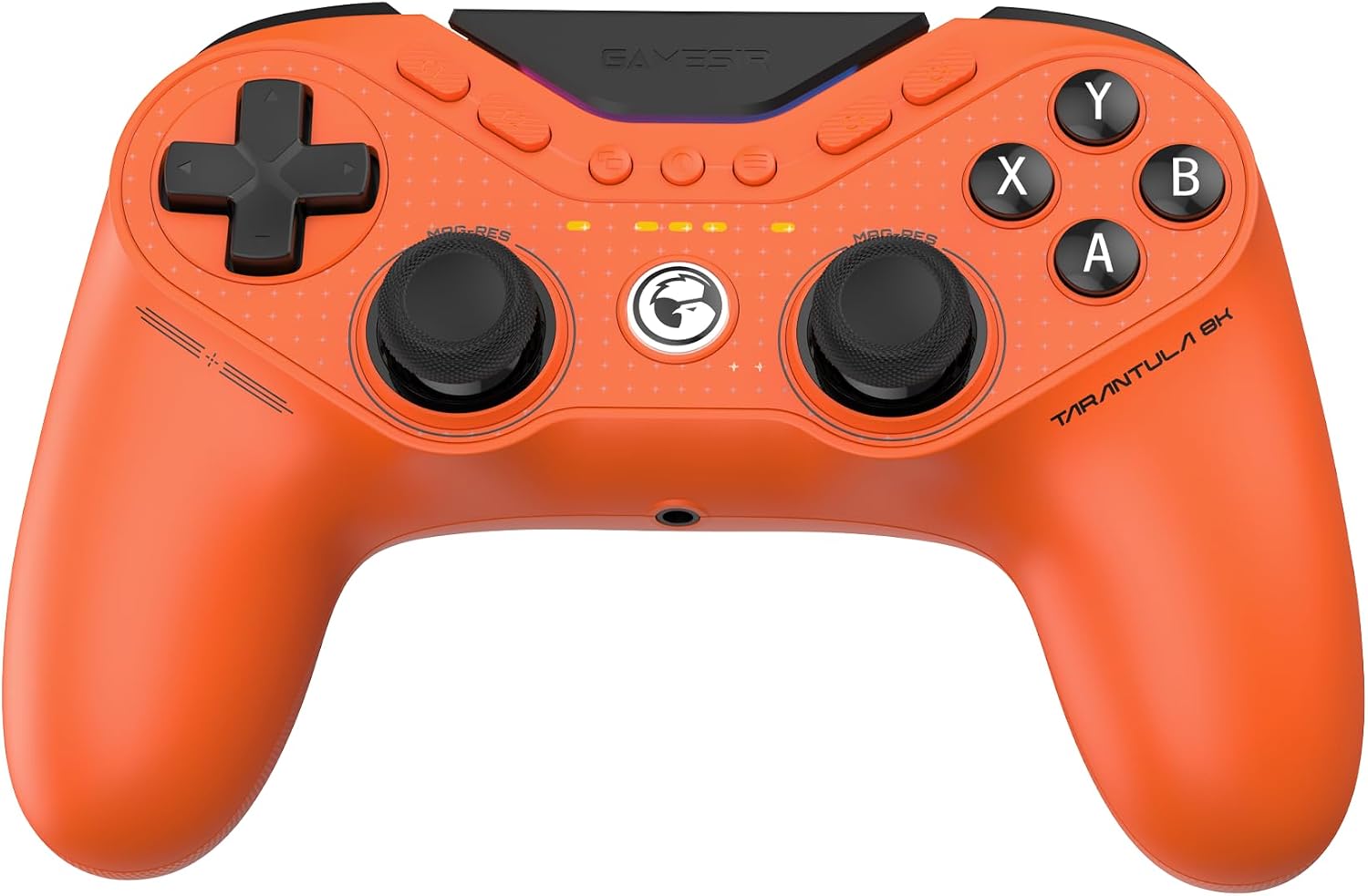
At $69.99 on Amazon, the GameSir Tarantula 8K is the purest expression of the spec: a wired-only, PC-only, 180-gram esports pad with switchable 250/1000/4000/8000Hz polling and some of the lowest input latency ever measured on a gamepad at any price — 0.49 milliseconds stick, 1.04 milliseconds button at 8,000Hz on the Prometheus 82 bench. Our review scored it 9/10, and our Cyclone 2 vs Tarantula 8K comparison frames the trade: no battery, no rumble, no radio — just the fastest measured stick response in the category and nine remappable inputs in a featherweight shell. If your 8K controller lives three feet from the PC and never leaves the desk, this is the cheapest legitimate path to the full spec.
When 1,000Hz is enough
Here is the arithmetic nobody's marketing mentions. Moving from 1,000Hz to 8,000Hz cuts the average reporting wait from 0.5 milliseconds to about 0.06 — a gain of roughly 0.4 milliseconds. A single rendered frame at 60fps takes 16.7 milliseconds; a typical display adds 5-15 more; human reaction time is measured in the hundreds of milliseconds. The 8K delta is real and measurable, but it is a 0.4ms slice of a pipeline measured in tens of milliseconds, and the press that tested these pads says exactly that: GamesRadar built its G7 Pro 8K review around the question of whether anyone can actually feel the difference, and TechRadar called the extra polling "a divisive extra" after 25 hours of testing — great for esports, irrelevant for most PC titles.
Where the gap genuinely matters: high-refresh displays (144Hz+) where frame pacing is tight enough for single milliseconds to register, competitive shooters where stick micro-corrections compound over a match, and wireless setups — 8K over 2.4GHz tightens jitter and latency consistency, not just the headline rate. Where it doesn't: single-player games, RPGs, anything played casually, and every console — Xbox caps licensed pads at 125-250Hz no matter what the box claims, and PlayStation doesn't support these pads at all.
The honest tiering, then: if you play ranked shooters on a high-refresh monitor, the 8K class earns its price — and the G7 Pro 8K at $71.99 or the Tarantula 8K at $69.99 get you the whole spec without the $200 tariff. If you don't, a 1,000Hz pad with the same drift-proof sticks — the Cyclone 2 at $44.79 tracked, the Ultimate 2 Wireless at $49.99 — is the rational buy, and our best gaming controllers 2026 guide ranks the whole field. The sensor technology that actually prevents drift is common to every pad in this guide and costs $22.99 at the floor.
How to choose
Competitive PC, wireless: the G7 Pro 8K. Dock, triggers, 8K on both wired and 2.4GHz, and the best bench-verified latency in its price class.
Competitive PC, minimum weight and price: the Tarantula 8K — 180g of wired scalpel with the fastest measured stick response here.
Xbox and PC in one pad: the Wolverine V4 Pro — the only licensed 8K-capable option, with the caveat that the console itself caps it at 250Hz.
Enthusiast tuners: the Raikiri II Pro — hot-swappable TMR modules, the on-pad color panel, dual-mode triggers, and the most complete accessory kit, if $219.99 and PC-only fit your setup.
Everyone else: spend the difference on a better display or the games themselves. 1,000Hz with TMR sticks covers everything short of ranked esports, and the budget guide starts at $19.99.
FAQ
What does 8,000Hz polling actually do? It makes the controller report its state to the PC every 0.125 milliseconds instead of every 1 millisecond at the standard 1,000Hz rate, cutting the average time between a physical input and its registration from roughly 0.5ms to about 0.06ms. Whether that survives contact with a 16ms frame pipeline is the real question — it matters at the competitive margins and nowhere else.
Can you feel the difference between 1,000Hz and 8,000Hz? Almost certainly not directly. Independent testing reproduces the latency gain but press reviews consistently conclude it is imperceptible outside high-refresh competitive play — GamesRadar and TechRadar both tested it and landed on "measurable, not feelable." The value is in consistency and jitter reduction, which competitive players describe as the feelable part.
Does 8K polling work on Xbox or PlayStation? No. Xbox caps controller input at 125-250Hz depending on the radio, which is why the Wolverine V4 Pro runs at 250Hz on console despite its 8K PC capability. PlayStation does not support any of the 8K-class pads.
Do you need a high refresh rate monitor for 8K polling to matter? Effectively, yes. On a 60Hz display the frame pipeline swamps a 0.4ms input gain entirely; the polling advantage only becomes proportionally meaningful on 144Hz-and-up displays where every stage of the pipeline is tight.
Which 8K controller is best for competitive shooters? On a budget, the GameSir G7 Pro 8K — verified 8K over both wired and 2.4GHz, dual-mode triggers with stops, and the best stick latency Gamepadla has measured, at $71.99. If you play wired only, the Tarantula 8K matches the spec at $69.99 and posts the lowest raw latency of any pad here.
Is wired or wireless better for 8K polling? Wired, marginally — the G7 Pro 8K's bench figures run 0.69ms stick latency over cable versus about 3.5ms over 2.4GHz, both excellent. Modern 8K 2.4GHz links are competitive with older wired pads, so the choice is ergonomics and desk setup rather than performance for most players.
Are 8K polling controllers worth it in 2026? For ranked competitive play on a high-refresh display, yes — and the $69.99-$71.99 tier makes that cheap. For everyone else, no: the drift-proof stick sensors that define the 2026 generation start at $22.99 and don't need the 8K radio attached.
Related Guides
Buying Guide
Best PC Controllers 2026: The Definitive Roundup
From the $19.99 budget king to the sub-millisecond esports monster — every PC controller worth buying in 2026, ranked by use case with verified specs and community sentiment.
Buying Guide
Best Nintendo Switch 2 Controllers 2026: Hall Effect, Budget & Pro Picks
From the official Switch 2 Pro Controller to drift-proof Hall Effect and TMR alternatives like the FlyDigi Direwolf 4, EasySMX S10 and GameSir Super Nova — the best Switch 2 controllers for every budget in 2026.
Buying Guide
Best PS5 Controllers 2026: Hall Effect, Pro & Budget Picks
From the DualSense to drift-proof Hall Effect and TMR pros like the SCUF Omega — the right PS5 controller for every budget in 2026.