Stardew Valley Ancient Fruit Farming: Ultimate Profit Guide
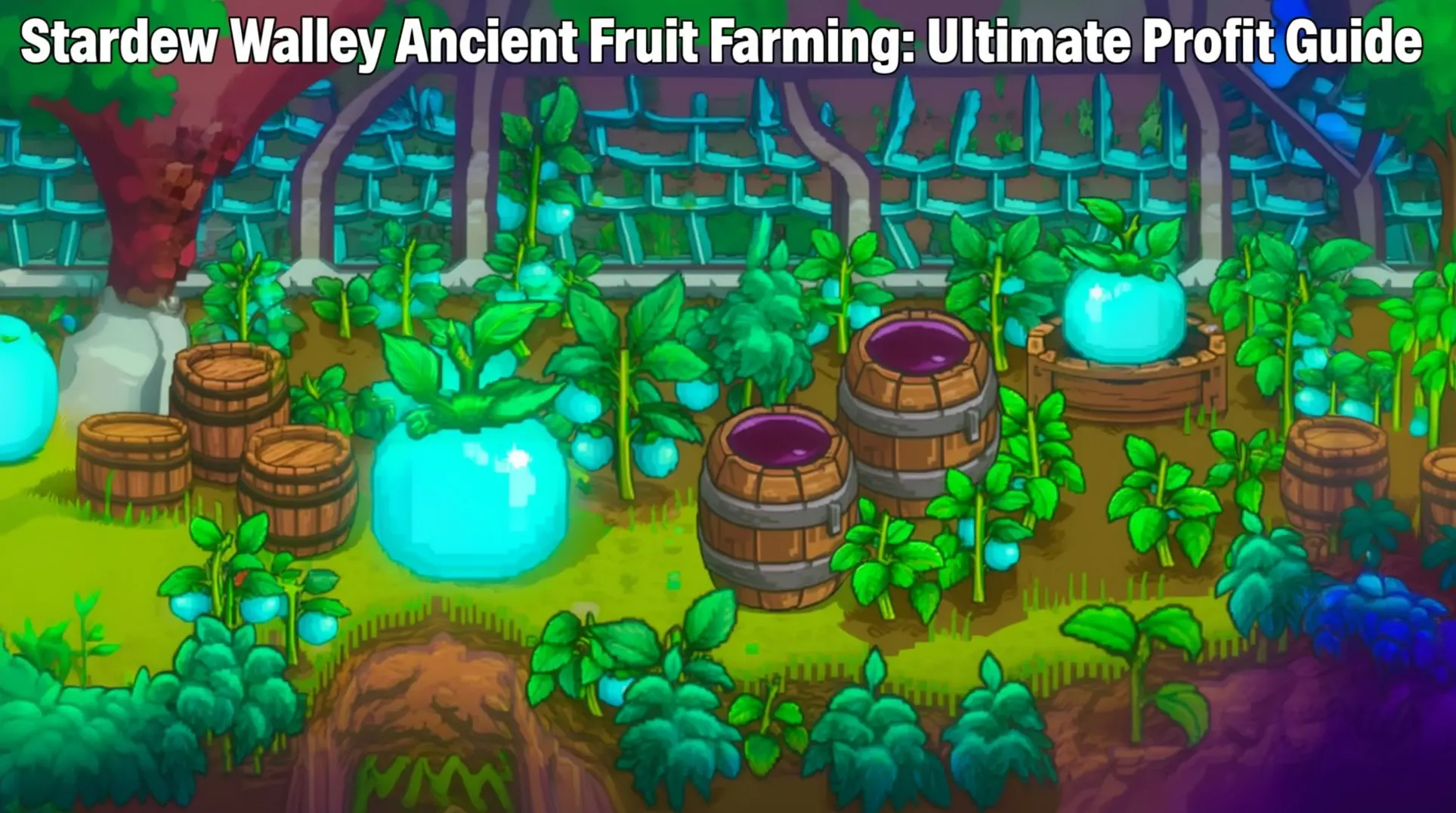
Unlocking the Ancient Seed Mystery
The quest for the Ancient Seed artifact is a rite of passage for any dedicated Stardew Valley farmer, unlocking one of the game's most profitable and sustainable crops. This elusive relic can be found through several methods, though each requires patience.
Finding the Ancient Seed
Your best chances come from:
- Digging in artifact spots in Cindersap Forest or The Mountain
- Slaying bug-type enemies on levels 20-60 in the Mines
- Finding one in a fishing treasure chest
- Opening Artifact Troves purchased from the Desert Trader
Donating to the Museum
Once you secure this prized artifact, your first move should be a trip to the Pelican Town Museum. Donating it to Gunther is the crucial key; he will reward you with a pack of plantable Ancient Seeds and, more importantly, the crafting recipe to convert any future artifacts into more seeds. This donation is a non-negotiable first step, as it is the only way to begin cultivating the fruit yourself.
The Value of Ancient Fruit
With the recipe in hand, you can embark on a highly lucrative agricultural venture. Ancient Fruit plants produce fruit every seven days after maturing and grow across Spring, Summer, and Fall.
When planted in the Greenhouse or on Ginger Island, they become a year-round moneymaking machine. The fruit itself sells for a tidy sum, but its true value is realized when turned into Ancient Fruit Wine, creating a powerhouse economy on your farm and making the arduous hunt for that first seed well worth the effort.
Planting Your First Ancient Fruit Empire
To build a truly profitable Ancient Fruit empire, your first major decision is choosing where to plant. While outdoor farming is possible during Spring, Summer, and Fall, the greenhouse is vastly superior for one critical reason: year-round production.
The Greenhouse Advantage
Inside the greenhouse, your plants are protected from seasonal changes. This means they will continue to produce fruit every seven days, even through the harsh Pelican Town winter. This creates an uninterrupted income stream that outdoor patches simply cannot match, as crops grown outside will die when the season changes to Winter.
Choosing the Right Fertilizer
Once you've secured your greenhouse plot, your fertilizer choice is paramount. For maximum profit, Deluxe Fertilizer is the undisputed champion for your Ancient Fruit.
- Fruit quality directly affects wine price: Basic, Silver, Gold, and Iridium quality Ancient Fruit produce wine worth 1,650g, 2,062g, 2,475g, and 3,300g respectively (with Artisan).
- Using Deluxe Fertilizer results in higher average profit per day (~379g/day vs ~330g/day) due to the higher prices of quality wine, even with fewer harvests.
Maximizing Ancient Fruit Profitability
To truly maximize your profits with ancient fruit, a strategic approach to expansion and processing is non-negotiable. The key to exponential growth lies in your Seed Maker.
Seed Multiplication Strategy
Instead of selling your first precious fruits, process each one. This machine yields 1-3 seeds per fruit, allowing you to rapidly multiply a single ancient seed into a full greenhouse and beyond without ever spending gold on more. This creates a self-sustaining operation where your initial investment pays for itself endlessly.
The Power of Wine Production
Once your production is scaled up, the real profit driver is wine production. The numbers speak for themselves: selling raw fruit from a full greenhouse yields solid returns, but processing that same harvest into wine multiplies your annual profit by nearly 3.75 times.
The 7-day regrowth cycle of ancient fruit serendipitously aligns with the 7-day wine production cycle in a keg. This creates a perfectly efficient, closed-loop system for continuous output.
Expanding to Ginger Island
For the ultimate endgame setup, expand your empire to Ginger Island. Its unique climate functions as a second, massive greenhouse, allowing for year-round ancient fruit cultivation without any regard for seasons.
By combining the output of your standard greenhouse with the vast planting space on Ginger Island, you effectively double your production capacity. This creates a powerhouse of wine production that is unmatched by any other crop.
Advanced Ancient Fruit Farming Strategies
The quest for sustainable, high-yield agriculture isn't a modern invention; it's built upon foundations laid by ancient civilizations. As far back as 6000 BCE, Babylonian farmers pioneered sophisticated crop rotation systems, a practice later refined by the Romans.
Ancient Agricultural Techniques
They astutely alternated cereal crops with legumes like chickpeas and lentils, recognizing that the legumes helped fix atmospheric nitrogen and naturally fertilize the soil for subsequent plantings. This ancient wisdom is a cornerstone of sustainable soil management today.
Beyond rotation, our ancestors developed other ingenious techniques:
- The Incas and Chinese mastered terraced farming to cultivate hilly terrain.
- The Greeks and Romans practiced companion planting by interspersing vegetables and herbs.
- The Aztecs and Mayans created incredibly productive chinampas, or elevated garden beds on lake surfaces.
These methods all shared a common goal: working with nature to maximize output and maintain ecological balance.
Integrating Ancient Wisdom
The most successful modern operations seamlessly integrate these time-tested principles with cutting-edge technology. While ancient farmers used legumes for natural fertilization, we now enhance this with advanced soil testing and precision nutrient management.
The ancient concept of companion planting is supercharged within modern controlled-environment greenhouses, which can yield up to 55 kg of tomatoes per square meter. By combining this ancient wisdom with strategies for year-round harvests—like using unheated hoophouses to extend seasons—growers can achieve consistent production of high-value crops, proving that the best farming strategies are both timeless and innovative.
Building Your Million-Gold Ancient Fruit Empire
The heart of your empire begins with a perfectly optimized greenhouse. The ideal layout utilizes 116 ancient fruit plants fed by six iridium sprinklers, a setup that capitalizes on the fruit's continuous regrowth cycle.
Optimizing the Greenhouse
After the initial 28-day maturation, these plants yield fruit every seven days.
With the Artisan profession boosting wine prices by 40%, this single greenhouse operation can generate an estimated 500k weekly. This forms the formidable core of your financial engine.
Doubling Production on Ginger Island
To achieve true million-gold status, you must expand your operations to Ginger Island. This paradise functions with the same beneficial mechanics as the greenhouse, providing a year-round growing season free from seasonal restrictions.
By establishing a full automated ancient fruit farm here with sprinklers, you effectively double your production capacity. This creates a massive and passive stream of raw fruit.
Constructing a Keg Empire
However, growing the fruit is only half the battle; processing is where the real fortune is made. The true end-game goal is constructing a keg empire of 600 or more kegs housed in sheds, the quarry, or the desert.
Each ancient fruit, when processed into wine with the Artisan profession, sells for 1,650g (Base quality), 2,310g (Silver quality), 3,465g (Gold quality), or 4,620g (Iridium quality).
By ensuring your processing capacity meets or exceeds your weekly harvest, you transform your farms into a well-oiled machine printing millions of gold, with some optimized players reporting earnings of up to 2.8 million weekly.
Conclusion: Mastering Ancient Fruit Domination
Building an ancient fruit empire represents the ultimate achievement in Stardew Valley farming economics. From that first elusive seed artifact discovery to filling both your greenhouse and Ginger Island with these precious plants, the journey requires patience and strategic planning.
The payoff, however, is nothing short of spectacular—a self-sustaining, perpetual income machine that generates millions of gold with minimal ongoing effort. By combining optimal greenhouse layouts, strategic seed multiplication, massive processing infrastructure, and the Artisan profession's wine bonus, you'll transform your farm into Pelican Town's most prosperous agricultural operation.
Remember that true wealth comes not just from growing ancient fruit, but from processing every single harvest into premium wine. This creates the most efficient gold-per-tile operation possible in the valley.
More Stardew-Valley Guides

Stardew Valley Sebastian Romance Guide: Gifts, Heart Events & Marriage
Discover how to romance Sebastian in Stardew Valley with our spoiler-free guide covering his favorite gifts, heart event triggers, and marriage requirements.
Ultimate Stardew Valley Farm Layout Designs Guide 2025
Discover expert Stardew Valley farm layout designs for maximum profit, aesthetic appeal, and efficiency. Learn optimal strategies for all farm types and advanced techniques.

Stardew Valley Demetrius Friendship Guide: No-Spoiler Tips
Learn how to build friendship with Demetrius, Pelican Town's scientist. Discover his favorite gifts, daily schedule, and conversation strategies without spoilers.
AI Tactical Companion
Consult with our specialized tactical engine for Stardew-Valley to master the meta instantly.