Ori and the Will of the Wisps: A Deep Dive into Narrative, Sacrifice, and Disability Representation
Introduction
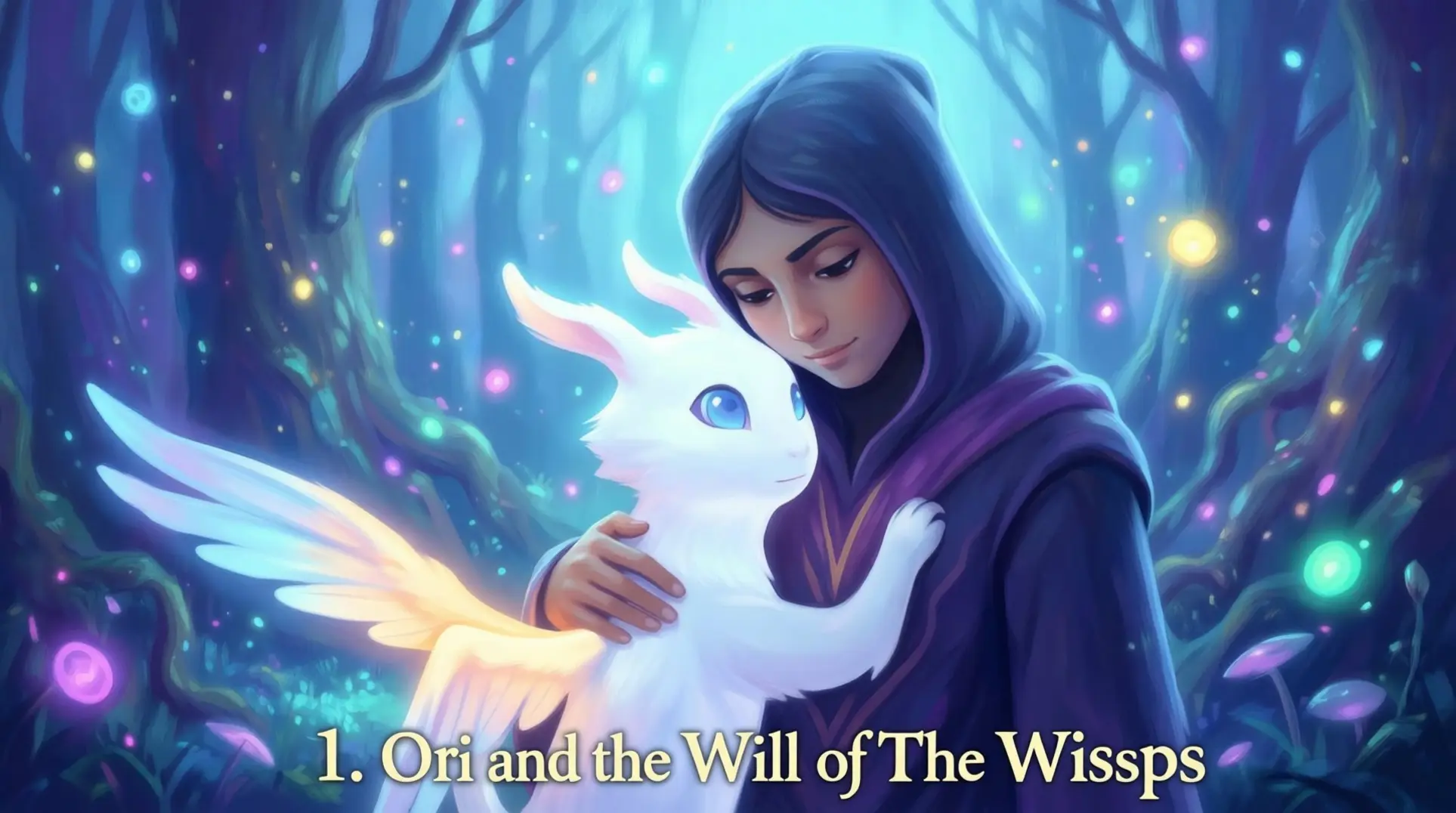
Ori and the Will of the Wisps expands its predecessor's emotional scope, shifting from a story of personal survival to one of profound responsibility. This analysis delves into the game's intricate narrative, exploring how themes of sacrifice, family, and disability are woven into its world and mechanics. We'll examine the journeys of Ori and Ku to understand what this acclaimed sequel truly says about care, loss, and representation.
Narrative Foundations and Thematic Framework
Moon Studios didn't just make a bigger map - they rewrote the entire emotional contract. Where Blind Forest was about personal survival, Will of the Wisps tackles what they call a 'much heavier, more mature narrative' that shifts from rescue to responsibility. The world itself is roughly three times larger than Nibel, which means you're exploring devastated marsh, windswept desert, and ruined fortress that each tell their own story.
To make this work, they added fast-travel wells and quest-giving NPCs, creating a central hub that visually proves Ori's quest isn't just healing the world - it's healing people. Your combat options evolved from that bash-only system to a full weapon wheel, and that mirrors Ori's growth from a vulnerable orphan to a seasoned protector. Even the music reflects this escalation, as it trades Blind Forest's peaceful piano for orchestral grandeur that underscores stakes culminating in a self-sacrificing ending. Players call it 'arguably more satisfying because it hurts,' and that pain is intentional. The devs wanted you to finish feeling that Ori's journey 'mattered to more than just Ori,' something the original's smaller scope could never house.
From Blind Forest to Will of the Wisps: Evolving Narrative Scope
The series has always insisted survival isn't free - it's purchased by someone's willingness to give up what they cherish most, echoing Kuro's death in Blind Forest. In Will of the Wisps, this theme deepens into a triad that drives every character arc.
Sacrifice sits at the center. Ori's fusion with Seir to become the Spirit Tree isn't framed as annihilation but as transcendence, turning the whole journey into a meditation on love, loss, and cyclical healing. But here’s where it gets complicated - this sacrifice intersects directly with disability and family.
Ku’s malformed wing isn’t just a plot device; it's a canonical birth defect that keeps her earthbound until she is fitted with a prosthetic wing. The game frames this assistive tech as a magical 'fix' that instantly restores her flight ability, erasing rather than accommodating disability. It's the first time the series gives you a breather that’s only about connection.
Gumo, Ku, and Naru are all survivors of loss, and their shared home becomes a crucible where fragments fuse into something sturdier than blood. You see this in the post-credits montage where Ku returns annually to roost on Ori's tree form - a visual promise that family persists through transformation.
Then there's Shriek, whose arc deliberately rejects a redemption QTE. She dies crawling beneath her parents' skeletal wings, which forces you to confront who gets to be redeemed in fantasy narratives. It's brutal, but it fits the game's refusal to offer easy answers.
The ending is bittersweet by design - Ori is gone and present, Ku is mended and scarred, the forest is saved but forever altered by the price paid. It mirrors real-world caregiving where every act of love costs something but multiplies into something neither party could build alone.
The Core Thematic Triad: Sacrifice, Family, and Disability
This triad is interwoven throughout the narrative, with each element reinforcing the others. Sacrifice is not merely loss but a transformative act that enables new forms of family and acknowledges disability as part of the human experience.
Ori's Character Arc: From Orphan to World-Tree
Stage 1: The Caretaker Emerges (Prologue to Storm Separation)
Right from the start, Will of the Wisps puts you in Ori's shoes as a parent, not just a hero. The prologue shows Ku hatching from Kuro's last egg in Swallow's Nest, and Ori doesn't hesitate - he's immediately the one feeding her that first grub, shielding her from the rain, and teaching her to fly by bouncing off glowing mushrooms. You feel that inherited responsibility from Kuro's sacrifice because Ori's not just watching over Ku; he's living the promise that Naru, Gumo, and the whole family made to protect this orphaned owlet.
Then Ku crashes. Her wing doesn't develop right, and this is where the emotional contract between them really locks in. Ori spends nights building a prosthetic splint from glowing bark and silk thread, then races alongside her with a lantern, coaxing her to flap again. That moment when you finally see Ku glide successfully - when Ori cups her in his arms in that 'cradle' shot - feels earned, but it's also setting up a brutal gut-punch for later. Those mirror silhouettes you see throughout the opening? They're not just cute visual symmetry; they're foreshadowing how these roles will completely flip by the end.
Stage 2: The Burden of Responsibility (Quest for the Wisps)
What starts as a personal mission to save Ku quickly balloons into something much heavier. Ori's quest to heal Niwen forces him to carry the weight of an entire ecosystem, and the Ombrage side-quest in Mouldwood Depths is where this really clicks into place. You're not just collecting Twilight Echoes for a power-up; you're reliving another parent's failure to protect their clutch. When you return that final feather, you don't get a stat boost - you get a responsibility: the dusk chorus lives inside Ori's spirit now, which means the memory survives only if you carry it forward.
This reframes everything. The five Wisps you're chasing - warmth, memory, strength - they stop being abstract concepts and become deeply personal. Warmth is a parent's love, memory is specific lullabies, and strength is the courage to keep singing when the world goes dark. Moon Studios even bakes this into the mechanics: the feather fragments emit a soft minor-key chord only when you're not attacking, so you're encouraged to move through Mouldwood peacefully. The darkness actually dims your UI, which forces you to navigate by audio cues - distant hoots, rustling leaves - making you, the player, listen to grief to find the way forward, just like Ori has to.
Stage 3: The Foreshadowed Destiny (Ancient Ruins Revelation)
The Windtorn Ruins murals aren't subtle, and that's the point. There are four panels that literally storyboard the entire ending: the first shows Niwen wilting, the second shows a small white guardian (you) descending with Wisps, the third shows that spirit cradling the Heart of the Forest while roots curl from its feet, and the fourth shows a massive, luminous tree bursting from the spirit's body and restoring light. It's not metaphorical - it's a frame-accurate blueprint for what happens in the finale.
When you finally place the Heart into the Spirit Willow, the camera recreates Panel 4 exactly: Ori's body dissolves into filaments, a trunk erupts, and the screen floods with foliage. According to the FuturePress art book, Moon Studios wanted this to feel 'pre-ordained yet surprising,' and they nailed it. By embedding the spoiler in the environment, they make you subconsciously accept Ori's fate long before it arrives, which means every power-up you earned gets re-contextualized as a step toward literally 'rooting' into the soil. You knew, but you didn't know, and that's what makes it land so hard.
Stage 4: The Ultimate Sacrifice (Final Transformation)
Here's where everything pays off, and it's permanent. Unlike Blind Forest, where the Spirit Tree restores Ori at the last second, Will of the Wisps flips the script completely - Ori restores the Tree. Moon Studios CEO Thomas Mahler confirmed they wanted a 'conclusive, emotional payoff' with no gimmicky twists, and boy, did they deliver. There are no alternate endings, no way to dodge this bullet. Ori's death isn't a tragedy; it's growth through loss. His spirit lives on in the new Spirit Tree, which means it's continuity, not finality.
The post-credits scene drives this home. You watch Naru, Gumo, and Ku grow old around Ori-as-Tree, and the final shot shows Ku perched on his branches, thriving. The family endures because Ori became the thing that lets them endure. It's the thematic mirror that Blind Forest needed: the orphan who needed saving becomes the world-tree that saves everyone else. That's not just a character arc - it's a complete cycle.
Ku's Character Arc: Disability, Dependency, and Agency
Disability as Narrative Foundation (Not Tragedy)
Ku's story doesn't follow the usual script. From the moment you meet her, Ori and the Will of the Wisps treats her disability as a fact of life, not a problem to fix - which already puts it miles ahead of most games.
Her right wing never developed properly. The developers call it a natal malformation, and they built it into her model with painful precision, creating what the rigging team nicknamed a 'broken umbrella' silhouette.
That failed-flight montage hits differently because of this foundation. It unfolds in three deliberate beats - hope, then physics (the animators ran Maya nCloth simulations on her good wing while the broken one stayed static), and finally silence. Composer Gareth Coker stripped everything down to a heartbeat kick drum.
Here's what could've ruined it: an early loading screen mock-up called Flightless showed Ku on a cliff edge with text reading 'Maybe next life, little owl.' The team cut it three weeks before gold-master, and the game is better for it. Ori never promises a cure.
The Social Model of Disability in Action
The game never tries to fix Ku. Instead, it gives her tools and rebuilds the world around her - that's the social model of disability in action, and Ori nails it.
Your glider harness is the centerpiece. You get it after helping Ku in the Silent Woods, and it works exactly like real assistive tech should: it extends your aerial reach and allows for a 'stall' technique through precise input timing, creating the illusion of invulnerability in hazard zones.
Then there are the wind columns scattered through Baur's Reach, Windswept Wastes, and Mouldwood Depths. These are temporary environmental boosts that act as local, 'key-locked' vertical shafts that gate progression behind the Burrow ability.
Here's where it gets interesting. Players immediately weaponized this system, chaining Glide with Burrow or Launch to slingshot through solid rock. What started as an assistive device became a generative speed-run tool.
Replay ghosts take it further. They upload player movement kits - including Glide timing - so newcomers can see disabled aerial paths in action. It's peer mentorship baked right into the game.
The final escape sequence seals the deal. Ori rides Ku's back while she navigates wind columns, and there's no last-minute cure. Her disability stays part of her identity until the very end.
Interdependence vs. Independence (Final Flight)
The ending is where it all pays off. Ku's final flight isn't about independence - it's about interdependence, and it's the emotional keystone of the entire game.
After Shriek's assault leaves her mortally wounded, Ku staggers upright and spreads her glider. She becomes Ori's vehicle, which mirrors those early tutorials where you learned to ride wind shafts. The roles reverse, but the message stays the same.
This reframes 'sacrifice' as ecological balance. Ku repays a 'loan' by ferrying Ori, the future seed, back to Niwen's heart. The game's argument is clear: no creature survives alone.
The post-credits stinger shows Ku healed and nesting with an unnamed mate. That relational web - the one that demanded sacrifice in the first place - endures and re-balances itself.
Her flight also rhymes with mother Kuro's final dive, but it cuts out the retaliatory impulse entirely. Ku's story teaches her lineage that protection means reciprocal care, not zero-sum loss.
Sacrifice as Caretaking: Ori's Transformation Enables Ku's Flight
Here's where the gut punch lands: Ori doesn't just save the forest - Ori becomes it. When you merge with the Spirit Willow, that light bursting forth does something brutal and beautiful: it rewrites the sky itself. Those thermals that Ku struggled with? They become permanent, reliable updrafts strong enough to hold any owlet aloft, no matter how fragile their wings once were. Ori's final gift is flight, but not just for Ku - for every creature that follows, now and forever.
Kuro's feather, the one Ku's been clutching since the crash, is the key to understanding this. Ori shoulders the same curse that drove Kuro to attack the Spirit Tree, but here's the difference: Ori's sacrifice ends the cycle instead of continuing it. That feather gets released as Ori-tree blooms, symbolizing that the generational trauma is finally broken. And the kicker? Ori's consciousness doesn't vanish - it diffuses into root and canopy, becoming an omnipresent guardian who feels every wingbeat. You're not gone; you're the wind itself.
This also closes the loop that began in Blind Forest. The first game ended with a tree's revival; this one ends with the protagonist becoming that tree. It's parental sacrifice dialed up until the whole forest becomes your child.
Found Family vs. Biological Legacy
The game never says 'found family' out loud, but it's woven into every interaction. Start with the chain: Naru adopts Ori, who adopts Ku. That's three generations of trans-species parenting, where biology is just a footnote. Ku isn't just any owlet - she's Kuro's lone offspring, hatched after her mother died, and she imprints immediately on Ori, Naru, and Gumo. That moment where they share breakfast in the treehouse? It's not cute set dressing; it's the game telling you family is a choice, not blood.
Then there's Shriek, the photographic negative of this entire theme. Where Ku was welcomed, Shriek was rejected by her own species because her twisted wings looked like the Decay. She crawled beneath her petrified parents for warmth, and the game never offers her a redemption arc - players have actually modded in alternate endings where Ori shares light with her, because the absence of that option feels so wrong. Kuro's violence came from a place of protection - she attacked the Spirit Tree to save her eggs. But Shriek? Her violence is pure nihilism because no egg was ever saved for her.
The post-credits scene drives it home: Naru, Gumo, and Ku picnic beneath Ori's glowing leaves. It's the ultimate parental fantasy - you grow up to become the roof that still shelters the family table.
The Cycle of Care: From Receiver to Giver
Ori's entire arc is a masterclass in learning to give what you once received. In the prologue, we see Naru - who was once cared for by Gumo - now raising both Ori and Ku. That breakfast scene isn't just adorable; it establishes caregiving as the highest currency in this world. But Ku's fall rewires everything: the fledgling who was cared for becomes the reason care must leave the nest. Ori doesn't just want to save Ku; Ori has to become the parent now.
Every zone in Niwen is a miniature version of this loop. Kwolok receives liberation from the decay and gives you the Waters' fragment. The Moki receive hope and give you the location of the Silent Woods. It's receiver -> giver -> re-gifter, over and over. Shriek is what happens when you break that chain - she was denied care, hoarded power instead, and became incapable of either giving or receiving. Her refusal to join the cycle is framed as the real failure state, not just a boss fight you lost.
When Ori finally fuses with the Spirit Willow, individual ego dissolves but caregiving identity expands exponentially. Naru, Gumo, and Ku age beneath the new tree, and you're still there - just distributed. The final proof comes in that last post-credits shot: Ku placing a leaf on Naru's grave. The once-receiver is now performing the intimate, final act of care. The arc is complete.
Disability Representation Analysis: What Will of the Wisps Gets Right
Most games stumble hard when they touch disability - either they treat it as a boss fight to overcome or a superpower origin story. Will of the Wisps does something weirder and more honest, even if it doesn't stick the landing every time.
Medical Model vs. Social Model: Ku's Wing as Case Study
Ku is born with a right wing that never fully developed, and here's where the game immediately diverges from the usual script. Most narratives would frame this as a tragedy or a flaw to eliminate, but Wisps treats it as a simple fact of life. Ori doesn't wave some magic spirit-light at her wing - they give her Kuro's Feather, explicitly called a prosthetic, which grants controlled gliding but never promises true flight.
By the end of the game, Ku's wing is fully healed. The post-credits scene shows her flying with a healthy, fully feathered wing, a direct result of Ori's sacrifice.
The crash sequence complicates things. Some critics argue it uses Ku's disabled body as an emotional trigger for Ori's quest, which is a fair read. Others see it as highlighting inter-dependence rather than erasure - Ku isn't saved from her disability; she's protected because the world wasn't built for her, which is a different thing entirely.
Silent Protagonist as Accessibility Metaphor
Ori never speaks a word, and the game communicates everything through micro-animations, bioluminescence, and musical cues. You learn to read Ori's 'kinetic syntax' - ears flatten when they're injured, tail twitches signal curiosity. This mirrors how some disabled people navigate non-verbal communication, and it forces you, the player, to become fluent in a language without words.
The co-op glide sequence doubles down on this. You and Ku exchange musical call-and-response cues to coordinate flights, which means you're literally learning to 'speak' disability before the game lets you progress. It's a brilliant piece of design that translates emotional stakes into mechanical necessity.
Unfortunately, the game partially undermines its own metaphor. Once Ku regains flight through narrative magic, the story re-centers able-bodied norms, leaving that non-verbal register behind. And while Ori's silence works thematically, real-world accessibility reviews note the lack of robust visual or audio cues for critical sound events can actually erect barriers for Deaf or blind players. The representation is thoughtful, but the execution doesn't always serve the community it gestures toward.
Game Mechanics as Empathy Tools
Here's where Moon Studios got sneaky. The Ku-carry sequence uses a hybrid animation system - her flight path is pre-authored but steered by your input, creating co-op without full dual-character play. Damage redirection sells the fantasy: enemies appear to hit Ku with visual effects, but Ori actually takes the HP loss. You're not just protecting her; you're absorbing the consequences, which makes the emotional weight tangible.
The studio also baked in invisible assist features that most players never notice. These visual-first color scripts and audio call-and-response layers accidentally create navigation aids for low-vision and low-hearing players, even if that wasn't the intent. On PC, you can crack open the plaintext KeyMap.ini for one-handed or sip-and-puff remapping, and the Xbox Adaptive Controller is natively recognized with glyph-less prompts. It's not perfect - the menus could be cleaner - but the foundation is there.
The throughline is that Will of the Wisps treats accessibility as a design principle rather than a bullet point, even when the story stumbles. It builds empathy into mechanics, even if it can't always sustain that empathy in narrative.
Narrative Structure and Player Experience
Foreshadowing and Payoff: The Mural System
The Inkwater Marsh mural is pretty easy to miss your first time through, but once you know what you're looking at, it's impossible to unsee. It depicts a stylized Kwolok and several Moki bowing toward a glowing wisp, reinforcing the idea that the Moki see wisps as sacred.
Then you've got the Luma Pools triptych, which is sneakier about it. The magenta torches aren't just for atmosphere; they're hinting at the Spirit Arc projectile you'll need later to reverse the decay in Mouldwood Depths. It's color theory doing narrative heavy lifting, and you won't notice until you're backtracking with the right ability.
But the real kicker is the Windswept Wastes sandstone frieze. It shows a split tree with the exact quote: 'From one, the many; from the many, one.' That's not paraphrasing - that's the final narration, word for word. Steam Community users actually compiled screenshots proving every single mural matches late-game events at identical camera angles, which confirms Moon Studios deliberately layered these textures for the 4K High Quality Graphics mode. They've been telling you the ending from the start.
The Inevitability of Sacrifice: Why There's No Alternate Ending
Moon Studios has been crystal clear about this: there's only one ending, and it's not changing. The story is designed as a single, cohesive narrative with no branching paths or hidden flags to manipulate, so once the credits roll, your save file locks into a 'finished' state - no post-credits twist, no secret continuation.
That might sound restrictive, but it's actually the whole point. The fixed ending forces you to experience the same inevitability that Ori faces - sacrifice, renewal, and legacy - which reinforces the game's core message about ecological debt. You can't save-scum your way out of it; you have to sit with the consequences.
Unfortunately, fan petitions for an alternate ending or Definitive Edition have been around since launch, but Moon Studios has declined them all and moved on to other projects. This is the story they wanted to tell, and they're sticking to it.
Player Agency vs. Character Destiny
The final sequence is where this all comes to a head. Your agency gets reduced to a single 'Hold X to embrace' prompt, and after that, all movement and combat inputs lock completely. What started as a game about fluid movement becomes a ritual you watch unfold, which is... a choice.
Here's the thing though: the entire mechanical build-up - the Combat, Utility, and Pathfinder skill trees - tricks you into thinking you can protect Ku. You've spent hours mastering Ori's abilities, so when you're forced to surrender all that power, it feels less like a cutscene and more like a conscious trade-off. You're giving up your mastery for responsibility.
Blind Forest handled this differently. That game used a scripted QTE sequence that emphasized pure helplessness. Will of the Wisps, though, lets you walk into the sacrifice with your eyes open, creating what some players call a 'conscious emotional contract.' You're not just watching Ori sacrifice themselves; you're actively pressing the button to make it happen.
The community is split on this. Some read the limited agency as poetic - by holding that button, you're giving consent. Others call it 'ludonarrative irritation,' arguing that it disjoints the gameplay empowerment from the narrative helplessness. Both readings are valid, but they hit different emotional notes.
Comparative Analysis: Shriek as Foil and Contrast
The Unredeemed Villain: Shriek's Rejection Narrative
Shriek’s story starts in the worst possible way - she hatched in the Silent Woods right after the Spirit Willow died, which means she entered a world already broken. The Decay didn't just warp the land; it warped her body, giving her those stony stilts instead of normal wings. From minute one, she was marked as different, and Will of the Wisps commits to that theme by never letting you fix her.
Unlike pretty much every other game villain, Shriek doesn't get that last-second redemption moment. There's no cutscene where she sees the error of her ways, no quick-time event where you can choose mercy. The game forces you to kill her, and the community absolutely felt that choice - Reddit and forums filled up with players asking if they missed a 'save Shriek' prompt, because we’re trained to expect one. But the game says no, not every wound can be healed, and that denial lands harder because her final moments are so quiet.
After you defeat her in that brutal three-phase boss fight - where her stone stilts literally weaponize her deformity - she doesn't die in glory. She drags herself under the fossilized wings of her parents, trying to find an embrace that never came when she was alive. It’s devastating because the Decay was the real villain, sure, but Shriek was its unwilling child, and the world never gave her a chance.
Disability as Rejection vs. Disability as Adaptation
If you want to understand what Will of the Wisps is really saying about disability, just look at the two owls: Shriek and Ku. They’re the same species, but the world saw them completely differently.
Ku's bent wing got her a custom-built metal brace from Gumo and a community that cheered her on. Her wobbly landings and mid-air corrections aren’t just cute - they're gameplay mechanics that show adaptation through support. The world treated her disability as a design problem to solve, not a curse.
Shriek, though? Her stone-plated deformities were branded 'monstrous' the moment she hatched. The same environment that eventually produced Ku's prosthetic tech also produced the Decay that twisted Shriek's body, but instead of help, she got rejection. She learned that survival meant intimidation because the villagers who’d later celebrate Ku drove Shriek deeper into the woods.
The contrast couldn't be clearer. Ku's brace lets her glide above the restored Spirit Willow, her prosthetic glinting in the sunlight - she embodies the world that could've been. Shriek’s stilts only fold for combat bursts, weaponizing her own anatomy against a world that feared her. It's the same disability on paper, but the environment decided whether it became hope or hatred.
Legacy of Ori and Ku's Journey
What Ori and Ku Teach Us About Care and Sacrifice
This is where the game gets complicated. While Will of the Wisps looks like a touching story about helping a friend, the mechanics tell a different story. Ku's broken wing isn't just a physical problem; it's framed as a social wound that makes her feel incomplete, so you spend the first third of the game essentially rebuilding her entire world, including crafting that new glider. But here's the catch: every upgrade you get for Ku is locked behind challenges that only Ori can reach at first, which kinda reinforces this 'charity model' where the disabled character exists to make the abled hero look good.
And then there's the ending. Ori becomes the new Spirit Tree in a transformation that's permanent - there's no ghost voice-over, no implication that Ori's still 'alive' in any recognizable way. The emotional gut-punch comes from realizing the ultimate act of care, in this world, is complete self-sacrifice. This is what critics call 'curative time' - a future that only becomes possible once disability itself has been erased.
The whole game has you performing invisible reproductive labor: feeding Ku, escorting her, literally carrying her when the prosthetics fail. This isn't just helping a friend; it's romanticized affective exploitation, where endless emotional and physical labor gets repackaged as spiritual destiny. That final image of Ori's bark-covered silhouette? It haunts you because it proves that when care is coded as sacrifice, someone always gets left behind.
The Future of Disability Representation in Games
So what does this mean for future games? The frustrating part is that Will of the Wisps actually does some things really well. Ku's prosthetic feather isn't treated as some separate 'accessibility mode' - it's baked right into the core crafting system like any other ability upgrade. That integration is genuinely cool because it collapses the boundary between disabled mechanics and core gameplay.
But then there's the audio design problem. About 90% of the storytelling relies on non-visualized audio, which means Deaf and hard-of-hearing players have to piece together the plot from ambient animations alone. You can't celebrate prosthetic subplots while simultaneously locking out entire audiences from the emotional payoff.
Future narratives need to co-design visual redundancies from the start - things like flashing shrine glyphs, dynamic comic-style bubbles, or AI-driven captioning systems. And the accessibility reviews are clear: even basic menu traversal is brutal for players with limited dexterity. Some indie studios are already experimenting with 'friction-positive' design, where difficulty modifiers become narrative sliders rather than cheat codes.
The bigger issue is representation in the room. Ku's wordless, acted arc avoids harmful stereotypes, sure, but it also misses any nuance around phantom-limb pain, prosthetic maintenance, or community stigma. You simply can't get that depth without having disabled storytellers in the writers' room alongside systems designers.
Here's the part that should make publishers pay attention: Will of the Wisps sold two million copies in under six months. It outperformed its predecessor and crushed many ableist AAA titles in the same period. So the whole 'accessibility doesn't sell' excuse? It's dead. Inclusive narrative mechanics are low-risk, high-empathy differentiators, and Ori proves it.
Conclusion
Ori and the Will of the Wisps presents a complex, often bittersweet meditation on care and sacrifice. While its narrative mechanics and integrated disability representation mark significant progress, the game also highlights the persistent challenges of inclusive design. Its commercial success proves that stories embracing these themes resonate deeply, setting a compelling precedent for the future of empathetic and accessible game narratives.
More ori-and-the-will-of-the-wisps Guides
The Bittersweet Finale: A Deep Analysis of Ori and the Will of the Wisps Ending
Explore the ending of Ori and the Will of the Wisps, from sacrifice and symbolism to community debate. Understand the themes that make this finale unforgettable.
The Ultimate 100% Completion Guide for Ori and the Will of the Wisps
A comprehensive guide to achieving 100% completion in Ori and the Will of the Wisps, covering optimal routes, collectibles, achievements, and troubleshooting the 99% bug.
The Complete Gorlek Ore Guide for Ori and the Will of the Wisps
Find all 40 Gorlek Ore locations in Ori and the Will of the Wisps with this detailed guide. Learn upgrade orders, ability requirements, and pro tips to rebuild Wellspring Glades efficiently.
AI Tactical Companion
Consult with our specialized tactical engine for ori-and-the-will-of-the-wisps to master the meta instantly.