Mastering the Adamic Language in Indiana Jones and the Great Circle
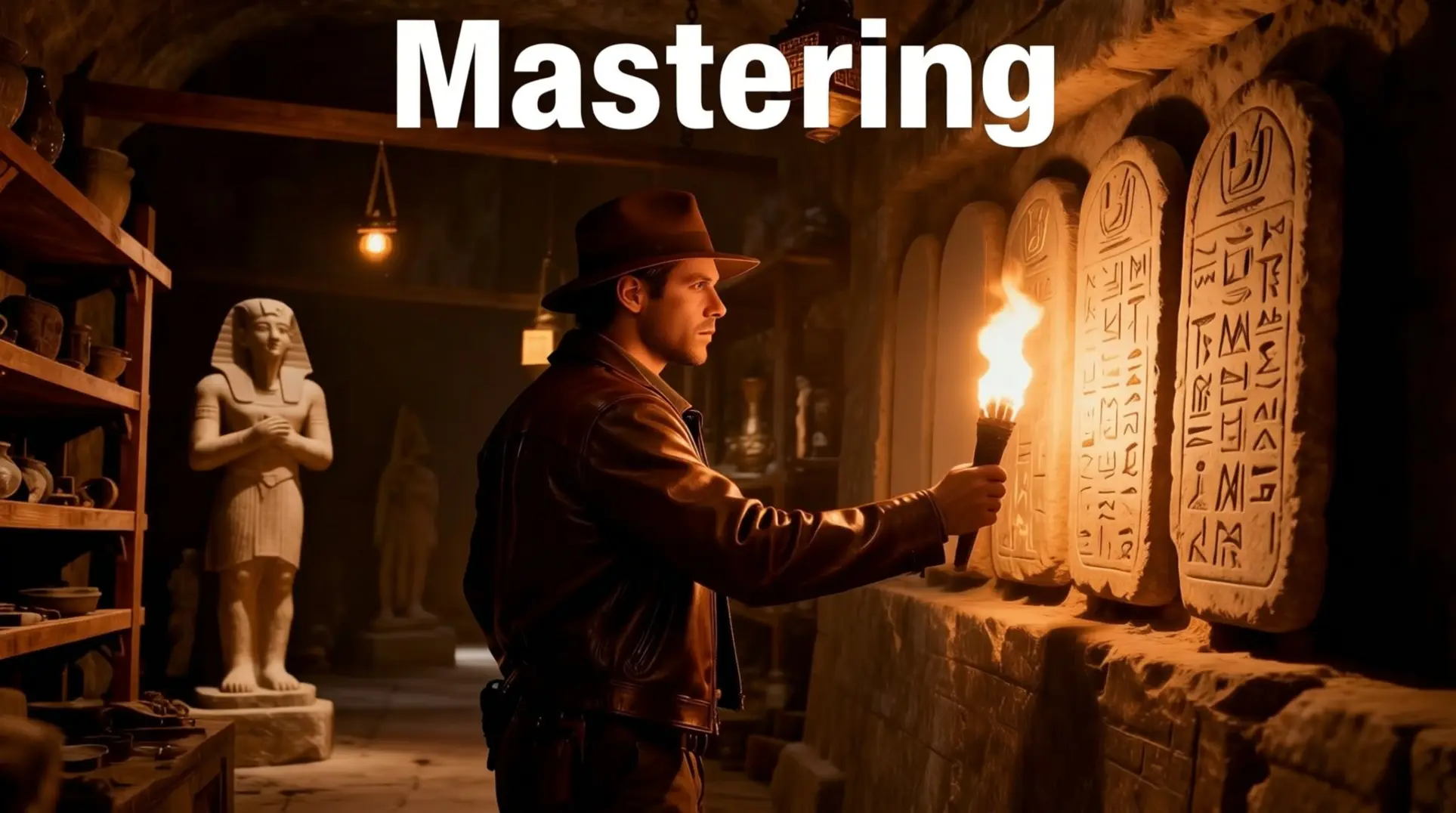
Indiana Jones and the Great Circle introduces a radical new puzzle mechanic: the Adamic language. This isn't just another ancient script to translate; it's a fabricated, primordial tongue of only 17 words that serves as the key to a global teleportation network. This guide will break down what Adamic is, how to use it to solve the game's central puzzles, and explore the real-world myths and brilliant game design behind it.
What is Adamic? The Game's Linguistic Core
Adamic isn't just some throwaway puzzle language - it's the backbone of the entire Great Circle mystery, and it only has 17 words. That's it, but each one's a single-syllable command etched onto a uniquely colored and shaped stone artifact, which means you're not just collecting vocabulary, you're gathering a set of magical keys.
These words don't just sit there looking pretty. They form a global teleportation network, and here's where it gets interesting: speaking the correct word while standing on a stone teleports Indy to the next stone in a predetermined sequence along the Great Circle arc. Speaking a random word does nothing or triggers a fail-state. Nailing the correct sequence allows for precise travel across the map.
The full lexicon is actually pretty straightforward, even if the pronunciations are a mouthful:
| Word | Meaning |
|---|---|
| Šāʾ | arise |
| Naphal | fall |
| Qūm | stand/rise |
| Hālak | walk/go |
| Yāṣāʾ | come out |
| Bôʾ | enter |
| ʿĀbar | cross |
| Nûaḥ | rest |
| Šûb | return |
| Nāṣaʾ | lift |
| Nātan | place |
| Rāʾâ | reveal |
| Sāṯar | conceal |
| Bādal | separate |
| Chābar | join |
| Qārāʾ | call |
| Shāmaq | deactivate |
You'll first encounter six of these in the Gizeh tunnels - the core movement verbs that'll get you through the Chamber of Resonance. The rest pop up as you chase artifacts across the globe, each one color-coded so you can spot them in your inventory.
Gameplay Mechanics: How Adamic Works in Puzzles
Actually using Adamic in puzzles follows a simple two-step dance, and the Chamber of Resonance is your tutorial that gates progression through Act 2.
First, you need to photograph every tablet scattered around the room. There's six in Gizeh, but one of them is cracked - you'll need your lighter to reveal the hidden fragment. Don't skimp here, because the game won't let you fake it; missing even one photo means the mechanism stays dead.
Once you've got all the photos, step up to the central dais and recite the words in the correct order: Šāʾ, Naphal, Qūm, Hālak, Yāṣāʾ, Bôʾ. Mess up the sequence and the mechanism just sits there, with Indy muttering 'That didn't resonate...' - which is your audio cue to try again. The syntax is deliberately English-like (verb-first commands) so you're not learning an actual conlang, but the Semitic-inspired phonetics keep it feeling authentically archaeological. It's the best of both worlds: accessible but not cheap.
Real-World Origins: From Biblical Myth to Game Mechanic
Biblical and Medieval References
The idea of a divine language didn't just pop out of nowhere. Medieval Islamic scholars were already telling stories about the angel Gabriel teaching Adam an alphabet on a luminous tablet - what they called Lingua Adamica, a concept documented in historical linguistics research. That belief stuck around, and by the Renaissance, occultists like John Dee were obsessed with recovering this same Adamic language. They thought it was the original tongue from Paradise, and if they could just piece it together, they'd restore some kind of prelapsarian unity to the world.
Heinrich Cornelius Agrippa took things even further in his Three Books of Occult Philosophy from the early 1500s, where he devoted entire chapters to encrypting divine names and mapping out angelic alphabets connected to this supposed original language. So when you see these concepts in the game, you're not looking at pure fiction; you're seeing centuries of actual esoteric tradition that scholars and mystics took very seriously.
The Great Circle Theory: Real Archaeological Hypothesis
Here's where things get weird: the Great Circle isn't just a plot device. It's based on a real-world hypothesis from researcher Jim Alison, who proposed that ancient monuments like Giza, Easter Island, and Sukhothai all line up along a single perfect circle around the globe. The game's developers drew inspiration from Jim Alison's theory, which posits that ancient monuments align along a single great circle.
What's wild is how perfectly this fits the game's 1937 setting. The whole ley-line and ancient alignment craze was booming in the 1920s and 30s thanks to authors like Alfred Watkins and William H. Pickering, the same pseudo-archaeology that was circulating at the time. So while you're globe-trotting in the game, you're not just following some made-up MacGuffin - you're diving into the exact kind of archaeological conspiracy theory that would have felt cutting-edge during Indy's era.
Game Design Analysis: Why Adamic Works as a Puzzle System
Simplified Semitic Roots for Accessibility
The Adamic language in Indiana Jones and the Great Circle isn't just fantasy gibberish - it's built on triconsonantal roots, the same foundation as Hebrew and Arabic. You can actually see the DNA in words like ʔ-D-M for 'earth' or N-H-R for 'river,' which gives the whole system a weight random symbols never could. But here is the smart part: MachineGames didn't make you learn actual Semitic grammar. Instead, they kept English's straightforward SVO word order, so you can string words together intuitively without memorizing complex rules.
They also capped the entire vocabulary at just 17 lexical items, each tied directly to one Great Circle stone. This keeps the puzzle focused instead of overwhelming you with a full dictionary. The sounds themselves are authentic enough to feel ancient, but developers smartly used predictable vocalization patterns like CaCāC to help you recognize and remember them. You get the flavor of a real lost language without the semester course.
Color-Coded Artifacts and Gamification
The 17-word limit works because of a brilliant visual system: each Great Circle stone is made from a unique mineral and color-coded. The Wordspeaker stone glows with raw blue sapphire, while the Sunsparker burns citrine yellow. Each hue is distinct enough that you can verify a complete set by sight alone - which means you don't even need to pronounce the Adamic words to track your progress.
In the Chamber of Resonance, the system gets even smarter - each tablet's border color matches its glyph on the obelisk, which means color-blind players can solve by hue-matching. This whole design echoes classic adventure game principles. You're hunting 50 'Ancient Relics' across regions, but only the 17 color-coded stones unlock the true Great Circle sequence. Basically, you're getting collectible mechanics layered over linguistics, and that is why it clicks.
Adamic Language in Indiana Jones and the Great Circle
Power of Speech vs. Physical Artifacts
Indiana Jones has always been about chasing dusty artifacts, but The Great Circle flips the script completely. This time, the real power isn't in the relics themselves - it's in the words carved into them. See, Adamic isn't just some ancient language; it's humanity's first tongue, spoken by antediluvian giants before getting absorbed into Egyptian and Sumerian.
Each of the seventeen Great Circle relics has a single Adamic word etched into it, and here's where things get wild: speaking that word lets you bend space and teleport across the planet's ley-line network.
This fundamentally changes the franchise's formula. In Raiders, the Ark melted faces; in Last Crusade, the Grail granted immortality - physical objects you could steal and run with. But Adamic? You can't just 'grab' language. So the central question shifts from 'Who gets the artifact first?' to 'Who learns to speak first?', and suddenly Indy's philology becomes the actual super-power the films only hinted at. If you've ever rolled your eyes at Indy being a 'professor' in the movies, this game finally makes that title matter.
Global Stakes and Colonial Critique
The Great Circle doesn't just give you magic words - it wraps them around the entire planet. Seventeen relics sit along a single line that circles the globe, which means every culture's sacred site becomes a potential battlefield.
And here's where the 1937 setting gets really sharp. MachineGames positioned the story between Raiders and Last Crusade specifically to dig into colonial logic and how fascist powers were already weaponizing archaeology. This isn't just window-dressing; 1937 sits at the peak of colonial anxiety, which makes the globe-trotting hit differently.
You're not just exploring random ruins. The sites in Morocco, Iraq, Iran, Nepal, and Peru all reflect real-world colonial tensions of the era, turning Indy's adventure into a critique of the very 'adventure archaeology' the franchise was built on. It's a gutsy move that actually lands.
Solving Adamic Puzzles: A Practical Guide
Chamber of Resonance Step-by-Step Solution
You'll run into this puzzle during The Idol of Ra quest in the Gizeh chapter, buried in the tunnels beneath Khafre's Pyramid. The setup sounds straightforward - photograph six Adamic tablets around the Chamber of Resonance - but there's a catch right out of the gate: one tablet is smashed in half.
That means your first stop is a hidden corridor where the missing fragment sits at the very end. Grab a metal pole on the way because you'll need it to bash through a cracked wall that loops you back to the main chamber. Once you've got the shard, you're ready to track down all six tablets.
Four of them are out in the open, while the other two hide in a secret crawl space that reveals itself after you snap the main ones. Here's where to look:
- NE plinth
- E wall
- SE behind pillar
- SW ceiling
- W ledge
- NW under torch
After you've photographed everything, your journal will display each entry with its Adamic word. Place them on the central pedestal and arrange the tablets to form the English sentence: "The light of Ra drives away the darkness."
Get it right and sand pours from the pedestal, lowering Indy into the Ancient Caverns below.
The Six Words of the Chamber of Resonance
The Chamber of Resonance is where you'll hit your first real Adamic wall, and it's not just about knowing the words - you have to earn them. Six stone tablets are carved into the walls around the room, each engraved with a unique symbol and pronunciation, but Indy won't commit them to memory automatically. You need to physically photograph every single tablet with your camera, which then logs them in your Adventure Journal as usable entries. No photos, no progress.
Each word corresponds to a specific element, and the chamber's center holds six statues that represent these concepts visually. The game nudges you toward the solution through mural silhouettes on the walls, but the hints are vague enough that you'll want the actual sequence.
Here are the six words you'll need:
- AH-dah - Beginning
- KHEH-tha - Earth
- ZOH-mah - Sky
- NOO-rah - Fire
- VEH-thu - Water
- TIH-lah - Life
Now for the order that actually opens the exit. You need to select your photos to form the English sentence: 'The light of Ra drives away the darkness.' Get it wrong and nothing happens, but nail the pattern and the chamber's door will grind open, letting you continue the hunt for the Great Circle artifacts.
Common Mistakes and Troubleshooting
The most common headache is the turntable clicking without moving - that sound means your word order is wrong. Double-check against the Dream Stele rubbing, but don't bother pulling up your journal mid-puzzle; it won't show the rubbing while you're interacting with the statues.
If a tablet photo doesn't have 'Adamic' in the journal entry, you need to retake it. Try a different angle or pop your flash on in the darker corners. Missing tablets will show red outlines in your notebook, and you can hold Q / L1 (IndySense) to make nearby ones glow if you lose track.
Watch out for snakes in that hidden corridor - they'll extinguish your lighter, which is frustrating. Hold E to pull out a torch and scare them off, then relight the brazier for proper lighting.
And seriously, make a manual save before you start. The auto-save only triggers after you claim the Idol of Ra, which means replaying the entire tunnel approach if something goes sideways.
The Missing 11 Words: What the Game Doesn't Show You
Here's where things get messy. The section title promises eleven additional words, but unfortunately, they don't exist in any version of the game you can actually play. According to asset file analysis, the remaining vocabulary slots are labeled Adamic_Redacted, which means the developers intentionally stripped them out before release. You can't find them, photograph them, or unlock them through any normal means.
So what do we know? The lore suggests the Wordspeaker Relic is part of a larger set of seventeen sapphire stones that form the complete Great Circle teleportation network. When activated in sequence, these artifacts supposedly create fast-travel nodes across the world. Five of the six words from the Chamber of Resonance overlap with this theoretical list, but the remaining eleven were never finalized - or were deliberately withheld for future content.
This leaves the full teleportation spell as one of the game's biggest unsolved mysteries. Data miners have confirmed the strings are absent, and official sources remain silent. For now, you'll have to settle for solving the six-word puzzle and wondering what could have been.
Lore Expansion: Adamic in Indiana Jones Canon
Comparison to Other Indy Linguistic Puzzles
If you have ever tried to decode the Grail shield in The Last Crusade, you will remember that satisfying moment when Latin suddenly made sense - those N-P-N-A-D letters spelling 'PANDA' as 'open!' That is the thing about classic Indiana Jones puzzles: they almost always anchor themselves to real-world languages and cultures. The Sankara Stones demand you recognize actual Sanskrit mantras like 'Aum Namaḥ Śivāya' and understand Hindu iconography, which means you are leaning on historical knowledge, not just pure deduction. Adamic completely flips that script. This language is not just obscure; it is entirely fabricated, a constructed primordial tongue that exists only within The Great Circle. When you hit the Chamber of Resonance puzzle under Giza, you are not translating - you are pattern-matching. You will photograph six phonetic verses, sequence them by sound, and brute-force your way through pure audio recognition because there is no Rosetta Stone to bail you out. Unlike Latin or Sanskrit, Adamic has zero modern translation, which forces you to treat it like an archaeologist who has dug up something truly alien.
Future Implications for the Franchise
Here is where things get exciting. MachineGames is not treating Adamic as a one-off gimmick; the game's narrative design suggests they are building a linguistic system for the long haul. The upcoming Order of Giants DLC (due September 2025) already teases this with a post-credits shot of Indy holding a clay tablet covered in glyphs that match no known script, which feels like a pretty heavy wink at Adamic's return. Industry insider DanielRPK claims Disney is pushing for a sequel storyline described as 'Tower-of-Babel-meets-Raiders,' where Adamic could literally let Indy 'speak creation into existence' - a concept that would turn this puzzle language into a core plot device. Xbox Game Studios CFO Tim Stuart has hinted at a full-sized follow-up landing around 2027-2028, so we are likely looking at a multi-game arc where Adamic becomes as central to the franchise as the Ark or the Grail.
Adamic's Unique Design Philosophy
So why invent a whole language when you could just use Akkadian or Ancient Egyptian? Creative director Jens Matthies has been clear: the team wanted a pre-Babel mythos that could unite multiple ancient cultures without playing favorites or committing historical errors. Adamic is rendered as a phonetic syllabary with a invented script that feels Semitic-adjacent - familiar enough to evoke ancient mysticism, but completely original to the game. This design lets them lean into that 1930s occult-fiction obsession with Ur-languages without stepping on real-world traditions. The puzzle itself reinforces this philosophy by turning linguistics into a hands-on archaeology experience: you are not just staring at text, you are using your camera to document verses, your lighter to illuminate dark corners, and your hammer to break through masonry. It is a multi-step, tactile process that makes deciphering feel earned rather than academic.
Adamic transforms Indiana Jones from a relic hunter into a linguist, making his academic expertise the true superpower. By grounding its fabricated language in real-world occult traditions and a clever, accessible puzzle system, The Great Circle delivers a fresh and intellectually satisfying adventure. Mastering its 17 words is the key to unlocking the game's deepest mysteries and perhaps the future of the franchise itself.
More indiana-jones-and-the-great-circle Guides
Indiana Jones and the Great Circle: Complete Puzzle Guide and Solutions
A comprehensive guide to all puzzles in Indiana Jones and the Great Circle, with solutions for early game, Vatican City, Giza Plateau, Sukhothai, Shambala, and more.

Ultimate Fix Guide: Indiana Jones and the Great Circle Technical Issues and Solutions
Comprehensive guide to fix stuttering, crashes, visual bugs, audio problems, and more in Indiana Jones and the Great Circle on PC, Xbox, and PS5.
Complete Guide to Indiana Jones: Order of Giants DLC - Achievements, Collectibles, and Walkthrough
Master the Order of Giants DLC with our full guide. Find all achievements, collectibles, puzzle solutions, and tips for 100% completion in Indiana Jones and the Great Circle.
AI Tactical Companion
Consult with our specialized tactical engine for indiana-jones-and-the-great-circle to master the meta instantly.