Europa Universalis V Economy Mastery: Maximizing Ducats, Development & Wealth
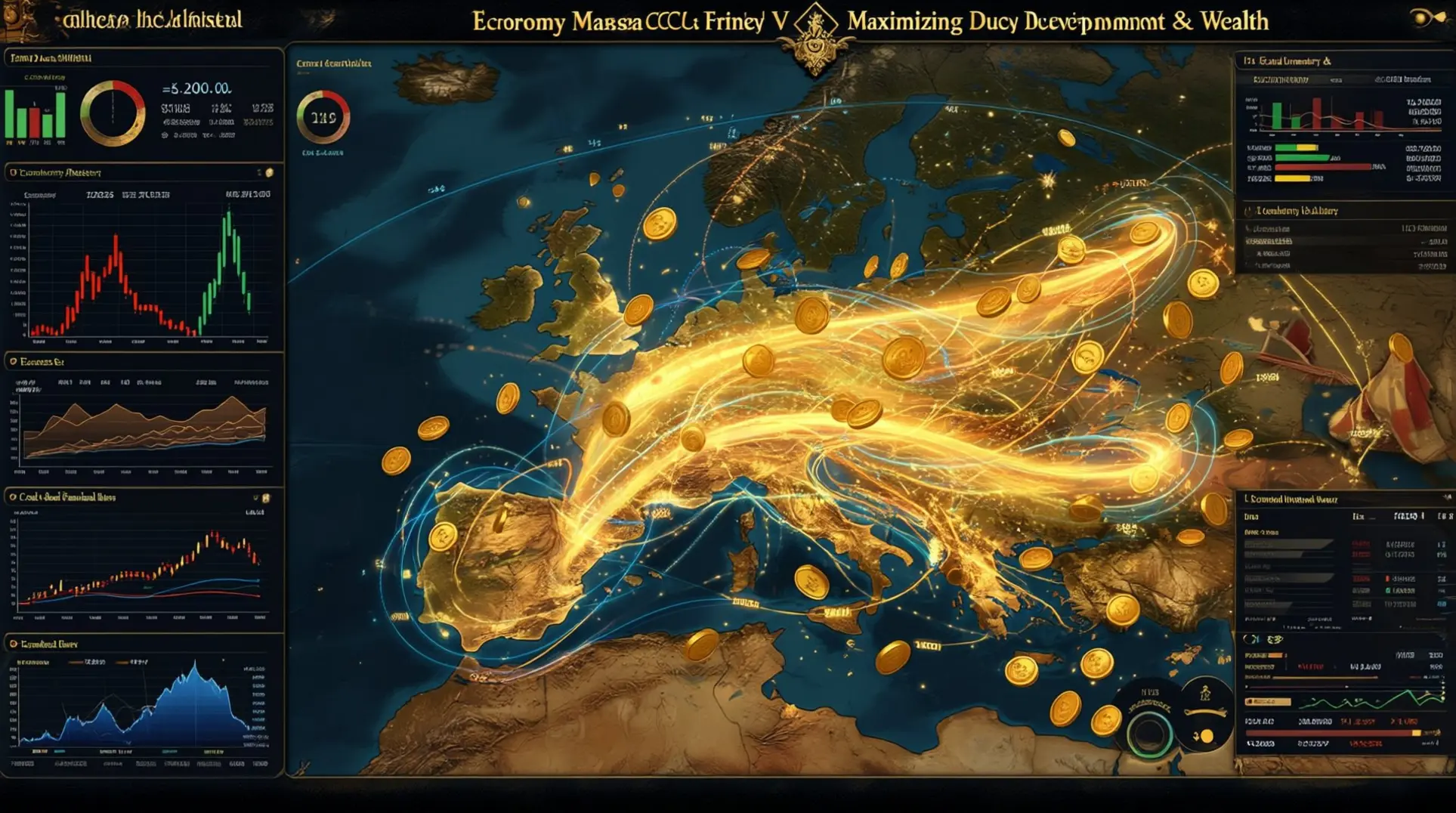
Understanding EU5's Economic Pillars
Taxation Mechanics
Taxation in EU5 revolves around a straightforward calculation that determines your income from each province. The Tax Base is calculated from the combined profits of Rural Buildings (RGOs) and Urban Buildings, multiplied by your Tax Efficiency Modifiers.
Tax Base Formula: Tax Base = (RGO Profit + Urban Building Profit) * (1 + Tax Efficiency Modifiers). This means your base profits get scaled up based on how efficient your tax collection system is.
Provincial Control directly impacts how much tax you actually collect. A province at 100% control provides the full calculated tax base, while lower control applies a direct penalty (for example, 50% control means you only collect 50% of the tax base).
RGO profits come from the type and quantity of goods produced, such as Grain or Iron, combined with their current market price. Urban Building profits from structures like Workshops and Manufactories add to this base, with higher-level buildings contributing greater profits.
You can increase your Tax Efficiency Modifiers through technologies, ideas, and estate privileges. These act as a multiplier on your base tax calculation, allowing you to extract more wealth from the same economic output.
Production Income
Production generates wealth by having your population staff RGOs and buildings to create goods sold on the market. Your Tax Base is essentially the combined profit of RGOs and buildings selling their goods, plus Burghers activities.
RGO (Rural Goods Produced): Profit is determined by the type and quantity of goods produced and their market price, contributing directly to the provincial tax base. Effective Supply in the market is calculated as: Effective Supply = Domestic RGO Production + Common Goods + Manual Import * 0.5.
Goods are sold in the Market, and prices are influenced by broader market dynamics rather than fixed values. This means your production income depends heavily on market fluctuations and supply/demand conditions.
High-demand goods create higher profit margins, so focusing production on what the market needs will maximize your income. Population assignment to RGOs and buildings directly drives this production engine.
Trade System Deep Dive
The trade system operates through nodes with limited capacity for imports and exports. Trade Capacity in EU5 is determined by the number of Merchants assigned to a trade node and the level of trade buildings constructed in provinces within that node.
Market Access is calculated based on the distance from a province to the nearest trade node and the infrastructure level of that province. Higher infrastructure provides better market access, making trade more efficient.
You can optimize trade routes by focusing on nodes with high trade value and ensuring sufficient trade capacity through strategic merchant placement and building construction. This allows you to maximize the price gap between origin and destination markets.
Trade Power in a node is influenced by the population and production of goods in upstream nodes, creating a cascading effect on trade value throughout the network. Building trade structures like Trade Posts and Marketplaces increases both your trade capacity and trade power in a node, giving you better control and more income from trade routes.
Population as Your Economic Engine
Workforce Management
Production efficiency in RGOs (Rural Goods Produced) is directly tied to the number of Peasant pops working in them. Insufficient peasants lead to lower output. Urban Buildings require Burgher pops to be staffed. A building without enough Burghers will operate at reduced efficiency, lowering its profit contribution.
- Peasant pops: Directly staff RGOs; shortages reduce production output
- Burgher pops: Required for Urban Buildings; insufficient numbers decrease building efficiency and profits
- Clergy pops: Do not directly staff production buildings but contribute to tax efficiency and stability, indirectly affecting overall economic output
The 'Staffing' tab in the province interface shows the current workforce allocation. It highlights any staffing shortages in RGOs or Urban Buildings. Promoting pops from Peasants to Burghers can help staff Urban Buildings. This reduces the workforce available for RGOs, creating a trade-off.
Basic Needs & Growth Caps
Each pop has basic needs for Food and Housing. If these needs are not met, it causes negative modifiers like reduced population growth and increased unrest. Food is produced by RGOs that generate Grain, Fish, or Livestock. A shortage can lead to starvation, halting population growth and causing devastation.
Housing is provided by Urban Buildings and certain rural buildings. Insufficient housing caps the total population a province can support, limiting economic expansion.
- Food: Essential for pop survival; shortages cause starvation and halt growth
- Housing: Limits total population capacity; insufficient housing stops economic expansion
Population growth is capped by the available housing in a province. Once the housing cap is reached, growth stops until more housing is constructed. Building Granaries increases local food storage. This helps to mitigate temporary food shortages and stabilize population needs during economic expansion.
Strategic Building Optimization
Early Game Building Priority
Early game construction should prioritize economic buildings for maximum return. Marketplace: A building that maximizes trade income in provinces with high-value goods like Cloth, Silk, or Iron.
- Build Marketplaces first in provinces with high-value goods as they provide the cheapest and biggest immediate return.
- Prioritize RGO buildings that produce high-demand goods such as Iron Mines and Grain Farms over luxury goods for stable income.
- Construct basic housing like Town Centers early to prevent population growth caps and support future workforce expansion.
- Build Barracks in provinces with high manpower potential only after economic buildings are established, as economic growth takes priority.
Focus all construction efforts on provinces with high control first. Buildings in low-control provinces provide reduced benefits until control is improved.
Advanced Building Combinations
Strategic synergy between RGOs and production buildings creates powerful supply chains that maximize profitability. Workshop: A production building that adds value to raw materials from RGOs through manufacturing.
- Place Workshops in provinces with high-value RGOs like Iron Mines to create production chains that increase profitability.
- Build Manufactories to process raw materials into finished goods, boosting both tax base and trade value through supply chain synergies.
- Combine Grain RGOs with Breweries to create a food processing chain that generates higher-value goods and increased tax revenue.
- Construct Trade Posts in provinces with both high-value RGOs and production buildings to capture value at multiple points in the supply chain.
Strategic placement of Urban Buildings near complementary RGOs creates regional economic hubs. These hubs benefit from reduced transportation costs and increased market access.
Development Map Mode & Provincial Growth
Terrain-Based Development Limits
Terrain, climate, and vegetation determine the maximum population capacity of a province. This creates hard development caps based on geography. Fertile plains with temperate climates support higher development than deserts or mountains. Development costs are also higher in difficult terrain, imposing resource and time penalties on province growth.
Development Potential: This is calculated from the mix of terrain type, climate conditions, and vegetation density. EU5 provides Terrain Map Mode and Development Map Mode to visualize terrain features and current development ceilings. This aids planning and expansion decisions.
- Infrastructure improvements like road construction can partially mitigate terrain penalties.
- Building upgrades and technological advances can push development beyond typical limits, though at significant cost and with diminishing returns in extreme terrains.
- Terrain assessment is a core early-game activity for prioritizing provinces with favorable terrain.
Settlement Planning Strategy
Settlement upgrades follow a fixed hierarchy from Rural Settlement to Town to City. Each upgrade unlocks new capabilities and serves as a prerequisite for further growth. Upgrading from Rural to Town requires meeting a population threshold, commonly around 5,000 inhabitants. The Town to City upgrade also depends on reaching sufficient population before the option becomes available.
Food supply management is crucial when planning upgrades. Upgrading too many food-producing Rural Settlements to Towns can cause shortages, so many guides recommend establishing only one Town per province initially.
Settlement Hierarchy: Rural Settlement -> Town -> City, with each tier unlocking new capabilities.
- Upgrades are accessed via the Location view in the province when conditions are met.
- Towns and Cities enable advanced buildings like workshops and guilds that drive production and trade growth.
- Upgrading settlements increases provincial control and expands administrative capacity.
Advanced Economic Strategies
Estate Specialization for Profit
The tax base for each province is distributed among the three Estates—Burghers, Nobility, and Clergy—based on the relative population of their pops in that province. Each Estate then pays a portion of that province's tax revenue to your national treasury according to the tax rate you set for them.
Tax Base Distribution: This is the proportional allocation of provincial tax revenue among Estates based on their pop composition.
Burghers specialize in trade and production, and granting them privileges boosts trade efficiency and the output of workshops and manufactories. Nobility control a large share of the tax base, especially in rural provinces, and can be granted exemptions or taxed via the Taille with political tradeoffs. Clergy enhance stability and improve tax collection efficiency in the provinces they influence, which increases effective tax revenue.
- Burghers: Specialize in trade and production; privileges boost trade efficiency and workshop/manufactory output.
- Nobility: Control large tax base shares in rural provinces; can be granted exemptions or taxed via the Taille with political tradeoffs.
- Clergy: Enhance stability and tax collection efficiency, increasing effective tax revenue.
Estate Power: This percentage represents an Estate's political strength in parliament, and high estate power can constrain your ability to pass laws or alter taxes. Granting privileges to an Estate raises its satisfaction and economic impact but increases its political clout. Managing Estates involves balancing privileges, power, and tax policies to maximize crown revenue while maintaining stability and support across the realm. Estates can invest surplus wealth to grow their own budgets, which can indirectly boost national income if managed effectively.
Trade Network Domination
Trade power in a node is influenced by the population and production of goods in upstream nodes, creating a cascading effect on trade value. Controlling key upstream nodes allows you to steer trade value toward your home node, maximizing the income you can collect from the trade network.
Trade Power: This represents your influence in a trade node and is affected by upstream population and production.
Trade capacity is determined by the number of Merchants assigned to a trade node and the level of trade buildings constructed in provinces within that node. Building trade buildings like Trade Posts and Marketplaces increases both trade capacity and trade power in a node, allowing for better control and income from trade routes.
- Trade Posts: Increase trade capacity and power, especially effective in provinces with high-value RGOs and production buildings.
- Marketplaces: Increase trade capacity and trade power in a node.
Trade Capacity: This is determined by Merchants assigned and trade buildings constructed, enabling better node control. Market access is calculated based on the distance from a province to the nearest trade node and the infrastructure level of the province, with higher infrastructure providing better market access.
Market Access: This is calculated based on province distance to trade nodes and infrastructure level. Trade routes can be optimized by focusing on nodes with high trade value and ensuring sufficient trade capacity through merchant placement and building construction. Building Trade Posts in provinces with both high-value RGOs and production buildings maximizes trade income by capturing value at multiple points in the supply chain.
Common Economic Pitfalls & Solutions
Unprofitable Building Recovery
Unprofitable buildings reduce your economic efficiency and profits. Follow this systematic troubleshooting approach to identify and fix root causes.
- Staffing: Check the Staffing tab in the province interface to identify understaffing. Insufficient Peasants for RGOs or Burghers for Urban Buildings causes reduced efficiency and profits.
- Market Access: Verify this for the province. Low market access due to poor infrastructure or distance from trade nodes reduces the ability to sell goods, lowering profits.
- Assess the goods being produced. Buildings producing low-demand goods or goods with low market prices will be less profitable.
- Provincial Control: Check this in the province. Buildings in provinces with low control operate at reduced efficiency, directly impacting profitability.
- Ensure the building has the required input resources. Some production buildings require specific RGO outputs to function properly and generate profits.
- Consider demolishing unprofitable buildings and replacing them with more profitable alternatives, especially if the province lacks the necessary workforce or resources.
Overextension Management
Overextension: A dynamic mechanic representing the administrative strain of governing newly acquired lands, fundamentally different from EU4's fixed land-quantity penalty. It directly ties to pops, estates, and infrastructure rather than just territory size.
High overextension creates multiple economic problems. It impairs tax collection and tariff monetization due to strained bureaucracy, disrupts trade routes, and diminishes mercantilist effectiveness. Population and estates also suffer, decreasing estate loyalty and reducing economic bonuses.
Implement these strategies to manage overextension:
- Bolster infrastructure and administrative capacity in core provinces to better absorb new territories.
- Pursue diplomatic integration through annexation or vassalization for controlled expansion with smaller, steadier overextension spikes.
- Strategically select which provinces to conquer and sectionalize expansion to keep overextension manageable while still growing.
- Prioritize consolidation, infrastructure development, and gradual integration in a disciplined expansion plan to reduce economic collapse risk.
Long-Term Economic Planning
Institutional Synchronization
Institutions originate in specific geographic locations and spread across provinces via multiple channels. Synchronizing economic development with upcoming institutions helps minimize embracement costs.
Embracement Costs: The expenses and challenges associated with adopting new institutions in your provinces.
Natural geographic spread moves to adjacent provinces. Speed is influenced by terrain, infrastructure, and diplomatic relations with neighbors who already have the institution. Trade route propagation allows importing institutions by linking to market centers where the institution exists. This accelerates spread without conquest.
Active Development Spending: Using monarch points to develop provinces can trigger an institution's appearance sooner, at the cost of monarch points and development.
- Build infrastructure such as universities to significantly accelerate institution spread in key provinces and boost absorption capacity.
- Conquer a province containing an origin institution to serve as a rapid accelerator for your own spread, though it carries military and diplomatic risks.
Advanced planning—allocating resources before institutions emerge—helps align embracement with strategic development and industry needs. Ages in EU5 each contain three institutions; understanding their origin and timing is essential to synchronize technology costs and development. Geographic disadvantage can be mitigated by leveraging trade, targeted development, and selective conquest to bring institutions closer to your core regions.
Exponential Growth Strategies
Early investments in infrastructure such as roads and marketplaces create compounding returns by improving market access and trade efficiency over centuries of gameplay. Consistent contributions to development and technology, even small ones, can lead to substantial wealth growth over the long campaign period.
Compounding Returns: Gains that generate additional gains over time, creating exponential growth rather than linear progression.
Building a strong economic foundation early allows for greater investments in armies and technology. This creates a feedback loop where military dominance secures more resources for further economic expansion.
Feedback Loop: A cycle where economic strength enables military and technological investment, which in turn secures more resources for further economic expansion.
Reinvesting economic surpluses into technology research creates a compounding advantage. Being ahead in tech unlocks better units, buildings, and ideas that further boost economic growth.
8-4-3 Rule: Early growth is gradual, but over time, returns generate even more returns, emphasizing the power of early and consistent economic strategies.
Conclusion
Mastering Europa Universalis V's economic system requires understanding the interconnected nature of its core components. The three economic pillars—taxation, production, and trade—work together to create a dynamic system where population management, strategic building placement, and long-term planning determine your empire's prosperity.
Key takeaways include prioritizing marketplaces and high-value RGOs in early game development, managing workforce allocation between peasants and burghers, and synchronizing institutional adoption with economic expansion. By focusing on compounding returns through infrastructure investments and maintaining disciplined expansion strategies to avoid overextension, you can build an economic foundation that supports military dominance and technological advancement throughout your campaign.
The most successful EU5 economies balance immediate profit with long-term growth, leveraging the game's population-driven mechanics to create sustainable wealth that compounds over centuries of gameplay.
More Europa-Universalis-V Guides
Advanced EU5 Colonization Strategy: Build Your Global Empire
Master EU5's sophisticated colonization mechanics with our comprehensive guide to building global empires through strategic range, settler management, and trade optimization.
EU5 Institutions Guide: Mastering Technology Cost & Spread Strategies
Master Europa Universalis V institutions with our complete guide to technology cost penalties, spread mechanics, and the 20% adoption threshold for optimal gameplay.
Europa Universalis V Trade Guide: Mastering Dynamic Markets & Trade Networks
Complete guide to EU5's revolutionary trade system - learn dynamic markets, trade capacity, market access, and advanced strategies for economic dominance in Europa Universalis V.
AI Tactical Companion
Consult with our specialized tactical engine for Europa-Universalis-V to master the meta instantly.