Settlement Layout Mastery: Best City Designs for Maximum Efficiency in Anno 117: Pax Romana
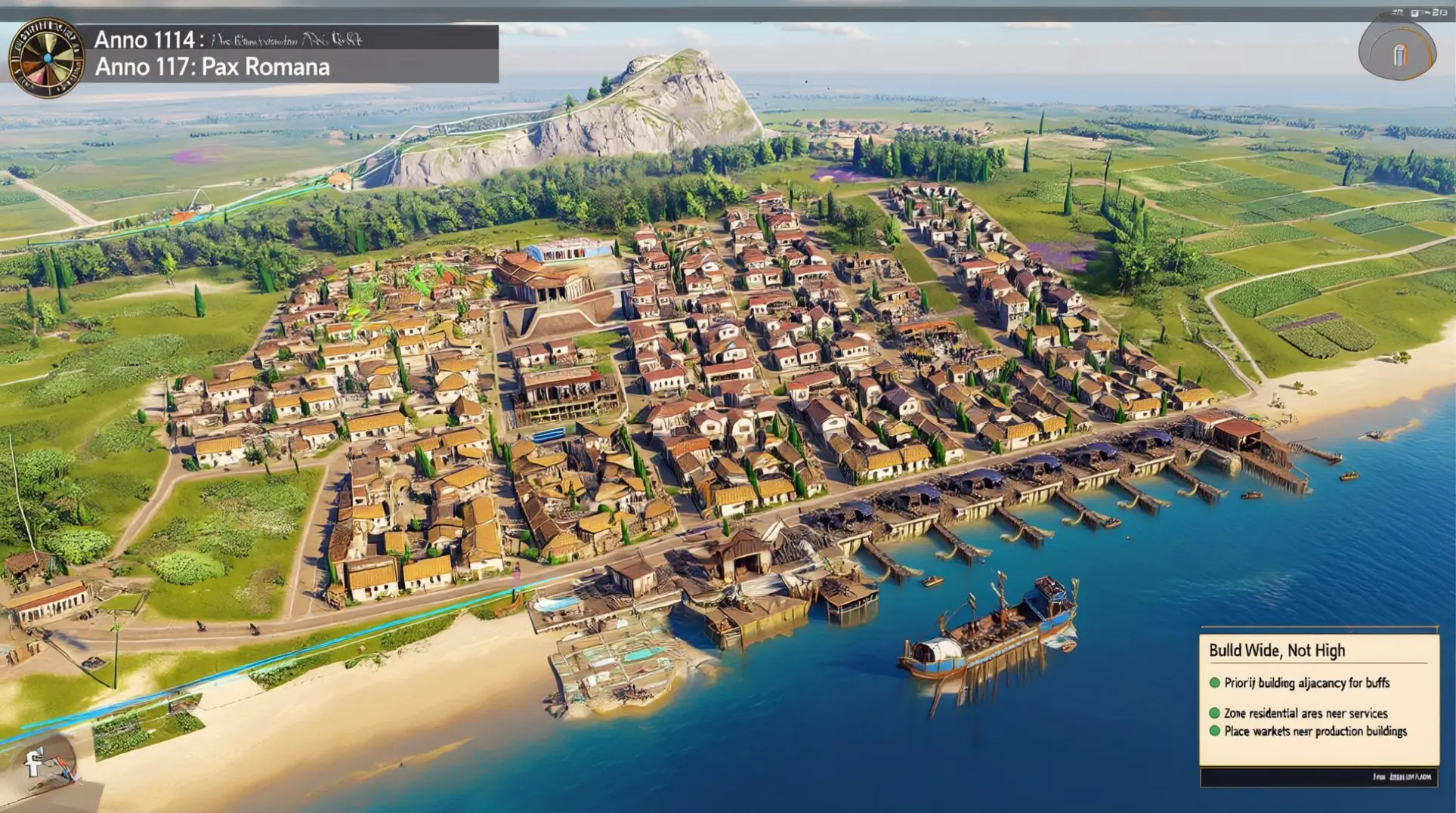
Building an efficient Roman settlement in Anno 117: Pax Romana requires more than just placing buildings randomly. Your city layout directly impacts travel times for citizens and goods, service building effectiveness, and overall economic success. Proper planning from the start prevents costly reorganizations later and ensures your empire can expand smoothly. With new diagonal construction mechanics allowing for more organic designs beyond traditional grids, strategic city planning becomes even more crucial for maximizing efficiency while maintaining historical authenticity.
Foundational Principles of Efficient City Design
Efficiency vs. Symmetry Trade-offs
A perfectly symmetrical city layout can be aesthetically pleasing but often leads to longer travel distances for citizens and goods, reducing overall efficiency. Efficiency-Focused Layouts: These often use a grid or block system, sacrificing perfect symmetry to minimize the distance between production buildings, warehouses, and residential areas.
Service Building Coverage: Placing service buildings like Bathhouses in a perfectly symmetrical pattern can leave gaps in coverage; an efficient layout prioritizes central placement to cover the maximum number of houses, even if it breaks symmetry. Road networks designed for efficiency are often straight and direct, while symmetrical designs might include decorative curves and circles that increase travel time for citizens and carts.
- Travel distance: Symmetrical layouts increase travel distances; efficient layouts minimize them.
- Road networks: Efficient designs use straight roads; symmetrical designs use decorative curves that slow travel.
- Building placement: Grid/block systems reduce distances between key areas.
Expansion Planning Strategies
Hub-and-Spoke Model: A common expansion strategy where you build a central core of essential services and production, then expand outwards in planned blocks to maintain efficient road and supply lines. When expanding, always leave space between your initial residential blocks for future service buildings like Bathhouses and Temples, as their radius of effect is fixed and crucial for citizen happiness.
Plan your industrial zones separately from residential areas from the start, placing them downwind to avoid negative effects on citizen morale as your city grows. Reserve space along your main roads for future warehouse expansions; a single, centrally located warehouse can become a bottleneck as production chains grow more complex.
- Leave space between residential blocks for future service buildings.
- Separate industrial zones from residential areas and place them downwind.
- Reserve main road space for warehouse expansions.
Regional Layout Considerations
In the Latium region, the landscape is more forgiving with large, inviting islands, allowing for a classic Anno city layout with expansive farming and industrial districts. Albion is characterized by a wetter landscape compared to Latium, which influences the placement of buildings and road networks from the start.
Building in the marshlands of Albion requires integrating and preserving marshland areas into your city layout, as many key Celtic production buildings can only be placed there. Celtic Strategy: A purely Celtic strategy in Albion makes you heavily reliant on buildings that can only be constructed within marshlands, dictating your city's geographical expansion. Romanization Path: This alternative approach shifts building requirements away from marshlands, allowing for a more conventional city layout focused on Roman resource chains.
- Latium's forgiving islands enable expansive farming and industrial districts.
- Albion's marshlands demand integration of Celtic buildings that can only be placed in those areas.
- Choosing a Celtic strategy makes your expansion dependent on marshland availability.
- The Romanization path frees you from marshland constraints for a more traditional layout.
The Ultimate Latium Layout Strategy
Central Core Design Principles
Diagonal roads: In Latium, implement diagonal roads to create a flexible central core that minimizes travel distances between farms, workshops, and residential blocks. Take advantage of Latium's forgiving terrain by designing a semi-regular core that leverages diagonals to fit more production and housing while allowing straightforward expansion.
Establish a central production hub early in Latium by tightly clustering primary resource-gathering buildings, their processing facilities, and warehouses to shorten production chains. Apply zoning that keeps residential areas near the core but separates them from industrial zones; use diagonal connectivity to maintain efficient traffic without sacrificing happiness.
Place central Bathhouses and Temples to maximize their radii of influence, ensuring service coverage without fragmenting the core.
Production and Housing Integration
Production-housing integration: In Latium, integrate housing directly adjacent to production areas by using diagonal road layouts to minimize travel time for workers while keeping industrial zones slightly separated to avoid negative effects on citizen morale.
Place residential blocks in a ring around a central production hub to ensure workers have short commutes, but avoid placing homes directly next to high-pollution buildings like smelters.
Warehouse buffers: Use warehouses as buffers between housing and heavy industry; this keeps goods accessible to both production and residential needs without direct exposure to industrial negatives. Design production chains so that final goods are produced near residential areas, reducing the distance luxury items need to travel to reach homes and satisfy citizen needs.
Strategic Building Placement and Zoning
Residential Zone Optimization
A highly effective strategy involves designing your initial settlement around a centralized service core. Place critical buildings like markets in the center of a residential grid to maximize service coverage for all citizen homes.
Start with 10 Libertus Residences arranged in a grid pattern. Deliberately leave space in the center for essential buildings like Taverns and Markets to maximize their radius of influence.
- Place the Tavern and Market at the heart of the residential area
- Save the middle zone specifically for non-house buildings
- Rotate service buildings to match the six-tile height of surrounding houses
For late-game development, a Villa-centered layout using 2×3 housing blocks creates clean, functional districts. This advanced strategy requires paved roads and all civic technologies to implement properly.
Industrial and Production Zoning
Industrial buildings like Smelters and Tanneries should be placed downwind from residential areas. This placement minimizes negative effects on citizen happiness while maintaining production efficiency.
Group related production buildings together in dedicated industrial zones. This creates efficient production chains and reduces transportation time between facilities.
- Use warehouses as central hubs within industrial zones
- Position warehouses to collect and distribute goods between production buildings and residential areas
- Separate heavy industry from residential zones using natural barriers or dedicated buffer zones
Service Building Coverage Strategies
Place Bathhouses and Temples centrally within residential blocks to maximize their radius of effect. This ensures they cover the maximum number of citizen homes efficiently.
Use a grid layout for residential areas with service buildings positioned at intersections or central points. This provides optimal coverage for surrounding housing while maintaining organization.
Scannability: The practice of formatting content to be easily scanned by users.
- Rotate Taverns and Markets to match the six-tile height of surrounding houses
- Create standardized blocks that maximize service coverage efficiency
- Plan service building placement early by leaving designated spaces in the center of residential zones
In Latium, design residential areas with a central core specifically reserved for Taverns and Markets. This ensures complete coverage of surrounding housing blocks and prevents costly redesigns later.
Advanced Layout Techniques for 2025
Organic City Design Approaches
Diagonal roads in Anno 117: Pax Romana allow building placement at 45-degree angles, enabling organic city layouts that blend with the landscape. This diagonal construction system lets settlements curve around geographical features like coastlines, hills, and marshlands.
Diagonal Construction: The system enabling 45-degree building placement and curved road networks that adapt to terrain.
The diagonal-road update represents a major shift from rigid grids, delivering both aesthetic appeal and practical benefits in pathing and build placement. Diagonal layouts can create pockets within a city, breaking the monotony of uniform blocks while preserving connectivity and efficiency.
- Place buildings at 45-degree angles for more natural layouts
- Curve roads around coastlines, hills, and marshlands
- Create city pockets to break up uniform blocks
- Maintain optimal connectivity between production, housing, and services
Although aesthetically organic, diagonal road and building placement remains designed to preserve efficiency and connectivity. This ensures roads still optimally link production, housing, and services.
Population Management Integration
In Latium, a layout strategy involves placing Plebeian housing blocks directly adjacent to production areas to minimize worker travel time. Higher-tier Patrician housing is reserved for more scenic, central areas.
Class-Based Zoning: The practice of separating residential areas by citizen class to optimize workforce distribution and service access.
A key strategy is to design residential zones with a central core for service buildings, ensuring all citizen classes have access to essential services like Bathhouses and Temples. Higher-tier citizen classes like Patricians require more luxury goods and have a larger influence radius for service buildings.
- Position Plebeian housing near production workplaces to reduce travel time
- Place Patricians in centrally-located areas with better amenities
- Provide central service cores with Bathhouses and Temples for all classes
- Account for Patricians' larger influence radius and luxury goods requirements
Balance your population by zoning separate residential areas for different classes. This ensures Plebeians are near workplaces while Patricians are in areas with better access to advanced services and amenities.
Economic and Diplomatic Considerations
Efficient city layouts that maximize production of goods like Olive Oil and Wine are crucial for establishing profitable trade routes with other factions. Your city's ability to produce surplus goods efficiently directly impacts your diplomatic standing.
Surplus Production: The efficient creation of excess goods for trade agreements and diplomatic gifts.
A well-designed city with high citizen satisfaction produces more tax revenue, providing the financial foundation for military and diplomatic endeavors. Strategic placement of military buildings like Castra within your city layout is essential for defense against rival factions and barbarian incursions.
- Maximize Olive Oil and Wine production for profitable trade routes
- Generate high citizen satisfaction to increase tax revenue
- Position Castra and military buildings strategically for defense
- Use surplus goods as gifts or in trade agreements to improve relations
Common Layout Mistakes to Avoid
Early-Game Planning Errors
A common early-game mistake is rushing to upgrade Tier 1 homes. This introduces complex needs your fledgling economy cannot yet support.
Tier 1 (Libertus) Homes: Upgrading these prematurely creates demands your production cannot satisfy.
Building too many houses too quickly without first establishing stable production for basic goods leads to unmet needs and citizen dissatisfaction. Failing to plan a scalable grid layout from the start creates long-term problems with traffic, logistics, and future expansion.
- Haphazard placement of roads and buildings without a modular system makes the city difficult to expand efficiently later on.
- Constructing extensive aqueduct systems too early consumes valuable resources and space before your city's economy truly needs them.
Mid-Game Optimization Challenges
Mid-game challenges include managing complex production chains that require goods from multiple islands. This necessitates efficient inter-island trade routes.
Inter-Island Trade: Planning efficient routes between islands is essential as production chains grow more complex.
As cities expand, maintaining citizen happiness becomes more difficult due to increased needs and the negative effects of industrial buildings on residential areas. Traffic congestion also emerges as a major struggle when production chains become more complex and require more transportation between buildings.
Space management becomes critical in mid-game. Players need to balance residential expansion with industrial growth while maintaining service coverage.
- Careful planning of warehouse placement and road networks is needed to handle increased goods transportation between production facilities and residential areas.
Mastering city layout in Anno 117: Pax Romana requires balancing efficiency with adaptability. The most successful designs prioritize practical considerations like service building coverage and production chain optimization over perfect symmetry. Whether you're building in the forgiving terrain of Latium or the challenging marshlands of Albion, the key principles remain the same: plan for expansion, separate industrial zones, and create modular layouts that can scale with your empire. Remember that the best city designs are those that can evolve with your growing settlement while maintaining efficient resource flow and citizen satisfaction. By applying these strategies, you'll build Roman cities that are not only prosperous but also resilient enough to withstand the challenges of empire-building.
More Anno-117-Pax-Romana Guides
Anno 117 Pax Romana: Ultimate Tier 4 Patrician Endgame Strategy Guide
Master advanced strategies for Tier 4 Patrician gameplay in Anno 117 Pax Romana. Learn economic optimization, military tactics, political influence, and city planning for endgame success.
Anno 117 Pax Romana: Complete War Types Guide - Limited War vs All-Out War Strategies
Master war dynamics in Anno 117 Pax Romana with a complete guide to Limited War vs All-Out War, blending diplomacy, economy, and strategic maneuvering.
Anno 117: Pax Romana Perfect Production Ratios Guide
Master Anno 117 production ratios with our complete guide. Learn optimal building ratios for Latium, Albion, and military production chains to maximize efficiency.
AI Tactical Companion
Consult with our specialized tactical engine for Anno-117-Pax-Romana to master the meta instantly.