AOC
AOC Q27GAZD Review
Good
$349.99
The cheapest complete QD-OLED gaming experience you can buy: third-gen Samsung panel contrast, 0.03ms response, and 240Hz clarity at $349.99, with honest cuts (tilt-only stand, no USB) that never touch the panel. 8.4/10.
As an Amazon Associate we earn from qualifying purchases made through links for AOC Q27GAZD.
panel
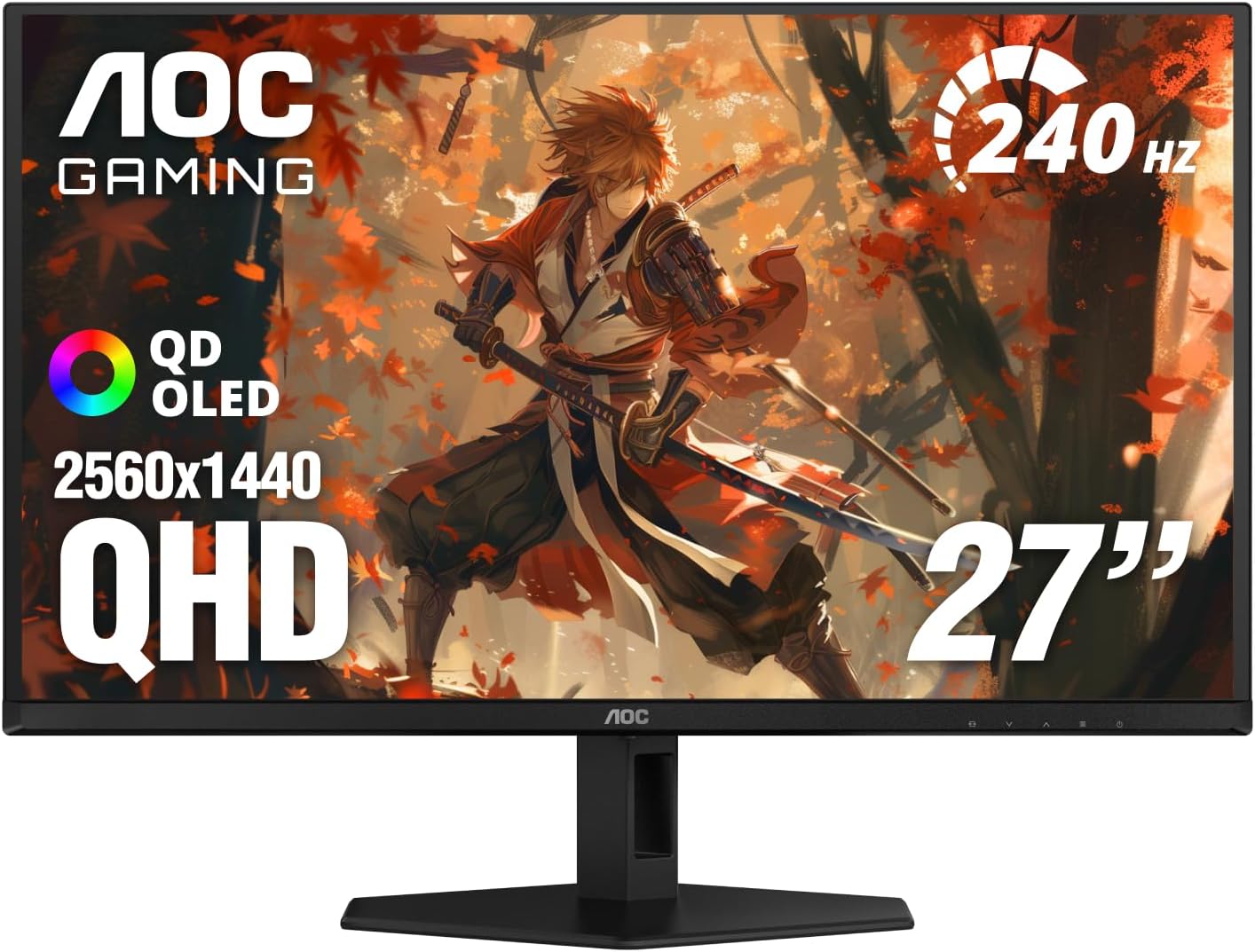
27-inch (26.5-viewable) QD-OLED (3rd gen Samsung), flat, matte anti-glare
resolution
2560x1440 (QHD), ~109 PPI
refresh_rate
240Hz
response_time
0.03ms GtG
Pros & Cons
Pros
- Cheapest credible third-gen Samsung QD-OLED on the market at $349.99 — undercuts panel-class rivals by $120-480
- True OLED fundamentals with no asterisks: 1.5M:1 contrast, 0.03ms GtG, per-pixel motion clarity no LCD matches
- 240Hz with G-Sync Compatible + Adaptive-Sync VRR over DP 1.4 (DSC) and HDMI 2.0
- 10-bit color with 99% DCI-P3 quantum-dot saturation — the best color at $350
- Matte anti-glare finish, rare on QD-OLED, genuinely usable in bright rooms
- 4.5/5 across ~250 Amazon ratings with 78% five-star — strongest owner consensus in our monitor pool
- 3-year warranty with AOC's zero-bright-dot policy
- 3.5mm headphone out and light 4.11kg VESA-100 panel that mounts anywhere
Cons
- Tilt-only stand: no height, swivel, or pivot — budget for a monitor arm
- No USB hub at all (no downstream ports, no USB-C)
- Single HDMI 2.0 port caps consoles at 1440p/120 and limits multi-device setups
- Modest brightness (200 nits SDR / 400 nits HDR peak at 10% APL) — dim-room panel, not an HDR showcase
- No Dolby Vision or DisplayHDR True Black certification on this SKU
- HDR color slightly undersaturated per panel-family testing (Tom's Hardware, Q27G4ZD)
- 109 PPI text sharpness merely adequate next to 4K rivals
- No dedicated press reviews of this exact SKU — coverage is of the $469 Q27G4ZD sibling
Overview
QD-OLED has spent three years as a $700-1,000 proposition. The AOC Q27GAZD is part of the wave that finally breaks that floor: a 27-inch, 1440p, 240Hz quantum-dot OLED currently selling for $349.99 on Amazon (AOC lists it "from $379.99"), which puts genuine third-generation Samsung QD-OLED panel technology in budget-mini-LED territory. For context, Tom's Hardware reviewed the very similar AOC Q27G4ZD — same panel class, same 240Hz, Agon trim — at $469 and titled the review "reasonably priced." The Q27GAZD undercuts that by $120 while carrying the same core display fundamentals.
Let's be precise about what this is, because AOC's naming is a maze. The Q27GAZD sits in the mainstream AOC GAMING line (not the premium AGON Pro line). It's the flat, matte-finish sibling of the Q27G4ZD family: 26.5-27" third-gen Samsung QD-OLED, 2560x1440, 240Hz, 0.03ms GtG, 10-bit color with 99% DCI-P3 coverage (CIE 1976, typical), HDR with ~400 nits peak on a 10% APL window, G-Sync Compatible and Adaptive-Sync VRR, and a 3-year warranty. Press coverage of the panel family has been strong — Tom's Hardware gave the Q27G4ZD 4/5 — and the owner consensus on the Q27GAZD itself runs warm: 4.5 stars across roughly 250 Amazon ratings, with 78% five-star and a histogram that leans emphatically positive.
The pitch is simple and it's the reason this monitor exists: if what you want from OLED is the contrast, the response time, and the per-pixel motion clarity — and you don't need 4K density or 1000-nit HDR peaks — this is the cheapest credible ticket currently on sale.
Design and Build
The Q27GAZD presents like a budget monitor that doesn't feel budget. The cabinet is matte black plastic with a 3-sided frameless bezel design (8mm-class borders that visually vanish against dark content), a slim 57mm panel depth without the stand, and a compact fixed-function stand. At 4.96kg with the stand (4.11kg without), it's lighter than the Alienware AW2725Q's 6.8kg, and it VESA-mounts cleanly at 100x100 if the included stand doesn't suit.
That stand is the first place the price shows: it tilts (-3° to +21.5°) and that's it. No height adjustment, no swivel, no pivot. AOC's spec sheet lists tilt under "Ergonomic information" and then simply stops. If your desk setup needs the panel higher, budget for a monitor arm or a VESA stand — the 100x100 mount and the lightweight panel make that a cheap and easy fix, but it's an add-on you should plan rather than discover.
Connectivity is honest for the tier: one DisplayPort 1.4 (with DSC, HDCP 2.3), one HDMI 2.0, and a 3.5mm headphone output. Notably, there is no USB hub at all — no downstream ports, no USB-C. The Q27G4ZD that Tom's Hardware reviewed at $469 has "1 up, 4 down" USB; the Q27GAZD spends that budget on the panel instead. If you route keyboard/mouse/audio through your monitor, this isn't that machine. The headphone jack is genuinely welcome, though — the more expensive Alienware AW2725Q doesn't have one.
The finish is matte anti-glare per AOC's spec ("Panel treatment: Antiglare (AG)"), which is worth pausing on. Most QD-OLEDs ship glossy, which pops contrast in dark rooms but turns into a mirror in bright ones. A matte QD-OLED at this price is a real differentiator for desk placements near windows — you trade a little "wow" sparkle for day-to-day usability, and for most budget buyers that's the right trade. One Amazon reviewer specifically praised the finish; RTINGS' testing of this panel class notes black levels rise in bright rooms on glossy QD-OLED, which the AG treatment mitigates.
Image Quality
The heart of the monitor is the third-generation Samsung QD-OLED panel, and it delivers the two headline numbers that matter: a 1.5M:1 static contrast ratio (functionally infinite next to the 3,000-4,000:1 of any LCD) and self-lit pixels that switch in 0.03ms. What that means in practice: blacks are black with the lights off, HDR highlights sit next to genuinely dark darks, and there is no visible ghosting, smear, or inverse-ghosting at any refresh rate — the motion-clarity advantage that makes OLED the competitive-gaming panel of record.
Brightness is where budget QD-OLED tells the truth. AOC specs 200 nits SDR (typical, full white) and 400 nits HDR peak (typical, 10% APL). Those are modest numbers next to the AW2725Q's 250/1,000 — this panel is not trying to be a HDR showcase, and its HDR10 implementation (VESA isn't certifying it True Black 400 on this SKU) is best understood as "wider contrast range" rather than " HDR spectacle." In a normal or dim room, SDR content looks excellent. In a sunlit room, expect to run brightness near max. The glossy-vs-matte question above matters more than the raw nit count here.
Color is a strength: 10-bit depth (1.07 billion colors), 99% DCI-P3 coverage typical (CIE 1976), with the quantum-dot layer doing the saturation work. Tom's Hardware's measurements of the same panel family in the Q27G4ZD found accurate SDR color without calibration and only slight HDR undersaturation — characteristic of this panel generation rather than this specific SKU, and the kind of flaw a firmware update can address. For a $350 gaming monitor, color performance sits comfortably above anything LCD at the price.
The 1440p-at-27-inch resolution is the pragmatic choice for this tier. At ~109 PPI, text is adequately sharp (not 4K-crisp — see our AW2725Q review for what 166 PPI buys) and, crucially, a mid-range GPU can actually drive 1440p at 240Hz. That's the entire point of this product: 4K/240 requires a $700+ graphics card to feed; 1440p/240 is reachable with a $350-450 GPU. Buying OLED motion clarity you can actually saturate beats buying pixel density you can't.
Gaming Performance
240Hz, 0.03ms GtG, VRR on both ecosystems — this is the complete OLED gaming fundamental set at one-third the flagship price. There's no response-time mode matrix to tune; per-pixel emission means the panel's motion behavior is effectively perfect out of the box, which is precisely why every specialist reviewer (RTINGS included, on this panel family) describes OLED motion in absolutes: no overshoot, no dark-level smear, full clarity at high frame rates.
VRR support is G-Sync Compatible certified plus Adaptive-Sync/FreeSync over both DP 1.4 and HDMI 2.0. Console note: the single HDMI 2.0 port means PS5/Xbox caps at 1440p/120Hz rather than 4K/120 — fine, since the panel is 1440p anyway, but it's a one-console-port household unless you add a DP device on the side.
AOC's gaming OSD carries the family feature set: Shadow Control (black-level lift for spotting campers in dark corners), Game Color presets, Dial Point (custom crosshair overlay for games that lack one), Sniper Scope, frame-counter and low-input-lag modes, plus PbP/PiP for dual sources. None of it matches Alienware's AlienVision editor for depth, but Shadow Control and Dial Point are the two competitive tools that actually get used, and both are here. Flicker-Free and AOC's Low Blue Mode round out the comfort features.
Panel care follows the standard modern QD-OLED playbook: automated pixel-refresh routines run on idle, and AOC covers the panel with a 3-year warranty — with AOC's trademark zero-bright-dot policy on this line (the Amazon listing title advertises it explicitly: "3-Year Warranty" and AOC's ZBD promise appears across the Q27G4 family). Burn-in anxiety for a 1440p gaming/competitive use case is low; static desktop UI all day every day is the pattern to avoid on any OLED.
Sound
No speakers — normal at this price, and matching monitors costing $450 more (the AW2725Q omits them too). The 3.5mm headphone output on the rear handles audio routing, which at this tier counts as a plus; budget monitors that omit even that are common.
Pros and Cons
Pros:
- Cheapest credible third-gen Samsung QD-OLED on the market at $349.99 street — undercuts the panel-class competition (AOC Q27G4ZD $469, MSI MAG 272QP X50 ~$750, Alienware AW2725Q ~$830) by $120-480
- True OLED fundamentals with no asterisks: infinite-class 1.5M:1 contrast, 0.03ms GtG, per-pixel motion clarity that no LCD at any price matches
- 240Hz with G-Sync Compatible + Adaptive-Sync VRR over DP 1.4 (DSC) and HDMI 2.0
- 10-bit color with 99% DCI-P3 (typ.) quantum-dot saturation — comfortably the best color at $350
- Matte anti-glare finish, rare on QD-OLED, makes it genuinely usable in bright rooms where glossy rivals wash out
- 4.5/5 across ~250 Amazon ratings with 78% five-star — owner consensus matches the panel's quality
- 3-year warranty with AOC's zero-bright-dot policy
- 3.5mm headphone out; VESA 100x100 with a light 4.11kg panel that mounts anywhere
- 1440p is the honest resolution for mid-range GPUs — 240Hz you can actually feed
Cons:
- Tilt-only stand: no height, swivel, or pivot — budget for a $25 monitor arm
- No USB hub at all (no downstream ports, no USB-C) — keyboard/mouse/audio route to the PC directly
- Single HDMI 2.0 port caps consoles at 1440p/120 and limits simultaneous console+PC hookup
- Modest brightness (200 nits SDR / 400 nits HDR peak at 10% APL) — a dim-room panel, not an HDR showcase; no Dolby Vision, no DisplayHDR True Black certification on this SKU
- HDR color slightly undersaturated per panel-family testing (Tom's Hardware, Q27G4ZD); no variable-brightness SDR mode
- 109 PPI text sharpness is merely adequate next to 4K rivals — visible if you're coming from a 27" 4K panel
- No press reviews of this exact SKU yet (coverage is of the Q27G4ZD sibling at $469) — you're buying on panel-family evidence + owner consensus
- AOC firmware/OSD polish trails Dell/ASUS; G-menu organization is functional, not elegant
Who Should Buy This
Buy the Q27GAZD if you've been waiting for OLED to get cheap and you game at 1440p. This is the monitor for the RTX 4060 Ti / RX 7700 XT / 4070-class builder who wants OLED motion clarity and contrast without the $700+ tariff or the 4K GPU burden — and the matte finish makes it the rare budget OLED that works in a bright dorm or office-adjacent room. Competitive players (Valorant, CS2, Fortnite at high frames) get the full 240Hz OLED advantage for less than many 180Hz IPS monitors cost. It's also the logical "first OLED" for a teen battlestation where the zero-bright-dot 3-year warranty quietly matters.
Skip it if you need HDR spectacle (the 400-nit peak and uncertified HDR10 are contrast-range HDR, not highlight HDR — the AOC Q27G3XMN mini-LED at ~$250 does brighter HDR for less), if you want a monitor hub (zero USB ports), if you need ergonomic adjustment without buying an arm, or if you're pairing with a PS5 as your only device and want more than one HDMI port.
Alternatives to Consider
- AOC Q27G3XMN (~$250): Our 8.5-rated budget champion. 336-zone mini-LED, 1,200+ nits real HDR brightness, 180Hz VA. Brighter HDR, no burn-in worry, $100 less — but VA response times and blooming can't match OLED motion. The brightness-first alternative.
- Alienware AW2725Q (~$830): Our 8.3-rated 4K flagship. Same QD-OLED generation at 4K/240 with Dolby Vision and 1,000-nit peaks, plus the full ergonomic stand and USB hub. If budget stretches and your GPU is beefy, it's the upgrade path.
- MSI MAG 272QP QD-OLED X50 (~$750): Our 8.8-rated 1440p/240 QD-OLED. Richer feature set (KVM-class USB, better OSD) on the same panel fundamentals — if it's on sale near $550-600, the gap narrows to worth-it.
- LG UltraGear OLED 27GX790A-B (~$550 street): Our 8.9 top monitor pick. 480Hz W-OLED, brighter full-screen behavior, matte finish. The competitive player with a bigger budget.
- AOC Q27G4ZD (~$469): The same panel in Agon trim with USB hub and Tom's Hardware's 4/5 — if the Q27GAZD sells out, it's the fallback at $120 more.
Verdict
The Q27GAZD does one thing and does it without apology: it puts a genuine third-generation Samsung QD-OLED panel — the same contrast, the same 0.03ms response, the same 240Hz motion clarity that flagships charge $800+ for — into a $349.99 box. Everything AOC cut to get there is visible and honest: a tilt-only stand, zero USB ports, one HDMI, modest brightness, and an HDR implementation that's about range rather than spectacle. Nothing cut touches the core experience of playing games on OLED.
Against our own scale, that puts it in interesting company. The MSI MAG 272QP X50 (8.8) and LG 27GX790A-B (8.9) are better monitors, full stop — but they cost 2x and ask whether their extras are worth $200-400 to you. The Alienware AW2725Q (8.3) is a more magical panel held back by a rough owner-reliability record. The Q27GAZD's 4.5-star owner consensus across ~250 ratings is the strongest community signal in our current monitor pool, and the zero-bright-dot 3-year warranty removes the classic budget-OLED fear.
8.4/10 — Excellent. The cheapest complete QD-OLED gaming experience you can buy today, executed without corners on the panel itself. Buy it for the contrast and motion at 1440p; add a $25 arm; spend the $400 you saved on the GPU that feeds it.
What the Experts Say
Professional review consensus for this product
Full Specifications
| panel | 27-inch (26.5-viewable) QD-OLED (3rd gen Samsung), flat, matte anti-glare |
|---|---|
| resolution | 2560x1440 (QHD), ~109 PPI |
| refresh_rate | 240Hz |
| response_time | 0.03ms GtG |
| brightness | 200 nits SDR (typ.) / 400 nits HDR (typ., 10% APL) |
| contrast | 1.5M:1 static |
| color | 10-bit (1.07B), 99% DCI-P3 (CIE 1976, typ.) |
| hdr | HDR10 (HDR Ready) |
| vrr | NVIDIA G-Sync Compatible, Adaptive Sync |
| ports | 1x DP 1.4 (DSC, HDCP 2.3), 1x HDMI 2.0, 1x 3.5mm audio out |
| stand | Tilt only (-3° to +21.5°), VESA 100x100 |
| dimensions | 609.3 x 454.3 x 192.2mm (WxHxD with base); 57mm panel depth |
| weight | 4.96kg with stand / 4.11kg without |
| audio | No speakers; 3.5mm headphone out |
| warranty | 3 years, zero-bright-dot policy |
The Verdict: Good
The cheapest complete QD-OLED gaming experience you can buy: third-gen Samsung panel contrast, 0.03ms response, and 240Hz clarity at $349.99, with honest cuts (tilt-only stand, no USB) that never touch the panel. 8.4/10.
— GamepadSquire, October 2026
As an Amazon Associate we earn from qualifying purchases made through links for AOC Q27GAZD.
Related Buying Guide
Buying Guide
Best Gaming Monitors Under $300 (2026): Real HDR, High Refresh, and the Traps to Avoid
The sub-$300 monitor market in 2026 is led by the AOC Q27G3XMN mini-LED (the only real HDR at the price), the Alienware AW2726DM QD-OLED that broke the OLED floor at $350, the 300Hz MSI MAG 274QPF X30MV, and the 32-inch AW3225DM — plus the edge-lit HDR400, 27-inch 1080p, and budget-4K traps to avoid.
Buying Guide
Best OLED Gaming Monitors 2026: 4K, 1440p, and the 480Hz Question
The full 2026 OLED range in one decision tree: the $350 AW2726DM entry point, the AW2725D value sweet spot, LG 27GX790A-B 480Hz with DP 2.1, ASUS PG27AQDP premium 480Hz, MSI 500Hz esports, the AW3225QF 4K value flagship, and RTINGS-top-ranked PG32UCDM Gen3 — with QD-OLED vs W-OLED, burn-in, and text-fringing answers.


