Lenovo
Lenovo Legion Go 2 Review
Good
$1199.00
As hardware, the Legion Go 2 is the most complete Windows handheld ever made — a stunning 8.8-inch 144Hz OLED, drift-proof Hall-effect sticks, modular detachable controllers, and Z2 Extreme power. Owners overwhelmingly love it; the only real argument against it is the price, with RAM-shortage inflation pushing the flagship config to $1,999.99. If you can afford it, there is nothing else like it; if you can wait for a sale or the $1,199 SteamOS edition, you will be buying the same great hardware for sensible money. 7.8/10.
As an Amazon Associate we earn from qualifying purchases made through links for Lenovo Legion Go 2.
processor
AMD Ryzen Z2 Extreme (8C/16T: 3x Zen 5 @ 5.0GHz + 5x Zen 5c @ 3.3GHz, 15-35W cTDP) or Ryzen Z2
gpu
AMD Radeon 890M (RDNA 3.5, 16 CUs)
display
8.8-inch 1920x1200 OLED, 144Hz, VRR, HDR, touch, 445 nits SDR / 623 nits HDR
memory
16GB or 32GB LPDDR5X-8000 (soldered)
Pros & Cons
Pros
- Best-in-class 8.8-inch OLED: 144Hz, VRR, HDR, class-leading color accuracy (0.28 Delta-E) and gamut (191.7% sRGB, 135.8% DCI-P3 per Tom's Guide)
- Hall-effect joysticks eliminate drift; redesigned grips and pivot D-pad are the most comfortable Legion controls yet
- Unmatched versatility: detachable TrueStrike controllers, kickstand tabletop mode, FPS mouse mode, dual USB4 for docking
- 32GB LPDDR5X + Ryzen Z2 Extreme delivers strong 800p frame rates and handles VRAM-hungry modern titles
- Windows Hello fingerprint login, microSD expansion, 74Wh battery that stretches past 5 hours in efficiency mode
- Legion Space quick-settings overlay is the most responsive on any Windows handheld
Cons
- RAM-shortage price inflation: Z2 Extreme/32GB/1TB now $1,999.99 street (up from $1,349.99 launch); 2TB config reached $2,849
- 920g (2.03 lbs) is the heaviest flagship handheld — long sessions tire hands
- Windows 11 friction: launcher logins, desktop navigation, and Legion Space freezes during in-game remapping
- OLED mura (grain in dark/gray areas) reported by multiple owners on some units
- SSD upgrade requires removing battery and glued-in fan — not user-friendly
- Z2 Extreme gains over Z1 Extreme are modest at 1200p; 2-2.5h gaming battery in demanding titles
Overview
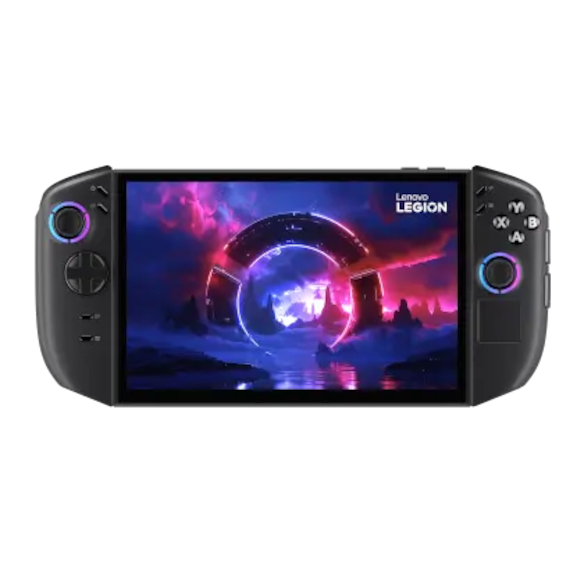
The Lenovo Legion Go 2 is the flagship of the second wave of Windows handheld gaming PCs, and it arrives carrying the biggest swing for the fences in the category. It pairs an 8.8-inch 144Hz OLED panel, the largest and most color-rich display on any handheld from a major manufacturer, with AMD's new Ryzen Z2 Extreme APU, 32GB of LPDDR5X memory, a 74Wh battery, and the detachable Legion TrueStrike controllers that make this the only mainstream handheld with Switch-style modular controls plus a mouse-style FPS mode.
Lenovo launched it in late 2025 at $1,349.99 for the Z2 Extreme / 32GB / 1TB configuration, with a base Z2 / 16GB model at $1,099.99. The 2026 RAM shortage then did what RAM shortages do: by mid-2026 the Z2 Extreme model carried a $1,999.99 street price at major retailers, the 2TB variant hit $2,849, and a SteamOS version of the same hardware was announced at $1,199. That pricing reality now dominates every conversation about this device, including this review, because the hardware underneath is, by near-universal consensus, genuinely excellent.
Community sentiment across r/LegionGo owners is strikingly positive on the device itself: owners describe it as the best handheld they have ever used, praise the screen as sensational, and note it hooks them for longer sessions than far more expensive setups. The consistent refrain is that the hardware delivers, and the price is the only real argument against it. This review is a synthesis of that owner feedback, hands-on press testing, and the spec sheet, what the Legion Go 2 does brilliantly, what will annoy you after purchase, and who should (and shouldn't) pay for it.
Build Quality and Design
The Legion Go 2 is unapologetically large. At 295.6 x 136.7 x 42.25mm with controllers attached and 920g (2.03 lbs) on a scale, it is the biggest and heaviest handheld from any major manufacturer, heavier than the original Legion Go (1.88 lbs), the ROG Ally X (1.49 lbs), and the Steam Deck OLED (1.41 lbs). Press reviewers consistently report feeling that weight immediately, with some ending longer sessions with tired hands. That mass is the price of the 8.8-inch screen and the detachable-controller rail system, and it is the single most common physical complaint in both professional reviews and owner feedback.
What offsets the weight is a genuinely improved shape. The original Legion Go's angular, uncomfortable grip is gone; the Gen 2 body has rounded edges, deeper palm support, and better button reach. The detachable TrueStrike controllers keep the Xbox-style offset stick layout, and the redesigned grips sit much more naturally in the hands. The Hall-effect joysticks, which use magnetic sensors rather than potentiometers, eliminating the drift failure mode that plagues conventional sticks, get near-universal praise for their smooth tension, and the new pivot-style D-pad is a real upgrade for fighting games, with a distinct, purposeful press that owners say feels far more controllable than the original's.
Build details are mostly thoughtful. The kickstand spans most of the rear width and is sturdy enough that press reviewers never worried about the device tipping in tabletop mode. The power button doubles as a large fingerprint reader with Windows Hello support that reviewers describe as flawless. Ports include two USB4 40Gbps Type-C ports (one on top, one on the bottom), a 3.5mm headphone jack, and a microSD slot. The bottom USB4 placement is awkward for docked or tabletop use, and the glossy OLED is quite reflective at low brightness, two small but recurring nits from reviewers. One hardware quirk: the controllers connect via pogo pins on rails, and while detaching is easy, sliding them back in takes care, at least one reviewer scratched paint on the rail reattaching the right controller.
Storage upgrades are the notable sore spot. The M.2 2242 SSD (the slot also accepts standard 2280 drives) sits under the battery and a glued-in fan, so upgrading requires disassembly that Windows Central explicitly recommends most users skip, a sharp contrast to the first-generation Legion Go, where SSD swaps were straightforward, and to rival handhelds leaning into user-upgradeable storage.
Key Features
- 8.8-inch PureSight OLED, 1920x1200, 144Hz, VRR, HDR, touch. The defining feature. Tom's Guide lab tests measured 445 nits SDR (623 nits HDR peak), 191.7% sRGB and 135.8% DCI-P3 color volume, and a 0.28 Delta-E, the best color-accuracy and gamut numbers of any handheld display they have tested, comfortably beating the Legion Go S and ROG Ally X panels. Native landscape orientation with variable refresh rate is a meaningful upgrade over the original Legion Go, which lacked VRR entirely.
- AMD Ryzen Z2 Extreme APU, 8 cores / 16 threads (three Zen 5 cores boosting to 5.0GHz, five Zen 5c efficiency cores at 3.3GHz), 15-35W configurable TDP, with Radeon 890M graphics (RDNA 3.5, 16 CUs).
- 32GB LPDDR5X-8000 (soldered), enough shared memory for both the system and a generous GPU allocation, which matters for modern VRAM-hungry titles that choke 16GB handhelds.
- Detachable TrueStrike controllers with Hall-effect sticks, pivot D-pad, RGB rings around the sticks (battery-status indicators included), rear buttons, and a touchpad on the right controller.
- FPS mode, the right controller docks vertically into an included base and acts as a mouse with dedicated click buttons, for shooters and desktop navigation.
- 74Wh battery with a 65W USB-C adapter; Wi-Fi 6E and Bluetooth 5.3; Windows Hello fingerprint login.
- Legion Space software suite, quick-settings overlay, performance profiles, controller remapping, and a game launcher.
Two configurations exist at retail: the base Ryzen Z2 / 16GB / 1TB model, and the reviewed Z2 Extreme / 32GB / 1TB flagship (with a 2TB option). Both share the same OLED panel, controllers, battery, and chassis.
Performance
The Z2 Extreme is the fastest mainstream handheld silicon of its generation, but the honest headline is that the uplift over the Z1 Extreme generation is modest, concentrated at 1280x800 rather than native 1200p. Tom's Hardware benchmark data shows the pattern clearly: Shadow of the Tomb Raider at medium settings runs 66 FPS at 800p unplugged (75 FPS plugged at higher TDP) versus 42-47 FPS at 1200p; Red Dead Redemption 2 at its lowest settings hits 65 FPS unplugged at 800p and 80 plugged, dropping to 46-50 FPS at 1200p; Cyberpunk 2077 on the Steam Deck preset manages 47 FPS unplugged at 800p and 57 plugged. Reddit owners upgrading from the Steam Deck OLED report roughly doubling their frame rates in the same titles, the gains over that target are real, while owners coming from Z1 Extreme devices describe a smaller, single-digit-to-25% improvement depending on the game.
At native 1200p, upscaling is the secret weapon. Tom's Guide found Cyberpunk 2077 hovering in the mid-30s at default settings, jumping to the mid-50s with FSR 3 enabled at full resolution, and to the high 50s/low 60s at 800p; they note the Radeon Super Resolution toggle in the quick settings is effectively required for smooth AAA play. Windows Central's 30W testing produced 38.7 FPS in Cyberpunk at 1200p on the Steam Deck preset and 36 FPS in Shadow of the Tomb Raider at high settings, playable, if not silky. The 144Hz OLED with VRR smooths motion beyond what the raw frame counts suggest, which reviewers say makes gameplay feel better than the numbers.
Software is where the experience frays. This is a pure Windows 11 machine, and Windows remains an awkward handheld OS: launcher logins demand touchscreen poking, the desktop is a chore without a mouse, and setup involves more fiddling than any SteamOS device. Legion Space's quick-settings overlay is widely described as the most responsive and useful of any Windows handheld, better than what ASUS ships, but reviewers hit freezes when remapping controls mid-game, and VRAM allocation still requires a BIOS visit rather than a software toggle. Battery life lands in the expected Windows-handheld range: 2 hours 15 minutes in Tom's Guide's PCMark gaming test and 2 hours 17 minutes in Windows Central's Cyberpunk run, versus roughly 3 hours for the ROG Ally X; drop to efficiency mode for lighter titles and 5+ hours is achievable (Windows Central measured 5h18m on Celeste), with web and office use stretching past 10 hours. Thermals are a genuine strength, the controllers stay cool, the rear panel peaks around 86°F, and even the exhaust stays under 124°F, with fan noise around 35 dB at arm's length.
Pros and Cons
Pros:
- Best display on any handheld, period, 8.8-inch OLED with 144Hz, VRR, HDR, class-leading color accuracy and gamut coverage
- Hall-effect sticks eliminate drift; redesigned grips and pivot D-pad make it the most comfortable Legion yet
- Unmatched versatility: detachable controllers, tabletop kickstand, FPS mouse mode, and dual USB4 for docking
- 32GB RAM plus Z2 Extreme handles modern VRAM-heavy titles at 800p with strong frame rates
- Windows Hello fingerprint login, microSD expansion, and a big 74Wh battery that shines in efficiency mode
- Legion Space quick settings are the best on a Windows handheld
Cons:
- The price: $1,999.99 street for the Z2 Extreme/32GB/1TB model (up from $1,349.99 at launch) after 2026 RAM-shortage hikes; the 2TB config reached $2,849
- 920g is heavy, long sessions tire hands, and it's the least portable flagship handheld
- Windows 11 friction: launcher logins, desktop navigation, and Legion Space freezes during in-game remapping
- OLED mura (a faint grain in dark/gray areas) reported by multiple owners on some units
- SSD upgrade requires removing the battery and a glued-in fan, not user-friendly
- Z2 Extreme gains over Z1 Extreme are modest at 1200p; gaming battery life is 2-2.5 hours in demanding titles
Who Should Buy This
The Legion Go 2 is for buyers who want the biggest, most beautiful screen in handheld gaming and don't want to compromise on Windows compatibility, every storefront, every launcher, Game Pass included. It's also the only mainstream handheld that genuinely replaces a Switch-style tabletop setup, with detachable controllers, a sturdy kickstand, and a mouse mode that makes it a credible mini-PC on a desk. If you play a lot of AAA titles from bed, stream from a desktop PC (owners rave about Moonlight on this panel), or want one device that covers handheld, tabletop, and docked play, this is the one.
Skip it if you prioritize portability (it's heavy and bulky), if you want a console-like experience without Windows fiddling (buy the SteamOS variant or a Steam Deck), or if you're budget-conscious, at $2,000 street price, the value case collapses next to the Steam Deck OLED at $649 or the ROG Ally X. And if you already own a Z1 Extreme handheld, the performance jump alone doesn't justify the upgrade.
Alternatives to Consider
- Steam Deck OLED ($649), a third of the price, far lighter, and the gold standard for pick-up-and-play console simplicity with SteamOS. Less raw power, smaller screen, no detachable controllers, but for most people, the sane choice.
- ASUS ROG Ally X ($999 at launch, Z2 Extreme), the disciplined rival: more portable (1.49 lbs), slightly better gaming battery life, and a more polished Windows handheld experience with software-adjustable VRAM. No detachable controllers, no OLED at this price, and a smaller 7-inch screen.
- Lenovo Legion Go S (from $599 at launch), the value sibling. The Z1 Extreme/SteamOS configuration delivers near-flagship performance with a proper console OS for far less money, and it's the pick for buyers who want the Legion experience without the flagship price tag or weight.
Verdict
As hardware, the Legion Go 2 is the most complete Windows handheld ever made: a stunning OLED that makes every other handheld screen look small, Hall-effect controls that will never drift, genuinely clever modular versatility, and enough silicon to run modern AAA games respectably. Owners love it, the most common sentiment in community feedback is that there is nothing else like it, and that the screen alone justifies the purchase. That is why, at its launch price, it would have been an easy 8.5+.
The catch is that 2026's memory-market chaos turned a premium product into an extreme luxury: at $1,999.99 for the flagship config, you are paying more than a good gaming laptop for a handheld, and even the discounted base model sits above its main rival. Score the device against what it is and it's excellent; score the purchase against what it costs right now and it's a hard sell. If you can afford it, you will not regret it, but if you can wait for a sale, an open-box unit, or the SteamOS edition at $1,199, you'll be buying the same great hardware at a price that makes sense. 7.8/10.
What the Experts Say
Professional review consensus for this product
Full Specifications
| processor | AMD Ryzen Z2 Extreme (8C/16T: 3x Zen 5 @ 5.0GHz + 5x Zen 5c @ 3.3GHz, 15-35W cTDP) or Ryzen Z2 |
|---|---|
| gpu | AMD Radeon 890M (RDNA 3.5, 16 CUs) |
| display | 8.8-inch 1920x1200 OLED, 144Hz, VRR, HDR, touch, 445 nits SDR / 623 nits HDR |
| memory | 16GB or 32GB LPDDR5X-8000 (soldered) |
| storage | 1TB or 2TB M.2 2242 SSD (2280-compatible slot) + microSD |
| battery | 74Wh, 65W USB-C adapter |
| weight | 920g (2.03 lbs) with controllers |
| dimensions | 295.6 x 136.7 x 42.25 mm (11.64 x 5.38 x 1.66 in) with controllers |
| connectivity | 2x USB4 40Gbps (PD, DisplayPort), Wi-Fi 6E, Bluetooth 5.3, 3.5mm jack |
| os | Windows 11 Home (SteamOS variant announced at $1,199) |
| features | Detachable TrueStrike controllers, Hall-effect sticks, pivot D-pad, FPS mouse mode, kickstand, Windows Hello fingerprint |
The Verdict: Good
As hardware, the Legion Go 2 is the most complete Windows handheld ever made — a stunning 8.8-inch 144Hz OLED, drift-proof Hall-effect sticks, modular detachable controllers, and Z2 Extreme power. Owners overwhelmingly love it; the only real argument against it is the price, with RAM-shortage inflation pushing the flagship config to $1,999.99. If you can afford it, there is nothing else like it; if you can wait for a sale or the $1,199 SteamOS edition, you will be buying the same great hardware for sensible money. 7.8/10.
— GamepadSquire, August 2026
As an Amazon Associate we earn from qualifying purchases made through links for Lenovo Legion Go 2.
Related Buying Guide
Buying Guide
Best PC Gaming Handhelds 2026: The Definitive Buyer's Guide
The 2026 handheld PC market explained tier by tier: Steam Deck OLED, ROG Xbox Ally X, Legion Go S, ROG Ally X, Legion Go, and MSI Claw 8 AI+ — with the new Z2 Extreme flagship, SteamOS off-Valve for the first time, and who each device is for.
Buying Guide
ROG Ally X vs Lenovo Legion Go: Which Should You Buy in 2026?
The two Z1 Extreme Windows handhelds finally face off on price: the Ally X's 80Wh battery and 24GB RAM versus the Legion Go's 8.8-inch 1600p screen, detachable FPS controllers, and clearance price. Same chip, opposite philosophies — here's the 2026 verdict.


