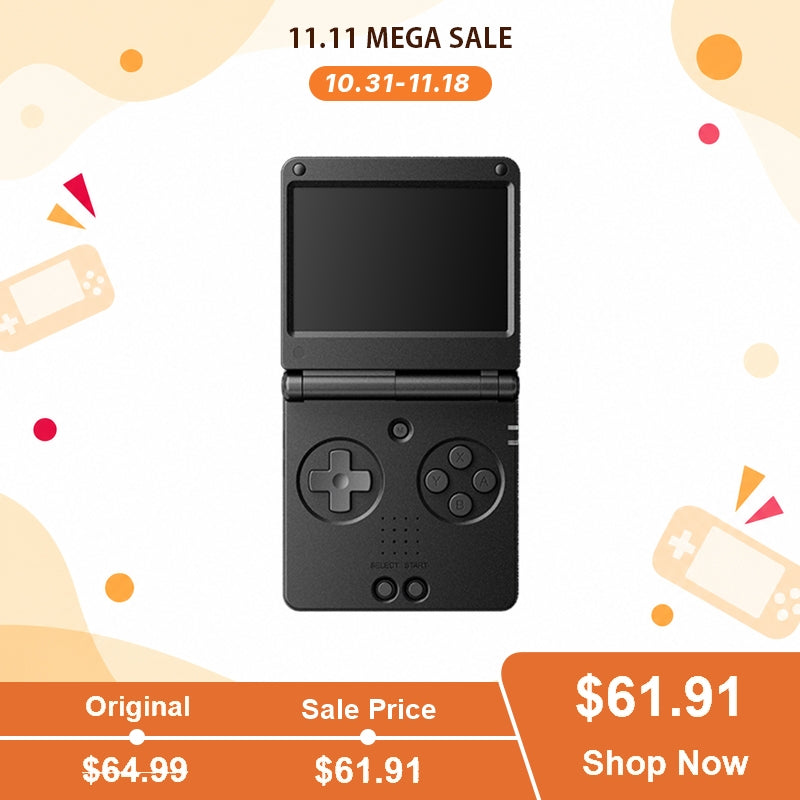
Anbernic
Anbernic RG SP Review
Good
$84.99
Anbernic finally nails its GBA SP clone: slimmer, better-finished, better-buttoned, with a screen that integer-scales GBA to perfection at $64.99. As a dedicated 2D and PS1 pocket console it is excellent — its limits (3:2 screen, sub-N64 ceiling, incremental appeal to existing SP owners) are scope, not failure. 8.2/10 — Good, excellent in its niche.
As an Amazon Associate we earn from qualifying purchases made through links for Anbernic RG SP.
Form Factor
Stickless clamshell (GBA SP style), hall-magnetic closure
Dimensions
8.3 x 8.2 x 2.39 cm folded
Weight
168 g
Screen
3.4-inch IPS, OCA full lamination, 720x480, 3x integer scaling for GBA
Pros & Cons
Pros
- Pixel-perfect 3x integer scaling — one of the best GBA screens at any price, let alone $65
- Genuinely pocketable: 168g, 2.39cm folded, magnetic snap closure
- Premium metallic finish and alloy hinges — the most polished shell in the SP line
- Best-in-class budget button feel: crisp dome-switch face buttons, micro-switch shoulders
- Lid-close sleep with auto-save and instant wake — real GBA SP behavior
- Dual microSD slots (512GB max each) separate OS from library
Cons
- 3:2 panel letterboxes or stretches 4:3 systems (SNES, PS1, arcade) — the screen plays favorites
- N64, Dreamcast, and anything newer are beyond the H700 — a 2D-and-PS1 machine, full stop
- Incremental upgrade: RG35XX SP or RG34XX SP owners gain polish, not capability
- Mono speaker is price-tier audio
- Runs warm with extended Wi-Fi use; USB-C port is picky about cables
- ~6-hour battery is adequate, not generous
Overview
The Anbernic RG SP is the company's third pass at cloning the Game Boy Advance SP, and the most disciplined one yet. After 2024's RG35XX SP (clamshell, no sticks) and 2025's RG34XX SP (same body, sunken sticks added), the RG SP strips the joysticks back out, slims the chassis down, and doubles in on a single promise: the sharpest possible pocket GBA experience for $64.99. At 168 grams and 2.39 centimeters thick folded, it is smaller and lighter than almost anything else running a full Linux emulation stack.
That focus is the whole review in miniature. This is not a do-everything handheld, and Anbernic isn't pretending it is — the marketing literally says "relive the pure joy of the 2D golden era." For Game Boy, Game Boy Color, and Game Boy Advance libraries it is close to ideal, with a 3.4-inch panel that pixel-perfect integer-scales GBA at 3x. It also runs PlayStation 1 well. Push toward Nintendo 64, Dreamcast, or anything newer and the H700 chipset waves the white flag — by design, not by accident.
Released August 5, 2026 and timed loosely to GBA's 25th anniversary, it lands in a small but loyal niche: buyers who want a GBA-shaped pocket console without the $200+ cost of a modded original or an Analogue Pocket. For that buyer, press coverage and community response agree it is one of the best options yet. For everyone else, the question is whether its single-mindedness fits your library — and this review is mostly about answering that.
Build Quality and Design
Anbernic has always been good at the industrial side of nostalgia, and the RG SP is its most polished shell yet. The clamshell borrows the GBA SP silhouette almost line for line, finished in a metallic paint — Platinum, Graphite, Pearl Blue, or Pearl Pink — with an acrylic logo badge on the lid. Coverage across the retro-gaming press describes the finish as genuinely premium rather than the glossy toy plastic of earlier attempts, and the matte texture resists fingerprints.
The fold mechanism is where cheap clones usually fall apart, so it matters that Anbernic fitted dual alloy hinges here, with a Hall-effect magnetic sensor that wakes the console when the lid opens and sleeps it when it closes. Rubber cushions at the screen bezel corners absorb the shock of closing. Hands-on coverage rates the hinge as sturdy with adjustable screen angles, and the magnetic snap is satisfying in the way the original SP's was.
The headline physical change is thinness. The RG SP is roughly 10% slimmer than its predecessors with a 25% thinner top bezel, and the removal of the RG34XX SP's joysticks lets the bottom half sit flat and closed without the usual claw-around-sticks bulge. Closed at 8.3 × 8.2 × 2.39 cm, it disappears into a jeans pocket in a way almost no Linux handheld does.
Controls are old-school on purpose: a full D-pad and four well-spaced face buttons on dome switches that press smooth and crisp, with micro-switch shoulder buttons — a deliberate tactile upgrade over prior SP models that reviews describe as the best button feel in this chassis family yet. There are no analog sticks, no joysticks, nothing to snap off in a bag. For 2D libraries that is purity; for anything 3D it is a hard ceiling.
Key Features
- 3.4-inch IPS display, 720×480, OCA full lamination — the same panel as the RG34XX SP, with full viewing angles and a laminated glass touch that removes the air-gap fuzz of budget screens
- 3x integer scaling for GBA — Game Boy Advance's 240×160 output maps to 720×480 perfectly, giving edge-to-edge, pixel-perfect sharpness with no uneven scaling artifacts
- Allwinner H700 quad-core Cortex-A53 @ 1.5GHz, dual-core G31 MP2 GPU, 1GB RAM — the proven Anbernic budget formula
- Linux 64-bit OS with 30+ emulators, save states, rewind, and fast-forward built in
- Dual microSD slots (up to 512GB each) — one for the OS, one for ROMs, so firmware updates never touch your library
- Hall-magnetic clamshell closure with lid-open wake and lid-close sleep
- Wi-Fi 5 (2.4/5GHz 802.11ac) + Bluetooth 4.2 — firmware updates, network multiplayer, and Wi-Fi streaming are all supported
- 3300mAh battery, USB-C charging (5V/1.5A) — around 6 hours of play
- Custom firmware support — the active New UI and Next UI scenes drop straight in for users who want a different front-end
- In the box: USB charging cable, screen protector, gift box — the 16GB card ships with the OS, not games (no preloaded ROMs)
Performance
For everything this console is built around, performance is excellent. Game Boy, GBC, and GBA run flawlessly with the integer-scaled display doing real work — GBA titles look crisper here than on most handhelds twice the price, and the optional LCD shaders plus color-correction profiles tune the image from "modern LCD" to "period-accurate" depending on taste. PS1 emulation — the traditional stretch goal for H700-class hardware — runs smoothly as well, which covers the two most valuable libraries in retro handheld gaming.
The limits arrive on schedule. Nintendo 64 and Dreamcast, which the H700 was never asked to run well, stutter and drop frames; community consensus treats them as off-menu. The 3:2 aspect ratio of the panel is a subtler constraint: 4:3 systems like SNES and PS1 render with black bars or a stretched image, since the screen is dimensionally a GBA screen rather than a general-purpose one. None of this is a defect — the panel choice is the point — but buyers intending a broad multi-system diet should know the display plays favorites.
Battery life lands at roughly six hours of active play, adequate for the class and consistent with the 3300mAh cell. Two quirks recur in hands-on reports: the RG SP can run noticeably warm with Wi-Fi active for extended periods, and USB-C charging is pickier about cables than it should be — some cables that charge other devices fine will not negotiate with it. Neither is a dealbreaker; both are worth knowing before a long flight.
One genuine modern convenience: closing the lid sleep-states the console and auto-saves, GBA SP-style. Open, resume, play. It is a small thing that changes how often the device actually gets used — the barrier to "quick session" drops to zero, which is precisely what a pocket retro handheld is for.
Software
The stock Linux front-end boots straight into a simple emulator menu with box art, save states, rewind, and fast-forward on hotkeys, and it requires zero setup beyond copying files to a card. Language support covers the majors. Out-of-the-box usability is the best in Anbernic's budget line.
The custom firmware scene is where this platform earns long-term value. The H700/1GB Linux generation is the most heavily supported hardware family in retro handheld custom firmware — New UI and Next UI both run on the RG SP — meaning buyers who dislike the stock interface have mature alternatives with richer sorting, filtering, and scraping. That ecosystem support matters more than any stock OS feature and is a real advantage over one-off AliExpress clones.
Storage handling is well considered: with dual card slots, the OS lives separately from the game library, so reflashing or updating firmware never risks the ROM collection. Maximum 512GB per slot is far beyond what any 2D library needs.
Audio is the one flat spot: a single mono speaker that is functional and price-appropriate but shallow, with the 3.5mm headphone jack the better path for anything immersive.
Pros and Cons
Pros:
- Pixel-perfect 3x integer scaling makes this one of the best GBA screens available at any price, let alone $65
- Genuinely pocketable: 168g, 2.39cm folded, magnetic snap closure — the form factor most "pocket handhelds" only claim
- Premium metallic finish and alloy hinges — the most polished shell in Anbernic's SP line
- Best-in-class budget button feel: crisp dome-switch face buttons, micro-switch shoulders
- Lid-close sleep with auto-save and instant wake — real GBA SP behavior
- Dual microSD slots (512GB max each) separate OS from library
- Mature custom firmware scene (New UI, Next UI)
- Smooth PS1 emulation on top of flawless GB/GBC/GBA
Cons:
- 3:2 panel letterboxes or stretches 4:3 systems (SNES, PS1, arcade) — the screen plays favorites
- N64, Dreamcast, and anything newer are beyond the H700 — this is a 2D-and-PS1 machine, full stop
- Incremental upgrade: RG35XX SP or RG34XX SP owners gain polish, not capability
- Mono speaker is price-tier audio
- Runs warm with extended Wi-Fi use; USB-C port is picky about cables
- ~6-hour battery is adequate, not generous
Who Should Buy This
The ideal owner has a 2D-first library — Game Boy through GBA, SNES, Genesis, NES — and wants it in a true pocket form factor with a screen that does GBA justice. It is also the right first retro handheld for a teenager or a partner: cheap enough to replace if lost, simple enough to need no configuring, and charming enough to actually get carried everywhere. Lapsed GBA owners chasing the exact feel of the original will find this closer in spirit than the candy-bar handhelds that dominate the category.
Skip it if your library lives in N64, Dreamcast, PSP, or beyond — the chipset tops out below that tier — or if you want joysticks for 3D systems; our Anbernic RG40XX H review covers a same-brand horizontal alternative with dual sticks and a 4:3 screen for a bit more money. And if you own last year's RG34XX SP, the RG SP is a refinement, not a reason to rebuy. Buyers who want original cartridges rather than ROMs should look at the Analogue Pocket instead — no Anbernic device reads carts.
Alternatives to Consider
- Anbernic RG34XX SP (~$70) — the immediate predecessor: same screen and chipset with sunken joysticks and slightly thicker body; the pick if you want 3D-capable controls in the clamshell.
- Anbernic RG40XX H ($86.95) — horizontal, dual-joystick, 3.5-inch 4:3 panel; better for multi-system libraries, worse for pockets.
- Miyoo Flip / Miyoo Mini family (~$50-70) — the other beloved budget pocket line; the Flip offers a similar clamshell concept with a smaller scene behind it.
- Analogue Pocket (~$220) — for original-cartridge purists who want hardware-level accuracy at four times the price.
For category context, our Best Retro Handhelds 2026 guide and Best Handheld Emulator Consoles roundup place the RG SP against the full field.
Verdict
The RG SP is Anbernic finally making the GBA SP clone it has been reaching for since 2024 — slimmer, better-finished, better-buttoned, and priced at $64.99 with a screen that integer-scales GBA to perfection. As a dedicated 2D and PS1 pocket console it is excellent; nothing else at the price folds, disappears into a pocket, and displays Game Boy Advance games this well. Its limits are honest ones — a 3:2 screen that favors GBA over 4:3 systems, a chipset with a hard ceiling below N64, incremental appeal to existing SP owners, and price-tier audio. Scored against what it sets out to be, those are scope, not failure. 8.2/10.
Full Specifications
| Form Factor | Stickless clamshell (GBA SP style), hall-magnetic closure |
|---|---|
| Dimensions | 8.3 x 8.2 x 2.39 cm folded |
| Weight | 168 g |
| Screen | 3.4-inch IPS, OCA full lamination, 720x480, 3x integer scaling for GBA |
| CPU | Allwinner H700 quad-core Cortex-A53 @ 1.5GHz |
| GPU | Dual-core G31 MP2 |
| RAM | 1 GB |
| Storage | 16GB + dual microSD (max 512GB each) |
| OS | Linux 64-bit, 30+ emulators, custom firmware support (New UI, Next UI) |
| Connectivity | Wi-Fi 5 (2.4/5GHz 802.11ac), Bluetooth 4.2, USB-C (5V/1.5A) |
| Battery | 3300mAh polymer, ~6 hours |
| Controls | D-pad + 4 dome-switch face buttons, micro-switch shoulders, no sticks |
| Audio | Mono speaker, 3.5mm headphone jack |
| Colors | Platinum, Graphite, Pearl Blue, Pearl Pink |
| Emulation Tier | Excellent: GB/GBC/GBA/PS1. Off-menu: N64/Dreamcast+ |
The Verdict: Good
Anbernic finally nails its GBA SP clone: slimmer, better-finished, better-buttoned, with a screen that integer-scales GBA to perfection at $64.99. As a dedicated 2D and PS1 pocket console it is excellent — its limits (3:2 screen, sub-N64 ceiling, incremental appeal to existing SP owners) are scope, not failure. 8.2/10 — Good, excellent in its niche.
— GamepadSquire, November 2026
As an Amazon Associate we earn from qualifying purchases made through links for Anbernic RG SP.
Related Buying Guide
Buying Guide
Best PC Gaming Handhelds 2026: The Definitive Buyer's Guide
The 2026 handheld PC market explained tier by tier: Steam Deck OLED, ROG Xbox Ally X, Legion Go S, ROG Ally X, Legion Go, and MSI Claw 8 AI+ — with the new Z2 Extreme flagship, SteamOS off-Valve for the first time, and who each device is for.
Buying Guide
Retroid Pocket 5 vs Anbernic RG556: The 2026 Retro Handheld Showdown
The two best-selling 1080p OLED retro handhelds, head to head. Retroid Pocket 5 brings Snapdragon 865 power and a launcher that just works; Anbernic RG556 counters with a bigger battery, class-leading comfort, and a lower price. After Retroid's permanent price cut they're within a few dollars of each other — here's how to pick in August 2026.


