Rapid Trigger & Magnetic Gaming Mice 2026: Hall Effect & HITS Explained
Rapid trigger crossed from keyboards to mice in 2026: the Logitech G Pro X2 Superstrike brought HITS haptic clicks at $180, and the Keychron G6 HE UltraLight answers at roughly $90. What the tech actually does, what is worth buying now, and who should wait for the budget wave.
By GamepadSquire — August 9, 2026Verified
Rapid Trigger & Magnetic Gaming Mice 2026: Hall Effect & HITS Explained
Rapid trigger did for keyboards what the optical switch did for mice a generation ago — and in 2026 it finally crossed over. For years the phrase "magnetic gaming mouse" was shorthand for a controller stick or a keyboard switch; the actual mouse button kept clicking away on the same Omron-style microswitch that has defined the input since the 1980s. That changed on February 10, 2026, when the Logitech G Pro X2 Superstrike shipped with HITS — the Haptic Inductive Trigger System — and became the first production mouse with adjustable actuation, rapid trigger resets, and haptic clicks. Six months on, the category has its second real product (Keychron's MagOptic-equipped G6 HE UltraLight), a queue of Chinese brands lining up magnetic switches of their own, and enough pro-tournament adoption to make the question impossible to ignore: is a magnetic click actually faster, and should your next mouse be one?
This guide is the explainer the category needs right now. It covers how magnetic sensing changes the click, what rapid trigger actually does in a mouse (as opposed to a keyboard), the two products you can genuinely buy in 2026, what's coming next, and — most importantly — who should buy in early and who should hold off. The short version: the technology is real, the benefits are measurable but situational, and the current price of admission is steep.
What "magnetic" means in a mouse
To understand why this matters, it helps to know what a traditional mouse button does. Every conventional mouse — including most of the "gaming" mice on shelves today — registers a click the same way a light switch does: two metal contacts physically touch, completing a circuit. That contact is what makes the satisfying click sound, and it is also the source of every longevity problem in the input world. Contacts bounce when they meet, which is why every mouse runs a debounce timer (typically a few milliseconds) to filter out the electrical chatter — a small but real delay on every single click. And contacts wear: after tens of millions of presses the metal degrades, the switch starts registering phantom double-clicks, and a $150 mouse starts acting like a $5 one. Optical switches solved the wear problem at the high end — they trigger on light interruption, so there is no physical contact to erode — but they still snap at a fixed depth. You cannot tell an optical switch to actuate sooner, and it still needs its reset point to be reached before the next click can register.
Magnetic sensing removes both limits. A magnet rides on the button stem, and a sensor (Hall effect or inductive) reads the button's position continuously, the way it reads a joystick. Because nothing touches, there is no contact bounce and no debounce delay, and because the sensor sees the whole travel range, the click point is software-configurable rather than physically fixed. Logitech's HITS is the inductive take on this: a magnet and coil pair detects button position, and tiny actuators generate the "click" feel artificially — which is why a HITS click can be loud, soft, or near-silent at the user's choice. Keychron's MagOptic switch takes a hybrid route, pairing a conventional optical trigger with a Hall-effect magnetic mode, so the same switch can behave like a traditional optical mouse or like a magnetic one, depending on what you select in software.
There is a naming trap worth flagging: the enthusiast community calls all of this "Hall effect," borrowing the keyboard terminology, but the shipped products are not all Hall effect in the strict sense — HITS is inductive, MagOptic's magnetic mode is Hall sensing. For buyers the distinction barely matters. What matters is the shared behavior: contactless, position-aware clicks that can be tuned.
Rapid trigger: the headline feature
Rapid trigger is the feature everyone asks about, because it is the one with the clearest competitive story. On a conventional mouse, after a click registers, the button must travel back up past a fixed reset point before the next press can register. That round-trip costs milliseconds, and in a burst-fire or jitter-click scenario it is the ceiling on your click rate. A magnetic mouse with rapid trigger does away with the fixed reset point: the instant the button starts moving upward, the system knows it and re-arms the click. Press and release are detected dynamically, so the only limit on repeat clicks is how fast your finger can move.
Logitech's claim is that this cuts the time from intention to first shot by up to 30 milliseconds versus a traditional click — the combination of a shorter, user-tunable actuation distance (down to 0.1 mm) and no debounce. IGN's tournament coverage in February 2026 gave the claim real-world texture: 13 of the 50 players still alive at the PGL Cluj-Napoca Counter-Strike 2 major had switched to the Superstrike within days of its release, including aim stars on NAVI, G2, FURIA, and The Mongolz. That kind of adoption speed is almost unheard of in a scene where pros famously refuse to change anything before a tournament. Notably, IGN also reported the honest counterpoint: pro players see less of an impact than amateurs, because their click mechanics are already near-optimal — the speed-up is proportionally bigger for players whose technique still has slack. Community testing has mostly been reaction-time benchmark anecdotes, with results in both directions, which is why the pro adoption data matters more than any forum thread.
Where rapid trigger shines most is sustained high-frequency clicking: counter-strafing, burst-firing, Minecraft-style PvP jitter clicking, and any game where your click rate is the bottleneck. If your playstyle is deliberate single shots with a slow, controlled trigger finger, the reset-point difference is a rounding error. That distinction — click-rate games versus click-timing games — is the single most useful lens for deciding whether any of this is for you.
The durability angle
The quieter argument for magnetic clicks is that they never wear out. There is no contact to pit, no spring fatigue that changes the actuation force over time, and no debounce circuitry aging. Both the Superstrike's HITS switches and the G6 HE's MagOptic switches are rated for 100 million clicks — and unlike a mechanical rating, there is no contact failure mode lurking at the end of it. For anyone who has RMA'd a flagship mouse for double-clicking 18 months in — an extremely common complaint across every major mechanical-switch brand, Logitech included — that alone justifies some interest. The trade-off is that the familiar click feel is now synthesized: HITS generates it with actuators (adjustable intensity, down to silent), and MagOptic keeps a physical leaf spring so the magnetic mode still feels like a real click. Reviews of the Superstrike are unanimous that the haptic click takes adjustment but is convincing; community opinion is split on whether the Superlight 2's honest optical snap feels better.
What you can buy in 2026
Two products define the category right now: Logitech's flagship, which created it, and Keychron's challenger, which is the first serious attempt to bring the price down.

Logitech G Pro X2 Superstrike — the flagship, and the only game in town at launch
The Superstrike is a Superlight 2 in a new costume: same proven ambidextrous shell (125 x 63.5 x 40 mm, 61 g), same HERO 2 sensor with up to 44,000 DPI and 888 IPS, same LIGHTSPEED wireless with up to 8,000 Hz polling, same 90-hour rated battery, same two-year warranty. The entire story is the click. HITS gives you ten adjustable actuation levels down to 0.1 mm, independent rapid trigger reset points for both main buttons, and haptic intensity you can dial from a full mechanical thock to near-silent. Logitech claims 9-30 ms of click latency shaved off versus a traditional switch, and the press consensus is that the implementation lands: RTINGS ranks it the best gaming mouse it has ever tested (9.5/10), IGN gave it a 10/10 Editor's Choice, PC Gamer scored it 95/100, and Tom's Guide called it the best wireless gaming mouse money can buy. GamepadSquire's own review scores it 8.6/10 — exceptional engineering, with the caveats below.
The caveats are real and consistently reported. At $179.99 it is $20-30 over the established flagship class (Viper V3 Pro, Superlight 2) for technology whose benefit is situational. Owner feedback across Reddit and Amazon clusters around the same four complaints: the side buttons are mushy with noticeable pre-travel (they remain conventional mechanical switches, which is a jarring contrast next to the magical main clicks), the coating is slippery for some grip styles, the stock UHMWPE feet feel scratchy on cloth pads, and the weight balance sits slightly forward. And it is a stripped-down flagship in the traditional sense — no Bluetooth, no tilt or free-spin wheel, five buttons total. None of that is a surprise for an esports-shaped mouse, but it is why the value question is a fair one.
Keychron G6 HE UltraLight — the value challenger with the hybrid switch
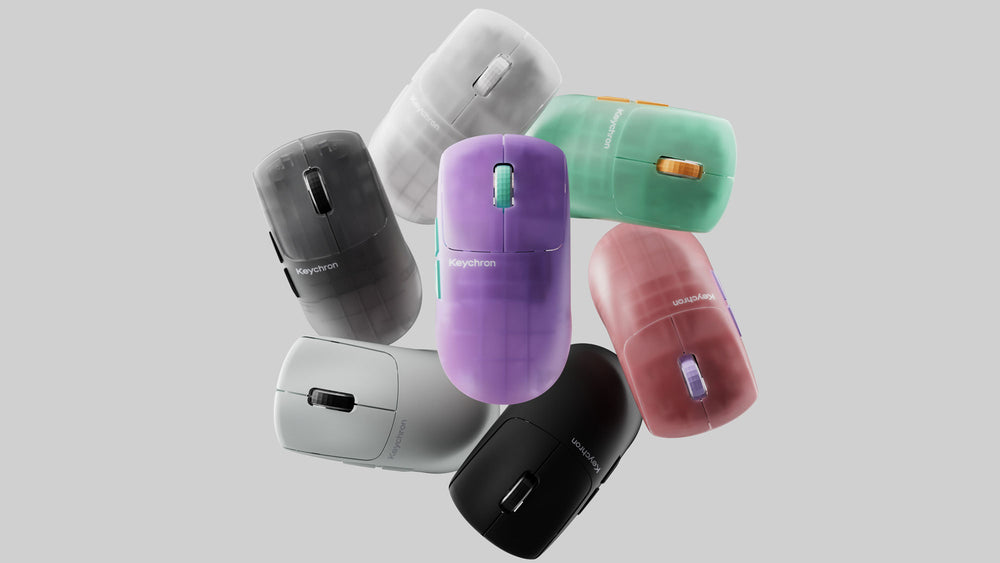
Keychron, the keyboard maker that helped popularize Hall effect boards for the masses, launched its answer in July 2026: the G6 HE UltraLight, a 42-46 g symmetrical wireless mouse built around the company's own MagOptic switch. The pitch is "one switch, two personalities." In optical mode it behaves like a conventional optical mouse — familiar, crisp, zero maintenance. In magnetic mode it uses Hall sensing to give you adjustable actuation points, with rapid trigger arriving as a firmware unlock — Keychron has been explicit that dynamic reset detection is in development for the switch, and early Japanese coverage of the mouse lists it among the headline features. The clever part is the leaf spring: unlike the Superstrike's synthesized haptics, the G6 HE keeps a physical click feel in magnetic mode, which may actually be the more comfortable transition for most people.
The rest of the spec sheet is competitive rather than exotic: a PixArt PAW3955 sensor (40,000 DPI, 750 IPS, 60 G), 8,000 Hz polling over 2.4 GHz, tri-mode connectivity with Bluetooth, a 350 mAh cell good for roughly 35 hours at 8 K polling or up to 340 hours over Bluetooth, and a Nordic nRF54LM20A controller. The two genuinely interesting details are the swappable battery module — you can carry a spare, or add weights to take the mouse from 46 g up to 52 g or 62 g to match your preference — and open-source firmware, a rarity in gaming mice that the enthusiast community has already noticed. There are seven colorways, five of them semi-transparent, which is a deliberate nod to the keyboard-enthusiast crowd Keychron knows best.
Pricing is the story, though. The G6 HE launched in Japan at the equivalent of about $73 (fixed battery) to $87 (swappable), with a global launch expected in early September 2026 at around $90. That is roughly half the Superstrike's price for the same core capabilities — magnetic adjustable actuation, 8 K polling, ultralight weight — minus the haptics and the Logitech ecosystem. The honest caveats: it is brand new with no long-term reliability track record, rapid trigger is not fully shipped at launch, and early units are going through crowdfunding channels, so availability outside Japan is thin until September. Anyone who buys one now is buying the promise plus a very good conventional mouse.
Coming next: MagOptic at scale, Snaptiq, and the Chinese wave
The pipeline behind these two products is where the category gets interesting. Keychron is rolling MagOptic out as a platform — PC Gamer called it "the next gen mouse switch" after a hands-on — so expect the technology to spread across Keychron's mice lineup rather than staying exclusive to the G6 HE. Meanwhile Lunacy's Snaptiq, an experimental magnetic sensing system developed by a Russian streamer, is targeting 1-micron button-position resolution with vibration-motor haptics and silent operation, with a possible release by the end of 2026 — though availability outside its home region is genuinely uncertain, and previews are exactly that.
The bigger signal is the supply chain. TechPowerUp reported in May 2026 that at least two Chinese peripheral makers are lining up magnetic mouse switches to compete with HITS, which historically means one thing: this technology is about to get cheap, fast. The same playbook played out with Hall effect keyboards, which went from Wooting-exclusive to $40 budget boards in under three years. The counter-signal is the AliExpress clone problem — IGN documented Superstrike lookalikes already on sale with fake HITS branding and unverifiable internals. Do not buy those. If you want the real thing cheaply, the rational move is to wait for the legitimate budget wave that the TechPowerUp report points to, rather than gamble on a knockoff.
One more thing to watch: tournament policy. Valve banned SOCD — the simultaneous-opposing-cardinal-direction automation built into some magnetic keyboards — back in 2024, and the rapid trigger mouse has inevitably raised questions about whether the advantage is legitimate. So far neither Valve nor any major organizer has restricted the Superstrike, and the arguments for allowing it are strong (it is a speed increase, not automation; the hardware is the same for everyone), but the debate is active and worth a footnote before you drop $180 on a tournament-adjacent edge.
Who should buy a magnetic mouse now
Buy now if: you are a click-rate player — high-CPS PvP, rhythm games, burst-fire heroes, jitter-clickers — where shaving the reset round-trip measurably raises your ceiling; you have been burned by double-click failures and want the contactless longevity guarantee; you are the kind of player who actually tweaks actuation and DPI profiles per game, because the tunability is the real product here; or you are a tech enthusiast who wants to own the first genuinely new mouse input in forty years.
Wait if: you are on a budget — the current premium over a conventional flagship is $30-90 for situational gains, and the legitimate budget wave is coming; you live in MMO/strategy land where five buttons and a plain scroll wheel are limiting (skip the Superstrike if you need thumb-grid buttons, tilt-scrolling, or a free-spin wheel — none of that exists on magnetic mice yet); you play mostly single-player titles where click feel matters more than click speed; or you want Bluetooth multi-device switching, which the Superstrike simply does not offer.
Left-handed buyers should note that both current magnetic mice are symmetrical designs with the side buttons on the left side — fine for left-hand use with remapping on the Superstrike, but neither is a true ambidextrous layout.
How the two magnetic mice stack up
| Logitech G Pro X2 Superstrike | Keychron G6 HE UltraLight | Razer Viper V3 Pro (conventional) | |
|---|---|---|---|
| Price | $179.99 | ~$90 (global launch Sept 2026) | $159.99 |
| Weight | 61 g | 42 g / 46 g (swappable battery) | 54 g |
| Sensor | HERO 2, 44,000 DPI | PixArt PAW3955, 40,000 DPI | Focus Pro 35K, 35,000 DPI |
| Polling | Up to 8,000 Hz wireless | Up to 8,000 Hz | Up to 8,000 Hz (with dongle) |
| Switch tech | HITS (inductive + haptics) | MagOptic (optical / Hall dual mode) | Razer optical |
| Adjustable actuation | Yes (down to 0.1 mm) | Yes (magnetic mode) | No |
| Rapid trigger | Yes | Via firmware (in development) | No |
| Battery | ~90 h | ~35 h (8 K) / ~340 h (BT) | ~95 h |
| Bluetooth | No | Yes | No |
| Extras | Haptic click intensity | Swappable battery, open-source firmware | — |
Alternatives to consider (if you decide to wait)
If the magnetic pitch is tempting but the timing is wrong, the conventional flagship class has never been stronger — and most of it is cheaper:
- Razer Viper V3 Pro — 54 g, optical switches, proven tournament pedigree, and the Superstrike's most direct rival; GamepadSquire scores it 8.9/10.
- Logitech G Pro X2 Superlight 2 — the shape the Superstrike builds on, with honest optical clicks and a $30-40 discount; 9.0/10.
- Hitscan Hyperlight — the 39 g value king of the ultralight class at $89.99, with RTINGS-verified click latency; 9.0/10.
- Pulsar X3 — the comfortable mid-weight alternative with superb build quality; 8.3/10.
- VXE R1 Pro — if the budget is tight, the $49 flagship-killer remains the best value in mice; 8.8/10.
FAQ
Is rapid trigger in a mouse cheating? No — it is a hardware speed improvement, not automation. Every player can buy the same mouse. Valve has not restricted it (its SOCD ban targeted keyboard automation, a different thing), and major tournaments have allowed it so far.
Does rapid trigger help outside FPS games? It helps any game where click rate is the bottleneck — rhythm games, high-CPS PvP, burst-fire characters. For slow deliberate clicking it makes almost no difference.
Will magnetic mice eliminate double-click? Contactless triggering removes the failure mode that causes double-clicking — there is nothing to wear. Both current products are rated for 100 million clicks. That is the strongest objective argument for the technology.
Is the Superstrike worth $180? For click-timing specialists and enthusiasts, yes — there is nothing else like it. For everyone else, the G6 HE at $90 delivers most of the same capabilities, and a conventional flagship undercuts both.
Do I need 8,000 Hz polling with a magnetic mouse? No. The click-speed gains come from the switch, not the polling rate. 8 K polling is a marginal-latency luxury that costs battery life; 1,000 Hz is fine for most players.
When will magnetic mice get cheap? Chinese brands are lining up magnetic switches as of mid-2026. Based on how Hall effect keyboards played out, expect legitimate budget magnetic mice within 12-18 months. The clones already on AliExpress are not the shortcut — they are the trap.
Bottom line
Magnetic mice are the first genuinely new input technology in the mouse world since the optical switch, and unlike some keyboard gimmicks, the physics is on their side: contactless, position-aware clicks are objectively more durable and objectively more tunable. The Superstrike proved the concept and earned its place as RTINGS' best-tested mouse; the G6 HE is the first credible step toward making it affordable. But this is still a category in its first inning. The benefits are real yet situational, the prices are early-adopter premiums, and the firmware and ecosystem questions are unresolved. Buy the Superstrike if you are a click-timing specialist or a hardware enthusiast with $180 to spend on the future. Buy the G6 HE in September if you want the technology at half the price and can tolerate being an early adopter. And if you just want to win games, the Viper V3 Pro or Superlight 2 will do it today for less — while the industry quietly builds the magnetic wave that will make this entire article look conservative in two years.
Related Guides
Buying Guide
Best Gaming Mice 2026: The Complete Guide for Every Budget
The 2026 gaming mouse market explained tier by tier: RTINGS-lab-verified picks from the $25 G203 to the $180 haptic Superstrike, with the Viper V4 Pro, DeathAdder V4 Pro, the $35 VXE R1 Pro budget flagship-killer, and the Chinese mid-range revolution covered in depth.
Buying Guide
Best Ergonomic Gaming Mice 2026: Sculpted, Vertical & Wrist-Saving Picks
Shape — not DPI — is what saves wrists. The best ergonomic gaming mice of 2026: the sculpted MX Master 3S benchmark, the 57° MX Vertical for existing wrist pain, the ergo-shaped Superlight 2 DEX for competitive play, and the Keychron M6 8K big-hand value pick, plus the vertical landscape (Pro Click V2 Vertical, Logitech Lift) explained.
Buying Guide
Best Wired Gaming Mice 2026: The Cable-Is-Value Buyer's Guide
Wireless won the convenience war, but wired mice quietly became the best value in gaming: the G502 X at $79.99, the OP1 8k v2's 8K polling under $90, and the Basilisk V3 — a $70 mouse at a $35 price. Seven lab-tested wired picks, honest latency talk, and who should still buy a cable in 2026.