Valve
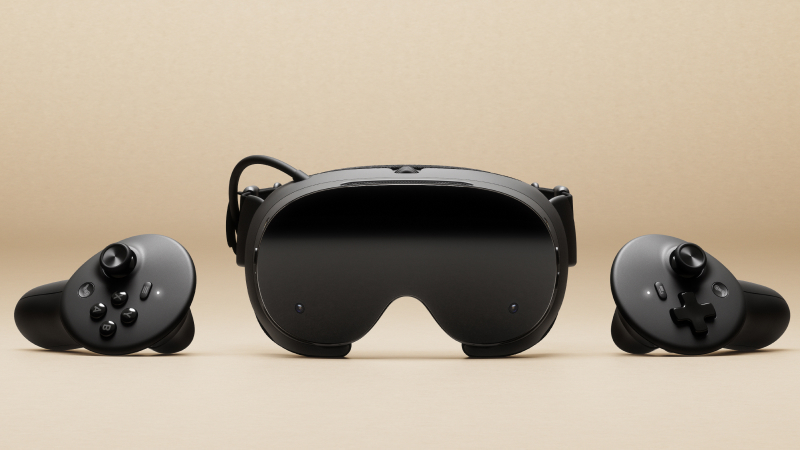
Valve Steam Frame Review
Good
$1059.00
The most capable standalone headset ever made and the least defensible value proposition in mainstream VR — Valve solved comfort, wireless latency and the Meta-account problem, then priced the answer at more than double a Quest 3.
chip
Qualcomm Snapdragon 8 Gen 3 (ARM64), 16GB LPDDR5X
display
Dual 2160x2160 LCD per eye, pancake lenses, 110-degree FOV
refresh
72 / 80 / 90 / 120 Hz (144 Hz experimental)
tracking
Inside-out SLAM (4 cameras + IR), eye tracking, foveated rendering + streaming
Pros & Cons
Pros
- Best-in-class comfort — 440 g total with rear-mounted battery and near-perfect weight balance
- Excellent wireless PC streaming: bundled Wi-Fi 6E dongle, dual Wi-Fi 7 radios, seamless multi-link handoff
- Native ARM Half-Life: Alyx port bundled; Superhot and Beat Saber run great standalone
- First headset to run flat Steam library games standalone via Proton, FEX and Lepton
- TMR thumbsticks, gamepad-layout controllers, physical IPD knob, eye-tracked foveated streaming
- Genuinely modular: swappable strap/speakers/battery, published CAD files, iFixit-repairable
Cons
- $1,059 / $1,299 pricing — more than double a Meta Quest 3 amid a memory-price crisis
- No power adapter in the box ($29 extra); reservation lottery instead of normal sales
- Battery life: about 1 hour of standalone Alyx, 2 hours streaming
- Monochrome passthrough only; on-board speakers disappoint at this price
- Thin launch library — only a few dozen Frame-verified VR games, one broken in testing
- Snapdragon 8 Gen 3 limits standalone non-VR gaming to older 3D titles like Portal 2
Overview
Valve spent most of the last decade watching VR from the sidelines. The Index shipped in 2019, Half-Life: Alyx landed in 2020, and then — nothing, while Meta's Quest line proved that most people would rather have a headset with no wires and no gaming PC than a lab-grade HMD tethered to a tower. The Steam Frame, codenamed Deckard through four years of leaks, is Valve's answer: a $1,059 standalone headset that runs SteamOS natively on a Snapdragon 8 Gen 3, streams your entire PC library wirelessly, and requires exactly zero base stations, zero Meta accounts, and zero cables.
It is also the most expensive mainstream standalone headset ever made — more than double the $500 Meta asks for a Quest 3 — during the worst memory-price crunch in a decade. That tension between genuinely excellent engineering and genuinely painful economics is the whole story of this device, and it runs through every review published at launch, including this one.
The Frame shipped September 18, 2026, in two configurations: $1,059 with 256GB and $1,299 with 1TB. The box contains the headset, two controllers, and Valve's USB streaming adapter. It does not contain a power adapter — that's another $29 — and you couldn't simply buy one anyway, because Valve sold the first batches through a reservation lottery with one entry per household and randomized order windows. The buying experience was, charitably, a mess.
None of which changes what the hardware actually is. IGN scored it 7/10, calling it "one of the best ways to play pretty much any game on Steam" and one of the most comfortable headsets their reviewer had ever worn. Ars Technica called it "simultaneously overengineered and underbaked." Both are correct. That's the Frame.
Design and comfort: the 440-gram trick
The Frame's single best feature is the way it distributes weight. The core module — lenses, compute, displays — is just 185 grams, with roughly half of the total 440-gram kit weight moved into a curved, cushioned 21.6 Wh battery that sits behind your skull. Ars Technica's Kyle Orland called it "a new high-water mark in comfort," noting it's about 15 percent lighter than a Quest 3 (515 g) and dramatically less front-heavy than any standalone headset he'd tried. The stretchy strap, generous nose cutout, and facial interface do the rest. IGN's Jacqueline Thomas highlighted vents that push hot air away from your face — a small thing that matters enormously in hour-long sessions.
The headset is also modular in a way nothing else in this price class is. The strap, speakers, battery, and face pad are all swappable; there's an expansion port with a lane of PCI Express 4.0; and Valve has published CAD files so third parties can build accessories. iFixit's teardown found a "surprisingly modular" design with repair guides and parts coming soon, and the first third-party accessory — Arcturus Vision's 5K HDR passthrough camera — was announced within a week of launch. Whether modularity becomes a real ecosystem or a graveyard of good intentions depends entirely on whether the Frame sells enough units to sustain it. At $1,059, that is not a safe bet.
One omission stings at any price: passthrough is handled by four monochrome cameras, so your view of the real world is grayscale. Rock Paper Shotgun found it adequate for quick trips out of the play area but conceded the full-color Quest 3 wins here outright.
Display and optics
Each eye gets a 2,160×2,160 LCD panel behind pancake lenses — a tidy sharpness upgrade over the Index that narrowly edges the Quest 3's overall resolution. Refresh rates run 72, 80, 90, and 120 Hz, with an experimental 144 Hz mode for the brave. Field of view is 110 degrees horizontal and vertical. There's a physical IPD adjustment knob, which remains rarer than it should be, and prescription lens inserts are available from Zenni Optical — though RPS's reviewer found his glasses fit without them.
Eye tracking is standard, and it does real work here: it drives foveated rendering in native games and — more interestingly — foveated streaming when you're playing from a PC. Tom's Hardware's launch interview with Valve pegged the technique at up to 10× bitrate efficiency, and because it's applied at the encoder level, games don't need developer support to benefit. RPS reported the quality transition between full and reduced resolution was imperceptible unless they deliberately looked for it.
Controllers and tracking
Inside-out tracking uses four cameras and infrared emitters with SLAM — no base stations, Index-style room setup deleted entirely. The controllers are openly derivative of Meta's Touch Plus wands, but Valve made one genuinely smart change: a full gamepad layout, with a D-pad on the left controller and XYAB face buttons on the right. That layout exists because the Frame wants to play your flat, non-VR Steam library, and it makes the transition between VR and virtual-theater gaming feel natural instead of awkward.
The thumbsticks use tunneling magnetoresistance (TMR) sensors borrowed from the 2026 Steam Controller — the drift-resistant tech that's become the year's quiet hardware upgrade. Finger tracking is capacitive and only partially successful at recreating the Index's fidelity, but RPS judged the wands "don't feel like downgrades" otherwise. They run on AA batteries, which is either refreshingly practical or disappointingly cheap depending on your temperament.
Standalone performance and software
Inside is a Snapdragon 8 Gen 3 with 16 GB of LPDDR5X — a phone chip, yes, and a modest step over the Quest 3's silicon rather than a generational leap. Native Standalone performance splits sharply along optimization lines. The bundled ARM-native port of Half-Life: Alyx is the flagship proof point: Ars called the compromises "relatively few," RPS found the world detailing and interactivity fully intact with reduced render resolution and animation smoothness. Superhot and Beat Saber run marvellously; heavier 3D fare needs lowered settings.
Beyond that curated island, compatibility gets rough. At launch only a "few dozen" SteamVR games were listed Frame-verified, and one of them simply didn't work in Ars's testing. The Frame's SteamOS build layers three compatibility systems: Proton for Windows software, FEX for x86-64 code running on ARM, and Lepton for Android apps. It's an audacious stack, and it delivers some genuine magic — flat games from your existing library running standalone in a virtual theater, no PC required — but the ARM chip limits verified non-VR titles to 2D and older 3D games like Portal 2. Ars's line about a portable Alyx feeling less impactful "at a time when big-budget games from 2024 are getting Verified for Steam Deck" lands hard: the Frame ships years late into an ecosystem that mostly wasn't waiting for it.
Storage is 256 GB or 1 TB of UFS, expandable by microSD — and in a lovely touch, cards hot-swap between Frame, Steam Deck, and the new Steam Machine, so one card can carry installs across all three.
Streaming: the Frame at its best
For maximum fidelity you stream from a PC, and this is where the engineering earns its keep. The bundled Wi-Fi 6E USB adapter creates a dedicated 6 GHz link that bypasses your router entirely, while dual Wi-Fi 7 radios can split internet and VR traffic across 5 GHz and 6 GHz bands. Valve's "multi-link streaming" blends dongle and network into one air tether that hands off automatically to whichever is faster. RPS measured dongle-in-same-room latency "as quick as any wired headset I've ever worn," with playable performance persisting two walls and two doors away. Ars found stream quality high with low latency but dinged Steam Link software stability at launch.
Battery life is the tax: RPS got 1 hour 3 minutes of standalone Alyx on default settings (with the automatic 120-to-72 Hz refresh drop), and around two hours streaming. The rear battery is swappable in principle — the modularity again — but at launch you're buying spare modules, not spare batteries, and none were listed.
Price and the verdict of everyone else
Seven of nine launch reviewers recommend the Frame, with numeric scores ranging from 50 to 80 — a spread that tells you the disagreement isn't about the hardware. RPS's James Archer concluded "if I was buying a VR kit for myself, it'd be this one" in the same review he titled "God, I wish this were £600." Tom's Hardware's Brandon Hill praised the build and performance but called the price "debilitating" for gamers already absorbing soaring memory, storage, and GPU costs. CNET's Scott Stein called it "an experiment in progress." Engadget liked the comfort, disliked the speakers and battery, and pointed buyers at a Quest 3 or a used Index instead. Ars was bluntest: Valve is "a few years late and a few hundred dollars short," and avoiding Meta's platform lock-in isn't worth the premium for unsubsidized hardware.
Who is this actually for? VR enthusiasts who already own large Steam libraries, refuse to enter Meta's ecosystem, and want one headset that does standalone, PC streaming, and virtual-theater flat gaming. If that's you — and you can stomach the lottery, the missing charger, and the memory-crisis pricing — the Frame is the most versatile VR kit ever sold. Everyone else should buy a Quest 3 and keep the $560 difference.
Pros
- Best-in-class comfort: 440 g total with rear-mounted battery, noticeably balanced on the face
- Genuinely excellent wireless PC streaming — dedicated Wi-Fi 6E dongle with seamless multi-link handoff
- Native ARM Half-Life: Alyx port bundled; Superhot and Beat Saber run great standalone
- First headset to run flat Steam library games standalone (Proton + FEX + Lepton stack)
- TMR thumbsticks, gamepad-layout controllers, physical IPD knob, microSD hot-swap with Deck and Steam Machine
- Real modularity with published CAD files and an iFixit-repairable design
Cons
- $1,059 / $1,299 pricing — more than double a Quest 3, in a memory-shortage economy
- No power adapter in the box ($29 extra) and a reservation lottery instead of normal sales
- Battery: ~1 hour of standalone Alyx, ~2 hours streaming
- Monochrome passthrough only; speakers disappoint for the price
- Thin launch library — "a few dozen" verified VR games, one of them broken; spotty x86 compatibility via FEX
- Smartphone-class standalone chip: native non-VR gaming tops out at older 3D titles
Verdict
7/10 — Very good. The Steam Frame is the most capable standalone headset ever made and the least defensible value proposition in mainstream VR. Valve solved wireless latency, fixed comfort, normalized the controllers, and deleted the Meta account — then priced the answer at double the question. If the hardware were £600, this would be an easy 9. It isn't, so it isn't.
What the Experts Say
Professional review consensus for this product
Full Specifications
| chip | Qualcomm Snapdragon 8 Gen 3 (ARM64), 16GB LPDDR5X |
|---|---|
| display | Dual 2160x2160 LCD per eye, pancake lenses, 110-degree FOV |
| refresh | 72 / 80 / 90 / 120 Hz (144 Hz experimental) |
| tracking | Inside-out SLAM (4 cameras + IR), eye tracking, foveated rendering + streaming |
| storage | 256GB / 1TB UFS + microSD (hot-swaps with Steam Deck and Steam Machine) |
| battery | 21.6 Wh rear pack; USB-C 45W charging |
| weight | 440 g complete / 185 g core module |
| connectivity | Wi-Fi 7 2x2 dual-radio, bundled Wi-Fi 6E USB link, Bluetooth 5.4, USB-C 2.0 |
| os | SteamOS (Proton + FEX x86-on-ARM + Lepton Android layer) |
The Verdict: Good
The most capable standalone headset ever made and the least defensible value proposition in mainstream VR — Valve solved comfort, wireless latency and the Meta-account problem, then priced the answer at more than double a Quest 3.
— GamepadSquire, October 2026
Related Buying Guide
Buying Guide
Best Mini PCs for Bazzite/SteamOS 2026: Build Your Own Steam Machine
The OS-first picker for DIY Steam Machines: four verified mini PCs from a $950 value pick to a $2,800 RTX 5080 no-compromise build, chosen for SteamOS-style living-room gaming.
Buying Guide
SteamOS vs Bazzite vs ChimeraOS vs Windows: Which OS for Your Mini PC?
Four operating systems can run a gaming mini PC in 2026, and picking wrong is about ignored constraints, not performance. This comparison maps GPU support, dual-boot, Secure Boot, and encryption across official SteamOS, Bazzite, ChimeraOS, and Windows — with install links and a four-question decision path.


