GuliKit
GuliKit TT MAX Review
Good
$71.99
The GuliKit TT MAX delivers elite latency, best-in-class metal paddles, an excellent D-pad, and genuine flagship features for ~$70 — the best feature-per-dollar controller in its class. Inconsistent stick centering and unit-to-unit QC, the absence of companion software, and a few small compromises keep it below the top tier. 7.5/10.
As an Amazon Associate we earn from qualifying purchases made through links for GuliKit TT MAX.
connectivity
Bluetooth (Xinput), Hyperlink 2 dongle, wired USB-C
polling_rate
1000Hz wired / ~980Hz dongle
latency
~2.0-3.5ms tested (Gamepadla, Wired A+/Wireless A+)
sticks
720-degree tension-adjustable TMR, 4000-level precision, 11-bit resolution
Pros & Cons
Pros
- Exceptional feature density for ~$70: tension-adjustable TMR sticks, dual-mode triggers, four metal paddles, gyro, and 10-minute macros
- Best-in-class metal back paddles for the price — tactile, quiet, and comfortable
- Excellent floating D-pad with accurate diagonals; a second D-pad included in the box
- Elite wireless latency across wired, dongle, and Bluetooth with true 1000Hz polling
- Deep on-device customization with no companion app required
- Broad multi-platform support: Switch, Switch 2, PC, Android, iOS
Cons
- Stick centering and circularity are inconsistent out of the box; unit-to-unit QC is the top complaint across owner and press feedback
- No companion software — paddle mapping is limited to controller inputs, RGB is preset patterns only
- Analog trigger deadzones at both ends of travel
- Battery drops to roughly 6 hours with RGB on and vibration maxed
- Hard shell case does not fit with paddles installed
- Switch 2 wake-up fails for a small but persistent minority of owners
Overview
The GuliKit TT MAX is the flagship of GuliKit's TT series, announced in January 2026 and aimed squarely at the gap between a $70 stock controller and $150+ premium pads. It is a wireless, multi-platform gamepad built around tension-adjustable TMR (tunneling magnetoresistance) joysticks, the same drift-resistant magnetic sensor tech that has become the 2026 budget-to-midrange standard, but here paired with a twist no rival in this price band offers: you can dial the stick resistance from roughly 25g to 75g with an included tool, no soldering or disassembly required. Around that headline feature sits a genuinely loaded package: Hall Effect analog triggers with physical microswitch trigger locks, four detachable metal back paddles, a 950mAh battery, three vibration modes, gyro aiming, and up to 10 minutes of macro recording.
The TT MAX sells at around $70 (list price $69.99, street prices hover between $70 and $72 depending on the listing and whether you buy the bundle with GuliKit's multi-functional adapter). For context, that's the same money as a first-party Nintendo Switch Pro Controller, and roughly half of what a Flydigi or SCUF-class pro pad runs. The catch: and it is a real one, is that GuliKit's hardware ambition has historically run ahead of its quality control, and the TT MAX is the latest test case: community reviews are full of praise for the feature set and repeated, specific complaints about stick centering and unit-to-unit consistency. This review weighs both sides.
Build Quality and Design
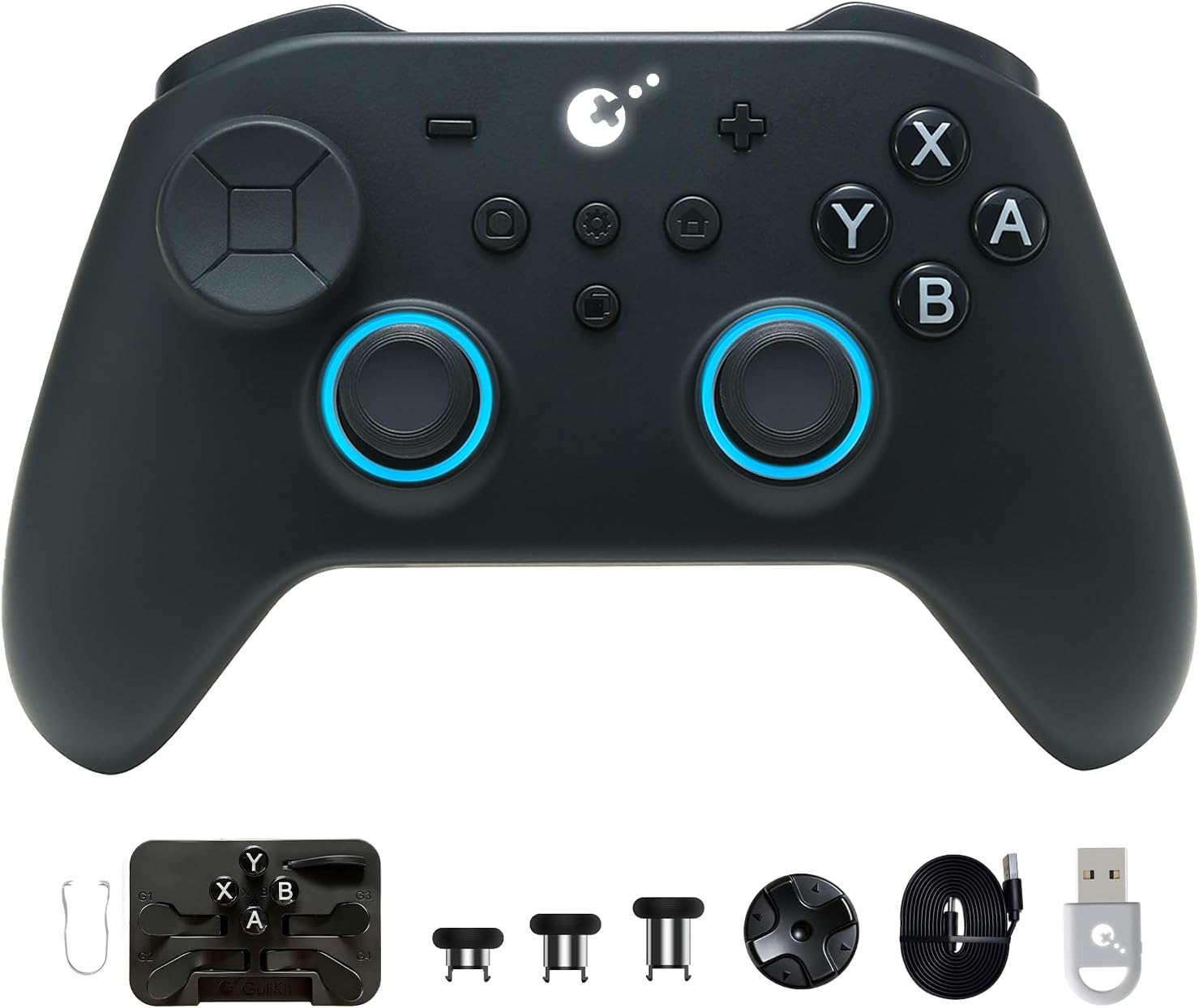
The TT MAX makes an immediately distinctive first impression: it is a PlayStation-style symmetrical controller poured into an Xbox-style shell. The sticks sit low and symmetric like a DualSense, but the body is wider than an Xbox pad by roughly 3cm, and at 285, 300g it is on the heavy side of the midrange, noticeably weighty in hand, though the size distributes that mass well enough that most owners describe it as comfortable rather than tiring. Large hands are well served; smaller hands may find the stretch to the Start/Select cluster awkward, a point several reviewers raised.
The shell is mostly plastic but feels dense and solid rather than hollow, with a distinctive dot-matrix grip texture on the handles and triggers that reads as grippy, almost too rough for some, while the bumpers get no texture at all. The black finish is a fingerprint and smudge magnet; the grey variant hides that better. Build quality impressions split along revision lines: early units, per long-term community reports, suffered from internal clips breaking and rear paddles failing after weeks of use, while owners of the newer revision describe a much tighter, premium-feeling product with no paddle issues. That revision split is the single most important thing to know before buying, more on it below.
The modularity is the design's real flex. Face buttons pop out and swap between Switch (BAYX) and Xbox (ABXY) layouts, two different D-pads are included (a deep-dish floating pad and a more traditional cross), three pairs of thumbstick caps ship in the box at 8.7mm, 13.1mm, and 16mm heights, and the tension adjustment screw sits under each stick cap. The included hard shell case is a nice touch that comes with one glaring flaw: it only closes with the paddles removed, forcing owners to strip their setup every time they travel, a complaint that appears in nearly every written review of this controller.
Key Features
- Tension-adjustable TMR joysticks: 720° stepless adjustment range with a hidden screw mechanism (roughly 25g to 75g of resistance), 4,000-level precision, anti-snapback mode, and an 11-bit resolution that tests as above average. This is the headline feature, and it works: tightening the tension genuinely changes aiming feel, though the practical range is subtle for general play and most noticeable in shooters.
- Dual-mode Smart Triggers: full-travel Hall Effect analog triggers for racing and flight, toggled via physical switches on the back into near-instant microswitch digital triggers with satisfyingly short travel.
- Four metal rear paddles: detachable, remappable entirely on-device, and widely described as some of the best back paddles on any controller in this class, tactile, quiet, and comfortable.
- Hyperlink 2 wireless: GuliKit's low-latency protocol runs at up to 1000Hz over the included dongle, and, unusually, Bluetooth also speaks Xinput with latency close to dongle levels.
- Three vibration modes: a magnetic levitation "Super Haptic" mode (default on PC), HD Rumble for Switch, and a standard rotor mode. The maglev mode is the standout, stronger, faster, and more detailed than the rotor fallback.
- APG macro recording: record up to 10 minutes of inputs, including stick movement, and replay once or loop, the TT MAX's party trick for auto-farming and long fighting-game combos. (The cheaper TT Pro caps this at 10 seconds.)
- Gyro with PC motion aim assist: full 6-axis gyro in Switch mode, plus gyro-to-right-stick aiming on PC while holding a shoulder button, a feature the TT Pro lacks entirely.
- Switch / Switch 2 wake support: the controller is marketed with console wake-up, and most owners confirm it works; a meaningful minority report it failing (see below).
- Everything in the box: hard shell case, Hyperlink 2 dongle, braided USB-C cable, second D-pad, Xbox-layout face button set with removal tool, four extra tall stick caps, four metal paddles, and the tension tool. Almost nothing is sold separately.
Configuration is handled entirely through on-controller button combos via a dedicated gear/settings button, deadzone on/off, ABXY swap, D-pad 4/8-way mode, sensitivity presets (50/100/150%), vibration intensity, RGB patterns, and turbo are all reachable without any software. That's impressive for Linux and Steam Deck users who hate proprietary apps, but it cuts both ways: there is no companion app at all, so paddle remapping is limited to controller inputs (no keyboard/mouse binding), and firmware updates require the web tool.
Performance
The latency story is the TT MAX's strongest selling point and it holds up under measurement. Independent testing data from Gamepadla's Prometheus rig shows wired button latency averaging about 2.5ms with stick latency around 2.0ms at a true 1001Hz polling rate; the dongle lands near 3.5ms at ~980Hz; and Bluetooth, where most controllers fall apart, stays competitive at roughly 2.4, 3.2ms. Gamepadla grades it Wired A+ / Wireless A+, which puts it in elite company for wireless input lag. In practical terms this is a controller that will not be the bottleneck in any competitive game.
The sticks are where the picture gets complicated. Sensor precision is genuinely good, smooth, linear, with excellent bit-depth, and the tension adjustment is a real differentiator for aim-heavy play. But stick centering, the exact spot where GuliKit's past controllers have stumbled, remains the TT MAX's most persistent criticism. Multiple independent testers report off-center returns out of the box, with the error ranging from minor to severe enough that one reviewer's unit exhibited visible drift even with the deadzone enabled. On-device recalibration helps but does not fully resolve it, one prominent tester measured up to 6% residual offset after calibration. The good news: the launch firmware was notably worse, and later revisions have measurably improved both centering and the "wobbly stick" feel that plagued early units. Community consensus now reads roughly as "great for Rocket League and general play, temperamental for precision shooters", with the caveat that your unit's mileage depends heavily on which batch you receive.
Two smaller performance notes: the analog triggers carry noticeable deadzones at both the top and bottom of their travel, which racers tweaking fine throttle control will notice, and there is no D-input or DS4 mode, PC users get Xinput or nothing, which matters if you play older titles or emulators expecting DirectInput.
Battery life is solid-but-not-class-leading: around 14, 15 hours with RGB off and vibration at normal levels, dropping to roughly 6 hours with RGB on and vibration maxed, far short of GuliKit's 26-hour marketing figure, which only applies with turbo enabled and every power draw disabled. The 4-LED battery indicator on the front face is a welcome touch.
Pros and Cons
Pros:
- Exceptional feature density for ~$70: TMR tension-adjustable sticks, dual-mode triggers, four metal paddles, gyro, macros, flagship specs at half the price of the pro tier
- Elite back paddles, widely praised as the best in class at this price; tactile, quiet, comfortable
- Excellent floating D-pad with accurate diagonals and a second D-pad included, a genuine selling point for fighting and platformer players
- Elite-tier wireless latency across wired, dongle, and Bluetooth, with real 1000Hz polling wired and on dongle
- Deep on-device customization with no app required (a plus on Linux/Steam Deck), plus 10-minute APG macro recording
- Broad multi-platform support: Switch, Switch 2, PC, Android, iOS, with Xbox-layout face buttons in the box
- Outstanding bundle: case, dongle, spare caps, spare D-pad, paddles, tools
Cons:
- Stick centering and circularity are inconsistent out of the box; unit-to-unit QC is the #1 complaint across owner and press feedback, and early revisions were worse
- No companion software: paddle mapping is restricted to controller inputs, RGB options are preset patterns only, and setup lives in button combos that require the manual
- Analog trigger deadzones at both ends of travel reduce fine control in racing games
- Battery life is middling with RGB or heavy vibration, as low as ~6 hours at maximum settings
- The hard shell case does not fit with paddles installed
- Switch 2 wake-up works for most but not all owners, a small but persistent minority report it failing
Who Should Buy This
The TT MAX is for the player who lives across platforms, Switch 2, PC, and Android, and wants one drift-resistant controller with pro-level features instead of three mediocre ones. It is an especially strong pick for fighting-game and platformer fans (that D-pad is a genuine differentiator), for anyone who wants adjustable stick tension without buying a $180 Elite-style pad, and for Linux/Steam Deck users who hate proprietary configuration apps. The 10-minute APG recorder makes it quietly useful for MMO and grindy-game players too.
Skip it if you need an officially licensed Xbox or PlayStation controller (it is neither), if you want app-based configuration with per-game profiles, if you need D-input for legacy titles, or if a lighter, smaller pad is a priority. And given the QC variance, budget-minded buyers who only need a great wireless pad for one platform will get a more consistent experience from a simpler, cheaper controller.
Alternatives to Consider
GuliKit TT Pro ($59.99), The same hardware and the same latency, minus the 10-minute macros (10 seconds instead), the 4-way D-pad mode, PC motion aim assist, and the extra stick caps. If you don't need those, it is the smarter value.
Flydigi Vader 4 Pro (~$70), TMR sticks, a much more mature software suite, and excellent build, but no Switch 2 wake support and a busier, gamier aesthetic.
8BitDo Ultimate 2 Wireless (~$70), Hall Effect sticks, a charging dock, and polished software, but fewer pro features (two back buttons, no adjustable tension) and weaker raw latency numbers.
GameSir Cyclone 2 (~$55), TMR sticks with a dock and popular software at a lower price, though with membrane triggers and a less complete accessory bundle.
Verdict
The GuliKit TT MAX is one of the most feature-complete controllers you can buy for ~$70, and on paper it embarrasses pads costing twice as much. The latency is elite, the paddles are best-in-class, the D-pad is excellent, the modularity is thoughtful, and the adjustable-tension TMR sticks are a genuine differentiator rather than a gimmick. What keeps it out of the top tier is execution consistency: stick centering and QC vary meaningfully between units and revisions, there's no software to smooth over rough edges, and the small stuff (trigger deadzones, the case/paddle conflict, flaky wake for some) accumulates. Buy the newest revision you can find and this is an easy recommendation for multi-platform players; roll the dice on old stock and you may find yourself recalibrating. At its price, that trade is still very much worth it. 7.5/10.
What the Experts Say
Professional review consensus for this product
Full Specifications
| connectivity | Bluetooth (Xinput), Hyperlink 2 dongle, wired USB-C |
|---|---|
| polling_rate | 1000Hz wired / ~980Hz dongle |
| latency | ~2.0-3.5ms tested (Gamepadla, Wired A+/Wireless A+) |
| sticks | 720-degree tension-adjustable TMR, 4000-level precision, 11-bit resolution |
| triggers | Hall Effect analog with physical microswitch trigger locks |
| back_buttons | 4 detachable metal rear paddles |
| battery | 950mAh — 14-15h RGB off, ~6h max settings |
| weight | 285-300g |
| gyro | 6-axis; PC motion aim assist (TT Max only) |
| macros | APG — up to 10 minutes of recording |
| platforms | Switch, Switch 2, PC, Android, iOS |
| vibration | 3 modes: Maglev Super Haptic, HD Rumble, Rotor |
| in_box | Hard shell case, Hyperlink 2 dongle, braided USB-C cable, extra D-pad, Xbox face button set + tool, 4 extra stick caps, 4 metal paddles, tension tool |
The Verdict: Good
The GuliKit TT MAX delivers elite latency, best-in-class metal paddles, an excellent D-pad, and genuine flagship features for ~$70 — the best feature-per-dollar controller in its class. Inconsistent stick centering and unit-to-unit QC, the absence of companion software, and a few small compromises keep it below the top tier. 7.5/10.
— GamepadSquire, August 2026
As an Amazon Associate we earn from qualifying purchases made through links for GuliKit TT MAX.
Related Buying Guide
Buying Guide
Best PC Controllers 2026: The Definitive Roundup
From the $19.99 budget king to the sub-millisecond esports monster — every PC controller worth buying in 2026, ranked by use case with verified specs and community sentiment.
Buying Guide
Gulikit KK3 Max vs 8BitDo Ultimate 2: Which Should You Buy in 2026?
Gulikit KK3 Max vs 8BitDo Ultimate 2 Wireless: both drift-proof, both 1000Hz, both ignore Xbox and PlayStation. The $68 feature monster (street price, down from $80 MSRP) vs the $60 value king — which one should you buy in 2026?


