Annihilation Comics vs. Marvel Cosmic Invasion: A Cosmic War Adapted
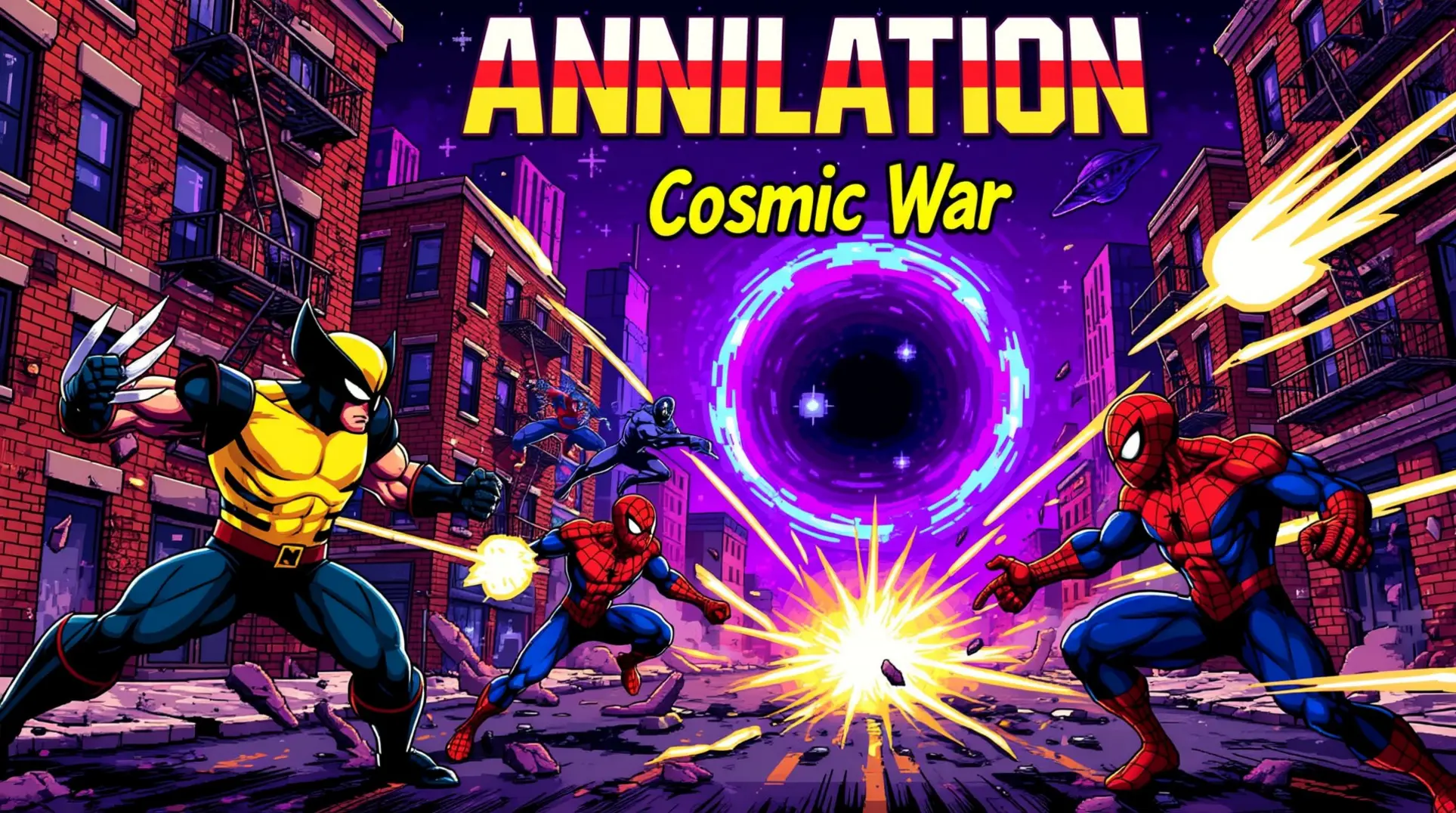
The 2006 Annihilation comics and the new Marvel Cosmic Invasion game tell the same cosmic war story in wildly different ways. One is a sprawling, gritty space opera; the other is a streamlined, nostalgic brawler. This breakdown explores how a galaxy-spanning epic was adapted into a weekend beat 'em up, and what was gained and lost in the translation.
Introduction: Two Versions of a Cosmic Epic
If you've read the original Annihilation comics, you're probably wondering how a sprawling space opera fits into a side-scrolling brawler. The 2006 comic event was a massive crossover that pulled in half the Marvel cosmic characters for a galaxy-spanning war, but the game takes a different approach. It's still Annihilus and his Wave, but everything's been refocused to work as a beat 'em up you can finish in a weekend.
Core Narrative Comparison
The comics threw you into a universe where the Annihilation Wave was tearing through the Kree, Shi'ar, and Skrull empires all at once. You had to follow multiple series just to keep track of Nova's squad, the Guardians' side missions, and whatever Ronan was up to on any given Tuesday. It was huge, and it expected you to do your homework.
The game doesn't have time for that, which isn't necessarily a bad thing. Marvel Cosmic Invasion condenses everything into a linear campaign where you're punching your way from New York City to the Negative Zone. The narrative designer apparently put together a specific reading list to capture the cosmic vibe, but they've stripped it down to the essentials: Annihilus is here, he's mad, and you need to stop him.
Key Lore Differences and Adaptations
The first thing you'll notice is the scope. The comics had the Annihilation Wave hitting multiple empires simultaneously with sub-plots for days, but the game narrows this to a manageable adventure with direct confrontations. You're not tracking Kree political drama; you're punching bugs in the Negative Zone.
Then there's the character roster. The comics could spend entire issues on Nova's PTSD or Star-Lord's leadership struggles, but the game picks an "all-star Marvel lineup" curated for combat variety. If your favorite character's arc was mostly dialogue-heavy, they probably got simplified or cut entirely.
Finally, the narrative structure itself has been rebuilt from the ground up. The comics used a multi-series format with main events and tie-ins, while the game adopts a linear campaign mode with levels and bosses. It's a straightforward pipeline: fight through a stage, beat the boss, move on. The complexity is gone, but so is the required reading list.
Thematic Fidelity and Creative Liberties
What They Kept
The core threat is intact. Annihilus is still a universe-ending menace, the Annihilation Wave still feels like an unstoppable force, and the cosmic heroes you do get still feel like they belong in space. The scale might be smaller, but the stakes feel familiar.
What They Changed
The political intrigue is the first casualty because you can't have a beat 'em up pause for a Shi'ar succession crisis. Character arcs are condensed into earned abilities and intro voice lines. Power levels are probably tweaked for balance, so don't expect a lore-accurate showing of every hero's full might. It's all in service of keeping the action flowing, which means some nuance gets left on the cutting room floor.
Scale & Scope: Epic War vs Streamlined Adventure
Annihilation Comics: Galaxy-Spanning Epic
The comic version is an absolute beast. We're talking a full-blown, galaxy-wide war against the Annihilation Wave - a relentless armada commanded by the bug-tyrant Annihilus. This isn't a self-contained story; it sprawls across a main series, a prologue issue, and multiple tie-in miniseries that each explore different corners of the conflict.
The invasion kicks off when the Wave smashes through The Crunch, a nasty spot where the Negative Zone bleeds into our universe. They immediately start swallowing star systems - the Kyln prison colony goes first, then neighboring sectors fall like dominoes. Before the heroes can even mount a defense, billions are dead and Xandar, homeworld of the Nova Corps, gets completely vaporized. This isn't just a big fight; it's a universe-defining catastrophe that permanently reshapes Marvel's cosmic playground, introducing key characters and factions while testing heroes and villains alike.
Marvel Cosmic Invasion: Condensed Action Campaign
Now flip to the game, and you'll see the scale gets... compressed. Marvel Cosmic Invasion takes that same epic premise but squeezes it into a tight, action-packed beat 'em up campaign running about 20 levels. Instead of tracking dozens of comics, you're playing through a focused three-front war that hits Earth, Asgard, and the Moon simultaneously.
The plot starts with the Annihilation Wave launching a surprise attack across all three fronts, which forces heroes from every corner of the cosmos to band together. While the comics kept things mostly in deep space, the game pulls in Earth-based Avengers and Asgardian realms, meaning you're not just playing as the cosmic oddballs - you're getting Spider-Man and Thor in the same roster. It's the same universe-ending threat, but delivered in quick, co-op friendly bursts rather than a months-long reading commitment.
Character Roles & Team Dynamics
Here's where the game starts pulling from Annihilation but remixes everything for beat 'em up action, and the character dynamics shift hard when you're controlling heroes instead of reading about them.
The Comic Origins: Three Arcs That Actually Mattered
Richard Rider's transformation into Nova Prime wasn't just a promotion - it was a complete evolution. After absorbing the entire Nova Force, he goes from being a lone survivor to commanding the United Front against the Annihilation Wave, and you feel every ounce of that responsibility weighing on him throughout the event.
Drax's story hits differently when you know the full context. He begins as pure vengeance, hunting Thanos for murdering his family, but his rebirth changes everything. When he chooses mercy over killing Ronan, that's not just a plot point - it's his first real step toward becoming something more than a destroyer, which is huge for his character.
And then there's Ronan the Accuser, whose arc might be the wildest of all. He starts as a Kree loyalist actually allying with the Annihilation Wave, gets captured and publicly humiliated, then completely flips sides. By the end, he's the new emperor of the Kree Empire. That's the kind of character depth the game simply doesn't have room for, unfortunately.
From Page to Playable: The 15-Hero Roster
Marvel Cosmic Invasion gives you 15 heroes to choose from, but it's a very different crew. While you still get cosmic heavyweights like Nova and Phyla-Vell, the game adds Earth-based Avengers - Spider-Man, Wolverine, and Captain America - who never appeared in the original Annihilation event.
The reason is pretty straightforward: beat 'em up gameplay demands familiar faces. Each character gets distinct playstyles and passive abilities designed for smashing through enemies, which completely changes the team dynamic from the comics' narrative-driven approach. You're not coordinating military strategies; you're picking the hero whose combos feel right for your playstyle.
What's Missing (And Why It Hurts)
This part stings for comic fans. The game completely cuts Silver Surfer, Ronan the Accuser, Drax the Destroyer, Gladiator, Beta Ray Bill, and Super-Skrull - basically half the cosmic powerhouses that made Annihilation epic.
But here's the trade-off: those Earth-based heroes broaden the game's appeal. While the omission leaves a noticeable gap in cosmic authenticity, adding Spider-Man and Wolverine gives casual players an entry point. It's a hybrid roster that sacrifices lore depth for accessibility, and honestly? For a co-op beat 'em up, that compromise makes sense even if it disappoints purists.
Narrative Tone & Thematic Differences
Comic: Gritty Cosmic Horror
The 2006 Annihilation comic event didn't just tell another cosmic story - it redefined Marvel's entire universe with a gritty, military sci-fi war narrative that pulls no punches. This is serious cosmic horror territory, where the Annihilation Wave isn't a foe you can punch into submission; it's a coordinated genocide that extinguishes entire civilizations, and you feel the weight of every lost world. Characters get destroyed in ways that matter: Nova transforms from your friendly neighborhood space cop into a war-weary leader making impossible choices while friends die around him. Even death isn't clean - Drax gets killed early and resurrected through unnatural means, which just makes everything more visceral and wrong. When cosmic titans like Silver Surfer and Galactus are captured and enslaved, you realize the stakes aren't just high; they're existentially terrifying. The whole narrative keeps asking if any victory is worth the cost, and most answers are Pyrrhic at best as you watch galaxies burn and suffer permanent scars.
Game: 90s-Style Heroic Adventure
Now flip to the game side, where Marvel Cosmic Invasion - and yeah, they didn't even call it Annihilation - goes in the complete opposite direction. This is premium-grade 90s comic book cheesiness. IGN describes it as "exactly what 90s kids want it to be," and they're not wrong. You're getting Spider-Man, Captain America, and Wolverine in beautiful pixel art, smashing through aliens with fluid combat and zero emotional baggage. The writing leans hard into the wit and bravado of that era, so instead of watching heroes break under cosmic horror, you're cracking jokes while throwing baddies through walls. There's no permanent consequences, no destroyed worlds haunting your conscience - just pure, nostalgic heroics where the good guys always feel like they can win. It's a love letter to when comics were campy, high-energy fun, and honestly, that's exactly what makes it work.
Annihilus: Complex Conqueror vs Straightforward Boss
The biggest letdown is how the game flattens Annihilus into a generic warlord. In the comics, he's driven by pure existential terror - the normal universe is literally shrinking his Negative Zone home, which means he's invading to reclaim what was stolen from him. That's a motivation you can almost understand, even if his methods are pure nihilism.
But the game strips all that nuance away. You're told he's just paranoid about living beings and wants to wipe them out, with no mention of the Negative Zone instability that makes the comic version so compelling. Sure, he still uses the Cosmic Control Rod to dominate and extend his lifespan, but the narrative depth is gone.
Instead of a villain with real motivations, you're fighting a final boss on NYC rooftops where the focus is on multi-phase mechanics: break his shields, dodge meteor patterns, repeat. The fight looks cool, but it feels like you're battling a set piece rather than a character.
Thanos: Manipulator vs Mid-Game Boss
Then there's Thanos, and this is where the game really misses the mark. In the comics, he's playing 4D chess - he allies with Annihilus not because he believes in the cause, but because he thinks it'll impress Death. Unfortunately for him, Annihilus is actually planning to destroy all life in both universes, which turns the Mad Titan into a manipulated pawn rather than a mastermind.
Thanos tries to betray Annihilus by freeing Galactus, but Drax kills him before he can pull it off. It's a brutal end that fulfills Drax's entire purpose for existing.
In the game? Thanos shows up as a mid-game boss at the end of Sanctuary II: The Great Experiment. There's no hint of his comic role as Annihilus's reluctant ally - he's just a big bad you need to beat to earn the Mad Titan Thwarted trophy. He's a gameplay milestone, not a narrative manipulator.
Additional Villains & Subplots
The game doesn't stop at adapting existing characters - it adds its own villains too. You've got the Queens of Annihilation: Consumption, Fracture, Mistress of the Web, and The Unseen. These aren't from the comics, but they're inspired by the Annihilation event and give you fresh challenges to chew through.
Then there's Knull, the symbiote god. He wasn't in the original Annihilation comic at all, but he shows up as a boss in the game. It makes sense since symbiotes are a big part of the game's lore, though he doesn't get much screen time in the story's conclusion.
So while the game does a decent job with some characters like the Annihilation Wave, these original additions feel like they're there to pad out the boss roster rather than serve the narrative.
Ending & Consequences: Bittersweet vs Triumphant
The endings pull in completely opposite directions - one leaves the cosmos in ruins, the other lets you ride off into the stars. Here's how they split.
Comic Ending: Sacrifice & Lasting Impact
The comics don't give you a clean win. The Annihilation Wave is stopped, but the bill is brutal and it comes due immediately. The entire Nova Corps is wiped out, which leaves Richard Rider as the last Centurion standing - a lonely guardian with the power of an entire police force rattling around in his helmet. And here's the kicker: Drax the Destroyer straight-up kills Thanos, a moment that shatters the cosmic power board completely. This isn't a feel-good finale; it's a pyrrhic victory that directly tees up Annihilation: Conquest, because the universe is now vulnerable, leaderless, and crawling with new threats ready to fill the void.
Game Ending: Heroic Victory & Sequel Hooks
The game plays things way more heroic. Before you even get to Annihilus, you and Phyla-Vell have to cut through the three Queens of Annihilation - Extirpia, Eradica, and Exermina - at the Heteropteron breeding facility. It's a multi-stage gauntlet that feels like clearing the board before the final boss. Once that's done, the real fight begins, and you actually win. Silver Surfer, now free from Control Bugs, manages to liberate Galactus, whose raw power helps turn the tide and crush the invasion for good. Stick around for the credits and you'll catch a post-credits scene teasing a new armada mobilizing - so while the day is saved, the devs are definitely leaving the door cracked for more cosmic chaos.
Cosmic Universe Impact Comparison
Here's where the two versions really diverge. The comics fundamentally rewired Marvel's cosmic landscape, spawning new series and events like Annihilation: Conquest and War of Kings - the whole continuity shifted because of the power vacuum left behind. The game, on the other hand, is a much lighter, self-contained story that serves as an easy entry point without messing with established lore. While the comic's aftermath created lasting consequences and real geopolitical (or cosmo-political) fallout, the game's ending is optimistic and has minimal impact on the wider universe. You get your heroic moment, then you move on.
Adaptation Choices & Creative Liberties
Gameplay-Driven Narrative Changes
The Annihilation comics were this massive cosmic opera focused on Nova and Silver Surfer wrestling with galaxy-ending threats, but you can't exactly turn that into a four-player brawler without some heavy chopping. So the developers condensed the whole sprawling conflict into digestible side-scrolling levels where you're just punching through the Annihilation Wave.
But here's where things get interesting - while the comics never left deep space, the game pulls you back to Earth with stages set in New York City. And that roster expansion? It's a big one. They brought in Spider-Man, Wolverine, and Captain America, which makes total sense when you need recognizable faces for a co-op beat-'em-up. Sure, the cosmic purists might grumble, but you can't sell a four-player couch game with just obscure space cops.
Accessibility for New Players
Let's be honest - Marvel's cosmic lore can be intimidating with all its Kree-Skrull politics and ancient space gods. The game knows this, so it ditches the dense political maneuvering and just tells you "big bug army invades, go punch them." That's it. You don't need a PhD in intergalactic relations to enjoy the ride.
The Earth heroes help here too. Spider-Man's web-slinging and Iron Man's repulsor blasts feel familiar right away, so you're not struggling with weird alien combat styles. The controls are intuitive and forgiving, plus there are difficulty settings that won't punish you for trying a solo run. It's the kind of design that lets casual players jump in without feeling lost.
Nostalgia & Fan Service Elements
The visual style is where the developers get clever. They're channeling that X-Men '97 energy - dark, high-stakes lore but wrapped in a retro cartoon aesthetic that hits you right in the nostalgia. It's a weird blend on paper, but it absolutely works.
And while they're adding Earth heroes, they're not forgetting the source material. Nova (Richard Rider) and Phyla-Vell as Quasar are front and center, which is a genuine love letter to the original Annihilation event. The real fan service though? That Cosmic Swap tag system. You can switch between two heroes mid-fight, pulling off combos that feel straight out of classic Marvel team-up comics. It's the kind of mechanic that makes you want to experiment with every possible duo just to see what happens.
Conclusion: Which Version Should You Experience?
For Comic Purists: Stick to the Source Material
If you're a comic purist, the answer's simple: stick to the source material. The 2006-2007 Annihilation event is a massive crossover that revitalized Marvel's cosmic lineup, and it's widely considered one of their most significant space sagas. You'll get the full, nuanced war between Annihilus's Annihilation Wave and heroes like Nova, Silver Surfer, and Ronan the Accuser - proper character development and all - which is something the game can only simplify. It's a rich, interconnected storyline that delivers the depth and impact the game can only hint at.
For Gamers & Casual Fans: Enjoy the Adaptation
If you're a gamer or casual fan, the game is a great entry point. Marvel Cosmic Invasion is a side-scrolling beat 'em up that captures the epic scale of the Annihilation Wave by blending classic arcade brawling with deep cosmic lore, which makes it super accessible for newcomers. The story's a "succinct but fun romp through comic lore" that keeps the essence of a galaxy-ending invasion while streamlining it into action-packed gameplay. It's perfect if you want action-heavy fun with Marvel heroes, and the comic lore is just bonus context.
Official Comic Reading List for Game Fans
If the game hooks you and you're hungry for more, Narrative Designer Yannick Belzil has you covered with an official reading list. These aren't random picks - they directly shaped the game's storyline and character portrayals, so they're basically the narrative blueprint. Here's what he recommends:
- Annihilation Omnibus (2022)
- Guardians of the Galaxy (2008-2010)
- Avengers by Busiek & Perez Omnibus Vol. 1 (2023)
- Beta Ray Bill (2021)
Ultimately, your choice depends on what you're looking for. For deep, character-driven cosmic horror, the original Annihilation comics are essential. For a fun, accessible, and action-packed Marvel romp, the game delivers perfectly. Both are valid ways to experience a universe-ending invasion, just on very different scales.
More marvel-cosmic-invasion Guides
Marvel Cosmic Invasion: The Ultimate Cosmic Cube Location Guide
Find all 16 Cosmic Cubes in Marvel Cosmic Invasion to unlock the Cosmic Cubist achievement and maximize the Cosmic Matrix reward board.
Ultimate Marvel Cosmic Invasion Cosmic Matrix Guide: Unlock All 101 Rewards
Master the Cosmic Matrix reward system in Marvel Cosmic Invasion. Learn how to earn Cosmic Cubes, unlock hero palettes, and get the Matrix Maven achievement with our complete guide.
Ultimate Marvel Cosmic Invasion Guide: How to Farm Cosmic Cubes Efficiently
Master Cosmic Cube acquisition with our complete guide covering campaign challenges, the Beta Ray Bill exploit, and smart spending strategies for maximum rewards.
AI Tactical Companion
Consult with our specialized tactical engine for marvel-cosmic-invasion to master the meta instantly.