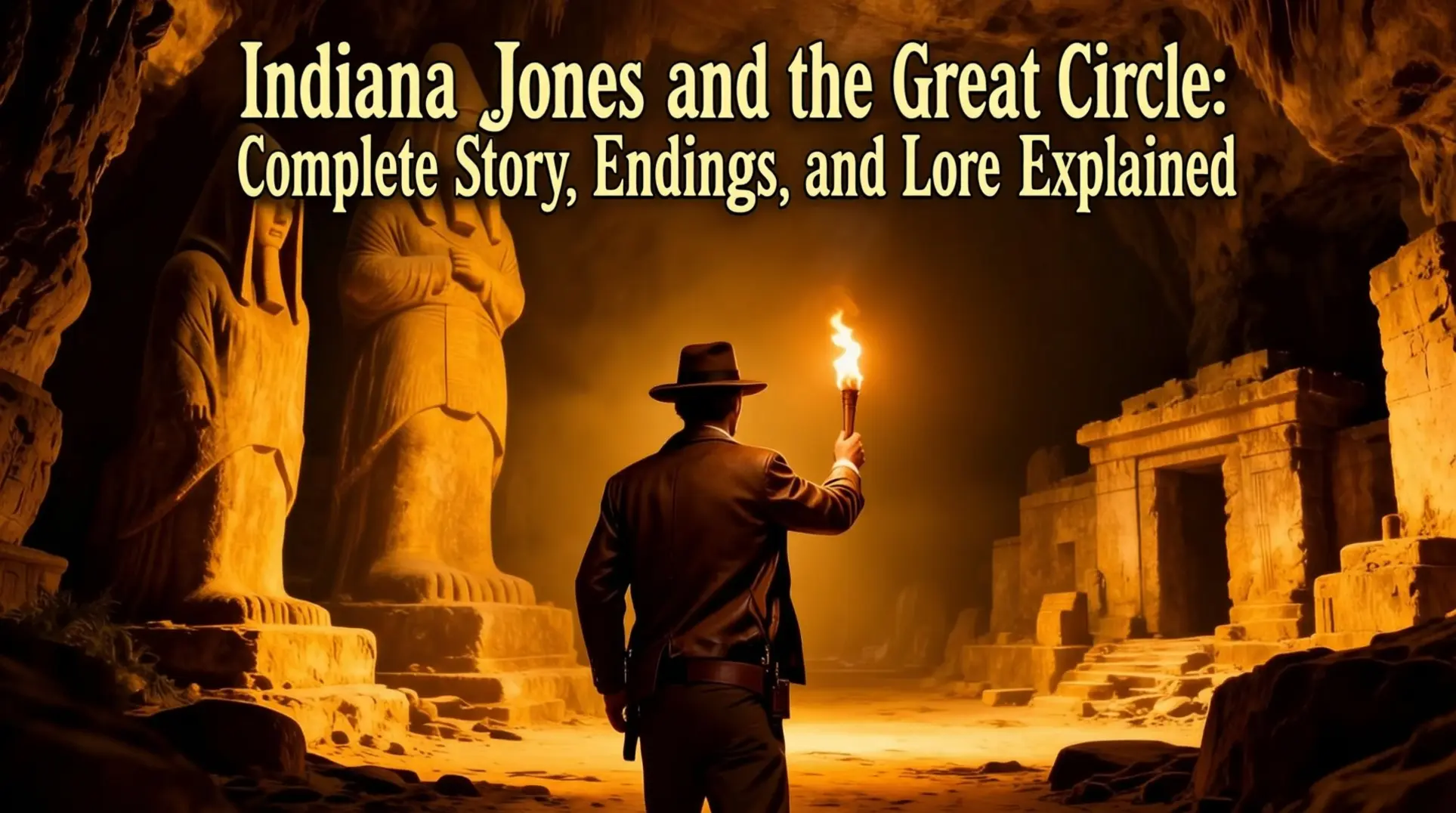
Indiana Jones and the Great Circle: Complete Story, Endings, and Lore Explained
Introduction
Indiana Jones and the Great Circle carves out a thrilling new chapter in the iconic adventurer's life, set squarely in the unexplored year of 1937. This story bridges Raiders of the Lost Ark and The Last Crusade, pitting a solitary Indy against a new Nazi threat obsessed with a biblical superweapon. We'll break down the complete story, its secret endings, and how it masterfully expands the franchise's lore.
The Complete Story Summary: 1937 Adventure Between Raiders and Last Crusade
Timeline Placement: The 1937 Gap Year
The game plants its flag right in the sweet spot: 1937, which puts it exactly one year after Raiders of the Lost Ark and one year before The Last Crusade. That narrow window matters more than you'd think. It gives MachineGames room to craft a full-throttle Indy adventure without stepping on the movies' toes - no need to explain why Marion isn't around or why Henry Sr. never calls.
This timing also paints Indy in a specific light. He's 38, still shook from staring into the Ark's face-melting light show, and he hasn't patched things up with his dad yet. So don't expect any warm father-son subplots; they've deliberately sidestepped that whole mess. You're getting a rawer, more solitary Dr. Jones - professor by day, relic-hunter by night, still processing the supernatural trauma of 1936.
The developers mostly stick to the period, though eagle-eyed players have spotted ammunition stamped with 1939 dates. Before you start screaming 'retcon,' those look like production goofs, not secret lore clues. And since the story unfolds before the events of Last Crusade, you won't see Henry Jones Sr. or hear more than passing references to him. The focus stays tight on Indy's immediate circle and the fresh faces pulled into this new crisis.
Main Story Beats: From Museum Heist to Ziggurat of Ur
It all kicks off when a towering thief named Locus crashes into Indy's museum and snatches a cat idol. That isn't just a random artifact - it's one of 17 stones that form the Great Circle, a globe-spanning network the Nephilim Order has guarded for millennia. Indy gives chase, and before you know it, you're neck-deep in a race against the Third Reich.
The Nazi side is led by Emmerich Voss, an SS-Sturmbannführer who runs the Special Antiquities Collection. He's not your typical Indy villain - Voss is polished, psychologically cruel, and treats every conversation like a chess match. He keeps dossiers on everyone, which means he knows your weaknesses before you even speak. While Indy and Italian reporter Gina Lombardi hop from the Vatican to Egypt, the Himalayas, Shanghai, and Sukhothai, Voss is right behind them, torturing locals and snatching relics out from under their noses.
Nephilim Order sigils start popping up inside dig sites, making it clear the Nazis aren't the only players. The deeper you go, the more the mystery unravels. Late-game tablets and a Vatican archivist spill the truth: the stones are tuned to resonant frequencies that open a path to Noah's Ark. Voss doesn't want it for the historical value - he wants to weaponize its 'cleansing flood' power, wiping enemy cities off the map while leaving Nazi bases untouched.
You'll face Voss directly twice: once in a flooded Sumerian vault where you slug it out up close, and again in a brutal, nearly twenty-minute brawl on a zeppelin. The final showdown happens in a Rome underground basilica, where Indy, Locus, and Order guardians hold off Waffen-SS reinforcements while Voss performs the activation ritual. When the Ark chamber floods with luminescent mist, Indy does the only thing he can - he topples the central obelisk, collapsing the whole chamber and apparently burying both the Ark and Voss under tons of rubble.
Voss's fate is left hanging. In the rubble, you see a gloved hand clutching a cracked Order medallion, which strongly hints he survived. After the dust settles, the U.S. government swoops in and confiscates Indy's notes (sound familiar?), but Marshall College re-hires him, leaving the door open for more adventures. And if you stick around for the DLC teaser, you'll see surviving Order members loading a second reliquary onto a cargo plane - so the Circle isn't fully drawn yet.
Key Characters and Their Roles
Indiana Jones (voiced by Troy Baker) is 38 and carrying the weight of the Ark's revelation. He's still separated from Marion, still untangling his father issues, and very much a man who's seen too much to fully trust any government - or any supernatural artifact.
Gina Lombardi is an Italian investigative reporter who latches onto the story for personal reasons: she's hunting for her missing sister, Laura. Her investigation intertwines with Indy's quest, and in a neat bit of Chekhov's gun, her sister's hairpin becomes the tool that frees the whole crew from Nazi bindings in the finale.
Locus (voiced by the late Tony Todd) starts as an antagonist but flips once he realizes Voss is the real threat. He's a hulking member of the Nephilim Order, and his arc ends with a massive sacrifice: he steers the Ark's vessel into a sky vortex to hide it from mankind. The post-credits scene shows the Ark in Antarctica with large footprints in the snow, suggesting Locus survived and is somehow still guarding it.
Emmerich Voss is the standout villain - a Nazi who uses charm and psychological warfare instead of just brute force. His final taunt to Indy - 'You found the Ark of the Covenant, yes, but I found Noah's Ark!' - perfectly mirrors the awe and obsession that drove Raiders. The secret ending doubles down on his survival: a gloved hand closes a leather journal stamped with the SS-Ahnenerbe logo, implying the Great Circle is only half-drawn and Voss is already planning his next move.
The Main Ending: Noah's Ark Revelation and Final Confrontation
Ziggurat of Ur Finale and Noah's Ark Discovery
The whole journey slams right into the Ziggurat of Ur in Iraq, which the Nazis have converted into a full-blown excavation camp. Inside the ziggurat's innermost chamber, buried beneath ancient bricks, you'll find the real prize: Noah's Ark. But this isn't the biblical boat from Sunday school - it's a massive geo-engineering device that literally 'sails' above the earth, powered by the Great Circle stones you've been chasing.
Here's where it gets wild: those stones aren't just artifacts, they're stops for Noah's Ark. They form a planetary ring that manipulates gravity and inertia, locking into the Ark so it could travel the globe during the flood, gathering pairs of animals. It's a clever piece of lore that reimagines the entire flood narrative as advanced ancient technology rather than divine intervention, which means the final puzzle solution isn't just about stopping the Nazis - it's about preventing them from rebooting a pre-biblical superweapon.
Voss's Demise and the Ark's Fate
Emmerich Voss thinks he's won when he slots all seventeen Great Circle stones into the Ark's wheel and starts reciting the Adamic language, but activation doesn't go as planned. The Ark summons the Great Flood inside itself, unleashing a catastrophic storm that fills the chamber. Locus, that mysterious entity who's been lurking in the background, actually warns Voss to move out of harm's way before striking him down with lightning - so Emmerich Voss's death is both brutal and humiliating.
After Voss dies, Locus immediately seizes control of the Ark and steers it through a portal straight to Antarctica. The relic ends up buried in an uninhabited part of the world, completely unreachable. Concept art even shows an alternate fate where Voss gets trapped alive underwater beneath an ice sheet as the Ark drifts away without him, which makes his actual lightning-charged demise look merciful by comparison.
Post-Credits Scene and World War II Foreshadowing
Days after the chaos, you'll catch up with Indy and Gina Lombardi on a Mediterranean shore. It's March 1938, and the world is holding its breath - you can actually hear a low-volume BBC German broadcast on a radio mentioning the recent Anschluss (Germany's annexation of Austria). Gina's departure comes when she turns down Indy's offer to travel to the United States, telling him she'll follow the next story instead.
She warns that the world won't stay quiet, which is journalist-speak for 'I'm about to expose all the Nazi's supernatural activities before the war breaks.' This neatly explains why you won't see her in the films - she's continuing her anti-Fascist work in Europe right up until The Last Crusade, and the whole scene serves as World War II foreshadowing that reminds you the clock is ticking toward global conflict.
The Secret Ending: How to Unlock and What It Reveals
Requirements: Collect All 50 Ancient Relics
Here's the deal - if you want to see the real ending, you can't skip the collectible hunt. You need all 50 Ancient Relics before you even think about finishing the game, which means sweeping every corner of the four major hubs. The Vatican holds 9, Gizeh has 14, Sukhothai hides 12, and Iraq contains 15 of them. The kicker? That final Iraq relic only spawns after you beat the main story, tucked inside a now-accessible tent in the Ziggurat of Ur, so you'll need to backtrack.
Once you nab the fiftieth piece, you'll pop the 'Riddles of the Ancients' achievement, and the game will flag your save as ready for the secret vault and post-credits stinger. Relics aren't just lying around screaming for attention, either - they emit a soft coin-chime sound when you're within about three meters, so headphones are basically mandatory. Rotating your camera helps pinpoint the direction, and if you're really stuck, you can exploit Photo Mode to clip through walls and spot them hiding in dark corners.
Ziggurat Secret Vault Puzzle Solution
Inside the Secret Vault, you're staring down four massive Nephilim mural rings - each representing Lion, Bull, Serpent, and Scorpion. The goal sounds simple: rotate the rings until every recessed slot lines up so you can slot in your relic silhouettes and fill the entire diagram. In practice? It's a spatial nightmare.
You'll need to physically place relics into matching mural slots, and each one can be rotated right or left. Turning a relic right fills the cardinal-direction lines (up, down, left, right), while turning it left fills the circles around the relic itself. The good news is there are multiple valid solutions, so you're not locked into one 'correct' pattern. The bad news is the in-game notes are cryptic as hell - phrases like 'Sunrise births the Lion' mean the Lion mural should face right, and 'Waters cradle the Serpent' hints that the Serpent body needs to form a sideways 'S'.
If you want the exact numbers, the community-solved pattern breaks down like this: Diagram 1 needs 11 relics (placements like D1 right, A3 left, C5 left, M5 right), Diagram 2 needs another 11, Diagram 3 needs 13, and Diagram 4 needs 14. That's 49 relics total across all four diagrams, so you'll use almost your entire collection.
Secret Ending Content: Gina's Survival and DLC Tease
The post-credits stinger hits different. You see Gina Lombardi - yes, alive - in a torch-lit catacomb, brushing dust off a colossal fossilized femur that's roughly three meters long. A gloved hand (clearly an ally) reaches into frame, and a voice-over teases future locations like the Himalayas, setting up the next chapter.
That femur isn't just a random bone, either. It's etched with the 'Great Circle' star-map sigil you saw on the Vatican electromagnetic spindle, which reframes the whole mystery as a global ley-line network designed to triangulate burial sites of a pre-human giant race. Gina's notebook adds more fuel to the fire: there's a sketch of a retractable grappling hook and coordinates pointing to the Baths of Caracalla, hinting that the 'Order of Giants' DLC will focus on vertical tomb-raiding mechanics when it drops in late Q2 2026.
Lore and Timeline Connections to Indiana Jones Films
Connections to Raiders of the Lost Ark (1936)
The game kicks off in 1937, literally one year after Indy barely survived the opening of the Ark of the Covenant, and MachineGames wastes no time tying those threads together. You're not just hearing about Raiders - you're standing in its shadow.
The Great Circle's entire mystery revolves around a proto-Ark, an older, weirder version of the same artifact, tucked inside a flooded ziggurat in Iraq. This isn't just a callback; it's the engine driving the plot. The climax even mirrors Raiders beat-for-beat: instead of angels of death melting faces, you get a biblical flood drowning every villain in the chamber when the artifact opens. Indy survives because the Nephilim Order teaches him a protective chant, which feels like the logical next step after 'close your eyes' stopped working.
Here's how the game directly echoes and expands on that 1936 adventure:
| Raiders of the Lost Ark Element | The Great Circle's Twist |
|---|---|
| Ark of the Covenant | Proto-Ark hidden in Iraq, revealed as the 'true' source |
| Divine fire melts Nazis | Divine flood drowns fascists when opened improperly |
| 'Close your eyes' | Chant taught by Nephilim Order (more complex, same idea) |
| 1936 adventure | Set in 1937, directly referenced as 'last year' |
The Great Circle concept itself - this global alignment of ancient sites - retroactively deepens why the Ark was so powerful in the first place. It wasn't just a radio for talking to God; it was a battery connected to a worldwide network.
Setup for Last Crusade (1938)
MachineGames basically left breadcrumbs for the Grail quest two years early, and you can miss them if you're not paying attention. The environmental storytelling here is chef's kiss.
In Tuscany, you'll stumble across shipping manifests at a dig site stamped with DONOVAN INDUSTRIES - PATERSON, NJ. That name shouldn't mean anything yet, but it will. These documents prove Walter Donovan was bankrolling fascist archaeology operations in 1937, long before he invited Indy to join his Grail Commission.
Dig deeper into the Vatican archives and you'll find the Ahnenerbe Letter - a personal message addressed to 'Herr W. Donovan' that explicitly mentions a 'Grail Commission.' The letter confirms Donovan's obsession with immortality artifacts started here, not in 1938.
Then there's the Venice catacombs sequence where Indy mutters, 'If the Grail's down here, it's gonna be the least fancy one.' That's not throwaway dialogue; it's foreshadowing his father's later clue about the 'cup of a carpenter' and Donovan's eventual, fatal mistake.
The smoking gun comes in the post-credits scene: a shadowy boardroom in Paterson, New Jersey, where a voice (clearly Donovan's) orders his team to 'prepare the Grail team.' The date stamp? 1937. The game doesn't just nod at Last Crusade - it builds the foundation.
Nephilim Order and Biblical Mythology
This is where the lore goes absolutely wild. The Nephilim Order isn't some throwaway cult; they're a secret monastic society of actual giants, reimagined as the descendants of fallen angels who survived the Great Flood. Their mission? Safeguarding Noah's Ark.
But here's the twist: Noah's Ark isn't a wooden boat - it's a powerful artifact with 17 stones that can 'fold the earth,' essentially teleporting anywhere to gather animals. This retcon explains how a single vessel could collect every species: it didn't sail, it warped.
The secret ending drives this home. After the credits, you see the proto-Ark - with Locus trapped inside - portal-travel to Antarctica. That's not a random location; it's a direct setup for the Order of Giants DLC, which drops in September 2026 and features a Vatican pyramid plus the Nephilim Augur himself.
Even the base game was laying groundwork. The Secret of Giants collectible (10 inscriptions hidden across levels) retcons every major location into Nephilim 'Stations,' revealing their global reach wasn't coincidence - it was infrastructure. You thought you were exploring random ruins? Nah, you were walking through their subway system the whole time.
Thematic Analysis: History vs. Mythology
Here's the thing: Great Circle actually wrestles with the central tension of Indy's character instead of just paying lip service to it. The whole adventure builds on real 1930s ley-line theories and period-accurate field notes, which gives the pseudo-science just enough credibility to make you question where archaeology ends and occultism begins. You're not just collecting artifacts; you're debating whether these patterns are historical coincidence or something... else.
That debate gets literal halfway through when you unlock the spectrographic filter for Indy's compass. Suddenly you're seeing glowing ley lines cutting across the map, and while it's visually cool, it also muddies the water. Is Indy following empirical evidence, or is he using a dowsing rod with extra steps? The game never quite lets you off the hook.
Then the final encounter at the Bolivian observatory forces your hand. Align the dials to the 1937 stellar ephemeris and you get a grounded archaeological discovery - neat, tidy, peer-reviewed. Slot in the crystalline prism instead and you'll trigger the full star-gate sequence, complete with cosmic light show. The game even tracks your choice with separate trophies: 'Peer Review' for the history path, 'Chariots of the Gods' for the myth. It's a small touch, but it means your version of Indy gets defined by which answer you find more compelling.
Character Arcs: Indy's Development Between Films
Set in 1937, this story slots perfectly between Raiders and Last Crusade, and you can feel the weight of that gap in every decision. This isn't quite the wide-eyed Indy who opened the Ark, but he's not yet the grumpy professor chasing the Holy Grail either. He's somewhere in the middle, and the game lets you nudge him in either direction.
The skill tree and optional dialogue choices are where this really shines. You can have Indy return a priceless artifact to its curator instead of fencing it, which feels like the mentor he'll become in Last Crusade. Or you can be a selfish treasure hunter - both work, but one path feels like you're actively building the character we see on screen later. The 'Order of Giants' DLC doubles down on this by sticking you with journalist Gina Lombardi, and Indy's reluctant tutelage mirrors his future dynamic with Marcus Brody and even his dad. He's learning, slowly, that he can't fly solo forever.
The real kicker comes from Indy's handwritten journal entries, where you learn he quietly sent Marion her cut of the Peruvian gold idol money. That one detail recontextualizes his whole cavalier attitude in Raiders and makes their eventual reunion hit harder. It's not just fan service; it's character work that makes the films feel richer.
Future Implications and DLC Setup
The Order of Giants DLC Tease
If you've been collecting those Celestial Spindle-whorls, you've probably wondered what they're really for. Turns out, grabbing all 12 unlocks a post-credit stinger in a Vatican archive where you'll spot a crate stamped with a swastika - that's your first real hint at what's coming.
The secret ending itself shows a cardinal filing a report labeled 'Order of the Giants - re-established 1938' next to a blueprint for a massive brass automaton. This isn't just flavor text; it directly ties into the DLC's premise that surviving Nazi scientists have gotten their hands on a second Nephilim artifact. When you boot up The Order of Giants, the opening cinematic recaps that vellum map from the main story - you know, the one with the crude ink-sketch of the Himalayas, the monastery 'Rongbuk,' and that impossibly large human femur Indy was chasing. MachineGames has confirmed you'll get a new fast-travel node called 'High Pass, Tibet' added to your globe-trotting menu once you hit Chapter 6, and this new valley is roughly the size of Gizeh's dig-site.
And that femur? It's not just a prop. The thing is a 1.8-meter bone you have to drag in both hands, which means your whip and pistol are disabled until you set it down. It functions as a crank handle that unlocks a 13th-century portcullis frozen into a glacier wall, so you're basically lugging around a key that weighs as much as Indy does.
Unanswered Questions and Loose Ends
The DLC clears up some mysteries but leaves others hanging. Take Laura Lombardi - she's mortally wounded when the Ark-Nephilim device backfires, dies in Indy's arms, and whispers an apology for her earlier Nazi collaboration. Indy mails her field notebook to her sister Gina to make sure history remembers Laura as a resistor, but her ultimate fate still feels unresolved.
Then there's the Nephilim themselves. The Order has supposedly guarded the keys to Noah's Ark for well over a thousand years, but the DLC reveals two Nephilim tombs - the Nameless Crusader and the Monster of Crete - which suggests the Order's history is way more complicated than we thought.
And what about that warehouse from Raiders of the Lost Ark? The Ark fragment that powered Voss's Nephilim device was recovered from there, which raises serious questions about how secure that government facility really is. If Nazis can just walk in and grab pieces of the Ark, what else is walking out the door? MachineGames isn't committing to full supernatural canon yet, though. A post-credit voicemail from Marcus Brody hints that the giant femur's carbon-date is 'off the charts,' teasing the Nephilim's reality without giving us a definitive answer.
Franchise Future: Where Indy Goes Next
So where does Indy go after this? The game is set in 1937, which puts it two years before WWII, and Gina's dialogue is full of sharp wit about Mussolini's tightening grip and anti-press crackdowns that clearly foreshadow the coming global conflict.
In her post-credit scene, Gina mails her finished exposé to an editor in New York while hinting that 'the real story is only beginning,' which could set her up as Indy's new companion in a sequel. MachineGames producer Craig Derrick has even called Gina 'Indy's new companion' - phrasing that practically invites return appearances.
Should a sequel push into 1939-1945, the same engine could reuse assets while adding London blitz sequences or North Africa campaign dig sites, and Gina's dialogue would naturally evolve from pre-war cynicism to full-blown resistance rhetoric. The franchise normally advances one to three years per installment, so a 1939 or 1940 setting would be historically appropriate and give us a front-row seat to Indy's wartime adventures.
Final Verdict: A Worthy Addition to the Canon
Critics have already landed on a consensus: this is the second-best Indiana Jones game ever made, trailing only Fate of Atlantis, and it's arguably the best Indy story we've gotten this century. That's high praise, but it's earned. Troy Baker's voice performance nails Harrison Ford's cadence without feeling like an impersonation - by the first hour, you've forgotten anyone else ever played the part.
The secret ending CGI teaser seals the deal. After the credits, you can find a second warehouse crate stamped 'ORDER OF GIANTS – 1939' with a reptilian eye glowing inside. It's not a sequel hook; it's MachineGames waving a flag that says we're expanding this story through DLC, not a whole new game. That's refreshing in an era of cliffhangers, and it means the world they've built here has room to breathe.
So yeah, Great Circle doesn't just fit into the canon - it actively makes the canon better.
Conclusion
The Great Circle succeeds by doing more than just fitting into Indy's timeline - it enriches it. Through clever foreshadowing, deep character work, and a lore-expanding secret ending, the game proves itself a worthy successor to the classics. It leaves the door wide open for future adventures, ensuring the world's favorite archaeologist has plenty of ground left to uncover.
More indiana-jones-and-the-great-circle Guides
Indiana Jones and the Great Circle: The Ultimate Guide to Every Secret, Easter Egg, and Hidden Detail
Uncover every movie callback, developer signature, and community discovery in Indiana Jones and the Great Circle. From the Staff of Ra puzzle to the 100% completion reward.
The Ultimate Guide to 100% Completion in Indiana Jones and the Great Circle
Complete guide to finding all 333 collectibles in Indiana Jones and the Great Circle. Learn strategies, locations, and tips for 100% completion.
Indiana Jones and the Great Circle: A Comprehensive Analysis of Narrative, Symbolism, and Ethics
A deep dive into the pseudo-scientific mythology, complex narrative layers, and ethical dilemmas of Indiana Jones and the Great Circle video game.
AI Tactical Companion
Consult with our specialized tactical engine for indiana-jones-and-the-great-circle to master the meta instantly.