Dyson Sphere Program Oil Processing Guide: From Crude to Casimir
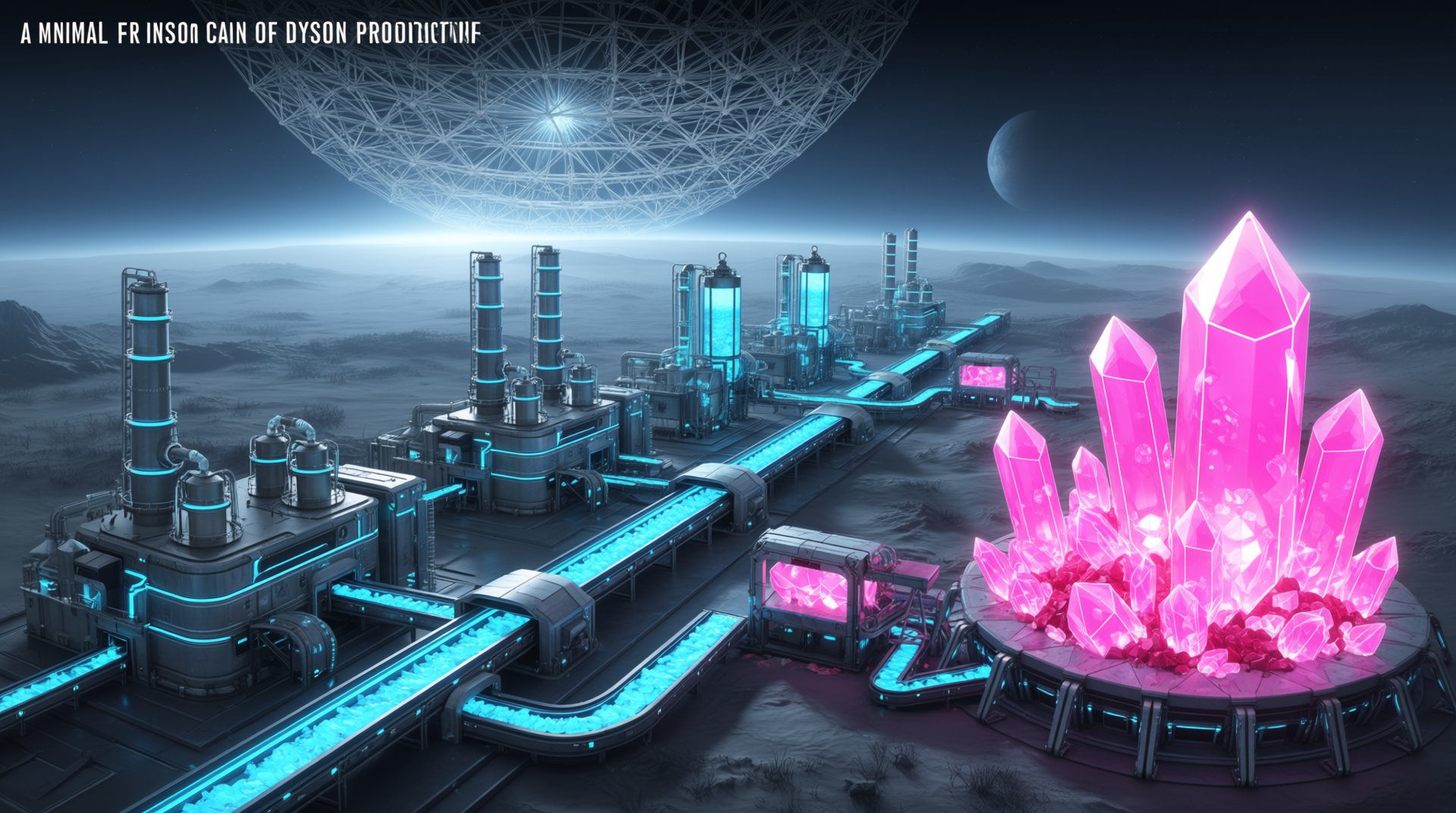
Oil processing in Dyson Sphere Program evolves from a simple fuel source into a complex industrial backbone. Mastering this progression is essential for scaling from early power generation to late-game megabase production. This guide walks you through each stage, from basic burning to advanced hydrogen loops, providing the ratios and blueprints you need to build efficiently.
Oil Processing Fundamentals: The 4-Stage Progression
Stage 0: Direct Burning (Pre-Research)
Before you get your hands on refining tech, you can just... burn it. Crude oil works as fuel in Thermal Power Stations, and while it's not elegant, it keeps the lights on early game.
Here's what that looks like in practice:
| Input Rate | Gross Power | Net Power (80% eff.) | Consumption |
|---|---|---|---|
| 2 crude/s | 6.4 MJ/s | 5.12 MJ/s | 40 crude/min per TPS |
The math works out to about 3.24 MJ of useful energy per crude oil, which actually isn't terrible for a starter fuel. It's dirty and inefficient, but it'll bridge the gap until you've got your first matrix lab churning out red cubes.
Stage 1: Plasma Refining (Red Matrix Cubes)
The first real refinery recipe will cost you 100 red matrix cubes in research, and it's worth every one. Plasma Extract Refining turns 2 crude oil into 2 refined oil and 1 hydrogen every second.
The beauty here is the 1:1 ratio: one oil extractor pulling 2 crude/s feeds exactly one refinery. No complicated math, no belt balancing headaches. The refined oil heads straight to sulfur production for plastic, while that hydrogen becomes fuel for your mecha or feeds directly back into making more red cubes.
Stage 2: X-Ray Cracking (Blue Matrix Cubes)
Here's where the magic happens. You'll need 400 red cubes to grab X-Ray Cracking, which takes 2 refined oil + 1 hydrogen and converts them into 3 hydrogen and 1 energetic graphite every 4 seconds.
You're probably thinking 'wait, I put hydrogen in and get more hydrogen out?' Yep. The loop nets you +2 hydrogen per cycle, turning oil into a hydrogen fountain. The ratio is simple: one plasma refinery feeds two cracking refineries. That extra hydrogen powers your blue cube production and sets you up for late-game expansion. The graphite byproduct isn't bad either - it belts straight into making more red cubes or steel smelting.
Stage 3: Reforming Refine & Advanced Processing
Late-game opens up Reforming Refine: 2 hydrogen + 1 coal → 2 refined oil + 1 energetic graphite. Pair this with X-Ray Cracking and you get a self-sustaining loop that eats coal and spits out graphite.
The full equation works out to -1 coal → +3 graphite with no net hydrogen loss. After you research Planet Smelting, you can tile this into the famous 'four-times-oil' block - a compact 6×28 tile module that turns coal into pure graphite profit. It's perfect for off-world setups where you don't want to ship crude around the cluster.
The 3 Oil Refinery Recipes: Complete Breakdown
Plasma Refining: 2 Crude Oil → 2 Refined Oil + 1 Hydrogen
This is your entry point into oil processing, and unfortunately it's also your only hydrogen source before orbital collectors. The recipe itself is dead simple: input 2 crude oil and you'll get 2 refined oil plus 1 hydrogen back every 4 seconds. Scale that up, and one refinery consumes 30 crude oil per minute while producing 30 refined oil and 15 hydrogen.
The power cost is where things get painful. A single refinery draws 720 kW continuously, which breaks down to roughly 960 kJ per item produced - nearly double what steel smelting costs, so your early generators will be working overtime.
Luckily, there's a clean early-game ratio that takes the guesswork out. Four refineries running together generate exactly 60 refined oil and 30 hydrogen per minute, which perfectly matches what you need for one graphite-per-second red-cube smelter line. Just remember you'll always produce more refined oil than hydrogen, so don't expect a balanced output.
X-Ray Cracking: 2 Refined Oil + 1 Hydrogen → 3 Hydrogen + 1 Graphite
X-Ray Cracking is where oil processing gets genuinely exciting because it's a hydrogen multiplier, not just a converter. You feed in 2 refined oil and 1 hydrogen, and four seconds later you get 3 hydrogen plus 1 graphite. What you're really gaining is 2 net hydrogen per cycle, which means you're creating hydrogen from oil.
The throughput breaks down to each refinery eating 0.5 refined oil per second and spitting out 0.75 hydrogen. After you loop the output back to feed the input, you're left with a solid 0.5 hydrogen per second as net gain per machine. Now, if you're trying to max out a Mk.III belt carrying 30 hydrogen per second, you'll need 60 refineries running flat-out, so start building.
This also pairs beautifully with deuterium fractionation. A fractionator has a 1% conversion rate per pass, but crucially it doesn't consume hydrogen - it just skims a little off the top while letting 99% continue down the belt. In a closed loop, one fractionator converts roughly 0.3 hydrogen per second into deuterium, meaning you'd want 20 of them in series to hit about 6 deuterium per second.
Reforming Refine: 2 Hydrogen + 1 Coal → 2 Refined Oil + 1 Graphite
Reforming Refine is the weird cousin of oil recipes because it runs in reverse. You combine 2 hydrogen, 1 coal, and 2 refined oil (which gets recycled), and every 4 seconds you get 3 refined oil and 1 graphite. Since you're reusing most of the refined oil, you're effectively spending 1 hydrogen to gain +1 refined oil compared to just running Plasma Refining.
This makes it your go-to hydrogen sink when your gas giants aren't online yet and you've got hydrogen coming out your ears. It's perfect for boosting refined oil production for plastic lines, sulfuric acid, or extra graphite. Just one critical tip: use priority splitters to feed the reformer's graphite output directly to smelters, otherwise you'll accidentally starve your plastic production and everything stalls.
But honestly, this isn't always the best play. If you're swimming in hydrogen, you might be better off running fractionators to convert it to deuterium without losing the main supply, or just torching the excess in thermal power plants for a juicy 1.5 MW per hydrogen per second. Reforming Refine is situational, so don't force it.
Hydrogen Management: 3 Essential Methods
Method 1: Priority Splitters & Loop Systems
If your oil refineries keep stalling from hydrogen backpressure, priority splitters are your best friend. The classic Rock Paper Shotgun blueprint uses a simple 1:2 ratio - one refinery feeding one chemical plant running X-ray Cracking - to create a self-balancing loop that yields 2 refined oil/s and 4 hydrogen/s per tileable block.
Here is how it actually works: the refinery's hydrogen output hits Priority Splitter #1, which you'll configure with a TAB-cycle filter. The left output (highest priority) ships hydrogen straight back to the cracking plant, while the right output (lower priority) only sends hydrogen out to your base or burn-off when the loop is saturated. This means your cracking never starves, and you never waste refined oil.
For a true 'set and forget' setup, you can wire in a smart switch using two tank sensors. Sensor-A monitors the cracking plant's input hydrogen tank (empty = demand), while Sensor-B watches your export hydrogen tank (full = surplus). The circuit logic keeps your thermal plants off while Sensor-A isn't empty, and only shuts down the refinery when both refined-oil and hydrogen export tanks are completely full. It sounds complex, but once you stamp the blueprint, you won't touch it again.
Speaking of stamping, the footprint is tiny: 9 tiles wide by 5 tiles deep. You'll want to tile these east-west so crude input and refined-oil output belts line up automatically, but leave a 1-tile gutter running north-south. That gutter becomes your priority hydrogen spine, linking every burn-off leg to a shared thermal plant array at the end of the line.
Method 2: Storage Tanks as Buffers
Sometimes you just need to store the problem away, and liquid storage tanks are absurdly space-efficient for this. One tank holds 10 000 units of hydrogen in a single 1×1 footprint - equivalent to sixteen basic storage boxes (600 units each) - and you can stack them vertically up to 20 high on the same grid cell. That is a quarter-million hydrogen in one postage-stamp area.
Tanks also have serious throughput: each connector handles 720 items/min, so a 4-belt manifold around a stack delivers 2 880/min. That is enough to feed 48 deuterium fractionators without breaking a sweat. The real magic happens when you build a 20-tank polar depot (200 000 H₂) near your casimir crystal production. It can absorb over 30 minutes of peak demand and completely prevents oil refinery back-pressure during those intense manufacturing spikes.
One critical warning: tanks store gases and liquids, but they cannot mix. Deuterium and hydrogen need separate tanks, full stop. Also, dismantling a tank destroys its contents - always empty it first via belt or pump, or you will watch hours of production vanish into the void.
Method 3: Burn-Off Arrays & Thermal Generators
When storage is full and you are drowning in hydrogen, it is time to build a dedicated flare stack - an array of thermal generators that exist purely to burn the excess and generate power while they are at it. The community-favorite 1-tile module uses an ILS set to 'Local demand only,' six fractionators, and twelve thermal plants. This setup removes 1 500 hydrogen/min and generates roughly 20.7 MW continuous (gross 2.16 MW per plant, net 1.728 MW at 80% efficiency).
If you are running a smaller refinery loop, the math is simpler: Refined Oil → Energetic Graphite yields +2 H₂/s, which three thermal plants (5.2 MW) can burn off completely. X-ray Cracking only yields +1 H₂/s, so 1.5 plants (2.6 MW) handle that surplus.
You can skip circuit logic entirely with a belt priority diverter: use a filter splitter to whitelist hydrogen to your ILS, then place a second splitter on the ILS output and set the UI slider to give priority to generators only when deuterium storage is ≥ 80%. No sensors, no wiring - just drag a slider.
The catch? As your power satisfaction hits 100%, fuel consumption drops and hydrogen can back up again. You will need to either add more factory load to keep the burn rate high, or ship excess hydrogen off-world to maintain the flow. Otherwise, your beautiful burn-off array just becomes another bottleneck.
Deuterium Production: 2 Advanced Methods
Fractionators: Surface-Based Conversion
Fractionators are the bread-and-butter of surface-based deuterium production, but don't let their simple description fool you - they're all about optimization. Each hydrogen item that passes through has a flat 1% chance to convert, which means your belt speed and saturation are everything.
On a Mk.III belt moving 30 items per second, a single un-stacked Fractionator spits out roughly 18 deuterium per minute. But when you saturate that same belt with 4-stacked hydrogen, the theoretical output jumps to 72 deuterium per minute. Player tests show that 8-10 Fractionators in a tight loop with consistent 4-stacking actually hit 60-65 deuterium per minute each, which absolutely demolishes single-pass efficiency.
Power draw is consistent at 720 kW when running, though they only sip 18 kW while idle. If you really want to push it, Proliferator Mk.III spray on the hydrogen belt bumps that 1% chance to roughly 2%, effectively doubling your entire output.
That's exactly why the 'Fractionator Row by mrvagabond' blueprint is so popular - it uses Pile Sorters between each machine to re-stack hydrogen back to 4x, keeping that maximum throughput constant. Just watch out: short loops drain too quickly and fall below that sweet 1% effective conversion rate, while long loops need continuous fresh hydrogen injection to replace converted volume.
Orbital Collectors: Gas Giant Harvesting
If surface conversion feels too slow, Orbital Collectors let you tap gas giants directly - and the yields are no joke. Each collector placed on a gas giant's equator grabs resources with a fixed ×8 multiplier, so you're not messing around with probabilities.
A standard gas giant baseline is 0.82 hydrogen and 0.10 deuterium per second, which means one collector pulls 6.56 hydrogen and 0.80 deuterium per second before power costs. Just don't confuse gas giants with ice giants - they swap deuterium for fire ice, so you'd be harvesting hydrogen and fire ice instead.
Vein Utilization research is your friend here; each level adds +0.8× to the multiplier, so at level 5 you're sitting at ×12 total, pushing a single collector to about 9.84 hydrogen and 1.20 deuterium per second.
These things aren't cheap - you're dropping 10 titanium alloy, 10 graphene, 8 super-magnetic rings, and 20 FULL accumulators per collector. You can fit 40 of them around a single gas giant's equator at minimum spacing, which turns the whole planet into a deuterium farm.
They burn 30 MW each, but here's the twist: they consume collected resources for power. Since hydrogen and deuterium both have 9 MJ energy values, you lose about 200 items per minute to fuel costs. With zero Vein Utilization, that leaves you with roughly 4.2 hydrogen and 0.47 deuterium per second net per collector.
Most players use an equatorial 'polar depot' layout - a central ILS surrounded by collectors to consolidate everything into one logistics hub for remote delivery.
Late-Game Hydrogen Optimization
Fire-Ice Processing & Hydrogen Synergy
If you are cranking out Graphene from Fire Ice, you are sitting on a sneaky hydrogen faucet that most people waste. Two Fire Ice go into a Chemical Plant and spit out two Graphene plus one Hydrogen every two seconds, which means you are getting a free hydrogen molecule for every single Fire Ice you refine. That is not a bonus you ignore.
The trick is treating this byproduct as your local supply before you even think about calling in gas-giant shipments. You will want to drop the minimum load on your logistics drones and vessels way down - like, 10% lowest setting - so this local hydrogen ships out first. If you don't, your orbital collectors just flood the network and your byproduct sits in storage forever. Ice Giants already give you Fire Ice and hydrogen, so think of the byproduct line as your priority tap; the orbital collectors are just backup.
The Hydrogen-Only Planet Strategy
This is the move when you are swimming in late-game tech: you pick a planet orbiting a gas giant and you turn the whole thing into a deuterium factory. Slap 24 to 40 Orbital Collectors around the gas giant's equator - each one burns about 1.5 hydrogen per second for power but still ships 14.5 to 22 hydrogen per second back to your planet, depending on your Vein Utilization level.
Now for the fun part: run a mk-III belt loop through 100 Fractionators. That 30-per-second belt churns out roughly 19 deuterium per second, and since each fractionator pass has a 1% conversion rate, you are turning almost two-thirds of your input into Deuterium directly. Power the whole loop with a few Thermal Plants burning that same deuterium, and boom - you have a self-fueling, energy-neutral hydrogen sink. Critical warning - never let that planetary ILS re-export the gas-giant hydrogen. Once it leaves the planet, you pollute every other byproduct line in your empire. Keep it sealed in that orbit-to-fractionator bubble.
Logistics & Distribution Systems
Here is where most factories clog: you have local hydrogen from refineries, imported hydrogen from orbit, and somehow everything stalls at the wrong station. The fix is priority routing. Run your local hydrogen on the straight leg of a T-junction; feed imported hydrogen into the side arm. The straight belt always fills first, so your byproduct gets eaten before any orbital hydrogen tops up the line. If you hate T-junctions, use a Splitter - plug local hydrogen into the priority input port and imported hydrogen into the normal port. Same result, local first, imports only when gaps appear.
For interstellar shipping, raw hydrogen is a volume nightmare. Compress it into rods instead: 60 hydrogen makes 2 Hydrogen Fuel Rods in 6 seconds, or 10 hydrogen refines into 5 deuterium then 1 Deuteron Rod in 2.5 seconds. Those rods are energy-dense and won't gum up your hydrogen logistics network. Keep your rod export ILS completely separate from your raw hydrogen supply ILS - cross-contamination is how you end up with hydrogen fuel rods feeding your fractionators and everything grinds to a halt.
Troubleshooting & Common Issues
Refinery Stuck at 0%: Backpressure Solutions
So your refinery's stuck at 0% and you're wondering what went wrong. Nine times out of ten, it's hydrogen back-pressure clogging the output, which means the refinery literally can't dump its products. The game won't warn you - production just grinds to a halt.
The quick-and-dirty fix is to delete the output belt for two or three seconds. This purges any stuck hydrogen packets and gets the flow moving again, but it's only temporary.
For lasting solutions, you're gonna need to either burn off or eliminate that excess hydrogen. Red science labs can chew through a decent amount if you feed it to them. Better yet, build Plasma Refineries to convert that hydrogen into deuterium at a 1:1 ratio. Or if you're swimming in coal, Reforming Refine completely eliminates hydrogen byproducts - which means no more backups, period.
And here's a pro tip: use your middle-mouse-button belt filters to keep hydrogen and refined oil on separate belts. This prevents cross-contamination in the first place. If you want to smooth out the bumps, add inline storage tanks with priority sorters - they act like capacitors, absorbing hydrogen spikes before they choke your system.
Fractionator Efficiency Problems
Your fractionators running but barely spitting out deuterium? Let me guess - you've got them on a closed loop and the yield is trash. That's because hydrogen items get 'tagged' after one conversion attempt, so recycling the same batch just wastes time.
Each fractionator chews through 60 hydrogen per minute, but here's the key: you must drain the rear output or the input chokes and everything stops. Think of it like a sink - if the drain's clogged, you can't pour more water in.
The secret sauce is Pile Sorters. Slap one down every 6-8 fractionators to re-stack hydrogen to max capacity and clear that rear lane. People have seen their yield double just from this. The optimal setup is 12 fractionators on a loop with Pile Sorters after every 4th machine. Oh, and add a bleed-off belt to vent any pressure buildup - otherwise you're right back where you started.
Gas Giant Yield Optimization
Seeing '0.04 D/s' on your gas giant and thinking your orbital collectors are broken? Don't panic - that number is lying to you. That's the base yield at ×1.0 gathering speed, and nobody runs at that speed.
Orbital collectors actually operate at ×8.0 gathering speed by default, so that '0.04' giant is really kicking out 0.32 deuterium per second per collector. Multiply that by 40 collectors on the equator and you're swimming in the stuff.
As you stack Vein Utilization upgrades, it gets even better. At ×11.2 speed, you're looking at 0.04 × 11.2 = 0.448 D/s per collector. Always max out at 40 collectors and plant them right on the equator - they'll start harvesting immediately instead of wasting time drifting into position.
Blueprint Ratios & Production Calculations
Early Game: 1 Yellow Belt (360 crude/min) Setup
If you're running a Yellow Belt, you're moving 360 crude per minute, which becomes your entire world early on. Six Plasma Refineries will pull exactly half that - 180 crude per minute - and convert it into 180 refined oil plus 90 hydrogen per minute. Scale up to twelve refineries if you want to tap the full belt, giving you 360 refined oil and 180 hydrogen per minute. The real trick is matching them with X-Ray Crackers in a 1:2 ratio; this keeps refined oil from backing up and choking your whole line.
Mid Game: Tileable 1:2 Module Design
The mid-game solution everyone tiles is the 1:2 module: one Plasma Refinery feeding two X-Ray Crackers. This setup drinks 30 crude per minute but nets you 1.25 hydrogen per second and 0.5 graphite per second, which is ridiculously efficient. You can squeeze the whole thing onto a 7×9 foundation grid, running your hydrogen output along the front edge. Use a hydrogen-loop for the internal H₂ and slap T-junctions on every second block to pull surplus hydrogen into your red-cube assemblers or Casimir crystal lines.
Late Game: Scaling to Megabase Requirements
When you're pushing for 1,000 white science per minute, you'll need 3,000 hydrogen per minute just for Casimir crystals, which is wild. Twelve chemical plants can keep up, churning out 3 crystals per second from 12 hydrogen/s, 6 optical grating/s, and 6 titanium crystal/s. But hydrogen isn't your only problem - you'll also need deuterium, and that's where 18 Fractionators on a blue hydrogen belt (1,800/min) come in, delivering 72 deuterium/min for both science and warpers. One complete oil stack would be: 4 Plasma refineries → 6 X-Ray Crackers → 36 Fractionators → 12 Casimir plants. Power is the real killer here though, so build a Dyson Sphere first (you're looking at **1.2 GW minimum**) or brownouts will stall your refineries and the whole chain backs up.
Effective oil processing hinges on managing hydrogen flow and scaling your designs with precise ratios. From the simple 1:2 refinery module to sprawling fractionator arrays, the right setup prevents backpressure and fuels your expansion. Implement these strategies to transform crude oil into a reliable engine for your interstellar factory.