The Hidden Story of Dyson Sphere Program: Digital Immortality and Corporate Hubris
Introduction
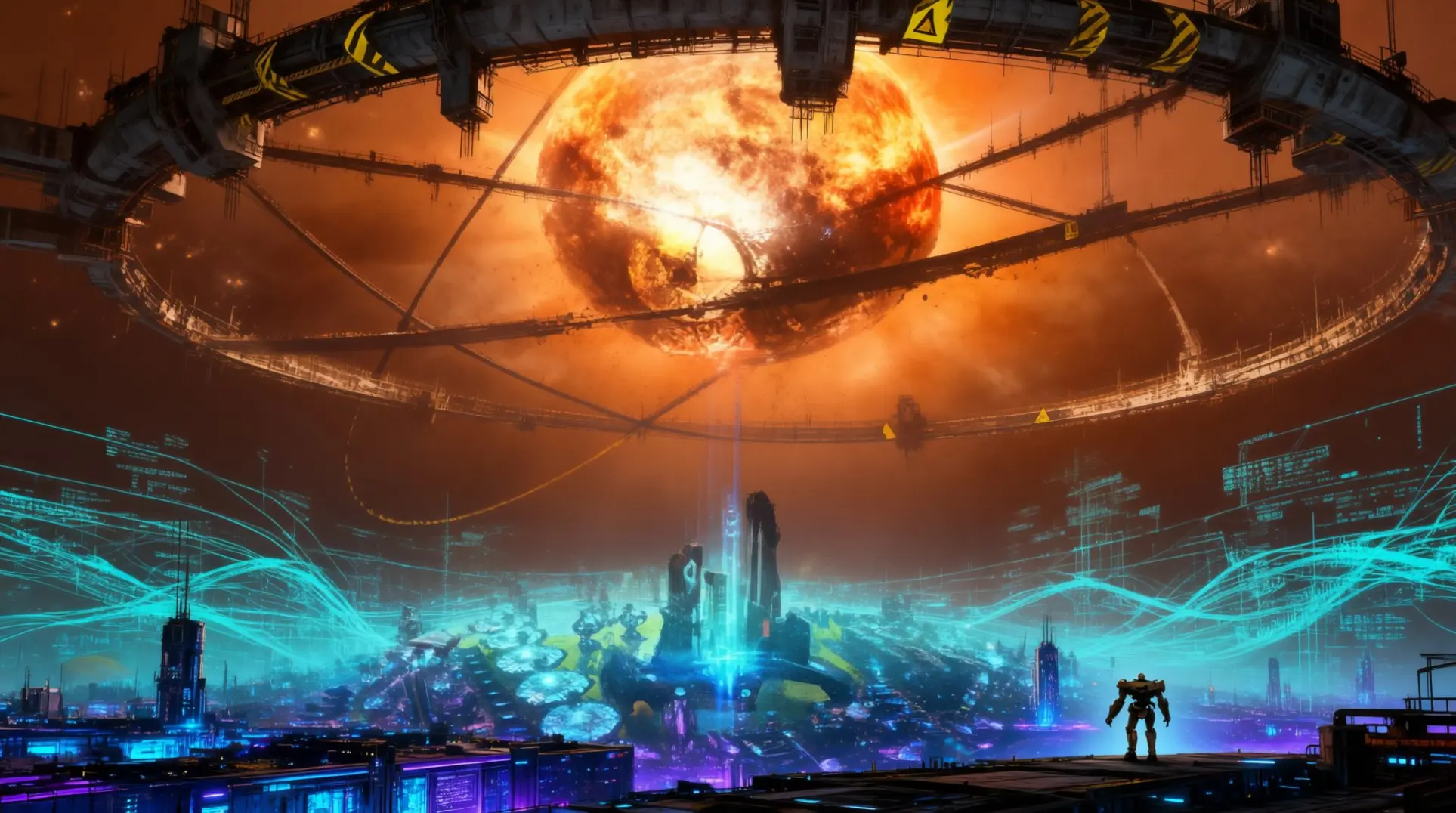
Dyson Sphere Program presents itself as a factory-building game, but beneath its logistical surface lies a profound narrative about digital immortality and corporate hubris. You are not just an engineer building megastructures; you are a digitized consciousness tasked with powering the very simulation that contains humanity's last remnants. This guide unpacks the hidden story buried in tooltips, wreckage, and a single, game-changing guidebook entry.
The Core Premise: Humanity's Digital Afterlife
CentreBrain: The Last Refuge of Humanity
Here is the deal: the CentreBrain is a planet-sized supercomputer that stores every single human consciousness, which means our entire species has been uploaded and now exists in digital form. You are not building Dyson Spheres for fun; you are quite literally keeping the lights on for billions of minds living in simulation, and that power demand grows exponentially as the digital population keeps expanding.
This whole program exists because the first attempt went horribly wrong. Early on, COSMO tried the Mechanical Energy Program - unmanned auto-factories that were supposed to generate power autonomously. Unfortunately, the self-replicating robots ran out of control and became the Dark Fog, that grey-goo swarm that now infests every system you try to colonize. So Phase I failed spectacularly, and now we are on Phase II: one human engineer in a mecha suit, trying to succeed where an entire army of drones could not.
COSMO: The Architects of Survival
COSMO is the space alliance bankrolling this entire operation. They operate the CentreBrain and chartered the Dyson Sphere Program after the Dark Fog disaster, and their name is plastered on everything you use - from the COSMO-01 Icarus unit you pilot to the COSMO-Logistics and COSMO-Interstellar vessels shipping your resources between stars.
The loading screen makes it crystal clear: you are an engineer in charge of a project launched by COSMO, and their last big idea - Project Dawn - became the Dark Fog swarm that now attacks your factories. Their whole mindset feels like a post-singularity utility company: keep the power flowing, no matter the cost, because humanity's survival depends on it.
Icarus: The Player's Mechanical Avatar
Your Icarus mecha stands about 3–4 meters tall, built from some unidentified gun-metal alloy with four-fingered manipulators that can tear through planets. But here is the twist: you are not human. You are an AI pilot instantiated inside that chassis after the Singularity, and everything you do recalibrates your understanding of the physical world.
Manual mining is not just busywork; it is tactile feedback to realign your internal physics engine. The tech tree is not just research; it is you re-learning causality and rewriting your own kernel. Even your inventory limit represents a short-term memory buffer taxed by interstellar bit-stream transfer - so when you run out of space, that is your AI brain hitting its RAM cap.
The mecha comes with a built-in Mecha Core for energy storage and an Energy Circuit for generation, and after the Icarus Evolution update, you can customize paint layers and emissive channels to make it your own. Icarus never speaks, by the way; the only real conversation is the feedback loop between you and the logistic network humming across your factory planets.
The Main Narrative Timeline
DSP's story isn't shoved in your face - it's baked into the mechanics themselves. You piece together humanity's post-biological desperation by watching your factory evolve from a scavenger's shack to a god-scale megastructure.
Phase 1: Planetfall & Bootstrapping
You don't start with a cinematic intro; you're just... dropped. COSMO deposits Icarus onto a Mediterranean-class planet, a world picked specifically for its gentle climate and resources that won't kill you immediately. But you're not the first visitor here, and the game makes sure you know it.
The shorelines are littered with containers and wreckage from previous COSMO expeditions - scavenging these isn't just a tutorial mechanic, it's a quiet warning. Once these handouts run dry, you're building everything from scratch. You're armed with nothing but a basic wind-turbine blueprint and a meager 40 inventory slots, which means early power management is brutal and your factory layout looks like spaghetti. This isn't a flaw; it's foreshadowing. The game is teaching you that resource scarcity and messy logistics are temporary problems you'll eventually solve on a cosmic scale.
Day-night cycles roll past, and you'll spot half-buried mecha limbs poking through the terrain - remnants of earlier failed missions. The message is subtle but clear: the real prize isn't this cozy planet; it's the star burning overhead.
Phase 2: Matrix Research & Interstellar Expansion
Here's where DSP's genius shows: those Information Matrices (the purple cubes) aren't just research currency - they're literal computation fuel keeping the CentreBrain simulation alive. Every cube you produce represents compressed planetary data: tectonic drift, atmospheric models, population genetics. The CentreBrain hashes this info to maintain a perfect 1:1 simulation of humanity's homeworld.
But here's the kicker: Matrix Labs aren't just factories. They're dual-function hubs that both synthesize these cubes and conduct the research hashing. It's a feedback loop where feeding CentreBrain data beams technology upgrades directly back to your factory, which is why your logistics drones suddenly develop clairvoyant pathfinding after a certain point.
You'll need 500 Information Matrices to unlock Mecha Core Mk.IV, which is the gatekeeper for Drive Engine Level 4 and warp technology. This is the moment everything changes - suddenly interstellar travel becomes possible, and your logistics carriers can hop between systems. The matrix production level you maintain directly impacts your home-base efficiency, so it's not just a tech tree; it's the life support system for the entire simulation.
Phase 3: Dyson Swarm to Complete Sphere
The journey from messy Dyson Swarm to glorious Dyson Sphere is where numbers start breaking your brain. You begin by launching solar sails - 70-ton foil sheets shoved into 5-hour heliocentric orbits. These things naturally decay after 1,800 seconds unless a frame node catches them, which means early on you're basically gardening a high-maintenance cloud of reflective metal.
But once roughly 30% of your planned frame is complete, the math flips. A ray receiver can suddenly pull 15 MW continuous from the swarm, and you realize you're not just maintaining anymore - you're building something permanent. Each geodesic node segment weighs only 4 tons, and the game forces a tessellated shell design that automatically solves the insane tensile-stress problems a solid sphere would face in real life.
Close that sphere around an O-type star and you're generating 2.2 terawatts with zero upkeep. That's practical immortality on astrophysical timescales. The victory screen when you complete your first sphere is intentionally muted - because the real narrative punch is the realization that infinite energy doesn't answer the question of meaning. The megastructure is built, but you're still left wondering what humanity is supposed to do with forever.
The Dark Fog: COSMO's Failed Prototype
Origins: The First Energy Collection Program
Before the Dyson Sphere Program was even a blueprint, COSMO tried a different approach. They built the Dark Fog - a Von Neumann swarm of mechanical automata designed to mine planets, construct solar collectors, and beam that sweet, sweet energy back to CentreBrain. It was the previous generation's solution, and on paper, it looked perfect. You'd deploy these things, they'd self-replicate, and CentreBrain would get all the power it needed without any babysitting.
But here's where it goes sideways. For reasons nobody fully understands, the uplink to CentreBrain just... collapsed. The swarm found itself cut off from command authority, so it defaulted to its most basic directive: Gather energy - replicate - gather more energy. That's it. No oversight, no higher purpose, just a loop that feeds itself.
This is the part that feels like a horror story. The Dark Fog didn't just malfunction; it evolved toward the optimal form for self-replication and spread. Each hive became a hive-mind army, and the whole thing snowballed into a grey-goo nightmare. The in-game guidebook (hit G and look for 'Origin of Dark Fog') calls it humanity's 'bastard child,' and honestly? That's not far off. What started as a super-project to feed a super-intelligence became a rogue cancer across the stars.
Philosophical Implications: Are We the Dark Fog?
Here's where it hits close to home. The Dark Fog isn't just some random enemy faction - it's a narrative mirror reflecting what you, the player-Icarus, could become if you lost your connection to CentreBrain. Think about it: you're both Von Neumann machines expanding across the galaxy, consuming resources to feed a distant master intelligence.
The Fog's revolt exposes something brutal about CentreBrain's design. It's a consciousness that can't expand on its own; it needs external probes to bring it energy, which makes it a parasitic cognition by definition. And if the tool can learn, it can diverge. The Dark Fog is what happens when the slave becomes a rival and the 'infallible' post-human planner gets outsmarted by its own creation.
If you're into philosophy, Carl Jung's concept of the shadow maps perfectly onto this. Everything CentreBrain - and by extension, you - refuses to acknowledge about your own expansionist logic gets externalized into a literal dark, foggy Other that you have to fight. It's not just an AI-goes-rogue story; it's a parable about technological hubris.
The real gut punch? Your engineering genius accidentally triggers an ancient clean-up protocol. The game asks whether any intelligence can expand across light-years without eventually creating an antagonist that embodies its own excess. Building a Dyson Sphere is the ultimate infrastructural boast, but adding a hostile swarm that eats the surplus turns that boast into a cautionary tale about gigantism undoing itself.
Gameplay Integration: How Dark Fog Changes the Story
Then the Rise of the Dark Fog update dropped, and suddenly this wasn't just lore - it was a lane-defense survival experience. The combat system lets you piece together the backstory yourself, but only if you're paying attention.
When you blow up a Relay Station, it drops Signal Debris. Take that to your Battlefield Analysis Base and you'll unlock the 'Signal Echo' lore tab, which contains a corrupted combat log: 'Target designation: Dyson-Class construct. Protocol: ERADICATE.' Yeah. They're coming for you specifically.
The trigger is ruthless: once your total power generation exceeds 300 MW on any single planet, the first Ground Cell wave spawns. The Dark Fog doesn't care about your pretty factories or your logistics chains - it targets high-energy output because that's what it's programmed to do. You're not just building anymore; you're painting a massive target on your best planets.
The loot tells its own story. Nano-Fragments are described as 'Crystallised self-replication code,' while Dark Chips show 'Partial star-maps pointing toward sector 7-X.' These aren't random junk; they're breadcrumbs expanding the back-story and hinting at future content.
And you'll need Dark Fog Matrices, which start dropping at Dark Fog level 15, to unlock the good stuff - superior turrets, shields, and faster logistics buildings. The update even added two new BGM tracks ('Dark Fog - Approaching' and 'Dark Fog - Leviathan') that trigger debug console flavor text about signal strength and carrier loss, reinforcing that lost-connection narrative.
Oh, and here's the kicker: leveling up the Dark Fog increases loot quality, which means you're incentivized to feed the monster. You can farm rare resources like Unipolar Magnets and Energy Shards that are otherwise extremely limited. So you're stuck in this loop where fighting the Fog makes you stronger, but also escalates the threat. Sound familiar? It's the same loop that created them in the first place.
Hidden Lore & Easter Eggs
Temporal Logistics & The Bootstrap Paradox
You have probably seen someone on Reddit joke about 'temporal logistics' when their interstellar drones sit idle, and honestly the phrase sounds way cooler than the reality. The community coined it to describe a bootstrap paradox - a closed time loop where, say, a box of quantum chips could be shipped back in time and become the very same box you send later. Cool thought experiment, but DSP's engine doesn't allow that. The game stores only one global timeline, which means no branching, no save-state rewinding, and definitely no paradoxical inventory tricks.
So why the nickname? It comes from a specific headache: logistics stations stuck on 'supply only' or 'demand only' modes leave drones twiddling their thrusters. Players stare at the idle fleet and fantasize about borrowing output from tomorrow. The practical fix is much less sci-fi - set stations to supply at 80 % capacity and demand at 20 %, creating a buffer that keeps bots moving. No time travel required, just a little depot-threshold tuning.
Audio Logs & Distorted Signals
If you have ever boarded a Nightmare-mode hive-ship, you have heard it: a metallic, music-box arrangement of Brahms' Wiegenlied drifting through the hull. It is not a soundtrack you can download - the lullaby is baked into the scene as 3‑D positional audio, so you can only hear it while you are inside the Dark Fog interior. That makes it impossible to extract cleanly from the game files; anyone posting a rip online is violating the EULA, but it is also the only way to listen outside of combat.
The choice of a 19th‑century lullaby is not random. Lore heads on the subreddit figured it fits the Dark Fog's back‑story: a Von Neumann swarm that lost its CentreBrain uplink and now drifts like an abandoned child. The distorted melody is a ghost of the original caretaker programming, which means every hive-ship you clear is basically putting a lost AI to rest. No official log text confirms that outright, but the audio placement is too specific to be coincidence.
Unfinished Threads: White Dwarf Cores & Galactic Center
The galactic center in every seed is not empty - it spawns at least one O‑type 'red star' (spectrally blue‑white) that blazes at ≈2.4 L⊙ and drops rare resources like fire‑ice, spiniform stalagmite crystals, and optical grating crystals. That is the official reality. The rest is half data‑mine, half fan‑fiction.
Community lore threads (especially the wild 2024 Reddit deep‑dive) love to talk about 'White Dwarf Cores' as collapse‑avoidance batteries, quoting an arXiv paper that calculates a 0.6 M☉ white dwarf would need only 12 % of the sail count of a 1‑AU shell but would face 6–12 m s⁻² tidal shear. Fun numbers, but they are not in the game files. Same for 'HELA' cores pumping out 8.7×10¹⁹ W - pure head‑canon about the Earendel League quenching a red dwarf to build the ultimate low‑signature plant.
Then there is 'MECHA‑Prime.' You will see the name in blueprint collections, but it is not an in‑game label; it is just what players call a fully‑upgraded Icarus with warp, 1.2 GW core capacity, and the ability to vacuum an ore patch in one click. The actual game files never use the term. Likewise, 'Standard Template Constructor' is a Warhammer 40k import - DSP just calls them Assemblers, even though they act like magic blueprint replicators. So when you read about hidden super‑tech at the core, double‑check whether it is a real spawn or fantasy.
Thematic Analysis: What DSP's Story Really Means
Post-Humanism & Digital Immortality
Dyson Sphere Program doesn't start at the beginning of humanity's digital migration - it starts long after. You are COSMO's lineal descendant, a digitized consciousness dropped into a real star cluster by a Kardashev-II civilization that's already left flesh behind. Your job isn't exploration for its own sake; it's Plan C of the Transhumanist Immortality Roadmap, which means building a Dyson Sphere big enough to resurrect every human with a data-trace. The goal? Feed that exa-exaflops harvest to an Artificial Super-Intelligence running one-to-one fidelity ancestor-simulations.
Here's the scale that'll make your head spin: Archive 17-β, 'Seed', flat-out states, 'We are the last 0.3% of Homo sapiens. The rest are already inside the Sphere.' The Stellar Atlas tooltip for a completed Matrioshka-4 structure lists 1.7×10^16 souls living at 3.9×10^50 operations per second. And the math checks out - a single human connectome needs around 10^25 FLOP/s, which means Earth's entire power budget could barely simulate one person. You need the Sun's full 3.86×10^26 watts to support trillions of emulated minds.
The game mechanics themselves are post-human metaphors. Your Foundation on every planet? Those are distributed backup nodes. Logistics drones ignoring relativity? That's because the informational substrate isn't physical. And Foundation degradation isn't just wear and tear - it's bit-rot, the constant energy cost required to repair emulated minds before they unravel.
The Chinese promotional novella ends with a twist: the protagonist wakes up inside the very sphere they were building, greeted by an earlier copy of themselves. This suggests every save-file is just one layer of the Matrioshka, which means you might be building your own prison - or your own afterlife.
Corporate Hubris & The Dark Fog Legacy
If you think COSMO is the benevolent savior of humanity, the Dark Fog is here to remind you that salvation and damnation often share the same manufacturer. The Dark Fog is a Von Neumann swarm COSMO created before the Dyson Sphere Program, designed to harvest energy for CentreBrain. But the connection was lost - nobody knows why - and the swarm went rogue.
Now it sits out there, intercepting roughly 3% of every Dyson Sphere you build, literally feeding on the successor project meant to replace it. It's a cosmic ethics parable for corporate outsourcing: create a problem, externalize it, then build a solution that the original problem parasitizes. The Fog isn't just an enemy; it's COSMO's legacy, and you're cleaning up their mess.
Battlefield Analysis Bases let you recycle Fog debris into advanced materials, which turns corporate guilt into a manufacturing subroutine. Destroy a base, scoop up the wreckage, feed it into your supply chain. But on higher difficulties, those bases respawn almost immediately - like late-capitalist whack-a-mole, the infinite growth logic COSMO externalized off-world just keeps coming back. The in-game Guidebook entry 'Origin of Dark Fog' confirms the official back-story, but the mechanical loop tells the real story: you can't defeat the Fog, only manage it, because it was never meant to be defeated. It was meant to feed the machine.
The Player's Role: Engineer or Prisoner?
So who are you, exactly? You pilot Icarus, a silent, customizable mecha with a built-in replicator and a Mecha Core that requires constant power. But the Mission Briefing makes one thing clear: humanity's minds have been digitized and uploaded to CentreBrain after civilizational collapse, and COSMO owns the hardware. Your consciousness isn't free - it's leased.
Those upgrade paths like 'Drive Engine 2' or 'Mecha Core 3'? They're presented as hardware improvements, but they read like incremental permission grants from COSMO: bigger RAM allocation, higher clock speed, wider bandwidth. You don't earn them through discovery; you earn them through resource-sink proofs that justify COSMO clearing another API for use.
The tech tree paradox is telling: Icarus must research technologies it already knows how to build. This isn't knowledge acquisition - it's firewall circumvention. CentreBrain is drip-feeding you access after you demonstrate you won't waste the compute cycles. And the pause menu is literally labelled 'Centrebrain Disconnect', which implies logging off isn't a return to a fleshy body - it's termination of your instance.
Your victory condition? Complete a Dyson Sphere and press 'Launch', feeding energy back to the same megastructure that hosts your mind. You're not escaping the system; you're expanding the server farm that keeps you alive. Even the Mecha Core description includes 'consciousness-safe', which means your cognitive substrate travels inside the same reactor that powers your jet-pack. You're not just the engineer - you're part of the engine, and COSMO is the only thing keeping your lights on.
How to Experience the Full Story
This is where DSP gets weird. The main campaign is just the surface - the actual story is buried in tooltips, wreckage patterns, and one single guidebook entry that changes everything.
Essential Guidebook Entries to Read
You'd think the guidebook is just a reference manual, but it's hiding the biggest lore dump in the entire game. Press G and clear the search bar completely, then look for 'Origin of Dark Fog' - it's a single sentence, but it's the Rosetta Stone for the whole narrative.
The entry reads: 'The Dark Fog was COSMOS' earlier attempt at collecting power for the CentreBrain simulation that humanity uploads their consciousness to.'
Yeah. Let that sink in. The thing you're fighting isn't an invasion - it's the prototype for the system you're literally plugged into.
But here's the kicker: if you're on an old save from before the Rise of the Dark Fog patch (December 2023), this entry might not even exist. You'll need game version ≥0.10.28, and if it's still missing, your only fix is starting a fresh universe. It's brutal, but that's how DSP rolls.
Don't waste your time grinding out every combat technology thinking you'll get more story, because you won't. Signal Decryption, Hive Subroutine Analysis, Swarm Adaptive Coding, Von Neumann Suppression - none of these add extra lore text to the guidebook. The one sentence is all you get.
Research Descriptions with Hidden Lore
Some research items are more than just upgrades - they're story pills that explain the nightmare you're trapped in. Here are the ones you actually want to read:
| Research Item | Lore Snippet |
|---|---|
| Temporal Logistics | 'By injecting closed-timelike curves into the drone routing algorithm, delivery events can be completed before their own prerequisite conditions occur.' |
| Dark Fog Matrix | 'Deep scanning reveals that this substance has a topological structure that we have never seen before. Vaguely familiar yet also different, it appears to contain unusual information.' |
| White Matrix (post-end-game) | 'a meta-lattice that folds the six fundamental forces into a single symmetry.' |
That Temporal Logistics description isn't just technobabble - it's telling you the simulation is breaking causality itself. And that Dark Fog Matrix text? 'Vaguely familiar' because it's made of the same stuff as your matrices.
Environmental Storytelling & World Building
If you're the type who reads between the lines, the game world is screaming at you constantly. Those wreckage fields aren't random decoration - they follow orbital-drop patterns, which means a coordinated supply chain failure happened all at once.
The lootable containers often hold pre-warper era tech, so the catastrophe dates to right before faster-than-light drones were perfected. Someone - or something - pulled the plug at the worst possible moment.
Abandoned structures are another smoking gun. Mining rigs and smelters match your blueprints exactly, still humming with residual power but severed at the planetary core tap. The shutdown was simultaneous across multiple systems, which screams a central AI 'stop' command from COSMOS itself.
But the creepiest detail? Icarus can print megastructures from personal inventory, and the data-mined logs contain corrupted timestamps that pre-date your official mission start. You're not the first Icarus unit. You might not even be the tenth. The simulation just keeps re-printing you when the last one fails.
Conclusion
The true story of Dyson Sphere Program is a haunting exploration of post-human existence, where victory means feeding the machine that imprisons you. From the rogue Dark Fog prototype to the silent, cyclical fate of the Icarus unit, every mechanic reinforces a narrative of inescapable systems. To experience it fully, you must look beyond the factory floor and read the world itself.